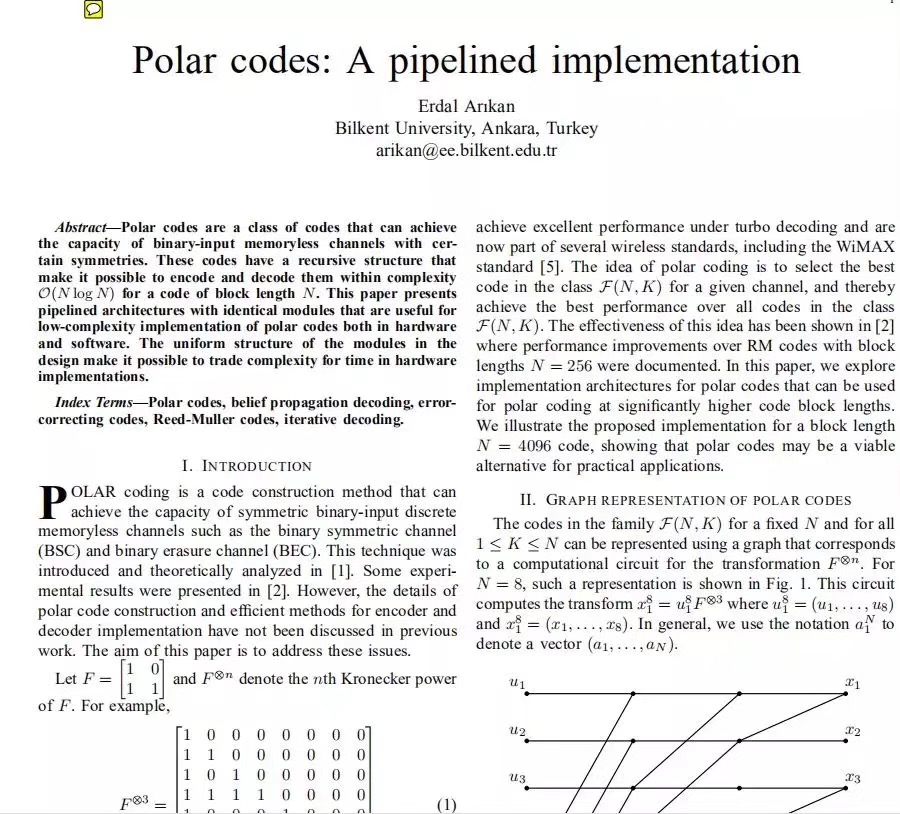
something interesting, invented by a Turkish professor, and brought to fruition by team Huawei
https://www.wsj.com/articles/where-china-dominates-in-5g-technology-11551236701
Where China Dominates in 5G Technology
Chinese companies are leaders in 5G patents and standards proposals. That means big royalties ahead.
Dan Strumpf
Feb. 26, 2019 10:05 p.m. ET

Huawei’s clout in the design of 5G stems from its massive research and development budget, and from its aggressive contributions to the round-the-world meetings where engineers cobbled together the underlying architecture of 5G.
As a result, the Chinese tech juggernaut as of early February owned 1,529 “standard-essential” 5G patents, the most of any company. Together with patents owned by ZTE, the state-owned China Academy of Telecommunications Technology, and Guangdong Oppo Mobile Telecommunications Corp., companies from China own 36% of all 5G standard-essential patents, more than double their share of comparable 4G patents, according to data-analytics firm IPlytics.
The Chinese 5G patents cover technology associated with everything from 5G handset componentry to base stations and driverless-car technology. And telecom companies around the world—including those operating in places where Huawei gear might be off-limits—will have to pay royalties to Huawei to license that technology when it comes time to put 5G networks on the ground, experts say.
U.S. firms, by contrast, including Qualcomm Inc. and Intel Corp. , hold just 14% of critical 5G patents, according to IPlytics. Huawei’s clout in 5G sets it apart from previous generations of wireless networks, which saw significantly fewer contributions from Chinese mobile companies compared with U.S. and European firms.
After 4G, Chinese companies led by Huawei amassed bigger delegations and submitted more proposals at meetings where 5G’s specifications were hammered out. Huawei in particular became known for its army of engineers and sheer volume of technical proposals at the meetings. It submitted 11,423 5G standards proposals, the largest share of any firm and more than double the most active U.S. firm, chip maker Qualcomm, according to IPlytics.
“In 4G, the situation was very much the Chinese players having to pay royalties to license these patents from the Western companies,” says Edison Lee, telecom analyst at the investment bank Jefferies in Hong Kong. “Now that the Chinese companies own such a significant share of the patents, the Western companies need to pay to license from them.”
Huawei’s prowess in next-generation technology stems partly from the fact that it now regularly outspends its rivals in research and development, a fact that has alarmed some policy makers in Washington. In 2017, the company spent $13 billion on R&D, more than any other Chinese tech company, and more than its chief rivals, Ericsson and Nokia Corp. , combined.
That spending has helped give Huawei an edge in the competition in standards and patents—which is just one part of the broader race among China, the U.S. and other countries to build fully functional 5G networks that run the gamut of promised technologies.
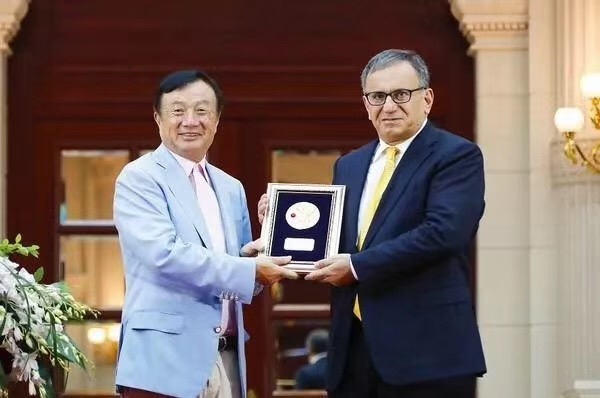
Some of Huawei’s proposals are now fundamental building blocks of 5G. They include one highly prized technique called “ polar coding,” a method for correcting errors in data transmission. Huawei poured resources into developing it, and polar coding became a rallying cry for Huawei and its Chinese peers at standards meetings. After it was partially adopted as an official 5G standard at a critical meeting in 2016, Huawei founder Ren Zhengfei threw an opulent ceremony at the company’s Shenzhen headquarters to celebrate.
The monetary value of Huawei’s 5G patents isn’t yet clear, and privately held Huawei doesn’t disclose its revenue from licensing its existing intellectual property.
Its rivals, however, do make such disclosures—and for some it is a big chunk of money. In 2017, Finland’s Nokia generated €1.65 billion ($1.86 billion at current exchange rates) from technology licensing, accounting for about 7% of revenue. In its most recent fiscal year Qualcomm, whose intellectual property is used in virtually all of the world’s smartphones, generated $5.2 billion from technology licensing, more than one-fifth of its total revenue.
To be sure, 5G licensing schemes will flow both ways, with Huawei paying its competitors to use their technology, too. But the sheer number of patents owned by Huawei means that the Chinese company will garner a substantial revenue stream from the licensing of its 5G patents—regardless of whether some countries choose to block Huawei from their 5G rollouts, says Tim Pohlmann, chief executive of IPlytics.
“It means guaranteed revenue,” Mr. Pohlmann says. While governments “don’t want to have the equipment provided by Huawei, they will for sure have to use the patents, and they will for sure have to pay Huawei for it.”
Huawei’s clout in 5G technology is independent of the political firestorm it faces. It has been effectively banned from selling telecom gear in the U.S. due to concerns that its equipment could be used to spy on Americans. The company has forcefully denied this, and last month Mr. Ren in a series of interviews said Huawei would never conduct espionage on behalf of any government.
Still, Many Western companies, at the urging of the U.S., are now weighing new restrictions on Huawei’s 5G technology. So far, Australia and New Zealand have already taken steps blocking Huawei gear in their 5G rollout.
Despite its troubles, Huawei is moving ahead with the production of 5G equipment. Company executives say Huawei has secured more than 30 commercial contracts to provide 5G equipment, and has shipped more than 25,000 5G base stations. It is set to unveil a 5G-capable mobile phone in late February.
The reliance, to be sure, cuts both ways. Some of the most crucial 5G
technologies still come from Western firms. For example, a type of critical chipset that telecom-equipment makers need to design 5G base stations called field-programmable gate arrays are made only by two U.S. companies, says Jefferies’ Mr. Lee: Xilinx Inc. and Altera Corp., a unit of Intel.
The lion’s share of 5G patents, however, are owned by the Chinese.
“When you invest like that in the standardization process, and you invest time and effort and manpower and so forth, you end up seeing a significant portion of the essential intellectual property being in your hands,” says Phil Marshall, CEO of Tolaga Research, a wireless-technology research firm. “It illustrates how embedded Huawei and ZTE are in these technologies,” Mr. Marshall says. “You can’t just turn the faucet off easily.”
Mr. Strumpf is a Wall Street Journal reporter in Hong Kong. Write to daniel.strumpf@wsj.com. |



