Energy Vault Funding Breathes Life Into Gravity Storage
Recent investments and patent filings indicate growing interest in a class of energy storage concepts that appear seductively simple but have yet to gain commercial traction.
Jason Deign
June 06, 2019
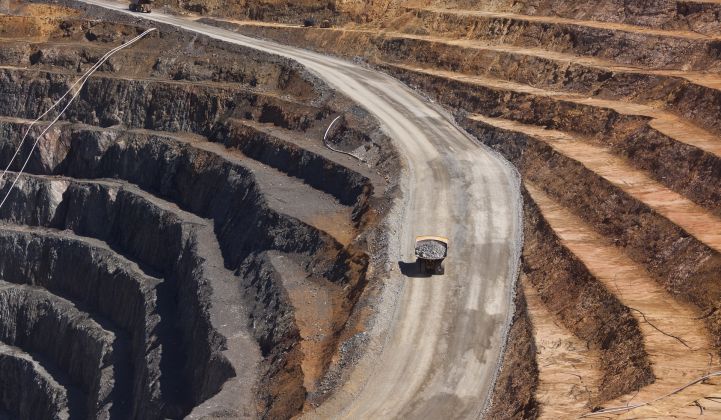
Open-pit mines: The next play in energy storage?
Photo Credit: Shutterstock.com
The speculative field of gravity-based energy storage got a boost recently with news of a strategic investment and new patents.
Swiss-U.S. startup Energy Vault, one of the most high-profile gravity storage players to date, secured financial backing from Cemex Ventures, the corporate venture capital unit of the world’s second-largest building materials giant, and a pledge to help with deployment through Cemex's " strategic network."
Meanwhile, the University of Nottingham and the World Society of Sustainable Energy Technologies confirmed the filing of patent applications for a concept called EarthPumpStore, which uses abandoned mines as gravity storage assets.
Implementing the technology across 150,000 disused open-cast mines in China alone could deliver an estimated storage capacity of 250 terawatt-hours, the University of Nottingham said in a press note.
The announcements indicate growing interest in a class of energy storage concepts that appear seductively simple but have yet to gain widespread acceptance.
Most gravity storage concepts are based on the idea of using spare electricity to lift a heavy block, so the energy can be recovered when needed by letting the weight drop down again.
In the case of Energy Vault, the blocks are made of concrete and are lifted up by cranes 33 stories high. EarthPumpStore, meanwhile, envisages pulling containers filled with compacted earth up the sides of open-cast mines.
Gravity is also the force underpinning pumped hydro, the most widespread and cost-effective form of energy storage in the world. But pumped hydro development is slow and costly, requiring sites with specific topographical characteristics and often involving significant permitting hurdles.
The proponents of newer gravity storage options claim that installation and deployment of their technology is quicker, easier and cheaper.
The University of Nottingham, for example, estimates EarthPumpStore would cost about $50 per installed kilowatt-hour, compared to $200 for pumped hydro and $400 for battery storage.
The university also said EarthPumpStore could achieve a round-trip efficiency of more than 90 percent, compared to between 50 percent and 70 percent for pumped hydro, plus an energy storage density up to eight times higher. Other sources have made similar claims.
In 2017, for example, a study by Imperial College London for the gravity storage technology developer Heindl Energy concluded that Heindl’s concept could achieve a levelized cost of storage of $148 per megawatt-hour, compared to $206 for pumped hydro.
“Based on the given data, gravity storage is most cost-efficient for bulk electricity storage, followed by pumped hydro and compressed air energy storage,” the research concluded.
Given gravity storage’s apparent simplicity and cost-effectiveness, it is curious that the concept hasn’t taken off. One of the first companies to emerge with a gravity-based idea was Advanced Rail Energy Storage (ARES), a Santa Barbara-based firm that was founded in 2010.
ARES plans to hoist railcar-based weights up a hillside, and in 2016 finally got U.S. Bureau of Land Management approval for a proposed 50-megawatt, 12.5-megawatt-hour project in Nevada. At the time, ARES was expecting the project to be up and running in early 2019.
However, as of last August the company was still securing permits and pushed its go-live date back to 2020. Other gravity storage hopefuls seem to be making equally slow progress, although last year saw two U.K. companies getting funding.
Energy SRS, a collaboration of five U.K. firms and the University of Bristol, got £727,000 (about $922,000 at today’s exchange rate) from the government research and innovation body Innovate U.K.
The funding was for a prototype, which Energy SRS is hoping to scale up by 2020. Meanwhile, another startup, Gravitricity, got a separate Innovate U.K. grant, of £650,000 ($824,000 today), to build a 250-kilowatt prototype of its mineshaft-based gravity concept.
Gravitricity is also aiming for full-scale implementation next year.
Daniel Finn-Foley, principal analyst at Wood Mackenzie Power & Renewables, said concerns over the safety, scalability and round-trip efficiency of lithium-ion batteries could lead to growing interest in alternatives such as gravity storage.
“It could be a key technology in the long term as states continue to mandate carbon-free energy,” he said. “I doubt the 100 percent vision will be solved by dropping lithium-ion batteries everywhere, so seeing new technologies emerge will be key.”
greentechmedia.com |



