SI
SI
discoversearch

We've detected that you're using an ad content blocking browser plug-in or feature. Ads provide a critical source of revenue to the continued operation of Silicon Investor.  We ask that you disable ad blocking while on Silicon Investor in the best interests of our community.  If you are not using an ad blocker but are still receiving this message, make sure your browser's tracking protection is set to the 'standard' level.
Non-Tech : The Brazil Board -- Ignore unavailable to you. Want to Upgrade?


To: kidl who wrote (1935)6/28/2019 2:25:29 PM
From: elmatador  Respond to of 2508
 
EU and Mercosur group agree draft free trade deal

Updated / Friday, 28 Jun 2019 19:04

By George Lee Agriculture and Environment Correspondent

Trade negotiators for the European Union and the South American Mercosur trading block have reached agreement on a free new trade deal.

It paves the way for a significant increase import of cheaper beef and other goods from South America.

The Mercosur trade deal has been almost 20 years in the making and involves Brazil, Argentina, Paraguay and Uruguay.

The region has 260 million consumers, making it the fifth largest market outside of the EU.

It is the largest free trade agreement negotiated by the EU to date and follows on from the completion of recent European trade agreements with Canada, Japan, Mexico, and Vietnam.

It comes at a critical time in global trade with the US engaged in trade wars on a number of fronts, including with China, and threatening more.

The Mercosur trade agreement still has to be fully ratified by the European Commission and by the European Parliament in a process that could take up to two years.

It would see a sharp reduction in import taxes levied on European goods and services exported to the South American block and a reciprocal reduction in taxes on imports from those countries into Europe.

The deal is expected to be very beneficial to Europe's car makers, machinery manufacturers, and the chemical and pharmaceutical sectors, which are expected to grow their exports significantly.

However, the beef sector in Europe is expected to lose out as a result of a significant increase in the amount of cheap South American beef that will be allowed at a very low tariff rate into the European market.

European poultry, sugar, and ethanol producers are also expected to lose out to cheaper imports from South America.

The deal has been heavily criticised by the agricultural community in Ireland, with beef farmers in particular claiming their sector has been sacrificed for the industrial and service sectors who will be the main beneficiaries.

Irish Farmers Association President Joe Healy said this was a bad deal for Ireland, a bad deal for the environment, and a bad deal for EU standards and consumers.

He said the trade negotiators have concluded a deal that has sold out Irish and European farmers and he called on the Taoiseach to make it clear to Brussels that Ireland will not ratify this deal.

He said that Europe turning a blind eye to double standards and environmental degradation in Brazil is indefensible.

Mr Healy accused the trade negotiators of conducting a backroom deal with big business that kowtows to the likes of Mercedes and BMW in their drive to get more cars into South America.

He claimed the deal is a disgraceful and feeble sell-out of a large part of Ireland's valuable beef market to Latin American ranchers and factory farm units.

The IFA leader said that farmers here adhere to the highest standards on traceability, animal welfare, food safety, and the environment. Farmers in Brazil do not, he said.

The IFA National Beef Chairman Angus Woods pointed out that the beef sector is much more important to Ireland that any other european member state.

The European Commission Joint Research Centre has calculated that the Mercosur Trade deal could potentially cost the European beef sector up to €7bn.

The IFA said that on the basis of those figures the cost of the Mercosur trade deal to the Irish beef sector could be between €500m and €750m.


To: kidl who wrote (1935)7/3/2019 8:44:37 AM
From: elmatador  Respond to of 2508
 
Market Report: Banking on Brazil

July/August 2019 (Magazine) By Florence Chong


The economic and political fortunes of Brazil are unpredictable, says Florence Chong.

But some investors have made big bets on the country

Caution is the watchword in Brazil. But there is more optimism as the country emerges from what was its worst recession, nurtured by a climate of political uncertainty.

While many investors took fright and left, some stayed on to deepen their commitments. They continue to believe that the B of the original BRIC countries (Brazil, Russia, India and China) still has the best growth potential of all emerging markets.

Foreign institutional investors are returning – statistics published by the Central Bank of Brazil show a strong increase since April 2018. Banco Central do Brasil says that,

in the first four months of this year, Brazil attracted foreign direct investment (FDI) inflows of more than US$28.1bn (€24.8bn).

The bank says that in the 12 months to April 2019,

FDI net inflows totalled US$92.5bn, equivalent to 4.96% of GDP, the highest percentage since May 2011. Brazil’s FDI (in all sectors) peaked at US$101bn in 2011 before the economic crisis unfolded from 2014.


Whether the upward trend is sustainable will depend on the performance of the government and whether the Brazilian economy continues to improve. But some believe that, with his pledge of market-friendly, pro-business policy and reforms, President Jair Bolsonaro could reset Brazil’s appeal as an investment destination.

All macro indicators, for now at least, are looking up. GDP growth has picked up, inflation and interest rates are at an inflection point, and improving. Among new initiatives proposed is reform of Brazil’s pension system.

But there are obstacles to overcome. Brazilians have taken to the streets recently to protest pension reforms, which include raising the minimum retirement age. “Pension reform is an important initiative and we expect that, once passed, it will be very favourably received by both domestic and international investors,” says Syl Apps, managing director at Hines.

“We think today is, without exception, the most compelling investment environment we have seen in the more than 20 years we’ve been on the ground there,” says Apps, who has oversight of Hines’ Brazilian operations.

“Look at current prices and investment opportunities and you see compelling opportunities. We are seeing a prototypical countercyclical investment environment today. We see discounts to peak values in the office sector of 50% to 60% in real terms. If you are a US dollar investor, São Paulo office is probably at a 75% discount to peak in real terms.”

Apps says the recovery of São Paulo’s commercial property market is about 18 months ahead of Rio de Janeiro. The Rio office market remains highly stressed.

“The really smart investors are seeing that as well, and I think that has really triggered the renewed interest,” he says. “In the last 18 months we have seen large, globally-relevant pension, sovereign wealth funds and limited partners come back to Brazil.”
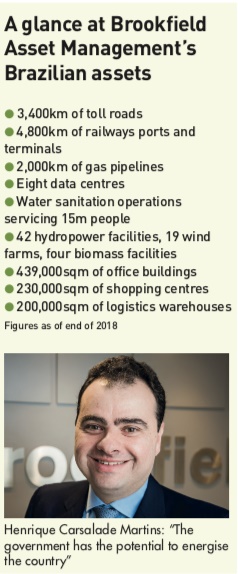


Henrique Carsalade Martins, Brazil CEO at Brookfield Asset Management Brazil CEO, says: “We have noticed increased competition and corresponding pricing for assets as investors return to the market.”

Brookfield has been in Brazil for more than 100 years – the company was founded as the São Paulo Tramway, Light and Power Company in 1899. “Looking ahead, we are optimistic that the government has the potential to energise the country’s economic reform, create healthy market competition and attract investment,” Martins says.

Brookfield is looking for value investments and potentially to harvest capital as a recovery continues to unfold. Staying power is the essence of success in investing in Brazil, according to those who have become the country’s largest foreign investors. Brookfield is close to the top, if not the single-largest investor in Brazil today.

By the end of 2018, Brookfield owned and operated a wide range of infrastructure, real estate, renewable power, and private equity assets in Brazil worth about US$23bn (€20.5bn).

“Our long history, along with having local on-the-ground operations, has provided us with deep knowledge of the market,” Martins says. “That has enabled us to invest in high-quality assets across economic cycles to deliver strong returns to our investors. We believe in Brazil’s strong fundamentals, including sound rule of law and a functioning democratic process, as well as an openness to and need for foreign capital to improve infrastructure and services.”

Brookfield continued to invest through the Brazilian recession and during the political turmoil created by a corruption scandal that implicated the government of the day. “While these and other factors made many investors wary of Brazil, and led direct investment to all but stop, we continued to believe in its significant growth potential,” says Martins.

“As contrarian, value-oriented investors, our experience shows us that the best opportunities are often found in regions or sectors undergoing periods of financial or operational challenge – and Brazil was no different.

“While investor sentiment was generally negative on Brazil, we took a contrarian view, acquiring a number of premier assets that, in normal periods, would not be available at a reasonable value.”


Brookfield pipeline: The company is one of the largest foreign investors in Brazil

During the downturn, Brookfield bought assets that included a 90% stake (for US$5.2bn) in NTS, the natural gas unit of Petrobas. It also acquired Odebrecht Ambiental, Brazil’s largest private-water sanitation business, servicing 15m Brazilians for about US$1bn. “We have doubled our AUM in Brazil since 2016,” he says.

Apps says Hines saw an opportunity to move into for-sale residential in São Paulo during the recession “to take advantage of lack of liquidity in the sector at the time”.

The Houston-based fund manager has since acquired or developed more than 9,000 residential units for sale in the city.

Over the past 20 years Hines has established a large, vertically integrated platform in Brazil, with a local staff of 125. Hines has committed more than R$6.9bn (€1.5bn) of equity and developed over 3m sqm of office, industrial and residential real estate in Brazil.

“Our investment performance over those 20 years has been strong, and I think our deep, in-country operating capability, combined with Hines’ global platform, has been able to deliver for our investors,” Apps says.

Growing logistics market
Singapore-headquartered global logistics specialist GLP is now a market leader in Brazil, significantly boosting its presence in the country in 2014 by acquiring BR Properties for US$1.4bn. In 2018, GLP expanded its partnerships with GPA, Brazil’s largest retailer, and Mercado Livre, an e-commerce company. In that year, GLP Brazil recorded its highest level of new leasing – up 57% over 2017.

“We see sustained leasing momentum, with demand mainly driven by the e-commerce and pharmaceutical industries,” says Mauro Dias, president of GLP Brazil. “Today they make up 35% and 9% of our portfolio in Brazil, respectively. Ongoing economic recovery and improving credit markets are expected to support domestic consumption, while companies continue to look to GLP for modern logistics solutions to increase supply chain efficiencies.”

Dias adds: “We believe Brazil’s logistics industry is supported by strong fundamentals. With a population of more than 200m, it is one of the most underserved logistics markets globally. It is also one of the fastest-growing e-commerce markets in the world. Put together, it offers considerable long-term compelling opportunities for growth.”

GLP Brazil has capitalised on market conditions to build up a pipeline in São Paulo. Diaz says: “We expect to start about 480,000sqm of new developments in Brazil over the next two years to meet growing customer demand.”

Today, GLP manages US$3bn of funds in Brazil, and sees room to further grow its platform given investor demand and attractive market opportunities.

Blackstone established a presence in Brazil in 2010, purchasing a 40% stake in Brazilian alternative asset manager, Patria. The platform runs private equity funds and covers investment in infrastructure, such as toll roads, agribusiness, real estate and debt. In April, Blackstone transferred its 35% stake in the Brazilian real estate developer, Alphaville Urbanismo, to its partner, Patria Investmentos.

Another global logistics player, Australian-based Goodman Group forged a strategic relationship in 2010 with the Brazilian company WT Torre to establish a local platform. In 2018 it bought out its Brazilian partner and launched a US$700m venture there with four large global investors.

Goodman Group CEO, Greg Goodman, says: “Things in Brazil take time. It takes two to three years to buy a site, get the planning and develop the site.” It can be more difficult buying sites in Brazil than in other emerging economies, he says. “We like it that the barrier to entry is high. It means less competition and, when you do a project, it means demand is strong.”

GIC marks five-year presence
The sovereign wealth fun has invested in Brazil for more than 20 years but opened a São Paulo office in 2014

Long-time investor Singapore’s GIC, is actively looking at sectors like real estate, infrastructure and technology in Brazil, according to its CEO, Lim Chow Kiat.

“There are sectors we are positive on, especially those related to consumers – such as healthcare and education,” Lim told an audience in Brazil. He said GIC already had exposure to all of these areas. “As the economy grows, we will look to build on them.”

Some 3% of GIC’s total portfolio is in Latin America, with investments across a range of asset classes including private equity, real estate, infrastructure and equities. A large proportion of these is in Brazil.

GIC first ventured into Brazil more than 20 years ago and in 2014 it established an office in São Paulo to have “boots on the ground”, in Lim’s words. In March, GIC celebrated the fifth anniversary of that office. “For the last five years, with the challenging environment in Brazil, GIC not only stayed on, we took the opportunity to expand our capabilities and partnership,” Lim told guests.

“Brazil is a very large economy. It has the ninth-largest GDP in the world. It is an important market for global investors like GIC.” Lim notes the long history of high real interest rates in Brazil has instilled discipline in the use of capital for many Brazilian entrepreneurs.

In some other economies with abundant savings, he said, there is little cost to borrowing, so entrepreneurs sometimes misuse resources. Because Brazil does not have that luxury, capital is more likely to be put to better use there, he said. If interest rates could indeed be brought down, there would be much upside for enterprise growth.

“We believe Brazil is on its way to recovery. There are, however, still important tasks to be completed, such as social security reform, privatisation and tax simplification,” Lim said.

“If government policy is done well, Brazil can usher in a period of low inflation and low nominal and real interest rates, which will help engineer growth and outperformance for Brazilian businesses.”


To: kidl who wrote (1935)7/20/2019 8:26:40 AM
From: elmatador  Respond to of 2508
 
Brazil stands out as the best story by far: (Fi) our valuation model says the Brazilian Real is around 10% undervalued; (ii) there've been very little hot money inflows (horizontal), but lots of FDI (vertical); and (iii) positioning by foreign real money investors is very light.

EDUARDO VINANTE, CPN
PARTNER & CEO at CENTRO ESTUDIOS ECONOMICOS


To: kidl who wrote (1935)7/25/2019 11:54:49 AM
From: elmatador  Respond to of 2508
 
OPEC projects a supply growth in Brazil of 300,000 barrels per day in 2019, second only to the U.S. among non-OPEC nations.

Brazil’s Energy Sector Needs Reform. Is Bolsonaro Up to the Task?

BY Lisa Viscidi and Nate Graham | June 26, 2019

Brazil’s president will need to work with Congress for the country to make good on its energy potential.

Revitalizing Brazil’s energy sector will be key to Jair Bolsonaro’s success as president – but so far, he’s had mixed results when it comes to getting reforms through Congress. Unless Bolsonaro learns to work with legislators and ease turbulence within his government, Brazil’s missing energy reforms will continue to threaten its economy, and its politics.

First, the good news. Oil production is on track to meet the administration’s target – with several large platforms beginning production this year, OPEC projects a supply growth in Brazil of 300,000 barrels per day in 2019, second only to the U.S. among non-OPEC nations.

However, beyond crude production, deep reforms in crucial areas of the energy sector are needed. Refining, natural gas transport and distribution and electricity generation remain stubbornly concentrated in the hands of state companies, stifling investment and weighing on economic growth.

Bolsonaro’s combative relations with Congress make reforms more difficult, but not impossible. Brazilian industry is plagued by some of the highest natural gas prices in the world, paying up to seven times as much for gas as companies in the United States, according to Carlos Langoni, former president of the Central Bank and architect of the proposed gas reform. In response, the administration hatched a plan to open the gas sector, which is currently dominated by Petrobras. The measures, presented to Congress this week by Mines and Energy Minister Bento Albuquerque, seek to reduce the price of natural gas by 40% in about two years. The designers of the plan estimate that these lower energy prices could increase industrial GDP by 8.4%.

The most crucial element of the plan is the liberalization of access to Brazil’s natural gas pipeline capacity, which is currently controlled almost entirely by state oil company Petrobras, even though it uses a mere 40%. Granting open access to pipelines would enable multiple players to market natural gas. It would also allow private companies that produce natural gas as a byproduct from offshore oil fields (set to nearly triple in the next four years) to the domestic market for power generation and industrial use.

But a broader power sector reform is also needed. Recent years have made it increasingly clear that Brazil must reduce its heavy reliance on hydroelectric dams (in May hydropower generated around three-quarters of the country’s electricity). In 2018, water levels at dams in the populous southeast and central west fell below historical averages for the fifth straight year. Wind and solar capacity are rapidly expanding, but starting from a small base, meaning power providers must turn to more expensive thermal generation when dams are low. In Rio de Janeiro, electricity bills have more than doubled in the past decade, well outpacing inflation. Around 40% of the electricity rate stems from taxes, largely determined and levied by state governments.

The Bolsonaro administration can take the lead in reforming the power sector to diversify Brazil’s energy matrix. Albuquerque has touted the potential of nuclear energy and supports the opening of Brazil’s uranium reserves to private companies, and he has argued in favor of new coal plants to maintain the fuel’s share of generation to 2027 as demand swells. Bolsonaro has also pushed for more small-scale hydroelectric plants.

But few new ideas have been offered to accelerate investment in renewable energy or implement an overarching reform (though the cheaper gas that the government is pursuing would help). A main focus of the administration in the power sector has been proceeding with plans, initiated under former President Michel Temer’s administration, to divest the government’s controlling stake in Eletrobras, Latin America’s largest electricity firm, which manages about a third of Brazil’s power generation and half of its transmission. Raising revenue is a principal reason for the sale of shares, but privatization could also modernize the firm, make it more efficient, and enhance transparency, in turn attracting more long-term investment. Over 15 years, Eletrobras lost 186 billion reais (about $48 billion at current exchange rates) due to politicization and inefficiency, according to 3G Radar, an asset-management firm that holds Eletrobras shares.

Brazil’s refining and fuel markets also need to be opened to more competition. Petrobras controls 98% of the country’s refining capacity and, thanks to its virtual monopoly, sets fuel prices for all of Brazil. Under previous governments, Petrobras was forced to sell fuel below market prices, creating losses for the company that contributed to unsustainable debt levels. Temer sought to end fuel price controls and raise prices at the pump, but backed away from the plan last year when hundreds of thousands of truck drivers paralyzed the country during a strike to protest high diesel prices.

Bolsonaro, for his part, promised not to interfere in fuel pricing. But on April 12, he rattled markets when news emerged that Petrobras CEO Roberto Castello Branco had suspended a planned diesel-price increase after receiving a call from the president. Bolsonaro vowed in a written statement days later that he could not and would not interfere in Petrobras. But his misstep signaled to investors that his instincts may not align with the views of his economic team of free-marketeers, and provoked concern that he would cave to popular pressure to subsidize diesel.

The action also damaged Petrobras’ plans to sell refining and fuel distribution assets, a move that would open space for private players. Petrobras intends to cut its refining capacity in half by selling eight refineries to shore up its finances and focus on the more profitable oil exploration and production business. On June 6, Brazil’s Supreme Court ruled that state-run firms do not need congressional approval to sell their subsidiaries, thus removing one potential barrier to Castello Branco’s privatization plans. However, the ongoing threat of a return to price controls is hampering interest in purchasing these assets and Petrobras has failed to find buyers. Furthermore, the oil workers union that brought the court case against Petrobras’ divestment plan may well continue opposing the refinery sales through strikes, and a sizable minority front in Congress will try to keep alive the debate over selling assets without the legislature’s consent.

Encouragingly, Bolsonaro’s relations with Congress have recently thawed somewhat. In early May, the president of the Chamber of Deputies, Rodrigo Maia, said as much and indicated that he expected a pension bill to pass the lower house in the first half of the year. Bolsonaro’s rearrangement of ministries was approved a week before the deadline. At the end of May, the president met with the heads of Congress and the Supreme Court, seeking a “pact of understanding and goals” to jointly back a number of vital issues. Bolsonaro’s political frailty may have dawned on him, and he may be ready to play by the rules. If he can navigate the political system and dodge popular pressure for subsidies in order to push through critical energy reforms, this would bode well for further reforms needed in other sectors to revive Brazil’s economy.

Viscidi is the director of the energy, climate change and extractive industries program at the Inter-American Dialogue. Graham is a program assistant for the energy, climate change and extractive industries program at the Inter-American Dialogue.


To: kidl who wrote (1935)9/16/2019 1:50:51 PM
From: elmatador  Respond to of 2508
 
Brazil could benefit from oil attacks on Saudi Arabia, veteran investor Mobius says

Message 32328980

