How Jeffrey Epstein Made His Money: Four Wild Theories
By Matt Stieb
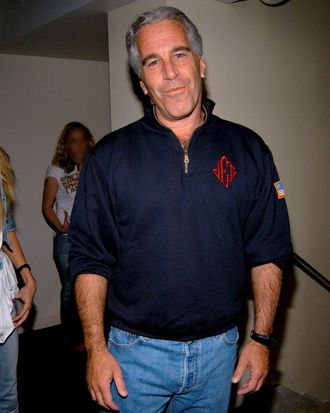
Jeffrey Epstein in 2005. Photo: Neil Rasmus/Patrick McMullan via Getty Image
Billionaire is a word that’s often thrown around when discussing Jeffrey Epstein, but unlike some of his other common modifiers — convicted sex offender, pedophile — there’s scant proof as to his financial bona fides. The bulk of Epstein’s wealth is believed to come from his money-management firm for ten-figure investors, although his only known client is Victoria’s Secret founder Les Wexner, who reportedly ditched Epstein over a decade ago.
After sex-trafficking charges were handed down on Monday, executive-suite financiers discussed how absent Epstein was from the field: “He’s supposed to run an enormous FX [foreign-exchange] trading firm,” said Enrique Diaz-Alvarez, chief risk officer at Ebury. “But I never once heard of him or his firm or anyone who worked or traded with him.” And as Forbes wrote in a 2010 blog post with a very direct title — “Sex Offender Jeffrey Epstein Is Not a Billionaire” — his money-management firm based in the U.S. Virgin Islands “generates no public records, nor has his client list ever been released.”
As we wait for more information to emerge in the investigation’s coming months, speculation is pouring out on how Epstein made his wealth. To make up for the lack of public information on his revenue stream, people are turning to unverified theories on how Epstein maintained such a sterling financial reputation in addition to his millions. But first we’ll start with the knowns.
Epstein’s mysterious careerAccording to a 2002 profile in New York — the one with the Trump quote — Epstein dropped out of Cooper Union and NYU’s Courant Institute of Mathematical Sciences before finding a job teaching calculus and physics at the Dalton School in the mid-1970s. Epstein was hired at the prestigious Manhattan college-prep institution by the father of Attorney General William Barr, and his students included the son of Bear Stearns chairman Alan Greenberg. In 1976, Epstein joined Bear as a floor trader’s assistant, making partner in a mere four years. By 1981, he was out, setting up the J. Epstein & Co. money-management business the next year. New York described his business strategy in 2002:
He would take total control of the billion dollars, charge a flat fee, and assume power of attorney to do whatever he thought was necessary to advance his client’s financial cause. And he remained true to the $1 billion entry fee. According to people who know him, if you were worth $700 million and felt the need for the services of Epstein and Co., you would receive a not-so-polite no-thank-you from Epstein.
In Vicky Ward’s recent process piece on her reporting of an Epstein profilefor Vanity Fair in 2003, she lays out some of her thoughts on the matter of a possible benefactor. In addition to a claim from a Ponzi schemer that Epstein was kicked out of Bear Stearns in 1981 for “getting into trouble,” Ward suggests that Wexner may have helped bankroll the financier. Ward writes: “While Epstein’s friends speculated that retailer Les Wexner was the real source of Epstein’s wealth, Wexner (who called him ‘my friend Jeffrey’) never commented on this, though he did send me an email praising Epstein’s ‘ability to see patterns in politics and financial markets.’”
No one knows how much he’s worthAccording to his lawyers, around the time of his notorious plea deal in Florida in 2008, Epstein’s net worth was over nine figures. The figure was “a bone of contention with Epstein’s lawyers,” Spencer Kuvin, an attorney representing three of Epstein’s alleged victims, told the Palm Beach Post in 2008. “In the litigation itself we were never able to get him to produce verified financial information. The ‘nine figures’ came by negotiation. It kept going up and up and up. They started at zero — they wouldn’t tell us at all.”
As Bloomberg states, “Today, so little is known about Epstein’s current business or clients that the only things that can be valued with any certainty are his properties.” According to a document submitted in advance of Epstein’s bail hearing, his Manhattan townhouse is estimated to be worth around $77 million. Then there are the properties in New Mexico, Paris, the U.S. Virgin Islands, his private jet, a fleet of 15 cars, and a Palm Beach compound estimated at $12 million.
But even the real-estate holdings have an air of mystery to them. Epstein purchased, or received, the Manhattan townhouse from Wexner around 1998. But there were no property records on the mansion’s transfer until 2011, when the company Wexner used to buy the place transferred it to an Epstein-owned company for $0. Epstein signed the document for both sides.
Financial Conspiracy Theory #1: Ponzi schemeA Ponzi scheme has been floated as a possible source of Epstein’s wealth since as early as 2009, when Business Insider noted that multiple red flags pointed to a possible Madoff-like fraud. The secrecy of his client list; the “administrative” nature of all his 150 employees in 2002; the absolute control over investors’ money, and the $1 billion basement investment required — all signs could point to Ponzi, although there’s no concrete evidence. In the story, finance writer John Carney raised a vital question, considering Epstein’s ( limited) time in jail during the 2008 financial crisis: “How could Epstein’s one-man show not fall apart while he was in jail during one of the most volatile years in history?”
In addition, one of his early employers in finance, Steve Hoffenberg, was convicted for running one of the largest pre-Madoff Ponzi schemes in U.S. history. According to journalist Vicki Ward, Hoffenberg brought on Epstein in 1981 after he left Bear Stearns. “He has a way of getting under your skin,” he told Ward. Hoffenberg paid Epstein $25,000 per month for his work as a consultant for Towers Financial, though Epstein had left well before Hoffenberg pleaded guilty in 1994 to defrauding investors to the tune of $450 million. For years, it appeared Epstein had no exposure in the Towers Financial case, until 2018, when shareholders filed a putative class action suit against him for his alleged role in the Ponzi scheme. In a separate New York state case in 2018, Hoffenberg reportedly detailed Epstein’s alleged involvement in the scam.
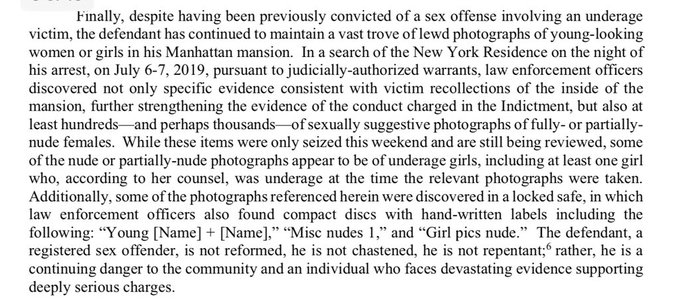
Theory #2: BlackmailAs the Intercept D.C. bureau chief Ryan Grim noted, a piece of evidence detailed in the SDNY’s detention memo could hold a great deal of blackmail potential:

Ryan Grim
?@ryangrim
CD's in Epstein's safe labeled: "Young [Name] + [Name]"
That looks an awful lot like they found the blackmail tapes t.co
erica orden
?@eorden
Replying to @eorden
Here is what law-enforcement officials found in Jeffrey Epstein’s Upper East Side mansion on Saturday night when they executed a search warrant, according to SDNY’s detention memo:
8,109
12:25 PM - Jul 8, 2019
And in a 2015 court filing, alleged Epstein victim Virginia Roberts Giuffre claims that U.S. authorities were in possession of footage of her having sex with members of Epstein’s elite friend group. “Based on my knowledge of Epstein and his organisation, as well as discussions with the FBI, it is my belief that federal prosecutors likely possess videotapes and photographic images of me as an underage girl having sex with Epstein and some of his powerful friends,” she said. Giuffre claimed that Epstein “debriefed her” after she was forced into sexual encounters so that he could possess “intimate and potentially embarrassing information” to blackmail friends into parking their money with him.
Theory #3: Epstein “Belonged to Intelligence”One of the more mysterious quotes of this whole conspiracy-adjacent messcomes from Alexander Acosta, the current Department of Labor Secretary and former U.S. Attorney who orchestrated Epstein’s wrist-slap in 2007. According to Vicki Ward, Acosta claimed during his Labor Secretary nomination process that he “was told ‘belonged to intelligence’ and to leave it alone.” Whether that’s the American intelligence community, the greater point-one-percent brain trust, or just a garbage excuse, the answer was good enough for the Trump administration to go forward with Acosta’s nomination.
Theory #4: Offshore Tax Schemes / Money LaunderingBecause Epstein’s wealth is held offshore and is shrouded in mystery, some speculate that he may have made his money in tax schemes or money laundering. According to a well-developed, if factually void, pan-conspiracist take from finance Twitter’s Quantian, Epstein could have blackmailed his social circle into investing with him, then dumped the cash in an offshore account to avoid taxes. Or, similar to the Ponzi scheme conspiracy — and, again, without basis in fact — there is so little paperwork on the funds that the whole thing could just be a rig for money laundering.
What could the coming investigation reveal?Because so little is known about Epstein’s wealth and his ambiguous-to-the-point-of-suspicious Financial Trust Company, pretty much any revelation would help shed light on the financial black hole. But because the Southern District of New York’s Public Corruption Unit is handling the case, the likelihood of a financial or tax-related charge is much higher than if another arm of the mother court were in charge. Gene Rossi, a trial analyst for Law & Crime, suggested that the PCU could provide more flexibility on charges, including money laundering, corruption, or tax-related crimes: “The sky’s the limit.”
nymag.com |



