National security ... something about all nations trying to maintain status quo or to change whatever norm ... suspect impetus for change shall overcome inertia, but the friction, and the overcoming of friction, shall cause damage.
Per below, team Japan trying to change processes endanger team Korea effort to change other processes, and all enabling / facilitating or hindering other teams China and USA respectively to change or maintain the state-of-is, again respectively
All good and positive, leading to some outcome and possible new equilibrium
Equilibrium is good.
upi.com
Analyst: Japan dispute with Korea could cripple U.S. China tech policy
Elizabeth Shim
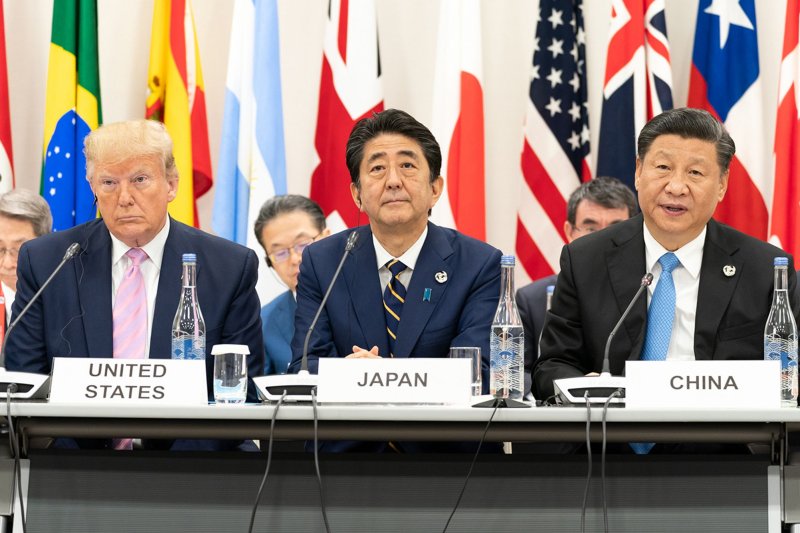
Japanese Prime Minister Shinzo Abe (C) has pushed for trade restrictions targeting South Korean companies. The move could hurt the United States. Photo by Shealah Craighead/White House | License Photo
NEW YORK, July 16 (UPI) -- Japan's trade restrictions targeting South Korea could ultimately undermine U.S. policy designed to rein in Chinese technology practices.
The decision from Japan's trade ministry to require individual permission to export key chemicals to South Korea potentially slows production at tech giants like Samsung and SK Hynix, Troy Stangarone, senior director of congressional affairs and trade at the Korea Economic Institute in Washington, D.C., told UPI.
As South Korean firms that control more than 60 percent of the global memory chip market struggle with delays, Chinese companies could gain a competitive advantage in the medium term, the U.S. analyst says.
"China is really pushing into the semiconductor industry with its Made in China 2025 program," he said. "If Samsung or SK Hynix can't supply, Chinese startups -- which are supposed to come online this year -- might step into the void."
The United States remains wary of China's use of technology. The Trump administration has said there is evidence China is using technology to steal information from the United States. It has also treated Chinese tech firm Huawei as a threat to national security.
Japan may not realize its measures, designed to exclusively retaliate against South Korea for longstanding disagreements, ultimately hurts the United States and helps the United States' biggest rival, China.
"The actions Japan is taking create an opening for China at a time when the Trump administration is trying to deal with China on technology," Stangarone said. "South Korea and Japan should find a way to resolve the dispute and the United States should be urging them to do so."
Samsung's smartphone brands have become household names. The company, along with SK Hynix, also provide the microchips needed to operate Apple's smartphones and Amazon's cloud service centers.
As the supply of South Korean microchips to the United States slows due to Japan's restrictive policies, firms with clout like Apple may not be affected. Smaller and more innovative U.S. firms could face shortages, Stangarone said.
"This impacts all tech companies around the world."
'National security threat'Japan's reasons for the restrictions, made public on July 1, have shifted in a matter of weeks.
Japan's Chief Cabinet Secretary Yoshihide Suga suggested a South Korean court ruling that allows Koreans to sue Japanese firms for exploiting forced laborers during wartime is a source of damaged trust between the two countries. During the same briefing, he announced the export restrictions.
Since July 1, Tokyo is pushing a new message: Seoul may have violated North Korea sanctions, and restrictions are being applied for the sake of national security.
Japanese Prime Minister Shinzo Abe first made the claim, without evidence, on local television on July 7. Seoul has fought back with its own allegations of Japan's violations of North Korea sanctions.
"It's unclear at the moment what Japan's actual rationale is here," Stangarone said.
In order to determine whether imports or exports affect national security, companies are allowed to submit statements, give testimonies and investigations take place. Japan has yet to confirm what process it has used to evaluate South Korea as a national security threat, according to the analyst.
Disputes between the two countries have raised the profiles of the leaders -- President Moon Jae-in in Seoul and Abe in Tokyo, raising speculation as to whether the two sides are working to appeal to their base of support.
"It seems to be more a politically driven problem right now, high on symbolism for both sides," says Corey Wallace, a postdoctoral fellow and Japan analyst at the Free University of Berlin. "If it escalates, however, it could have a more real-world impact."
The stoking of nationalist sentiment is not necessary for Abe ahead of Sunday's upper house election, Wallace said.
"It's likely Abe is signaling to more conservative supporters that he is being tough on South Korea regarding the issue of exploited workers' compensation and other issues," he said. "But these supporters are hardly going to vote for anyone other than the ruling Liberal Democratic Party anyway."
The Abe administration's message may primarily be intended for the South Korean government because of its position on the forced labor issue.
By early Wednesday local time, Japan was expanding the trade controls applicable to exports of fluorinated polyimide, hydrogen fluoride and photo-resists to third countries that could eventually deliver to South Korean producers, according to a South Korean press report.
But any escalation of the trade spat would be a lost opportunity, Stangarone says.
"This current dispute isn't really to the benefit of South Korea or Japan, especially with regard to the long-term goal of addressing the challenges posed by North Korea."
There is an interdependence between the two partners and the interconnection is underappreciated, he said. |



