SI
SI
discoversearch

We've detected that you're using an ad content blocking browser plug-in or feature. Ads provide a critical source of revenue to the continued operation of Silicon Investor.  We ask that you disable ad blocking while on Silicon Investor in the best interests of our community.  If you are not using an ad blocker but are still receiving this message, make sure your browser's tracking protection is set to the 'standard' level.
Strategies & Market Trends : 2026 TeoTwawKi ... 2032 Darkest Interregnum -- Ignore unavailable to you. Want to Upgrade?


To: Cogito Ergo Sum who wrote (149727)7/19/2019 5:57:43 PM
From: TobagoJack1 Recommendation

Recommended By
SirWalterRalegh

  Read Replies (1) | Respond to of 218108
 
Let us see whether Team America wishes to engage in total ‘trade’ war or instead prefers to declare total victory ...

bloomberg.com

Mnuchin, Kudlow Invite U.S. Tech Giants to Discuss Huawei Ban

Jenny Leonard

President Donald Trump’s senior advisers have invited U.S. technology companies to the White House on Monday to discuss a resumption of sales to blacklisted Chinese telecoms giant Huawei Technologies Co., according to people familiar with the matter.

White House economic adviser Larry Kudlow and Treasury Secretary Steven Mnuchin arranged the meeting with semiconductor and software companies because they wanted to talk about how to move forward. A person familiar with the meeting said the White House asked the companies “to discuss economic matters.”

Among those invited are Intel Corp. and Qualcomm Inc., according to the people. The White House did not immediately respond to a request for comment.

Trump and Chinese President Xi Jinping agreed to a tentative pause in their trade war and to resume negotiations after meeting at the Group-of-20 leaders’ summit in Japan on June 29. The U.S. president at the time said he would loosen restrictions on Huawei and that China had agreed to make agricultural purchases.

The White House meeting is an effort to show China that Trump is serious about allowing U.S. companies to resume business with Huawei and encourage Beijing to move forward with buying more from U.S. farmers, one of the people said.

Farm GoodsChina has told the Trump administration that it would only follow through on the farm purchases once the president issues export licenses for American companies to continue shipments to Huawei. The Commerce Department is leading the process, and has said it will only grant exceptions in cases where there’s no threat to national security.

U.S. companies had halted shipments after the U.S. added Huawei to a trade blacklist in May, though some have resumed certain sales after reviewing the terms of the ban.

Some in the U.S. administration are arguing for America to cut off Huawei from American suppliers entirely for national security reasons, and their view is supported by China hawks on Capitol Hill.

White House trade adviser Peter Navarro said earlier this month that Trump is allowing the sale to Huawei of “low grade” chips that aren’t a security risk. The administration will ensure the Chinese telecom company won’t end up dominating 5G infrastructure in the U.S., Navarro told CNN.

Chipmaker FortunesHuawei is one of the world’s biggest purchasers of semiconductors. Continuing access to Chinese customers is crucial to the fortunes of chipmakers such as Intel, Qualcomm and Broadcom Inc.

Some U.S.-based makers of the vital electronic components have already reported earnings and given forecasts that show the negative effects of the trade dispute. They’ve argued that their financial health is crucial to U.S. leadership of a strategically important industry.

Mnuchin and U.S. Trade Representative Robert Lighthizer spoke by phone with their Chinese counterparts about trade on Thursday. Mnuchin has said if the talks progress over the phone, he and Lighthizer may travel to Beijing for in-person meetings.

Trump said on Friday that the call with Chinese officials a day earlier was “very good” but that they’ll “see what happens.”

The Washington Post reported earlier that U.S. technology companies planned to meet Kudlow at the White House on Monday.

— With assistance by Mark Bergen


To: Cogito Ergo Sum who wrote (149727)7/19/2019 10:26:41 PM
From: TobagoJack  Read Replies (1) | Respond to of 218108
 
One more metal for trade warring

Something even better than the plentiful rare earth industrial-vitamins

Must say, the Huawei Boyz play rough, and must say, play well.

Little wonder why the alliance of the willing became less willing.

I am supposing that I shall be informed that gallium is available everywhere, mining readily re-started at ex-mines now on care & maintenance, ores through processing plants that are no longer around but can be built here there everywhere

some folks are oblivious to the truth that all weapons are meant to be used now, for immediate effect

am wondering which nation / company wishes to be experimentally cut-off from gallium

scmp.com

Gallium: China tightens grip on wonder metal as Huawei works on promising applications beyond 5G

China accounts for 95 per cent of the global supply of the soft, bluish metalHuawei has filed for more than 2,000 patents related to gallium nitride

Did you know that a 5G base station can be squeezed into a casing the size of a shoebox? It’s thanks to gallium, a soft, bluish metal that makes it possible.

The chipsets that generate powerful bursts of high frequency radio waves are not made with silicon, but gallium nitride.

They consume little electricity, produce little heat and can function comfortably at 800 degrees Celsius (1,472 degrees Fahrenheit), making bulky equipment for power supply and air conditioning redundant.

Gallium is one of the 35 technology-critical elements listed by the US government as a national security concern. Like rare earths, the global supply of gallium is under Chinese control.


China produced 390 tonnes of raw gallium last year, or more than 95 per cent of the world output, according to the United States Geological Survey.

China has become a super power in rare earth, rare metals and other dispersed elements, with increasing dominance over a wide range of sectors from ore to technology.


Chinese telecommunications giant Huawei has filed more than 2,000 patents related to gallium nitride, according to Google Patents. Nokia, Huawei’s major competitor in the 5G race, had more than 1,500 patents, while Ericsson had just over 400 filings.

Qualcomm, a US-based company and major supplier of 5G-based chipsets, had less than 1,000 patent filings.

“As the semiconductor industry shifts from silicon to gallium, China is preparing to take the lead position,” said professor Hao Xiaopeng, functional material researcher at the State Key Laboratory of Crystal Materials in Shandong University, Jinan.


Alexandra Feytis, an associate consultant at London-based industrial minerals consultancy Roskill Information Services, said although China’s dominance in gallium was not yet a major source of concern for other countries as the market was adequately supplied, it was likely to change in the long term.

“While China has kept increasing its primary gallium production, most other producing countries have reduced it,” she said, noting Kazakhstan had ceased production in 2013 owing to low prices, followed by Germany in 2016.

“New promising applications requiring gallium have been developed during the last few years and we see among them the widespread roll-out of 5G networks.

“Therefore, gallium will certainly become of more interest over the next few years and it remains closely monitored by Europe and by the US, which both listed it as a critical mineral,” she said.

After a five-year decline until the end of 2016 because of oversupply, gallium prices in China started to recover in 2017. The following year global prices surged by 40 per cent, as a result of restocking by consumers.

Meanwhile, the military sector has been using gallium nitride in radars, high-power laser and spy satellites.

According to Hao, Chinese telecommunication companies such as Huawei are coming up with innovative technology to make the “wonder material” work for mass civilian applications.

5G is just the start.


To: Cogito Ergo Sum who wrote (149727)7/24/2019 7:22:03 AM
From: TobagoJack  Respond to of 218108
 
at some juncture the South Koreans and the Japanese shall have to choose, between gold and/or silver, and, and and and ...

as I had mentioned earlier, a lot of months ago, trump is a symptom, only, globally, and is delivering on mandate

scmp.com

Anti-Japanese sentiment in South Korea brews as ‘trade war’ escalates

Animosity between both countries has reached a flashpoint over territorial, historical and trade issuesSome Japanese in South Korea are wary of discrimination but Zainichi or ethnic Koreans in Japan say xenophobia is an everyday reality

Aya Yanagishima has recently avoided mentioning her Japanese heritage while living in Seoul, fearing discrimination stemming from anger at Japan’s decision earlier this month to restrict hi-tech materials crucial to South Korea’s export-dependent economy. But Yanagishima has not been spared by the children she teaches, even though they are between six and 12 years old.

“When I say the word ‘Japan’ my students blurt out things like ‘I hate Japan’ or ‘your parents are Japanese and need to apologise, your ancestors are trash’,” the 31-year-old says.

Most recently, a student asked her to tell Japanese Prime Minister Shinzo Abe to apologise for offending South Koreans, she adds.

In recent weeks, cultural baggage and historical animosities have reached a flashpoint as the two countries, already tussling over territorial disputes and other matters, are now embroiled in an intensifying trade war.

For Koreans, the stand-off has fuelled anti-Japanese sentiment and calls for boycotts of Japanese products ranging from fast fashion brands to ramen chains and even stationery.

Japan is a top travel destination for Koreans, with about 7.5 million visiting last year. The trade dispute has taken a toll, though, as outbound bookings to Japan have fallen by 50 per cent, according to Korean travel agency Hana Tour.

There are nearly 61,000 Japanese living in South Korea, a country of 51 million, and they have become acutely aware of the tense environment.

Saito Himiko*, a 31-year-old housewife, moved to South Korea six months ago with her Korean husband and has worked hard to blend in. She asked to withhold her real name for fear of being targeted.

“I try to speak as much Korean as I can,” says Himiko, who also reads local papers to keep track of Korean perspectives regarding Japan.

South Koreans, who have staged protests against Japan’s use of Koreans in wartime labour and sexual slavery , have grown increasingly vocal in their resentment of Japan. On Monday, six university students in Busan, Korea’s second-largest city, were detained after illegally entering the local Japanese consulate and protesting there.

What’s driving Japan’s escalating feud with South Korea?

Choi Hee-man, a security guard in Paju, a city one hour from Seoul, says he would not go to the aid of a Japanese person or “treat them nicely”.

“We should treat them exactly the same way they have treated us,” the 69-year-old says, adding that most people his age dislike the neighbouring nation. “Even before I was born, we’ve had a shaky relationship with Japan.”

This kind of discrimination may be new to many Japanese in South Korea. They may enjoy going to South Korea – 3 million Japanese visited last year – but many see their home country as a monoethnic society.

Brand confusion threatens South Korean boycott of Japanese goods

Ethnic Koreans who have lived in Japan for several generations, known as Zainichi, say they have long experienced discrimination from Japanese. The term Zainichi itself means “foreigner” and implies temporary residency, reflecting the pariah status of early migrants.

During the period of Japanese colonisation of South Korea from 1910-1945, hundreds of thousands of Koreans moved to Japan in search of opportunity, attracted by the high demand for labour.

By the end of World War Two, there were about 2.3 million Koreans in Japan. Most eventually returned to live in South Korea but those who stayed were stripped of their Japanese citizenship and deemed resident aliens – a status many still hold. Today, there are an estimated 700,000 Koreans living in Japan, with many born there.



Kent Kim, a second-generation Zainichi who grew up in Fukuoka prefecture. Photo: Handout
Share:

Kent Kim, a 55-year-old martial arts instructor and second-generation Zainichi who grew up in Fukuoka prefecture, says older Japanese-Koreans like his father experienced deep-seated prejudice.

“Until the 1980s, [like other foreigners] Zainichis could not even get bank loans and were not eligible to receive government housing,” he says. “The discrimination against them was institutionalised – big companies like Hitachi wouldn’t hire Koreans back then.”

Japan’s rapid economic growth in the 1960s improved the situation for Zainichi Koreans, says John Lie, a sociology professor at the University of California, Berkeley who wrote a book about their mixed identity.

Japan-South Korea ‘trade war’: has Tokyo shot itself in foot?

“There were legal changes in the 1970s and 80s that made Zainichi eligible for public benefits and made outright discrimination illegal,” he says. “The educational and economic achievements of Zainichi were obvious by the 1980s.”

Notable Zainichi include Lee Myung-bak, the former president of South Korea who was born in Osaka, and Shin Kyuk-ho, also known as Takeo Shigemitsu, who founded the multinational Lotte conglomerate. Mayayoshi Son, the founder of tech giant Softbank, is another Zainichi to have achieved success.
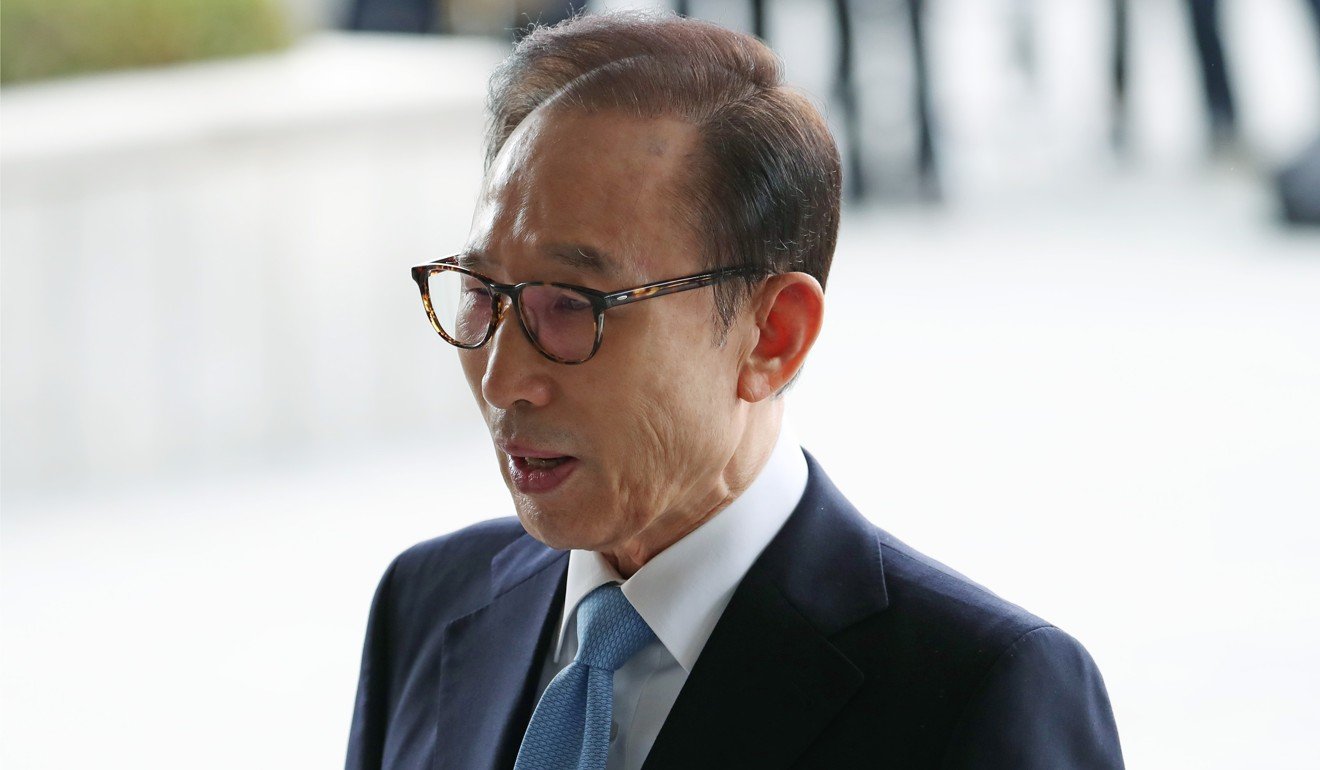


Lee Myung-bak, South Korea’s former president. Photo: Bloomberg
Share:

Nonetheless, stereotypes about Zainichi persist: they are often regarded as less educated and less well-mannered than ethnic Japanese.

“The other day, I was drinking with Japanese acquaintances, and they said ‘oh you’re outspoken because you’re Korean. It’s in your blood’,” Kent Kim says. “I wasn’t sure how to take that.”

Negative attitudes towards Koreans are especially prevalent among older Japanese.

“I can’t trust Koreans,” says Kazuhiko, a 59-year-old man living in Aichi Prefecture who preferred to be identified only by his first name. “Of course it depends on the individual but Korean people seem combative … I have heard of Koreans acting badly, so I don’t have a good impression of them.”

Man lights himself on fire in front of Japan embassy

For Miyuki, a 60-year-old woman living near Nagoya who also preferred to be identified by her first name, historical disagreements fuel the perception.

“I have an image of them as a country pestering us and asking for compensation over historical events,” she says, alluding to Korea’s demands for compensation over forced labour and wartime sexual slavery.

Younger Japanese, however, are more open-minded. Yuki Tanaka* lives in Australia but has also travelled to Korea.

“I have some Korean friends, so I try not to have any stereotypes or biased view towards them,” the 30-year old says.

Japan and Korea are at odds. Why won’t the US get involved this time?

In Japan, though, most Zainichi do not openly identify as Korean, instead using Japanese names to avoid being ostracised.

“Zainichi go by lots of Japanese names – some are really obvious,” says Kent Kim. “Kanaya, Kimura, Yoshimura and Aoki are all common Zainichi names.”

Kim did not consider himself Korean until eight years ago when he moved to his parents’ homeland aged 47.

“Back then I identified as Zainichi – as a Korean who wasn’t really interested in Korean culture. A lot of Zainichis are this way,” he says. “Then I went to Korea and it changed my mind. I started walking around and even cried. I went: ‘So this is where my grandparents are from.’”

*Names changed

Additional reporting by David Lee, Yumi Mizuno


To: Cogito Ergo Sum who wrote (149727)8/28/2019 7:22:38 PM
From: TobagoJack  Respond to of 218108
 
following up to this watch & brief initiative Message 32247708 <<Gallium: China tightens grip on wonder metal as Huawei works on promising applications beyond 5G ... China produced 390 tonnes of raw gallium last year, or more than 95 per cent of the world output, according to the United States Geological Survey.>>

now this shifting of order of battle kitco.com <<Chalco injects gallium assets into rare earths affiliate>>

and in context of below ...

Am wondering what if some decision-maker somewhere figures out to demand that all industrial vitamins and cardiac-prevention drugs shall only be transacted w/ all counterparties using team China digital currency so as to best defeat terrorism, hiccup money laundering, and protect the greater good? The move might change the global trade system for gallium, rare earths, titanium, cobalt, lithium, magnets, drones, nuclear reactors, high-speed trains, electric cars, super computers, 5G base stations, you-name-itiums ... and unobtaium, all for sharply-improved trusted-entities centralised ledger accounting, and if then married to gold and silver to boost confidence during a crisis, well, then ... geewhizbangohwhoaweeohmygolly

Let’s see how well the full-spectrum, every-domain, all-terrain, all-weather, day-night trade war evolves ...

theblockcrypto.com

7 things you probably didn’t know about China’s digital currency – Global Coin Research

by Ryan Todd

August 27, 2019, 3:25PM EDT · 8 min read

Shutterstock

Quick TakeGlobal Coin Research highlights details surrounding China’s Central Bank Digital Currency that have not been reported or emphasized by broader media
There have been a number of reports on China’s Central Bank Digital Currency (CBDC) in the crypto media, nevertheless, GCR has found numerous more rigorous sources on the details in Chinese language media and Chinese media. Here we highlight seven things that have not been reported or emphasized:

1. Private businesses and institutions are the focus for China’s CBDC pilot.

Thus far, multiple approaches are being tested for the launch of the first central bank digital currency in China. Multiple players, including private and state-owned companies, can join the process together with the central bank. But officials are expecting more participation from private institutions in adopting the government-backed currency.

No specific names of companies involved in the pilots.

Why?

For folks who are not familiar with China’s businesses, there are many state-owned enterprises and banks in China. State-owned companies are legal entities that undertake commercial activities on behalf of an owner government.

For example, China is home to 109 corporations listed on the Fortune Global 500 – but only 15% of those are privately owned.

Nevertheless, China’s private sector – which has been revving up since the global financial crisis – is now serving as the main driver of China’s economic growth. The combination of numbers 60/70/80/90 are frequently used to describe the private sector’s contribution to the Chinese economy: they contribute 60% of China’s GDP, and are responsible for 70% of innovation, 80% of urban employment and provide 90% of new jobs.

Given this increasing importance of China’s private institutions, integrating the CBDC into them will allow officials to have a full view of their money movements. It may be one of the ways regulators are attempting to onboard and “privatize” those companies.

If you are interested in learning more, check out this book on China’s economy that we recommend on the GCR booklist-> On China’s Economy: What Everyone Needs to Know

2. The PBoC is very forward-looking.

It may not be widely known that the PBoC initiated the CBDC project in 2014. Beginning five years ago, the officials have already began looking into launching its own digital currency to cut the costs circulating cash and boost policymakers’ control of money supply. Although the project has been closely guarded, various media reports suggest that the central bank’s researchers have been working intensively on the cryptocurrency’s systems for the past year.

We recently interviewed Jeremy Allaire from Circle on his thoughts on the digital currency. He claims that China is way ahead in terms of technical innovation as “not a single person in the United States government or in the federal reserve” has been working on anything remotely close to developing a government-backed digital currency.

3. The CBDC will return the financial power back to the banks in China.

The deputy director of China specified that PBoC would rely on Chinese commercial banks to be the conversion agency, helping to convert cash in circulation into the PBoC-backed digital currency, and vice versa.

By designating Chinese banks as the conversion agency, the PBoC is enabling them to regain the channel through which they could capture and analyze customers’ transaction data.

In the past, “Commercial banks have been disadvantaged in competing for mobile payment businesses because the big data related to the end-users’ payment and online behavior has been captured by Alipay and WeChat Pay. But with their new role under the PBOC’s digital currency initiative, I expect banks to form their own platform and network on big data,” said Hui, a professor at the Hong Kong University of Science and Technology.

While the largest banks in China are mostly state-owned and are relatively more advanced than banks in the states, they still lag the tech conglomerates that have entered fintech in the last decade. Some banks that are early movers in retail banking will likely benefit more from the digital currency project than others.

“Those that are more aggressive in mobile banking, such as China Merchants Bank and Ping An Bank, could be keen to work with the PBoC and support this digital currency project.”

By designating banks as the agent to convert between the PBoC digital currency and fiat money, then banks could use their own internet banking services to retain cash held by individuals and merchants and ultimately, turn them into banks’ deposits.

4. CBDC is not crypto, and the officials recognize that.

The Chinese officials recognize the difference between cryptocurrencies such as Bitcoin and CBDC. They claim that the CBDC is very different from Bitcoin. The ledger is centralized and the ledger must adopt real-name verification. Residents will be able to exchange the digital currency in commercial institutions.

Nevertheless, the ambition to be a recognized global currency is not to be ignored. Looking out to the rest of 2019, the PBOC said it would expedite the research of China’s legal digital tender and monitor the trends of virtual currency development both overseas and at home.

To sum up, the central bank’s digital currency system will be a centralized, electronic cash system that uses public/private key encryption technology to implement the off-account system. Mobile online banking and payment applications can support CBDC.

5. The CBDC will likely come out before Libra.

We believe the Chinese government-backed digital currency may come out earlier than the official launch of Libra.

While Libra’s official announcement is to come out 2020, we think it’s very unlikely to happen based on our discussion with related parties inside and outside of the team and the current regulatory limitations on cryptocurrencies in the U.S.

The time seems to be more ripe for introducing the central bank digital currency, based on ongoing trials in some areas and Shenzhen Special Economic Zone announcement, where they included research and promotion of digital funds and the national cryptocurrency based on the renminbi as one of the initiatives.

GCR learned that current reception among the Chinese for the Central Bank Digital Currency has been relatively controversial and political, according to Mindao Yang, founder of the Defi protocol Dforce, which was also invested in by a Chinese bank.

When launched, Libra’s announcement actually sparked discussions among Chinese financial regulators, driving the designer to rethink various models which can involve more non-governmental institutions in the CBDC development and issuance process. Multiple regulators, including the PBOC, have reiterated that Libra must be put under central bank oversight to prevent potential foreign exchange risks and protect the authority of monetary policy.

6. The CBDC will be 100% backed by reserves.

PBoC announced that the CBDC will be 100% backed by the reserves that commercial institutions pay to the central bank.

With banks’ loan-to-deposit ratio rising, if banks continue to lose their deposit base it will be difficult for them to keep up with their lending, so through the digital currency the PBoC hopes to divert some of the deposits back to the banking system,” said one bank researcher.

While Wechat and Alipay is also 100% backed by reserves, this was only a recent phenomenon, which we highlighted in October last year, which we are sharing some excerpts below again:

“Alipay and Wechat pay did not have actual assets backing its payment system for over 10 years. Yes, you read that right. Over 10 years. To be specific, it was more like 14 years.

[…]

It was not until this year that the Central Bank of China required payment firms to deposit 100% of their reserves of client funds with a centralized custodian by Jan. 14 — part of a broader effort to crack down on financial risk.

Additionally, it was only last year, in January 2017 when the People’s Bank of China (PBoC) said that it would require third-party payment companies to keep 20% of their customer deposits at commercial banks in single custodial accounts that bear no interest. China’s third-party payments providers had previously been given free rein to invest funds collected from customers, effectively functioning in a manner akin to depository institutions without the obligation to make interest payments for funds.

This means that Alipay’s reserve did not come into government supervision and spotlight completely until very recently, only when Wechat Pay and Alipay have become dominant payment systems in the country. […]

PBoC has since announced this reserve requirement will rise to 100% by January next year in 2019, after first lifting the ratio to 50% in April.”

7. Challenges with the CBDC

The value of CBDC will include “tracking the money flow in economic activities and supporting making monetary policy”, according to Shao Fujun, chairman of China UnionPay and a former PBOC official. But it is also facing difficulties, such as international coordination in monetary and exchange rate policy.

“Where we are now is just like in a horserace, when several designated institutions are taking different technical routes for developing the digital currency and electronic payment. The winner will be the one who has the best approach, accepted by the public and the market. So that is a process of market competition,” said Mu, the deputy director of the central bank’s payments.

