SI
SI
discoversearch

We've detected that you're using an ad content blocking browser plug-in or feature. Ads provide a critical source of revenue to the continued operation of Silicon Investor.  We ask that you disable ad blocking while on Silicon Investor in the best interests of our community.  If you are not using an ad blocker but are still receiving this message, make sure your browser's tracking protection is set to the 'standard' level.
Strategies & Market Trends : 2026 TeoTwawKi ... 2032 Darkest Interregnum -- Ignore unavailable to you. Want to Upgrade?


To: Maurice Winn who wrote (150111)8/18/2019 2:12:26 AM
From: TobagoJack  Respond to of 218221
 
Ultra bullish ... for what am unsure

mauldineconomics.com

Ray Dalio-John Mauldin Discussion, Part 4
By John Mauldin

June 28, 2019

This week is the fourth in a series of five open letters responding to a series of essays by Ray Dalio, the founder of Bridgewater Associates. His original letters are Why and How Capitalism Needs to Be Reformed, Parts 1 and 2 and It’s Time to Look More Carefully at ‘Monetary Policy 3 (MP3)’ and ‘Modern Monetary Theory (MMT)’. My replies are here, here, and here. Today I continue my response.

I was quite pleasantly surprised to read a very generous and gentlemanly reply from Ray in Forbes last week, in which he clarified some of my understanding of what he wrote. I encourage you to read it after this letter for more context. I’ll continue responding to his original material but first a short piece responding to his letter in Forbes.

Dear Ray,

I want to thank you for your thoughtful and courteous reply to my first three essays. It was remarkably civil and I learned a great deal. Clearly you and I agree more than we disagree. Many of our differences are an emphasis on a different syllable in a word rather than the word itself. Much like tomato and to-mah-toe. I will continue my series in the spirit in which you replied, noting that my misunderstandings would have been cleared up in a few minutes in a normal conversation rather than a public internet back-and-forth. Part of the times we live in…

I will encourage my readers who are following this discourse to read your response, as there is much to be learned in your explanations of the nuances of MP3 and MMT. I somewhat conflated them in my first few readings of your letter, and your clarification helps immensely. I believe my fifth and hopefully last letter in this series next week will offer an alternative to this path we both agree would be perilous. These paragraphs from your response are at the crux of the matter:

Having studied these dilemmas in the past and thought a lot about the cause/effect relationships that determine how they work, it is my conclusion that central banks will have to turn to what I call Monetary Policy 3 (MP3) in the next downturn. MP3 follows Monetary Policy 1 (which is interest-rate-driven monetary policy), which continues until interest rate cuts can’t be big enough to do the trick. That’s when Monetary Policy 2 (which is central bank printing of money and buying financial assets) happens and continues until that doesn’t work anymore either. MP3 is fiscal and monetary policy working together with fiscal policy producing deficits that are monetized by the central bank. Modern Monetary Theory as it’s described is simply one version of many types of MP3. What I’m saying is that I believe that in the next downturn you will either see some form of MP3 from central banks or you will have terrible economic and social conditions.

To be clear, I’m not saying that such policies don’t have some undesirable consequences, and I don’t think that MMT is the best form of MP3. What I’m saying is that MP3 is the best of the bad alternatives and some form of it will likely happen, so one had better know how it works and how to deal with it. I welcome alternative descriptions of what will happen when both interest rate cuts and QE don’t work to stimulate the economy in the next significant downturn.

I quite agree that unless something is done there will be terrible economic and social conditions. As you say, we will have to choose between bad and perhaps even worse choices, none of which will be easy. The longer we wait, the more difficult and limited the choices will be.

I’m looking forward to hearing what form of MP3 will be best (or least bad). I quite agree that more QE will have its own attendant complications, creating the same problems as last time. The image of Christopher Walken demanding More Cowbell comes to mind. More QE may be far more annoying, if not destructive.

I look forward to continued conversation…John

Comparative National Emergencies(continuing from last week…)

While I am unsure wealth and income disparities, as obvious and politically charged as they are, rise to the level of a national emergency, I wholeheartedly agree that when 53-54% of America votes as if they are, politicians will agree it is a national emergency and do something, at a not insignificant cost. The resulting new debt could indeed spark a national emergency.

Let’s first look at this using historical data and Congressional Budget Office projections, which presume steady (though mild) growth and no recessions. Then we’ll tweak that data to see what happens if there is a recession at some point.

As noted above, the one seemingly bipartisan point of agreement is to never, ever discuss deficits in any serious manner. By “serious,” I mean actually suggesting specific solutions that would bring either higher taxes, lower spending, or both. Simply noting the debt exists, while important, isn’t serious discussion.

My associate Patrick Watson spent much of this week searching government websites to produce the charts and tables below. Let’s run through these to set up later discussions.

This first chart simply aggregates CBO spending and revenue figures. The CBO, of course, can’t predict a recession in the future and uses what it thinks are “best practice” projections. Note that tax revenue (the black line) is not enough to pay for mandatory spending, defense, and all of the net interest. Again, this is pretty much a best-case scenario. (Also notice how tax revenue dropped in the Great Recession. That will become important later.)
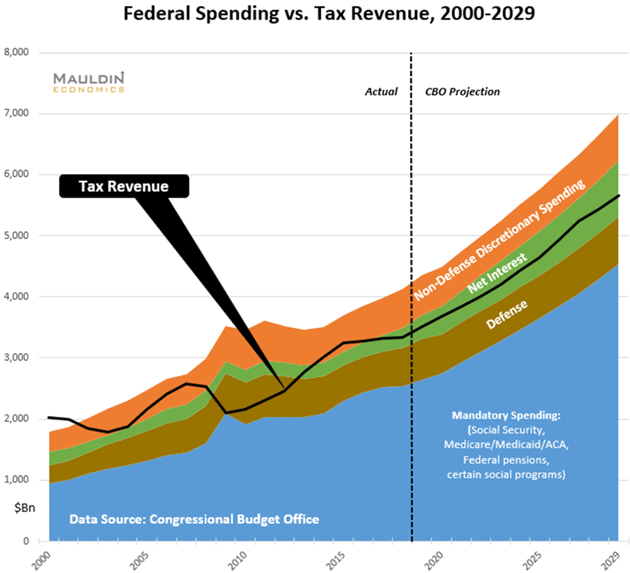


By the way, for this chart we treat Social Security and Medicare as if they were not separately funded. Payroll taxes are included in the revenue line and benefit payments are in the blue mandatory spending area. I think that is closer to reality, since taxpayers are liable for them regardless.Under these projections, total federal debt will rise to $25 trillion sometime in 2021. If there is a new president, he or she will not have enough time to change that. Total debt by the end of the decade will rise to the mid-$30-trillion range. Note that these projections do not include off-budget spending (more on that later) which is significant.

The CBO also assumes the bond market can and will absorb almost $35 trillion worth of US government debt. When combined with state and local debt it will easily exceed $35 trillion. (State and local debt is already over $3 trillion. It will certainly rise in the next 10 years.)


What Happens if There Is a Recession?Ray, I think you would agree that at some point there will be another recession in the US. I think we would also agree it is somewhat of a mug’s game to predict the timing of a recession more than a few months in advance.

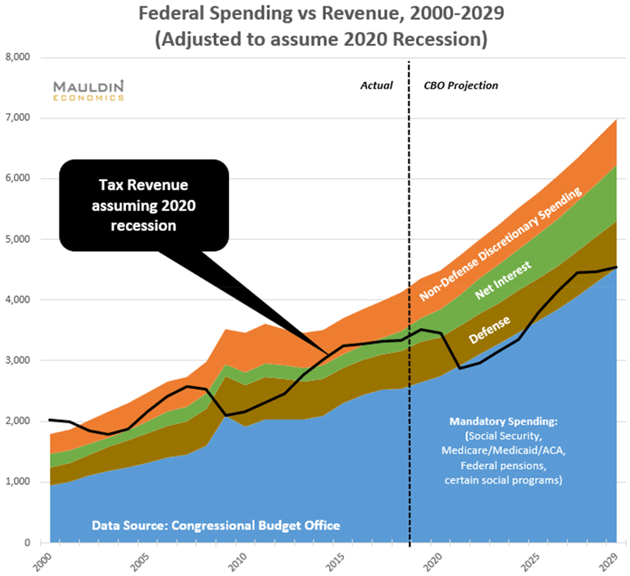
That being said, we should still ask what would happen to the deficits and debt if there were a recession. I asked Patrick to find the percentage change in tax revenues in the last recession (2008 and following) and the recovery thereafter. Using that historical data, the revenue line in the chart below assumes the same percentage revenue change following a hypothetical 2020 recession. (Note, recessions also raise spending due to increased unemployment insurance, welfare, and other economic backstops, but we ignore that in this chart.)

Possibly the next recession will not see revenues fall as much as the last one. Then again, it is also unrealistic not to expect an increase in expenses, so in my statistical dreamworld they will hopefully balance out. I’m sure we can look back in 2025 and see how close to the pin we actually were.This first graph assumes a recession in 2020. Note that revenues fall below mandatory spending by the middle of the decade, then never get back above mandatory spending plus defense spending. Then by the end of the 2020s mandatory spending will again have risen to consume all tax revenue. And again, these deficits don’t include significant off-budget deficits.


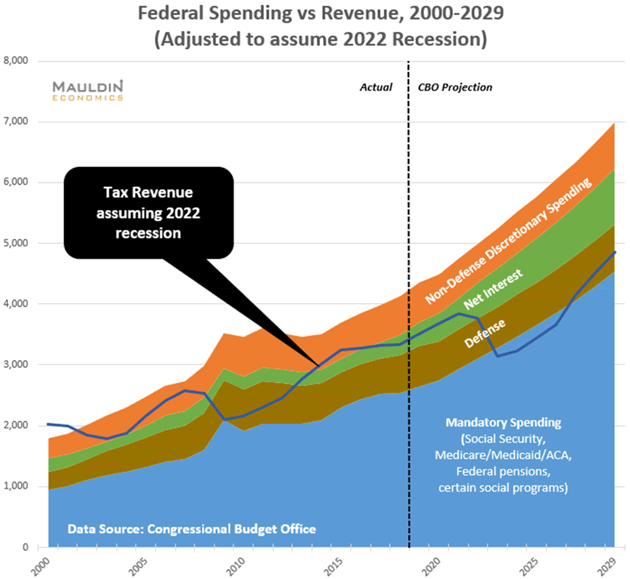
This next graph assumes recession in 2022 instead of 2020. The pattern is basically the same, except that the $2-trillion deficits don’t begin until 2023. Again, this uses actual CBO projections and reduces revenues by the same percentage they fell in 2008–2009, and recovered thereafter.


On-Budget Versus Off-Budget DeficitsFinding a simple projection for off-budget deficits is extraordinarily difficult. When you begin to look at the actual numbers over the last 20 years, you can understand why. There can be a difference of as much as $950 billion from one year to the next. A lot of it has to do with accounting vagaries and statistical timing, which of course are hard to forecast years in advance.

That being said, there is a remarkable consistency about the average annual off-budget deficit. It has averaged around $269 billion a year since 2000. Since 2009 the average is $271 billion.

The following table looks at the actual growth of the US debt since 2000 and uses CBO projections for both on- and off-budget deficits through 2021. After 2021 we conservatively assume that the off-budget deficit will average $269 billion for the next eight years. We also assume, for the sake of mathematical interest, a recession in 2022. We did not project a tax increase at any point in the future, which would of course have an impact on future revenues and deficits. For those curious, a recession in 2020 would increase the total debt by more than $2 trillion in 2029.
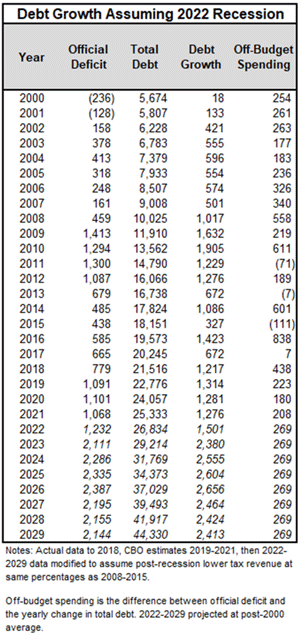


Under these assumptions, annual deficits rise to over $2.5 trillion by 2024 assuming a 2022 recession. It will be hard for any administration to raise taxes after recession for at least a few years. And as we saw last week, even a 25% tax increase on the highest tenth of income earners in America would only produce about $250 billion. And that is not net and does not assume any behavioral change that reduces total taxable income of that top 10%.

Under our assumptions total federal debt will rise to over $44 trillion by 2029. The CBO forecast that does not include a recession has total debt rising to over $33 trillion. There is one line on page 16 of the report mentioned below which discloses that factoid. The rest of the report talks about government debt held by the public, as if debt held in the Social Security “lockbox” and other similar inter-government debt won’t be paid by the public as well.

Explaining off-budget deficits can be exhausting. Literally. But essentially, it is Congress appropriating funds from government agencies that are theoretically used for future expenses like pensions and healthcare, spending the money this year and replacing it with government bonds. Social Security obviously, but the US Post Office, all kinds of government pension funds, and all sorts of funds go into this budget legerdemain.Forget Turning Japanese, We Are Turning GreekThe CBO produces a remarkably detailed report on the budget and economic outlook through 2029. It is very clear in its assumptions. Let’s look at its GDP projections for the next 10 years: slightly under 2% average growth with 2% inflation and modestly increasing interest rates. (Page 147 at the link above)
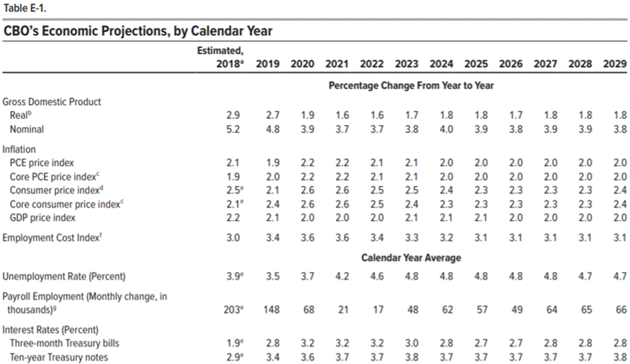
Source: Congressional Budget Office

On page 126 you find that a 1/10 of 1% decrease in productivity could increase federal deficit spending by $307 billion over the next 10 years. Clearly productivity matters. Labor force growth has about half the effect of productivity growth. But both are significant.

The CBO projects US GDP will be in the $30-trillion range by 2029, again without a recession, which would no doubt shave a few trillion dollars off that number, but let’s go with it. Without a recession debt is projected to be about 105% (give or take) of GDP and with a recession it is closer to 150%. Shades of Italy or Greece.

Paul Krugman and many others would say I’m being unduly bearish and foolish to worry about deficits and national debt. “We” just want to wear our hair shirts and force austerity on everyone. The Italians are vocally resisting such austerity, as they saw what happened to Greece when the EU forced it to live within a budget. It could only be called a six-year+ depression. “Brutal” hardly describes it. Why would I wish such a turn of affairs on the US?

Maybe I’m just afraid of finding out the answer to “How much debt is too much debt?” We will know the answer only when the bond market rebels, and then it will be too late. Much too late.

Can the Fed intervene? Surely. But at what cost?

The problem is the data and research, by Lacy Hunt and others, shows a clear correlation between higher debt, lower GDP growth, and lower productivity. This will increase the deficit and debt in a vicious spiraling downward cycle.

It also increases the likelihood of QE4, 5, and 8 into the future after the next recession, which will produce outcomes you (and I) are clearly unhappy with. With reasonable justification.As for raising taxes to make up the difference, total income taxes in 2018 were less than $1.7 trillion. If you literally doubled taxes on the top 10%, you would only get an extra trillion dollars and still not come close to balancing the budget. Not to mention the recession such a tax increase would cause.

After a recession? It wouldn’t even close half the deficit gap with a 100% increase. And that’s before any increased spending. Some of the ideas run into the trillions of dollars over the next 10 years. Maybe that’s just a rounding error given the actual deficits, but these things do matter.

Where Will the Money Come From?The cash government spends in excess of its tax revenue has to come from somewhere. If somehow it comes from the bond market (read US investors, as non-US investors in government bonds are increasingly scarce), that reduces the amount available for more productive endeavors, and thus reduces growth. If it comes from QE it increases distortions and misallocations in the market and, as you pointed out, increases wealth disparity. I am not exactly certain what MP3 would mean, but I look forward to learning.

Or…

Or we could completely (and somewhat radically) restructure the entire tax code along with getting expenditures under control (and maybe even reduced in some areas) and over three or four years come to a balanced budget. Let’s speculate about what that might look like…

(To be continued next week…)

Boston, New York, Puerto Rico, New York, Maine, and MontanaAs you read this, Shane and I are in Boston for Steve Cucchiaro and his beautiful bride Jama’s wedding Saturday night. The next day I meet with my business partners in Mauldin Economics (Olivier Garret and Ed D’Agostino). Monday morning I fly to New York where I am with CMG partner Steve Blumenthal, visit with Art Cashin, attend more meetings, have a CNBC shoot Tuesday afternoon for the Closing Bell, have dinner with accredited investor clients and prospects on Tuesday, and more meetings Wednesday before flying back to Puerto Rico on Thursday, July 4.

Early August sees me in New York for a few days before the annual economic fishing event, Camp Kotok. Then maybe another day in New York before I meet Shane in Montana and spend a few days with my close friend Darrell Cain on Flathead Lake.Shane and I celebrated her birthday and our wedding anniversary yesterday. It was quite glorious. We are really enjoying living in Puerto Rico, much more than I expected. I don’t think I can get Shane to move with dynamite. And if she’s not moving, I’m certainly not.

On a final thought, my editor Patrick Watson and I spent hours this week going back and forth over these deficit and spending numbers, along with my other thoughts you will read next week. As we talked, I asked him what he thought about my outlines. “John, you are being way too optimistic!” If $44 trillion is optimistic…

And with that I will hit the send button. You have a great week and I hope you get to be with some friends and family. All the best!

Your worried about deficits and debt analyst,

John Mauldin

subscribers@mauldineconomics.com


To: Maurice Winn who wrote (150111)8/20/2019 9:23:01 PM
From: TobagoJack  Read Replies (1) | Respond to of 218221
 
re <<1000 year>>

prefer the billion year stuff, and comrades in Aussie-land info-ed re natural organic free-range bank

Sender:R
Sent At:2019 Aug. 19 (Mon.) 12:37
Recipient:P; a; M; J
Subject:Toll feed

Gents

I have a group looking to toll treat at the plant. I should be meeting with them tomorrow. Cheers R

early 2020 start up and are looking for a toll treatment arrangement. deposit is 20km NW of C as the crow flies.will produce 50,000 tonnes of sorter concentrate per annum running at about 10gpt Au and 40gpt Ag.first 3 or 4 months will be oxide ore, then the sulphide ore will start to come in. pictured below is ore from some drill core. Its altered granite. White stuff is kaolin and the sulphides are mostly pyrite.recent detailed metallurgy work showed 90% recovery through 3 pass gravity separation and separately 92% recovery with cyanide leach at 70 micron grind and separately 97% recovery with flotation on 70 micron grind.


To: Maurice Winn who wrote (150111)8/22/2019 7:16:08 PM
From: TobagoJack  Respond to of 218221
 
good news

listening-in closer to be impossible, and Austria is swinging above weight class

and when married to G5+ or G6, all the better

technologyreview.com

A super-secure quantum internet just took another step closer to reality

Martin GilesAug 22

Scientists have managed to send a record-breaking amount of data in quantum form, using a strange unit of quantum information called a qutrit.

The news: Quantum tech promises to allow data to be sent securely over long distances. Scientists have already shown it’s possible to transmit information both on land and via satellites using quantum bits, or qubits. Now physicists at the University of Science and Technology of China and the University of Vienna in Austria have found a way to ship even more data using something called quantum trits, or qutrits.

Qutrits? Oh, come on, you’ve just made that up: Nope, they’re real. Conventional bits used to encode everything from financial records to YouTube videos are streams of electrical or photonic pulses than can represent either a 1 or a 0. Qubits, which are typically electrons or photons, can carry more information because they can be polarized in two directions at once, so they can represent both a 1 and a 0 at the same time. Qutrits, which can be polarized in three different dimensions simultaneously, can carry even more information. In theory, this can then be transmitted using quantum teleportation.

Quantum … what? Quantum teleportation is a method for shipping data that relies on an almost-mystical phenomenon called entanglement. Entangled quantum particles can influence one another’s state, even if they are continents apart. In teleportation, a sender and receiver each receive one of a pair of entangled qubits. The sender measures the interaction of their qubit with another one that holds data they want to send. By applying the results of this measurement to the other entangled qubit, the receiver can work out what information has been transmitted. (For a more detailed look at quantum teleportation, see our explainer here.)

Measuring progress: Getting this to work with qubits isn’t easy—and harnessing qutrits is even harder because of that extra dimension. But the researchers, who include Jian-Wei Pan, a Chinese pioneer of quantum communication, say they have cracked the problem by tweaking the first part of the teleportation process so that senders have more measurement information to pass on to receivers. This will make it easier for the latter to work out what data has been teleported over. The research was published in the journal Physical Review Letters.

Deterring hackers: This might seem rather esoteric, but it has huge implications for cybersecurity. Hackers can snoop on conventional bits flowing across the internet without leaving a trace. But interfering with quantum units of information causes them to lose their delicate quantum state, leaving a telltale sign of hacking. If qutrits can be harnessed at scale, they could form the backbone of an ultra-secure quantum internet that could be used to send highly sensitive government and commercial data.


To: Maurice Winn who wrote (150111)8/22/2019 8:24:11 PM
From: TobagoJack  Respond to of 218221
 
Good news, for 5G

Looks like a replay of the Intel Xeon chip embargo by the Obama administration as tee-ed up by deep-state, that it did nothing except redoubled effort per imperatives lead to solutions

globaltimes.cn

Huawei’s 5G business not impacted by US ban: Ren Zhengfei

Huawei founder and CEO Ren Zhengfei said that his company does not need to rely on US companies to roll out fifth generation (5G) wireless communication equipment.

Ren made the remark during an interview with UK-based Sky News, and the content of the interview was published on the official Huawei website on August 15.

Huawei, which was blacklisted by the US administration earlier this year, received a second 90-day reprieve earlier this week. That allowed the Chinese telecom giant to keep doing business with some US companies.

Ren said that Washington's ban didn't have that much impact on his company, and the company has found substituted components that are actually preferable.

Most of Huawei's more advanced equipment does not contain US components now, and these newfound alternatives even function 30 percent more efficiently, according to Ren.

In August and September, Huawei will undergo a run-in period before it can mass produce new components itself, Ren noted.

This means that Huawei can only produce around 5,000 base stations each month during that period, though it will be able to produce 600,000 5G base stations this year and up to 1.5 million next year, Ren said.

Despite the ban, Ren said Huawei will continue to buy US-made components "in bulk" to the extent permitted by law, and said that trade globalization "benefits everyone.”


To: Maurice Winn who wrote (150111)8/23/2019 8:53:23 PM
From: TobagoJack  Respond to of 218221
 
heart warming, that astute Brazilians embrace the coming 5G revolution and facilitates team Huawei to keep teams Ericsson and Nokia honest

and it is good that those who advise Africa to say "no" are ignored in Brazil even as they are ignored in Africa

mathematics work, and work well

reuters.com

China's Huawei to invest $800 million in new Brazil factory

SAO PAULO (Reuters) - Huawei Technologies Co Ltd plans to build an $800 million plant in Brazil’s Sao Paulo state over the next three years, the governor said, as the Chinese tech giant ramps up its Latin American presence against U.S. objections.

FILE PHOTO: People look at products at the Huawei stall at the International Consumer Electronics Expo in Beijing, China August 2, 2019. REUTERS/Thomas Peter

On a trip to China on Friday, Sao Paulo Governor João Doria, accompanied by Huawei executives, said the company was gearing up to build the plant to meet expected demand following Brazil’s first 5G spectrum auction, scheduled for March 2020.

The new factory is likely to produce smartphones, the company told Reuters in an email. “Depending on the performance of the smartphone operation in the local market, Huawei will consider building a plant in Sao Paulo in the near future,” it said in a statement.

Production would be for domestic and foreign markets, according to the Sao Paulo government.

Huawei, which has been operating in Brazil for 21 years, already has one factory producing equipment for telecoms infrastructure in Sao Paulo state, with 2,000 employees.

The location of the new plant, which according to Doria will employ 1,000 people, will be decided in the coming months and the $800 million will be invested over a three-year period following the upcoming 5G auction.

In April, Reuters reported that the Chinese company was making a second attempt at cracking the Brazilian smartphone market with the launch of two high-end handsets and local hires to manage the business.

Huawei, the world’s third-largest smartphone manufacturer, imports handsets from China for the Brazilian market and has mulled local production.

U.S. President Donald Trump has urged governments worldwide to shun Huawei, arguing its equipment could be vulnerable to Chinese eavesdropping.

So far, few have heeded the warnings, but limitations in the U.S. market have pressured Huawei to strengthen its footing elsewhere.

Trump raised the Huawei issue during a visit by Brazilian President Jair Bolsonaro to the White House in March. But Vice President Hamilton Mourão said in June that Brazil had no plans to bar Huawei from its 5G network.

U.S. diplomats did not immediately respond to a request for comment.

Sweden’s Ericsson and Finland’s Nokia Oyj also have factories in Sao Paulo state and are racing to lead 5G deployment in Brazil.

Ericsson and Nokia have not responded to a request for comment on Huawei’s push into region.

Reporting by Gabriela Mello; Additional reporting by Eduardo Simões in Sao Paulo; Editing by Brad Haynes, Steve Orlofsky, Dan Grebler and Richard Chang


To: Maurice Winn who wrote (150111)8/26/2019 5:42:37 PM
From: TobagoJack  Respond to of 218221
 
According to the wsj, the 2020 show might be centered around the trade war, or trade, or war, and if turns to be so, then near-directly about gold, via linkages of currency war, industrial fiscal policy, etc etc

Probably a more sensible focus than gender this, climate that, race something else, given that trade as framed affects all other issues.

Dunno, but am looking forward to 2020, 2025, 2026, and 2032

wsj.com

Trump Gambles That China Trade War Will Pay Off in 2020

Shaken markets and fears of wider slowdown test whether president’s posture will benefit him

By
Josh Zumbrun and
Alex Leary

Updated Aug. 25, 2019 10:13 am ET

0:00 / 2:26


Support for Free Trade Grows Despite Trump Criticisms, Poll Shows

As ?President Trump's campaign to revamp free?-trade deals negotiated in the past? has intensified, a growing number of Americans ?polled ?say they support free trade.Democratic presidential hopefuls including front-runner Joe Biden already see vulnerabilities for Mr. Trump in the effects at home, including businesses and consumers hit by tariffs and farmers who can’t sell their crops to China because of Beijing’s retaliatory measures.

“It’s crushing the American farmer,” the former vice president said Tuesday in Warren County, Iowa. “How many farmers across this state, across this nation, have to face the prospect of losing everything, losing their farm because of these tariffs?”


Amid Signs of a Recession, Government Is Running Out of Tools

The government typically uses three tools to help ward off a recession. But with these already in play to help prop up the economy, the Trump administration may have reason to worry. WSJ's Gerald F. Seib explains. Photo: AP
Mo Elleithee, executive director of the Georgetown Institute of Politics and Public Service and a former top Democratic National Committee official, believes Mr. Trump’s aggressive posture with China could backfire as consumers start paying higher prices.

“While it may help the president with some people who like the bravado of it, the economic bottom line for a lot of people is very shaky,” Ms. Elleithee said. “You’ve got some supporters of the president saying this pain is your patriotic duty, but I’m not sure that is something a lot of people are going to buy into a few months down the road.”

Democrats overall have been divided on trade, with top-echelon candidates like Sens. Bernie Sanders and Elizabeth Warren holding similar views as Mr. Trump. One of Mr. Trump’s fiercest critics, Senate Democratic leader Chuck Schumer of New York, has repeatedly urged him to carry on the fight with China.

At rallies and in his comments to reporters, Mr. Trump has portrayed himself as taking on a job others didn’t have the stomach to pursue.


Chris Krueger, a managing director at Cowen Washington Research Group, said Democrats would rather talk about topics such as climate change and income inequality than trade. Because they generally agree with Mr. Trump’s posture toward China, he said, they are left with arguing the more nuanced point that he is going about it the wrong way.

“It’s sort of a muddled message right now,” Mr. Krueger said.

Despite their public bravado, members of Mr. Trump’s team are preparing for a slowing economy by framing the trade war as a fight for American jobs and workers. One senior Trump adviser played down the impact of market turmoil on rank-and file voters, characterizing that as an issue that largely concerns the affluent.

“Democrats want to fight for the stock market and fat cats on Wall Street? Go right ahead,” the adviser said.

Even amid slowing manufacturing, the Trump campaign thinks the president could expand the electoral map to several other states with traditional manufacturing bases like Minnesota, New Hampshire and Maine.

Mr. Bannon is among those contending the conflict will run through the campaign season.

“Trump’s not folding and this is not going to be resolved by Election Day in 2020,” he said. “This is the single most defining issue in the first half of the 21st century and it will set the tone and the direction of not just the country but the global economy. That’s why this is a fight worth having.”

—Ken Thomas contributed to this article.

Write to Josh Zumbrun at Josh.Zumbrun@wsj.com and Alex Leary at alex.leary@wsj.com


To: Maurice Winn who wrote (150111)8/27/2019 1:07:04 AM
From: TobagoJack1 Recommendation

Recommended By
Pogeu Mahone

  Read Replies (2) | Respond to of 218221
 
am still not entirely sure how best to evaluate below item ...

am unsure how to compare workers in Canada, Australia, New Zealand, France, and Kenya

am guessing HK workers, at the front gate of globalisation are becoming aware of the state of IS and situation MustBe
zerohedge.com

Obamas' "American Factory" Film Backfires, Exposes "Damning Snapshot Of American Labor Entitlement"

Authored by Peter Earle via The American Institute for Economic Research,

The Inconvenient Truth of American Factory


Higher Ground, the production company founded by Michelle and Barack Obama, has released the first of a planned seven-film series on Friday.

American Factory chronicles the opening of a Chinese factory near Dayton, Ohio, where a GM plant closed in 2008. It’s reasonable to suppose that the point was to alarm us about the wiles of global capitalism. Oddly, the film might have the opposite effect on many viewers. It certainly did for me.


The documentary opens with a prayer on the day the plant closes as tearful workers see the last vehicle come off of the production line. A few years later, Fuyao Glass announced its intent to open a glass-production facility in the shuttered facility. One of our first glimpses is of a question and answer as American employees of the Chinese firm speak about the goals of the firm to prospective employees: they plan to employ several thousand people in all capacities, but mostly blue-collar work of the type that disappeared when the local GM plant shut down. One prospect asks if this will be a union shop. No, he is told. The plan is to be non-union.

Perhaps because of their proximity to widespread unemployment, everyone who heard that answer nods in agreement. This new factory is the only game in town, and the best news most of these out-of-work machinists and factory hands have heard in years.

Initially, most of the senior managers are Americans, but alongside the American workers are a group of Chinese workers. Also initially, most of the U.S. workers are deeply appreciative of the new opportunity. We follow one who, since the closing of the GM plan, has been reduced to living in her sister’s basement. Others have been out of work for some time, barely getting by on part-time work and odd jobs.

We don’t know how much of the documentary’s production choices were under the specific direction of the former president. Mr. Obama is sometimes astonishingly tone-deaf, as when, despite his regular trafficking with the global warming/climate change crowd — and more specifically in light of their incessant warnings about massive impending changes in sea levels and coastlines — he nevertheless purchased a $15 million estate on Martha’s Vineyard. If this is a story largely seeking to highlight differences in workplace culture, that objective is vastly overshadowed by the incredible arc that the formerly unemployed workers’ attitudes travel over a fairly short amount of time.

Initially, the woman who has been living in her sister’s basement has moved into an apartment. She extols her reacquired independence. Other employees bemoan their non-union pay and conditions but seem contented; they or friends and family have lost houses, have seen communities torn apart, and know firsthand the double impact of the so-called Great Recession and increasing competition from China. But even that wears off over time.

The work is sometimes dangerous, and the pay is lower than many of the workers have previously received, and before long thankfulness is replaced by myopia. Despite the company’s warnings, there are rumblings about unionization, and a United Automobile Workers agitator is caught walking through the private workspace with a “Union Yes” sign held aloft. The ineffectiveness of American managers to quash the unionization efforts leads to their sudden termination, and the Chinese CEO threatens to close the plant if it continues.

The same workers who, a short time before, were deeply appreciative of their unlikely bounty then begin to badmouth the company. Some are meeting secretly with union officials. Ultimately employees hold a vote, and the result is somewhat surprising.

There are two particularly telling moments in the film.

In one, a Chinese manager teaches a class on how to deal with Americans, whom the Chinese line employees are training. Americans, he explains, need constant encouragement. It’s a hilarious and somewhat cringeworthy section.

In another, an employee at a local union hall complains to a cheering crowd that while he earned $27,000 last year, his nail-polishing daughter earned $40,000. Apparently, this man is unaware that there is absolutely no prohibition against his learning to paint nails for higher compensation — and with a daughter who does so, he has ready access to a highly cost-effective apprenticeship.

Despite intense lobbying and enthusiasm, the union effort is defeated. A number of the labor organizers are fired; most just sheepishly return to their duties. In one of the last scenes, we overhear plans to automate many of the jobs at the factory, which would eliminate more positions. There’s no way of knowing whether this was the plan all along or whether the shift in workers from contentment to intrigue was a key part of the decision-making calculus of the Chinese owners, but it wouldn’t be surprising if the collective bargaining bid accelerated automation plans. None of this is surprising, especially given Fuyao’s clearly stated position against collective bargaining from the very beginning.

It’s difficult for people to unlearn things they’ve grown up seeing, they’ve been told for decades, and for which they have apparent confirmation: the idea that union work naturally paid well and provided a generous raft of benefits was feasible in decades when international competition was virtually nonexistent. Throughout the ’50s, ’60s, and early ’70s, owing to the need for most of the rest of the world to rebuild after World War II, the establishment of the Iron Curtain, and the spread of collectivism throughout Asia, billions of potential competitors were simply out of the global mix. The dollar was king, and all of the major financial centers were in the Western Hemisphere.

But this period was an anomaly, even if wishful thinking sought to enshrine it as an indication of intrinsic American superiority: by the ’70s and ’80s, what was true all along finally became practicable. Markets opened, information began flowing, capital aggregated, and most of all people in other parts of the world proved that they were willing and able to do the work that Americans firmly believed only we could do. And our upstart labor competitors were willing, indeed appreciative of, the opportunities that sprung up.

There’s a common refrain from labor unionists and union members: the American worker is the best in the world — better than any of his international counterparts. It’s a feel-good, self-congratulatory sentiment, but it crumbles upon even superficial consideration. Here, it’s empirically untrue: the Chinese workers alongside Fuyao’s American employees work harder, for longer hours — they’re often at the factory working on evenings, weekends, and holidays, and do so for less pay and fewer benefits. This may not make them better people, but it absolutely makes them better employees and thus better economic prospects for firms. Even they, though, have limits, and machines are more efficient and productive.

The Obamas may have intended to make a film about workplace culture clashes. However, as it turns out, American Factory is at its core a damning snapshot of American labor entitlement. In an era where painful truths about the declining relevance of blue-collar work and the potential of automation are becoming evident in many fields, it will undoubtedly remain instructive over time. The events depicted are not a fleeting glimpse of a changing past, but an indication and warning of a rapidly oncoming future.


To: Maurice Winn who wrote (150111)8/27/2019 1:26:47 AM
From: TobagoJack1 Recommendation

Recommended By
Cactus Jack

  Respond to of 218221
 
am reasonably certain on how to best evaluate below attached, that one deep-state is going weapons free against another deep-state, and soon enough other deep-states shall pile on, elbow in, crash through and burn down the plant, and all due to human albeit not so much pilot errors

ft.com

Boeing faces first lawsuit from 737 Max customer

Russian aircraft leasing group Avia sues to cancel order for 35 of the grounded planes
Flectitur5 hours ago


Signed, sealed but undelivered: 737 Max 8s pile up at Boeing Field in Seattle awaiting approval for the plane to fly againA Russian aircraft leasing company is suing Boeing for breach of contract in connection with its grounded 737 Max in what is the first lawsuit brought against the US manufacturer by a customer over the safety crisis.

Avia Capital Services, a subsidiary of Russian state conglomerate Rostec, claims two deadly crashes were due to the “negligent actions and decisions of Boeing” not just in designing a plane that was “defective” but also in “withholding critical information” from the US aviation safety regulator during certification.

The complaint, which was filed in Cook county circuit court in Chicago on Monday, claims that Boeing “intentionally” failed to disclose information about the airworthiness of the Max to its customers, including Avia, in order to induce them to buy the aircraft.

Avia ordered 35 Max 8 jets from Boeing before they were grounded worldwide in March, and now it wants the order cancelled. The company says it gave Boeing a cash deposit of $35m to secure the order, and is asking for that amount to be returned with interest, along with $75m in lost profits for a total of $115m in compensatory damages, plus “several times the amount” in punitive damages.

Avia’s lawyer, Steven Marks of the Miami aviation law firm Podhurst Orseck, told the Financial Times in an interview that Boeing had offered compensation but it was inadequate. He said other Boeing customers had been in touch with him about bringing similar lawsuits. The Chicago-based aircraft manufacturer has been negotiating compensation deals with customers and it took a $4.9bn charge in the second quarter for that purpose.

“I think you will see a number of other operators filing suit in coming months. This will be the first of many to come,” Mr Marks said.

The lawyer is also representing 30 families of victims of both the Lion Air crash in October last year and the Ethiopian Airlines tragedy in March, which together killed 346 people. The fallout from those two crashes has damaged Boeing’s reputation and finances; the company posted its biggest quarterly loss in July.

Boeing declined to comment.

Even before the crashes, Avia and Boeing had agreed to delay delivery of 33 of the Max aircraft to the Russian company. Originally scheduled for delivery between October 2019 and February 2022, the orders were pushed back to between March 2022 and December 2024. The reason for the delay was not clear.

While official investigations into the accidents are ongoing, an anti-stall system, the MCAS, which is unique to the Max, has been implicated. The system is designed to pitch the plane’s nose automatically downwards when it senses a stall is imminent, which it was found to have done repeatedly in both accidents. Boeing has been working on a software fix to ensure the system only activates once. It will also no longer be triggered by one sensor only.

Dennis Muilenburg, Boeing’s chief executive, said in April that the company had “followed exactly the steps in our design and certification processes that consistently produce safe airplanes”. The company has said it expects the Max to start returning to service “early in the fourth quarter”.


To: Maurice Winn who wrote (150111)8/27/2019 4:07:06 AM
From: TobagoJack  Read Replies (1) | Respond to of 218221
 
May have discovered the reason some Brazilians advise “just say no” to helping hands; either due to pride, warranted or not, or driven by motivations less rational still

bbc.com

Brazil to reject G7 money to fight Amazon fires


"It's extremely upsetting... to see this kind of devastation" - the BBC's Will Grant flew over northern Rondonia stateThe Brazilian government has said it will reject an offer of aid from G7 countries to help tackle fires in the Amazon rainforest.

French President Emmanuel Macron - who hosted a G7 summit that ended on Monday - said $22m (£18m) would be released.

Brazilian officials gave no reason for turning down the money. But President Jair Bolsonaro has accused France of treating Brazil like a colony.

His defence minister said the fires in the Amazon were not out of control.

Commenting on the G7 offer of aid, Mr Bolsonaro's chief of staff, Onyx Lorenzoni, told the Globo news website: "Thanks, but maybe those resources are more relevant to reforest Europe."

"Macron cannot even avoid a predictable fire in a church that is part of the world's heritage, and he wants to give us lessons for our country?" Mr Lorenzoni added, in a reference to the fire that hit Notre-Dame cathedral in Paris in April.

He also said Brazil could teach "any nation" how to protect native forests.

A record number of fires are burning in Brazil, mostly in the Amazon, according to the country's space research agency, Inpe. President Macron last week described the fires as an "international crisis".

AFPA Brazilian farmer walks through a burnt area of the Amazon in Rondonia state Mr Bolsonaro has previously said his government lacked the resources to fight the record number of fires in the Amazon.

Critics have accused him of making deforestation worse in the Amazon through anti-environmental rhetoric.

Greenpeace France has described the G7's response to the crisis as "inadequate given the urgency and magnitude of this environmental disaster", it said in a statement (in French).

On Monday, actor Leonardo DiCaprio pledged $5m towards helping the rainforest.

One world expert on forestry says what is needed in Brazil is a change in political priorities.

"The funding for Brazil's environment agency has gone down by 95% this year, it [has] essentially gutted large part of the actions that have been put in by the agricultural ministry," Yadvinder Malhi, professor of Ecosystem Science at the University of Oxford, told the BBC's Today programme.

"So the real thing is to look at the political direction of governance in the Amazon that's changing under the new Brazilian government."

What was pledged? The $22m was announced on Monday as the leaders of the G7 - Canada, France, Germany, Italy, Japan, the UK and the US - continue to meet in Biarritz, France.

Mr Macron said the funds would be made available immediately - primarily to pay for more fire-fighting planes - and that France would also "offer concrete support with military in the region".

But Mr Bolsonaro - who has been engaged in a public row with Mr Macron in recent weeks - accused the French leader of launching "unreasonable and gratuitous attacks against the Amazon region", and "hiding his intentions behind the idea of an 'alliance' of G7 countries".

Despite Mr Bolsonaro's comments, his environment minister, Ricardo Salles, initially told reporters that the funding was welcome.


Members of Brazil's indigenous Mura tribe vow to defend their landWhat is Brazil doing?On Friday, facing mounting pressure from abroad, President Bolsonaro authorised the military to help tackle the blazes.

Brazil says 44,000 soldiers have been deployed to combat the fires and environmental crimes in the Amazon, and military operations are under way in seven states as the result of requests for assistance from local governments.

On Saturday, EU Council president Donald Tusk said it was hard to imagine the bloc ratifying the long-awaited EU-Mercosur agreement - a landmark trade deal with South American nations - while Brazil was still failing to curb the blazes.

Wildfires often occur in the dry season in Brazil, but satellite data published by Inpe has shown an increase of 85% this year.

BBC analysis has also found that the record number of fires being recorded also coincides with a sharp drop off in fines being handed out for environmental violations.

Why is the Amazon important?

Why the Amazon rainforest helps fight climate changeAs the largest rainforest in the world, the Amazon is a vital carbon store that slows down the pace of global warming. It spans a number of countries, but the majority of it falls within Brazil.

It is known as the "lungs of the world" for its role in absorbing carbon dioxide and producing oxygen.

The rainforest is also home to about three million species of plants and animals and one million indigenous people.

