SI
SI
discoversearch

We've detected that you're using an ad content blocking browser plug-in or feature. Ads provide a critical source of revenue to the continued operation of Silicon Investor.  We ask that you disable ad blocking while on Silicon Investor in the best interests of our community.  If you are not using an ad blocker but are still receiving this message, make sure your browser's tracking protection is set to the 'standard' level.
Politics : Formerly About Advanced Micro Devices -- Ignore unavailable to you. Want to Upgrade?


To: Sdgla who wrote (1165397)9/21/2019 12:33:43 PM
From: sylvester80  Respond to of 1583623
 
OOPS! If This Isn’t Impeachable, Nothing Is
The president reportedly sought the help of a foreign government against Joe Biden.
8:10 AM ET
Tom Nichols
Tom Nichols is the author of The Death of Expertise
theatlantic.com

The president of the United States reportedly sought the help of a foreign government against an American citizen who might challenge him for his office. This is the single most important revelation in a scoop by The Wall Street Journal, and if it is true, then President Donald Trump should be impeached and removed from office immediately.

Until now, there was room for reasonable disagreement over impeachment as both a matter of politics and a matter of tactics. The Mueller report revealed despicably unpatriotic behavior by Trump and his minions, but it did not trigger a political judgment with a majority of Americans that it warranted impeachment. The Democrats, for their part, remained unwilling to risk their new majority in Congress on a move destined to fail in a Republican-controlled Senate.

Now, however, we face an entirely new situation. In a call to the new president of Ukraine, Trump reportedly attempted to pressure the leader of a sovereign state into conducting an investigation—a witch hunt, one might call it—of a U.S. citizen, former Vice President Joe Biden, and his son Hunter Biden.

As the Ukrainian Interior Ministry official Anton Gerashchenko told the Daily Beast when asked about the president’s apparent requests, “Clearly, Trump is now looking for kompromat to discredit his opponent Biden, to take revenge for his friend Paul Manafort, who is serving seven years in prison.”

MORE BY TOM NICHOLS

Trump Wants Tanks on the National Mall. What Could Go Wrong? TOM NICHOLS

Chernobyl Should Make Humanity Count Its Blessings TOM NICHOLS

Don’t Let Students Run the University TOM NICHOLS

Trump Goes Beyond Cronyism—To Something Far Worse TOM NICHOLS

Clearly.

If this in itself is not impeachable, then the concept has no meaning. Trump’s grubby commandeering of the presidency’s fearsome and nearly uncheckable powers in foreign policy for his own ends is a gross abuse of power and an affront both to our constitutional order and to the integrity of our elections.

The story may even be worse than we know. If Trump tried to use military aid to Ukraine as leverage, as reporters are now investigating, then he held Ukrainian and American security hostage to his political vendettas. It means nothing to say that no such deal was reached; the important point is that Trump abused his position in the Oval Office.

In this matter, we need not rely on a newspaper account, nor even on the complaint, so far unseen, of a whistle-blower. Instead, we have a sweaty, panicked admission on national television by Trump’s bizarre homunculus, Rudy Giuliani, that he did in fact seek such an investigation on Trump’s behalf. Giuliani later again confirmed Trump’s role, tweeting that a “President telling a Pres-elect of a well known corrupt country he better investigate corruption that affects US is doing his job.”

Let us try, as we always find ourselves doing in the age of Trump, to think about how Americans might react if this happened in any other administration. Imagine, for example, if Bill Clinton had called his friend, Russian President Boris Yeltsin, in 1996, and asked him to investigate Bob Dole. Or if George W. Bush had called, say, President Vicente Fox of Mexico in 2004 and asked him—indeed, asked him eight times, according to The Wall Street Journal—to open a case against John Kerry. Clinton, of course, was eventually impeached for far less than that. Is there any doubt that either man would have been put on trial in the Senate, and likely chased from office?

The Republicans, predictably, have decided to choose their party over their country, and the damage control and lying have begun. Senator Josh Hawley of Missouri, for one, has already floated the reliable “deep-state attack” nonsense that will play well on Fox and other conservative outlets. And while Giuliani did Trump no favors with his incoherent ranting on CNN, he did manage to hammer away at the idea that Biden, and not Trump, tried to shake down the Ukrainians while he was vice president.

The problem for Giuliani, the Republicans, and the president himself, however, is that Biden and his actions are now irrelevant to the offenses committed by Trump. The accusations against Joe Biden are false, as we know from multiple fact checks and from the Ukrainians themselves (which is why I won’t deign to repeat them here). But even to argue over this fable about Biden is to miss the point, because it changes nothing about Trump’s attempts to enmesh Biden in a foreign investigation for Trump’s own purposes.

There is no spin, no deflection, no alternative theory of the case that can get around the central fact that President Trump reportedly attempted to use his office for his own gain, and that he put the foreign policy and the national security of the United States at risk while doing so. He ignored his duty as the commander in chief by intentionally trying to place an American citizen in jeopardy with a foreign government. He abandoned his obligations to the Constitution by elevating his own interests over the national interest. By comparison, Watergate was a complicated judgment call.

In a better time and in a better country, Republicans would now join with Democrats and press for Trump’s impeachment. This won’t happen, of course; even many of Biden’s competitors for the presidency seem to be keeping their distance from this mess, perhaps in the hope that Biden and Trump will engage in a kind of mutually assured political destruction. (Elizabeth Warren, for one, renewed her call for impeachment—but without mentioning Biden.) This is to their shame. The Democratic candidates should now unite around a call for an impeachment investigation, not for Biden’s sake, but to protect the sanctity of our elections from a predatory president who has made it clear he will stop at nothing to stay in the White House.

I am speaking only for myself as an American citizen. I believe in our Constitution, and therefore I must accept that Donald Trump is the president and the commander in chief until the Congress or the people of the United States say otherwise. But if this kind of dangerous, unhinged hijacking of the powers of the presidency is not enough for either the citizens or their elected leaders to demand Trump’s removal, then we no longer have an accountable executive branch, and we might as well just admit that we have chosen to elect a monarch and be done with the illusion of constitutional order in the United States.


To: Sdgla who wrote (1165397)9/21/2019 12:35:27 PM
From: sylvester80  Respond to of 1583623
 
OOPS! Behind the Whistle-Blower Case, a Long-Held Trump Grudge Toward Ukraine
President Volodymyr Zelensky of Ukraine this month in Kiev. In a call in July, President Trump asked Mr. Zelensky to investigate Joseph R. Biden Jr. and his son.
By Kenneth P. Vogel
Published Sept. 20, 2019
Updated Sept. 21, 2019, 9:28 a.m. ET
nytimes.com

WASHINGTON — For months this spring and summer, Ukraine’s newly elected president, Volodymyr Zelensky, tried to deflect pressure from President Trump and his allies to pursue investigations into former Vice President Joseph R. Biden Jr., Mr. Biden’s son and other Trump rivals.

The pressure was so relentless that Mr. Zelensky dispatched one of his closest aides to open a line of communication with Rudolph W. Giuliani, one of Mr. Trump’s personal lawyers. Mr. Giuliani was the loudest voice among those demanding that Ukraine look at Mr. Biden’s dealings with the country when he was vice president at the same time his younger son, Hunter Biden, was doing business there, and also the release by Ukrainians in 2016 of damaging information about a top Trump campaign aide.

Over breakfast in early July at the Trump International Hotel, Mr. Zelensky’s aide asked the State Department’s envoy to Ukraine for help connecting to Mr. Giuliani. Several days later, the aide discussed with Mr. Giuliani by phone the prospective investigations as well as something the Ukrainians wanted: a White House meeting between Mr. Zelensky and Mr. Trump.

But if Mr. Zelensky’s goal was to reduce the pressure to pursue the investigations and win more support from the White House — not least for Ukraine’s fight against Russia — he would be disappointed.

On July 25, two weeks after the first call between Mr. Zelensky’s aide, Andriy Yermak, and Mr. Giuliani, Mr. Zelensky had a call of his own with Mr. Trump. During their conversation, Mr. Trump pressed for an investigation into Mr. Biden and repeatedly urged Mr. Zelensky to work with Mr. Giuliani, according to people familiar with the call.

In the weeks after the call, events unfolded rapidly in a way that alarmed some officials in both countries. They interpreted the discussions as dangling support to Ukraine in exchange for political beneficial investigations.

On Aug. 12, a whistle-blower filed a complaint with the intelligence community inspector general that was at least in part about Mr. Trump’s dealings with Ukraine, according to two people familiar with the matter.

Around the same time, Mr. Giuliani met face-to-face in Spain with Mr. Yermak to press again for the investigations and to discuss the status of the prospective Trump-Zelensky meeting. The State Department acknowledged that its envoy had helped connect Mr. Giuliani and Mr. Yermak, and Mr. Giuliani said he briefed the department on his discussions.

ImageRudolph W. Giuliani has pushed for Ukraine to investigate the Bidens.
Rudolph W. Giuliani has pushed for Ukraine to investigate the Bidens.CreditAnna Moneymaker/The New York Times
Then, in late August, the Ukrainians learned that a package of American military assistance was being delayed by the White House, because, Vice President Mike Pence later explained after a meeting with Mr. Zelensky, he and Mr. Trump “have great concerns about issues of corruption.”

That sequence of events is now at the heart of a clash between congressional Democrats and the White House over whether Mr. Trump used the powers of his office and United States foreign policy in an effort to seek damaging information about a political rival. The conflict has been fueled in recent days by the administration’s refusal to allow the intelligence community inspector general to disclose to Congress any information about the complaint.

The dispute has further stoked calls among House Democrats to advance impeachment proceedings against the president. Mr. Trump’s open backing for a Ukrainian investigation into the Bidens — “Somebody ought to look into that,” he told reporters in the Oval Office on Friday — is especially striking for coming soon after the special counsel’s lengthy investigation into whether Mr. Trump encouraged or accepted help from Russia in the 2016 campaign.

The situation has also highlighted Mr. Trump’s grudge against Ukraine, a close ally that has long enjoyed bipartisan support as it seeks to build a stable democracy and hold off aggression from its hostile neighbor to the east, Russia.

Mr. Trump has often struck a less-than-condemnatory tone toward Russian aggression, including its interference on his behalf in the 2016 presidential election, and its 2014 annexation of Crimea from Ukraine, which Mr. Trump said last month should no longer prevent Russia from rejoining the Group of 7 industrialized nations.

Only after Congress put intense bipartisan pressure on the administration did he release the military assistance package to Ukraine last week.

After delays in scheduling a White House meeting for Mr. Zelensky, and the cancellation of a trip by Mr. Trump to Europe during which the two would have met in person for the first time, a meeting was finally added to Mr. Trump’s calendar for Wednesday in New York, on the sidelines of the United Nations General Assembly.

Privately, Mr. Trump has had harsh words about Ukraine, a former Soviet state. He has been dismissive of his own administration’s recommendations that he throw the full support of the United States government to Mr. Zelensky, a former comedian and political neophyte who is seen in the West as a reformer elected with a mandate to stop both Russian aggression and the political corruption that has long plagued the country.

In May, a delegation of United States officials returned from Mr. Zelensky’s inauguration praising the new president and urging Mr. Trump to meet with him, arguing that Mr. Zelensky faced enormous headwinds and needed American support. The future of Ukraine, they said during an Oval Office meeting with Mr. Trump, would be decided in the next six months.

Image
Mr. Biden’s younger son, Hunter Biden, did business in Ukraine while Mr. Biden was vice president.CreditMichelle Gustafson for The New York Times
Mr. Trump was not sympathetic. “They’re terrible people,” he said of Ukrainian politicians, according to people familiar with the meeting. “They’re all corrupt and they tried to take me down.”

The skepticism harbored by Mr. Trump and Mr. Giuliani toward the Ukrainian government is derived at least partly from their belief that officials in the Ukrainian government of the time supported Hillary Clinton’s 2016 presidential campaign and tried to sabotage Mr. Trump’s.

Mr. Trump’s campaign chairman, Paul Manafort, was forced to resign after anti-corruption prosecutors in Ukraine disclosed records showing that a Russia-aligned political party had earmarked payments for him from an illegal slush fund.

Mr. Giuliani has claimed without evidence that the records were doctored, and one of the matters into which he has sought an investigation is the records’ provenance and release, including whether Ukrainian officials improperly worked with American allies of Mrs. Clinton’s to use the records to generate law enforcement and news media scrutiny of Mr. Manafort in an effort to damage Mr. Trump’s campaign.

Mr. Giuliani contends that the circumstances around the records could undermine the legitimacy of the special counsel’s investigation. Mr. Manafort is serving a seven-and-a-half-year prison sentence on charges brought by the special counsel related to his work in Ukraine. Even after Mr. Manafort pleaded guilty to some of the charges, Mr. Giuliani consulted with Mr. Manafort’s lawyers about ways to raise doubts about the ledger as a means to question the special counsel’s investigation. Mr. Giuliani’s assertions about Ukraine often closely parallel Mr. Trump’s claims.

As far back as the summer of 2017, Mr. Trump posted on Twitter about “Ukrainian efforts to sabotage Trump campaign” and bolster Mrs. Clinton’s, demanding, “So where is the investigation.”

The other matter involves the overlap between Mr. Biden’s diplomacy in Ukraine and his son’s involvement in a gas company owned by a Ukrainian oligarch.

Mr. Biden is a leading contender for the 2020 Democratic presidential nomination, and Mr. Giuliani has acknowledged that such an investigation could damage him.

Mr. Trump has called attention to the scrutiny of Hunter Biden, and to questions about the former vice president’s involvement in the removal of a Ukrainian prosecutor whose office had authority over investigations of the oligarch whose company paid Hunter Biden.

Image
Ukrainian soldiers during a military exercise this month. In late August, the Ukrainians learned that a package of American military assistance was being delayed by the White House.CreditMykola Tys/EPA, via Shutterstock
The former vice president’s support for the removal of the Ukrainian prosecutor was consistent with the administration’s policy and the anticorruption goals of the Western allies. But State Department officials at the time were concerned that Hunter Biden’s work for the gas company could complicate his father’s diplomacy in Ukraine.

On Friday, Mr. Biden dismissed Mr. Trump’s criticism.

The president has suggested he would like Attorney General William P. Barr to look into any material gathered by the Ukrainian prosecutors on the matters.

Starting almost a year ago, Mr. Giuliani, a former federal prosecutor and New York mayor, enlisted intermediaries in a monthslong effort to build interest in the Ukrainian inquiries. They worked with prosecutors under the former Ukrainian government to gather information about the investigations.

After Mr. Zelensky’s victory, Mr. Giuliani planned a trip to Ukraine in May to try to press Mr. Zelensky’s team to pursue the investigations and to meet with people Mr. Giuliani believed would have insights into the new administration and the investigations he was pushing. “We’re not meddling in an election, we’re meddling in an investigation, which we have a right to do,” Mr. Giuliani said at the time.

After the planned trip prompted a backlash from Democrats accusing him of trying to enlist foreign assistance to help Mr. Trump’s re-election, Mr. Giuliani canceled the trip at the last minute. He accused Mr. Zelensky’s allies of planning a “setup.”

Mr. Zelensky’s transition team, not wanting to be seen as taking sides in United States politics, rebuffed a request from Mr. Giuliani for a meeting with the new president, a former adviser to Mr. Zelensky, Serhiy Leshchenko, said in an interview.

“It was clear that the Zelensky team doesn’t want to interfere in American politics,” Mr. Leshchenko said. “They were very angry about this issue.”

Mr. Leshchenko and two other Ukrainians — all of them young, Western-leaning politicians and veterans of the 2014 revolution — said in interviews that Mr. Giuliani’s efforts created the impression that the Trump administration’s willingness to back Mr. Zelensky was linked to his government’s readiness to pursue the investigations sought by Mr. Trump’s allies.

When it became clear that he would not be granted an audience with the incoming Ukrainian president, Mr. Giuliani asserted in an interview on Fox News that Mr. Zelensky was being advised by “people who are the enemies” of Mr. Trump, including Mr. Leshchenko.

Mr. Giuliani seemed to be referring to Mr. Leshchenko’s role in helping to draw attention to reports about the “black ledger” book that detailed $12.7 million in off-the-books payments to Mr. Manafort, who did extensive work in Ukraine for Viktor F. Yanukovych, the disgraced former president.

Peter Baker contributed reporting from Washington, and Andrew E. Kramer from Moscow.


To: Sdgla who wrote (1165397)9/21/2019 12:41:01 PM
From: sylvester80  Read Replies (1) | Respond to of 1583623
 
OOPS! Across the globe, millions join biggest climate protest ever
Young and old alike took to the streets in an estimated 185 countries to demand action
Sandra Laville and Jonathan Watts
Fri 20 Sep 2019 19.01 EDTLast modified on Sat 21 Sep 2019 08.58 EDT
theguardian.com
'We will make them hear us': Greta Thunberg's speech to New York climate strike – video

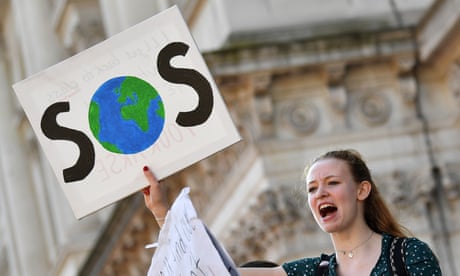
Millions of people demonstrated across the world yesterday demanding urgent action to tackle global heating, as they united across timezones and cultures to take part in the biggest climate protest in history.

In an explosion of the youth movement started by the Swedish school striker Greta Thunberg just over 12 months ago, people protested from the Pacific islands, through Australia, across-south east Asia and Africa into Europe and onwards to the Americas.

For the first time since the school strikes for climate began last year, young people called on adults to join them – and they were heard. Trade unions representing hundreds of millions of people around the world mobilised in support, employees left their workplaces, doctors and nurses marched and workers at firms like Amazon, Google and Facebook walked out to join the climate strikes.

Global climate strike: Greta Thunberg and school students lead climate crisis protest – as it happened

In the estimated 185 countries where demonstrations took place, the protests often had their individual targets; from rising sea levels in the Solomon Islands, toxic waste in South Africa, to air pollution and plastic waste in India and coal expansion in Australia.

But the overall message was unified – a powerful demand for an urgent step-change in action to cut emissions and stabilise the climate.

The demonstrations took place on the eve of a UN climate summit, called by the secretary general, António Guterres, to inject urgency into government action to restrict the rise in global temperatures to 1.5C, as agreed under the 2015 Paris agreement.

How the climate strike travelled around the world - videoCarbon emissions climbed to a record high last year, despite a warning from the UN-backed Intergovernmental Panel on Climate Change that there is little more than a decade left to act to slash emissions and stabilise the climate.

Sign up to the Green Light email to get the planet's most important stories


Read more

Donald Trump will be at the UN headquarters during Monday’s key summit on the climate crisis – but will be there to take part in a meeting on religious freedom instead, in what will be seen by many as a snub.

On Friday, the voices of key political leaders were noticeable by their absence. Instead it was a day for people to set forth their demands, ranging from a ban on new mining in countries like South Africa and Australia, to a “green new deal” in the UK and US to better air quality and more trees in countries like India.

“We are out here to reclaim our right to live, our right to breathe and our right to exist, which is all being denied to us by an inefficient policy system that gives more deference to industrial and financial objectives rather than environmental standards,” said Avinash Chanchal, a young protester in Delhi.

Asia-PacificThe action began in the Pacific Islands, where citizens have repeatedly asked wealthier nations to do more to prevent rising sea levels. Over the course of the day children and students from Fiji, Samoa, Vanuatu, Kiribati, Tuvalu, Marshall Islands, Tonga, New Caledonia, the Solomon Islands and Papua New Guinea took part in poetry performances, silent protests, sporting events and discussions. Students held placards in Kiribati and chanted: “We are not sinking, we are fighting.”

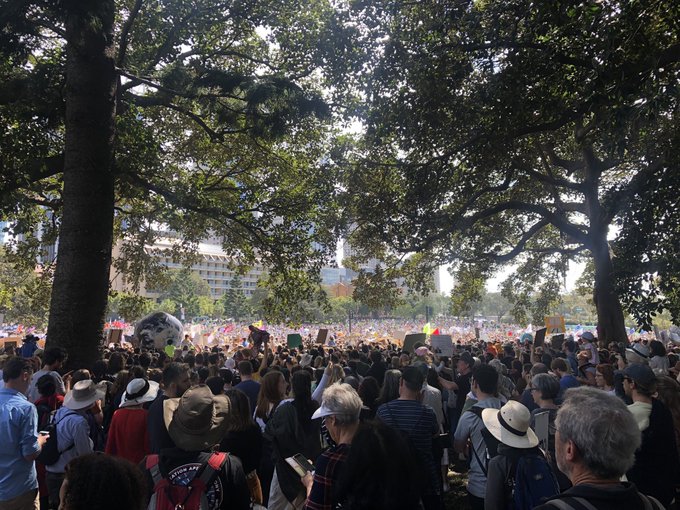
The demonstrations spread across Australia – the world’s biggest exporter of coal and liquid natural gas – where more than 300,000 people took to the streets in 100 rallies, prompting a tweet from Thunberg – awake in New York – that the “huge crowd” would set the standard.


Greta Thunberg

?@GretaThunberg


Incredible pictures as Australia’s gathering for the #climatestrike
This is the huge crowd building up in Sydney.
Australia is setting the standard!
Its bedtime in New York...so please share as many pictures as you can as the strikes move across Asia to Europe and Africa!


37.4K

7:28 PM - Sep 19, 2019
Twitter Ads info and privacy


10.8K people are talking about this


The Australian finance minister, Mathias Cormann, had said on Thursday that students should stay in class rather than go on strike.

In a retort, Danielle Porepilliasana, a Sydney high school student said: “World leaders from everywhere are telling us that students need to be at school doing work. I’d like to see them at their parliaments doing their jobs for once.”

In Tokyo, hundreds of students and environmental activists marched through the business and shopping district of Shibuya, chanting “Climate Justice!” while holding hand-painted placards made of cardboard with messages such as “Go Green,” ‘‘Save the Earth,” and “the Earth is on fire.”


FacebookTwitterPinterest
Protests in Melbourne. Photograph: Asanka Ratnayake/Getty ImagesSmaller rallies were held in more than a dozen cities around Japan, including Kyoto.

No protests were authorised in China, the world’s biggest source of greenhouse gas emissions, but Zheng Xiaowen of the China Youth Climate Action Network said Chinese youth would take action one way or another.

“Chinese youth have their own methods,” she said. “We also pay attention to the climate and we are also thinking deeply, interacting, taking action, and so many people are very conscientious on this issue.”

There was action, however, in Taiwan, where dozens of representatives from primary schools, high schools, and universities gathered in the capital, Taipei, to launch a petition to press candidates in the upcoming presidential election to lay out concrete policies to mitigate climate change risks.

In Thailand, hundreds of young people demonstrated outside the environment ministry in Bangkok and dropped to the ground feigning death.

“We are the future and we deserve better,” said 12-year-old Ralyn ‘Lilly’ Satidtanasarn – who has been dubbed “Thailand’s Greta” for her campaign against plastic bag use in a country where each person uses 3,000 throwaway bags a year.

In India’s capital Delhi, where the suffocating air pollution was the target of the demonstration, Rishika Singh, 18, said: “It’s the poorest who suffer the most. The rich are better off – they make the use of air conditioning and private cars for comfort.”


FacebookTwitterPinterest
Students and activists hold placards with messages as they participate in a Global Climate Strike rally in New Delhi. Photograph: Anushree Fadnavis/ReutersAn armoured personnel carrier was deployed in the Afghan capital, Kabul, to protect about 100 young people as they marched, led by a group of young women carrying a banner emblazoned with “Fridays for Future”.

Fardeen Barakzai, one of the organisers and head of the local climate activist group, Oxygen, said: ”We want to do our part. We as the youth of our country know the problem of climate change.”

AfricaIn Kenya’s capital Nairobi some young protesters wore hats and outfits made from plastic bottles to highlight the dangers of plastic waste, a major threat to people living in the developing world.

Strikes took place in several Nigerian cities, including Lagos, which is often beset by formidable quantities of toxic waste including thousands of tons of e-waste from the EU.

“Leaders should listen to what the climate scientists are saying. No leader should forfeit the future of younger generation,” said Oladosu Adenike, an activist in the Fridays4Future campaign in Nigeria.

A small but noisy crowd gathered in the financial district of Sandton in Johannesburg, outside the offices of Sasol, a huge South African energy and chemical company.

“We don’t really have a way out of this,” said Natalie Kapsosideris, 16. “The future looks really dismal at this point. There’s not going to be a lot of food available, there will be droughts, floods, natural disasters. The fact that Sasol gets away with stealing our future from us … and it’s all because they want to make money.”

EuropeDemonstrations took place in most European countries, with huge crowds in Warsaw, Poland and more than 1.4 million people taking action across Germany. In Berlin, demonstrators blocked roads and protested outside the German chancellery. In response, Angela Merkel announced a €50bn package of new measures to curb carbon emissions and review progress towards reaching its climate goals by 2030.

Merkel said that as a scientist she had been impressed by Thunberg’s motto “unite behind the science”.

“The chances are very good, they have grown, that we will reach our climate goals this time,” Merkel said. “If we should realise we’re not on track, then we will correct this.”

In Brussels one rather poetic placard read: “Respect existence or Expect resistance!”

Thousands took to the streets in Dublin. Luke Corkery, a university student, said in a tweet: “Blown away … This is a movement led by young people across the globe. We’re not just looking for an excuse for a day off school or college; we’re standing up for the future of our planet.”

AmericasThe global protest culminated in New York which was anticipating one of the largest climate strikes. Education chiefs in the city gave every one of the 1.1 million children in its schools permission to attend the climate strike and hear Thunberg speak at a rally at the United Nations headquarters.

“Greta! Greta! Greta!” the crowd chanted as she took to the stage.

The 16-year-old directed her speech to the students in the crowd, though she acknowledged that adults also skipped worked to strike.

“We will do everything in our power to stop this crisis from getting worse, even if it means skipping school or work, because this is more important,” she said. “Why should we study for a future that is being taken away from us?”

She sparked laughter when she described all the politicians she had met who asked for selfies and “tell us they really, really admire what we do” yet have done nothing to address the climate crisis. “We demand a safe future. Is that really to much to ask?”

It was estimated that more than 250,000 people turned out for the protests in New York, with thousands more demonstrating in Boston, Miami and San Francisco.

In Mexico City, protesters chanted “Se ve, se siente, la tierra está caliente” – “You see it, you feel it. The earth is getting hotter.” In Brazil, where recent fires in the Amazon have drawn attention to the climate emergency, students attended protests in Rio de Janeiro, São Paulo and the capital Brasília.

