I Ignored The Urgency Of Addressing Climate Change. Then My House Caught On Fire.
huffpost.com
0/13/2019 09:00 am ET
Ilgin Yorulmaz
huffpost.com
MIGUEL SOTOMAYOR VIA GETTY IMAGES
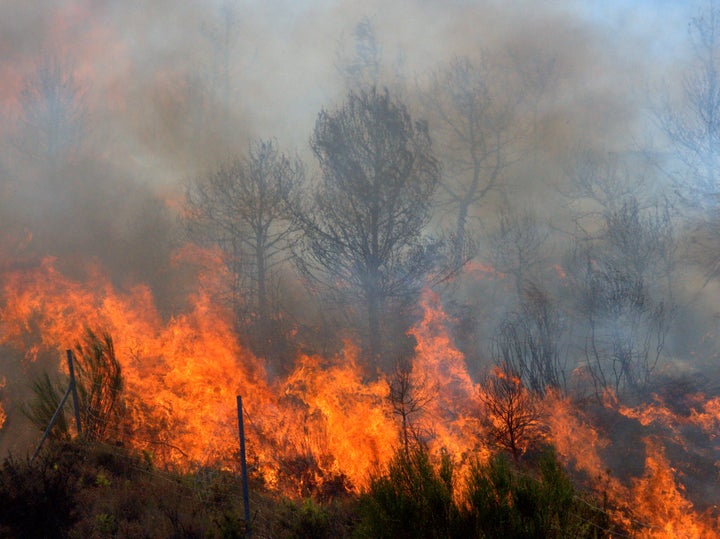
The home belonging to Ilgin Yorulmaz’s family in western Turkey barely survived a massive forest fire last month.
Growing up in the dangerously politicized environment of Turkey in the 1980s, I was far from an activist for any cause. In fact, like so many others of my generation who had seen the worst of political violence in those turbulent years of my home country’s history, I tried to avoid actively engaging in any political or social issues — and that included environmentalism.
In college, I thought of the environmentalists around me as an entitled minority, some of whom were rich elites who had everything, while a few seemed to be sincerely looking for a purpose in life. Others I dismissed then as hard “lefties” with impossible green agendas that did not appeal to me as an educated, middle-class graduate with corporate world ambitions.
Years went by and I had kids. While I was never an outright denier of climate change, I never fully understood the gravity and urgency around carbon emissions or the melting ice caps — threats that felt so far away. In short: I was ignorant.
Over the course of this past summer, three things happened that forced me to finally face reality.
Last month, my family’s house in the pine forests of Urla near the village of Demircili by the Aegean Sea in western Turkey barely survived a massive forest fire.
It started after the power lines above the forest became overheated in temperatures that were higher than normal. I watched in horror as the firefighters tried to control the flames ignited by the sparks of young pinecones that jumped hundreds of meters like loose cannons.
The flames ultimately reached the border of our compound next to the village. While the anxious villagers attempted to extinguish the flames, my neighbors hosed the soil with water to dampen the fire, which eventually died down. (Just weeks after this incident, I would read about the devastating Amazon fires ? 70,000 of them — and remember the day our own house was literally on fire.)
Then came the shocking images of deforestation carried out by a Canadian mining company near Mount Ida (or Kaz Mountains in Turkish) — a legendary mountain referenced in Homer’s “The Iliad” and “The Odyssey” — in the province of Çanakkale in northwestern Turkey.
Neither raging fires at my doorstep nor threats of cyanide leaks had delivered a message like the one that came to me much later — and yet, far too late ? as I observed millions of angry young activists march in a Global Climate Strike across three different time zones.
My mother’s side of our family hails from Çanakkale, and I spent my childhood in the working-class town of Çan in the mountains where Alamos Inc. was now thrashing to find gold. I witnessed local activists holding what they called a “Vigil for Water and Conscience” for days on end and fiercely protesting the possible contamination of their water by the cyanide solution that Alamos was planning to use to extract gold from its ore. The local dam provides water to over 180,000 people in that region and irrigates over 5,000 hectares of land. A cyanide leak would be deadly for any living organism in that area.
But neither raging fires at my doorstep nor threats of cyanide leaks had delivered a message like the one that came to me much later — and yet, far too late ? as I observed, from 4 a.m. to 4 p.m. on Sept. 20 millions of angry young activists march in a Global Climate Strike across three different time zones. It shook me to the core.
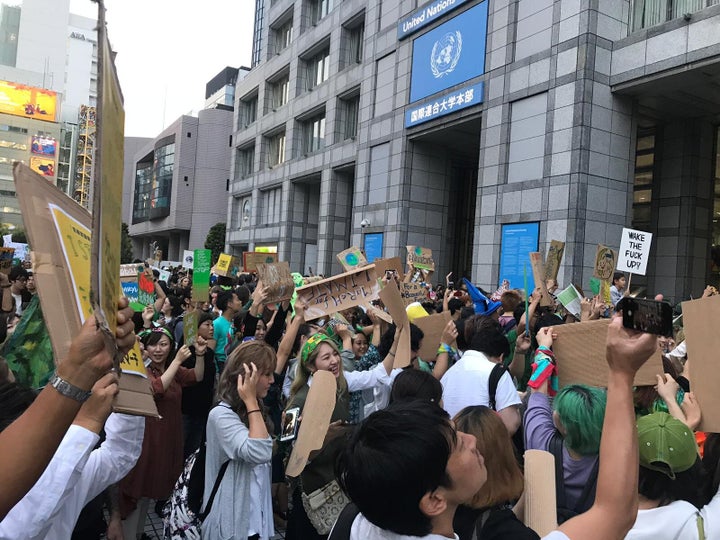
Prior to my departure for New York to visit my 18-year-old college-student daughter in mid-September, I had followed Japanese teenager Takuro Kajiwara and his friends from Fridays for Future Tokyo — the Japanese arm of the environmental movement inspired by 16-year-old Greta Thunberg of Sweden — prepare to protest in front of the United Nations University in Tokyo. Among them was my 13-year-old son.
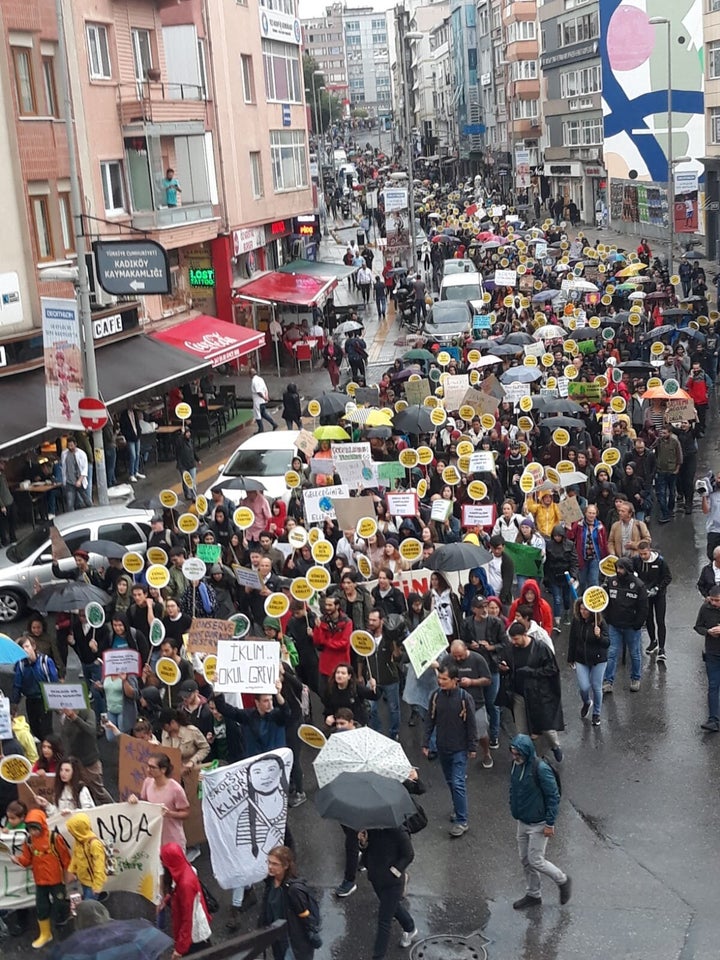
Six hours later, I connected to Istanbul and watched online as 12-year-old Atlas Sarrafoglu of SifirGelecek.com (Fridays for Future Turkey’s platform) mourn the death of 13-year old Berivan Karakeçili, who had been forced by her employers to continue picking in the fruit orchards in the southern Turkish city of Antalya when she was killed by an airborne roof during a freak tornado.
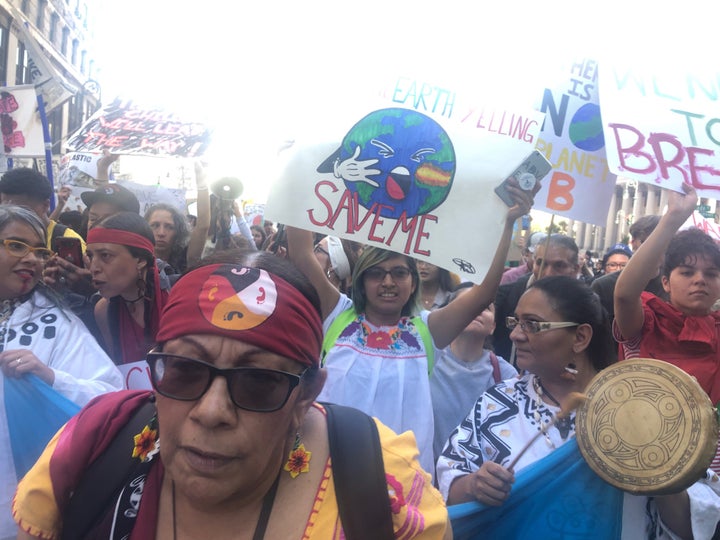
Finally, in New York, I marched together with 14-year-old Alexandria Villaseñor, the co-founder of the Earth Uprising movement, and listened to her introduce Thunberg to the 250,000 young people gathered at the Battery Park rally in the final leg of my climate marathon day.
It was there that Thunberg asked us adults that day (and again in her widely circulated speech at the U.N. Global Climate Summit two days later) why, despite already knowing so much about climate change and its impact, did my generation stall on taking action to fight it?
COURTESY OF KAYRA YORULMAZ
Activists protesting outside of the United Nations University in Tokyo on Sept. 20.
I have spent all of my life between Turkey and Japan. These two countries have relatively low levels of awareness of and interest in environmental issues, as well as very different economic growth histories.
Up until the 1990s, many of us Turks didn’t recognize the impact a plastic bag had on the environment and were still using our grandmas’ bags (known as “filé” in Turkish) to carry our purchases home from the market. In the years to come, most of us have deserted these local markets to shop at the American-style malls that spread throughout the country as the current government incentivized a construction boom and encouraged consumption under the pretense of “economic growth” — all at the expense of the environment.
Fortunately, shoppers in Turkey are now charged for plastic bags, but at 25 kurus (5 cents), the bags are so cheap that many continue using them despite knowing their damage on the environment.
I must confess that I, too, was drawn to this newfound consumerism during my youth spent in Turkey and, later, as a young adult working in the post-bubble Japan in the late ’90s. I simply could not see or acknowledge the changes coming and the alarm bells ringing in all corners of the world I was jetting to as an expat. But the signs were certainly there.
Take the increasingly volatile weather.
In Japan, where I now live, we don’t even have a direct phrase translation for climate change, and instead use the phrase “extraordinary weather conditions.” This year, it rained nonstop for a full month during tsuyu (monsoon season). Torrential rains triggered landslides so bad that the Japanese government had to evacuate 1.1 million people from the southernmost island of Kyushu.
It breaks my heart to think that my generation all around the world could have and should have done more.
COURTESY OF NIL SARRAFOGLU
Climate change activists marching in Istanbul on Sept. 20.
Having family living on three different continents, I still fly quite often. As an example of utter irony, my carry-on bag, which travelled with me for 6,736 miles to New York and back, has a sticker that reads “Combat Climate Change.” Even at the local farmers’ market in New York’s Upper West Side, where I went for shopping on a sunny Friday morning, I was upset to observe supposed environmentally conscious farmers placing two tomatoes in a massive plastic bag.
Similarly, at my local supermarket in a posh district of Tokyo, a single apple is packaged up in plastic without much concern.
Owing to local governments’ sorting rules, which are some of the strictest in the world, Japan recycles most of its plastic waste: Council for PET Bottle Recycling puts the figure close to 85% in 2017 – one of the highest in the world. But like Takuro-kun asked me during our conversation in Tokyo: “Wouldn’t it be better if you didn’t use plastics in the first place?”
Meanwhile, in Turkey, this year’s climate-themed Istanbul Biennale is titled the “Seventh Continent,” which is a reference to the island of plastic floating adrift in the Pacific Ocean. The event’s main sponsor is none other than the Koç Holding — one of Turkey’s biggest conglomerates and, with the oil giant Shell, owner of the top two oil refineries in Turkey, Tüpras and Petkim. While Koç should be applauded for their sponsorship, it should be noted that they also own Tofas, Turkey’s largest manufacturer of cars and trucks running on, of course, fossil fuels.
Other members of my generation, some of whom are political leaders in their countries, are also largely in denial of the urgency these kids, like Thunberg and Takuro-kun, want to emphasize. Take the Alamos gold mining controversy this past summer, where a Turkish government spokesman said that the mine was not even “technically” located in Mt. Ida, and that cyanide would not be used ( Alamos’ website says otherwise.)
COURTESY OF ILGIN YORULMAZ
Protesters marching in New York City on Sept. 20.
Again and again these kids say that they want to be part of the solution, not the problem. New protests are being planned as we speak, leading up to and beyond the U.N.’s Santiago Climate Change Conference in Chile in December. I am dreading that after the streets clear and the protest posters are discarded, older generations will continue “business as usual.”
As for me, I now carry my own shopping bag and no longer have to wonder where to dispose those ugly plastic bags once I’ve used them. I carry my thermos everywhere so that I no longer feel ashamed of the plastic water bottle I used to carry out in public.
I am more worried than ever about my carbon footprint and try not to fly unless necessary — opting instead for public transportation. I am no Earth scientist, but I began to follow No Fly Climate Sci, the online community of academics who go to lengths to reduce their carbon footprints. I have not yet abandoned eating meat altogether, but living in Japan means we have an abundance of seafood ? as long as we adhere to sustainable fishing, of course.
At home, I try (with great futility) to convince my husband, an avid Amazon Prime customer, to reduce his online purchases. (At the time of this article, Amazon founder Jeff Bezos pledged the company would become carbon-neutral by 2040 — 10 years ahead of the 2050 deadline set forth by the Paris Agreement.)
It breaks my heart to think that my generation all around the world could have and should have done more.
Next time I’m in Turkey, I also plan to convince my two business partners to build solar panels to generate electricity in a field we own near our village residence on the Aegean coast. I’m actually dreaming of moving there eventually to lead a self-sufficient life. As my back-to-the-earther hero, the late John Seymour, said, “Self-sufficiency is not being backwards and grubbing for our food with primitive implements. It’s going forward to a new and better sort of life. ... It means the acceptance of complete responsibility for what you do or what you do not do.”
Still, will it be enough to reverse our man-made climate disaster?
Before Sept. 20, I was convinced that we were past the point of no return, as Jonathan Franzen has recently suggested. I felt panicked and didn’t know what to do. But now, I have hope. The youth of today have spoken loud and clear and it’s long past time we listened to them.
One sign, carried by a young girl at the climate march, especially comes to mind: “Clean up your s**t. The world isn’t Uranus.” |



