SI
SI
discoversearch

We've detected that you're using an ad content blocking browser plug-in or feature. Ads provide a critical source of revenue to the continued operation of Silicon Investor.  We ask that you disable ad blocking while on Silicon Investor in the best interests of our community.  If you are not using an ad blocker but are still receiving this message, make sure your browser's tracking protection is set to the 'standard' level.
Politics : Formerly About Advanced Micro Devices -- Ignore unavailable to you. Want to Upgrade?


To: D.Austin who wrote (1197052)1/29/2020 11:41:23 AM
From: Brumar89  Respond to of 1575617
 
Doesn't it make sense? Trumpsters should all boycott Mexican beer, tequila, etc. Only American made white lightning. Do you want Americans to do from furrin viruses?

breakingburgh.com


To: D.Austin who wrote (1197052)1/29/2020 11:47:03 AM
From: Brumar89  Respond to of 1575617
 
Navy SEAL Promoted After Choking Green Beret to Death

“He should have never been promoted. The investigation was started right away. They whisked them out of there as fast as they could,” a former general says.

Kevin Maurer
Updated Jan. 28, 2020 8:37PM ET / Published Jan. 28, 2020 8:06PM ET


Photo Illustration by The Daily Beast / Photos Getty

The U.S. Navy promoted Chief Petty Officer Tony DeDolph four months after he admitted to choking a Green Beret to death.

DeDolph—who will be back in court Thursday for a preliminary hearing—was formally charged in November 2018 with felony murder, conspiracy, obstruction of justice, burglary, hazing, and involuntary manslaughter in the strangulation death of Army Staff Sgt. Logan Melgar, a Special Forces soldier assigned to the 3rd Special Forces Group.

Melgar was nearing the end of his deployment when he was killed in the West African nation of Mali in June 2017. He was part of an intelligence operation in Mali supporting counterterrorism efforts against al Qaeda’s local affiliate, known as al Qaeda in the Islamic Maghreb.

Days after Melgar was strangled, DeDolph, at the time a petty officer first class, was sent back to his base in Virginia Beach under suspicion of murder. Despite that, DeDolph found himself on the promotion list for chief petty officer in August 2017; he was “frocked”—meaning he began wearing the insignia of the higher rank—on Sept. 15, 2017, according to defense officials. He didn’t start drawing chief’s pay until December.

Three days before DeDolph’s promotion, the medical examiner’s report was signed. It concluded, based on a June 8, 2017, autopsy at Dover Air Force Base, that Melgar’s cause of death was asphyxiation and the manner of death was homicide, according to documents reviewed by The Daily Beast.

A defense official familiar with the case said Naval Special Warfare Development Group, commonly known as Seal Team 6, didn’t flag DeDolph because he was not formally charged or a person of interest in an ongoing investigation. He was a participant in the investigation but no charges were filed until November 2018.

Retired Brig. Gen. Donald Bolduc, the former commander of Special Operations Command-Africa, told The Daily Beast this week that he authorized an investigation after he learned of Melgar’s death. Bolduc alerted Army Criminal Investigation Command and told commanders in Mali to preserve evidence. He didn’t understand why DeDolph was promoted when he returned to his unit in Virginia Beach.

“It is another failure of leadership,” Bolduc said. “I mean senior leadership. It’s unfortunate. He should have never been promoted. The investigation was started right away. They whisked them out of there as fast as they could.”

When asked if he was surprised by the news, Bolduc said no.

“I’m disappointed,” he said. “But not surprised. It’s utter bullshit.”

“I’m disappointed. But not surprised. It’s utter bullshit.”
— Retired Big. Gen. Don Bolduc

Navy prosecutor Lt. Cmdr. Benjamin Garcia declined to comment on the promotion because DeDolph is part of an ongoing investigation.

“DeDolph has remained a member of Naval Special Warfare throughout this process,” said Navy Capt. Tamara Lawrence, a spokeswoman for Naval Special Warfare. “It is paramount that the rights of the service member are protected, thus any additional information regarding this case will not be discussed.”

Phil Stackhouse, DeDolph's civilian attorney, did not return calls or text messages seeking comment. Melgar’s idow, Michelle, declined to comment on the story.

DeDolph’s case is just one of several high-profile incidents that have exposed issues in the SEAL culture. Members of SEAL Team 7 were expelled from Iraq in 2019 after allegations of drinking and sexual assault. Six SEALs tested positive for cocaine last year. Then there’s the case of Chief Special Warfare Operator Edward Gallagher, a former member of SEAL Team 7, who faced a court martial for war crimes charges including murder, but was convicted of posing for a picture with a dead body and granted clemency by President Trump in November 2019.

Trump Wants Absolved War Criminals on Campaign Trail

Spencer Ackerman, Asawin Suebsaeng


[ They're talking about PARDONED war criminals, not actually absolved ones. Trump campaigned on promises to order troops to commit war crimes and promised they'd obey those orders, because he's a big man or something. ]


Some of the same issues were present in Mali, where there was widespread alcohol use, partying, and prostitutes at the safehouse, according to sources familiar with the investigation. “It was like a frat house,” one source said, when asked to describe what the safe house in Bamako was like.

In response to the recent incidents, Rear Adm. Collin Green, head of Naval Special Warfare Command, sent a memo last year to his subordinate units declaring the whole SEAL community has a problem.

“Some of our subordinate formations have failed to maintain good order and discipline and as a result and for good reason, our NSW culture is being questioned,” Green wrote in the July 2019 memo. “I don’t know yet if we have a culture problem, I do know that we have a good order and discipline problem that must be addressed immediately.”

Gen. Richard Clarke, the head of Special Operations Command, ordered an ethics review last August following several high-profile incidents. He acknowledged in a memo to service members on Tuesday that “unacceptable conduct” had been allowed to occur as a result of “lack of leadership, discipline and accountability.” The 71-page report summing up the ethics review warned of what Clarke described as an emphasis on “force employment and mission accomplishment over the routine activities that ensure leadership, accountability, and discipline.”

Chief Petty Officer Adam C. Matthews, who was in Mali doing an assessment of the mission there, testified in August he felt it was his duty to haze Melgar—on DeDolph’s recommendation—to teach him a lesson after Melgar “ditched” the team in Mali’s capital city of Bamako on his way to a party at the French embassy.

DeDolph, Matthews and two Marine Raiders—Gunnery Sgt. Mario Madera-Rodriguez and Staff Sgt. Kevin Maxwell—spent the rest of the night plotting to choke Melgar into unconsciousness, pull his pants down and videotape the incident and then show it to him later to embarrass him. When Melgar became unresponsive, Matthews and DeDolph tried to resuscitate Melgar with CPR and opened a hole in his throat. The SEALS with Sergeant First Class James Morris, Melgar’s supervisor, then rushed Melgar to a French medical facility, where he was pronounced dead. At the clinic, DeDolph admitted to an embassy official he choked Melgar, according to NBC News and subsequent reports.

Maxwell and Matthews have already pleaded guilty in exchange for plea agreements with prosecutors. Matthews, 33, pleaded guilty to hazing and assault charges and attempts to cover up what happened to Melgar. He was sentenced in May 2019 to one year in military prison. Maxwell, 29, was sentenced to four years of confinement after pleading guilty in connection with Melgar’s death in June 2019.

DeDolph and Madera-Rodriguez are the last of the four men who carried out the attack to stand trial. Both men are expected to face courts martial this spring. An exact date has not been selected, according to Navy officials.

thedailybeast.com


To: D.Austin who wrote (1197052)1/29/2020 11:51:54 AM
From: Brumar891 Recommendation

Recommended By
pocotrader

  Respond to of 1575617
 
Democrats Preparing for ‘Bad Faith’ Transition if Donald Trump Loses

HOSTILE TAKEOVER
Barbie Latza Nadeau Correspondent-At-Large
Published Jan. 29, 2020 6:50AM ET

[ I'd expect Trump to leave a big pile of crap in middle of his desk, and leave the White House looted and vandalized. Can you even imagine the Trump's welcoming the Biden's to the White House like the Obama's welcomed the Trumps? Of course not. ]


Leah Millis/Reuters

The good-government group Partnership for Public Service has confirmed it is already appealing to Donald Trump and key Democratic frontrunners to start thinking about transition planning, nine months before the upcoming election. According to a report by Politico, several Democratic candidates, including Elizabeth Warren, are already ahead of the game to ensure a smooth transition. “This will be no ordinary transition between administrations,” Warren wrote in her recently unveiled transition plan. “Unlike previous transitions, we will not be able to assume good faith cooperation on the part of the outgoing administration.” Several unnamed sources interviewed by Politico expressed concern that Trump’s political team won’t meet with a new Democratic incoming team or that there will be either be an absence of paperwork, outright destruction of documents, or that what documents are left will be untrustworthy to guide the transition. “This could be the most hostile, least professional transition in American history,” a former senior official in the Barack Obama administration told Politico. “And the new administration will have to spend the early period—when it should be hitting the ground running—unearthing buried bodies.”


To: D.Austin who wrote (1197052)1/29/2020 12:08:39 PM
From: Brumar891 Recommendation

Recommended By
pocotrader

  Respond to of 1575617
 
Trump's SEAL

Ugly, ugly stuff.
SAN DIEGO — A retired Navy SEAL whose war crimes trial made international news has launched a video attack on former SEAL teammates who accused him of murder, shooting civilians and who testified against him at his San Diego court-martial in June.

In a three-minute video posted to his Facebook page and Instagram account Monday, retired Chief Special Operator Edward Gallagher, 40, referred to some members of his former platoon as “cowards” and highlighted names, photos and — for those still on active duty — their duty status and current units, something former SEALs say places those men — and the Navy’s mission — in jeopardy.

Gallagher was accused of several war crimes by some of his platoon subordinates, including that he shot civilians and stabbed a wounded ISIS fighter in the neck, killing him, while in Iraq in 2017. He pleaded not guilty and was acquitted of most charges, but was convicted of posing for a photo with an Isis fighter’s corpse, a crime for which the jury reduced his rank.

The case and its fallout received extensive media coverage, especially among conservative outlets such as Fox News, where network personalities lobbied President Donald Trump on-air for months to intervene on Gallagher’s behalf.

As we already knew, Gallagher is Trump's favorite war-criminal... who has become a staple of Trump's campaign and a full-on influencer in his own right. "“Trump is a master of casting, and Gallagher is a perfect fit,” Paul Rieckhoff, the founder of Iraq and Afghanistan Veterans of America, told the Times. “He’s handsome, he’s heroic, he’s got a beautiful wife. He’s a Rambo version of the same story Trump has been telling over and over: The deep state is trying to screw you, the media is bad, and the rich people don’t understand you. But I’ll stick up for you.”


thebulwark


To: D.Austin who wrote (1197052)1/29/2020 12:17:25 PM
From: Brumar891 Recommendation

Recommended By
pocotrader

  Respond to of 1575617


Josh Dawsey

?@jdawsey1


Trump often criticizes people as entirely incompetent and untrustworthy that he once entrusted with very powerful positions, such as national security adviser, secretary of state, etc.


To: D.Austin who wrote (1197052)1/29/2020 12:33:39 PM
From: Brumar892 Recommendations

Recommended By
J_F_Shepard
pocotrader

  Read Replies (2) | Respond to of 1575617
 
Beach chairs, blankets and trash. Massive mess left after Trump's Wildwood rally.

By Chris Franklin & Tim Hawk | For NJ.com


The thousands of people who descended upon the Jersey Shore town for President Donald Trump's 'Keep America Great' rally at the Wildwoods Convention Center left behind a sea of trash in the parking lot — including their abandoned beach chairs and blankets — after the rally wrapped up.
....................
City officials said the park cleanup was the responsibility of Wildwood, while the parking lot mess was the responsibility of the convention center, which Wildwood city does not manage.

Mayor Pete Byron on Tuesday said he wasn't invited to the rally after he told NJ Advance Media he would be seeking reimbursement from the local Republican party. He had instructed all city workers to keep detailed logs of hours and expenses related to the rally. Byron did not return a request for comment early Wednesday morning.

.............


Clean up begins after President Donald Trump's "Keep America Great Rally" in Wildwood, Tuesday, Jan. 28, 2020. (Tim Hawk | NJ Advance Media for NJ.com)

Workers were seen throughout the day on Tuesday, picking up trash and emptying cans.

In the frigid January air, a group of men was moving about the night on Tuesday, not long after the streets and lots emptied out.

Lugging shovels and dressed in their orange and neon green vests and worn gloves, they walked about the parking lot, their eyes scanning the dark concrete beneath them, intensely focused as if a hawk had been tracking a field mouse.

The group of workers said they had been on the clock since 8 a.m. emptying the trash cans. Now, at 8:22 p.m., more than 12 hours into their shift, their efforts had accelerated. Nearby, was a small mountain of chairs along with an industrial-sized container of full trash bags.


But by daylight, most of the trash remained in the convention center parking lot.

Garbage cans that were scattered throughout the parking lot were overflowing. The fencing and big screens for viewing the rally were removed before 9:30 a.m.

There were discarded cans, food, signs, blankets and even an air mattress.

nj.com


To: D.Austin who wrote (1197052)1/29/2020 12:44:24 PM
From: Brumar891 Recommendation

Recommended By
pocotrader

  Respond to of 1575617
 
The White Trash Theory of Donald Trump
Nancy Isenberg's new book tells the story of a large and forgotten class of “waste people.”

By SARAH MARSHALL
July 6, 2016

Is Donald Trump a white trash icon? His hair is as teased and artificial as Dolly Parton’s; his eternally pursed lips recall Elvis’s, minus the sensuality; his orange skin suggests the kind of cosmetic mask that Tammy Faye Bakker once kept between herself and her viewers. Ten years ago, he even went so far as to gamely don a pair of overalls and perform the Green Acres theme, alongside a giggling Megan Mullally, at the Emmys.
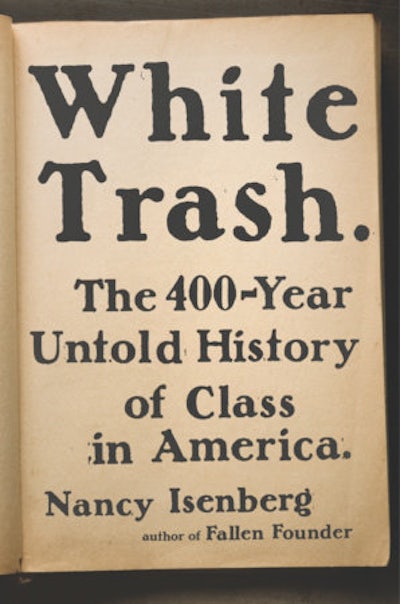


WHITE TRASH: THE 400-YEAR UNTOLD HISTORY OF CLASS IN AMERICA by Nancy IsenbergViking, 480 pp., $28.00

Today, commentators who try to make sense of Trump’s mass appeal often fall back on “white trash” signifiers, even if the term itself never rises above the level of subtext. A recent New York Times article announced that counties most likely to contain Trump supporters were also likely to be populated by mobile home residents who had no high school diplomas, worked “old economy” jobs, and listed their ancestry as “American” on the U.S. census. Trump’s public persona is the kind of brash, ball-busting bully you want on your side when you have become convinced that no one else will stand up for you. His campaign strategy may be unfamiliar to the democratic process—or at least to its public face—but he comes from a long and well-established tradition of heavies, henchmen, and block bosses. He is, in other words, the kind of leader who might well be called on by a population demographer William Frey described to the Times as “nonurban, blue-collar and now apparently quite angry.” Or, to put it in the kind of blunt terms we associate with the candidate: White trash.

If Trump’s success has indeed been driven by the “nonurban, blue-collar” and “quite angry,” then he is only exploiting a demographic that is as integral to American identity as the Founding Fathers. “The white poor,” historian Nancy Isenberg writes in her new book White Trash: The 400-Year Untold History of Class in America,

have always been with us in various guises, as the names they have been given across centuries attest: Waste people. Offscourings. Lubbers. Bogtrotters. Rascals. Rubbish. Squatters. Crackers. Clay-eaters. Tackies. Mudsills. Scalawags. Briar Hoppers. Hillbillies. Low-downers… They are renamed often, but they do not disappear. Our very identity as a nation, no matter what we tell ourselves, is intimately tied up with the dispossessed.

White Trash is a dizzying, dazzling four-hundred-year-long tour of American history from Pocahontas to Sarah Palin, seen from a vantage point that students of American history occupy all too rarely: that of the disposable citizens whose very presence disrupts what Isenberg calls our “national hagiography.”

The book’s first section is in many ways its most compelling. In it, Isenberg demonstrates that colonial America could never have existed without a large and forgotten class of “waste people”: the convicts and orphans and indentured servants who made America habitable for religious extremists and political idealists.

Isenberg’s argument is based on painstakingly supported factual analysis, and studded with narratives as horrific—and as disturbingly familiar—as that of Jamestown’s Jane Dickenson, the wife of an indentured servant. Captured by Native Americans in 1622, she was freed nearly a year later only to find that she owed an exorbitant sum to her dead husband’s master. Jane’s husband had not lived long enough to complete his period of indenture, so it was Jane’s job to work it off for him. The specter of indentured servitude itself—in which servants worked off the cost of their passage to the colonies on arrival—is chillingly familiar in an America where debt can follow us across national borders, through the decades, and even beyond the grave.

Yet perhaps even more illuminating is Isenberg’s conception of the role America played in the British imagination. From the beginning, Isenberg shows us, America was, to many Britons, not a “Citty upon a Hill” or a “Holy Experiment,” but a cesspool. “During the 1600s,” Isenberg writes, “Far from being ranked as valued British subjects, the great majority of early colonists were classified as surplus population and expendable ‘rubbish.’” When it came to disposing of the “rubbish” class, the theory went that:

Either nature would reduce the burden of the poor through food shortages, starvation, and disease, or, drawn into crime, they might end up on the gallows. Finally, some would be impressed by force or lured by bounties to fight and die in foreign wars, or else be shipped off to the colonies… Once there, it was hoped, the drones would be energized as worker bees.

Before we had a government or even a national identity, we had a foundation of disposable Americans who could best play their mandated role in society by either working or dying. But what do we do with those perverse individuals who refuse to do either? What do we do with those Americans who can neither be “energized as worker bees,” nor relied upon to relieve their country of the burden of providing for them?

“Those who fail to rise in America are a crucial part of who we are as a civilization,” Isenberg writes. Perhaps most meaningfully, they demonstrate that America is and always has been a country where one can fail to rise: A country where debt begets debt and money dries to nothing, where poverty is inescapable, and where there is and always has been liberty and justice for some.

Perhaps the most remarkable thing about Donald Trump’s campaign has been his ability to turn disenfranchised citizens into “worker bees” by alchemizing their alienation into votes. Such a class of Americans has always existed, and so has their often all too justified belief that their government is unable or unwilling to provide for their needs. Whether Trump’s success suggests an increase in this demographic’s size is ultimately less relevant than the question of why, as Americans, we remain so compelled to perpetuate a mythology that ignores our country’s very foundation—and what might happen, quite simply, if we accepted our heritage as a trash nation. Would doing so allow us to better care for the Americans we have done our best to forget?

White Trash loses some of its vitality as Nancy Isenberg leaves behind the wreckage she has handily made of early American rhetoric, and draws toward the present day. Despite her nuanced examination of such white trash icons and chroniclers as James Agee, James Dickey, Jimmy Carter, and Elvis Presley, these chapters pale in comparison to the finely-wrought destruction Isenberg wreaks on America’s founding narratives. Of all the contemporary figures Isenberg explores, however, perhaps the most revealing are those who have been able to simultaneously embody America’s white trash dreams and nightmares. Nowhere is this quality more compellingly on display than in The Andy Griffith Show, and in the show’s bitter, forgotten cousin, Elia Kazan’s 1957 film A Face in the Crowd, which Isenberg also examines.

Trump took sudden and surprising umbrage at an Apprentice contestant describing himself as “white trash.” A Face in the Crowd stars Griffith as Lonesome Rhodes, a redneck drifter who becomes first a pop culture sensation and then a down-home kingmaker, all while remaining, Isenberg writes, “a volatile mix of anger, cunning, and megalomania.” For Lonesome Rhodes, the ride ends when a hot mic reveals him to his adoring public as a crude and hateful tyrant in the making. Today, it seems that no such accident could harm Donald Trump’s, whose speeches are based less on any rhetorical tradition than on the primal scream. As long as voters believe Trump is screaming for them, and not at them, they have no reason to leave his side.

Perhaps the only accident that could hurt Trump’s numbers would be a hot mic that revealed him as thoughtful, empathetic, or even kind. So far, the closest thing we have to a moment like this might be a scene from a 2007 episode of The Apprentice, in which Trump took sudden and surprising umbrage at a contestant describing himself as “white trash.”

“You shouldn’t use that expression anymore,” Trump said, after firing the contestant. “It’s a terrible expression. It’s not a nice expression.”

If Donald Trump sees white trash as his core demographic, he isn’t telling. Doing so, after all, might mean facing the fact that his constituents are drawn to him not because they are impassioned by his message, but because they have been rendered voiceless for so long that they are happy to have anyone speak on their behalf. It might mean facing the fact that his own rise, in business and in politics, is based on exploiting others’ weakness. It might mean realizing that such a vast class of desperate, marginalized people has always existed but does not need to exist, and that, if America was “great,” there would simply be no one left to vote for him.

newrepublic.com

