Lifelong Democrat Laments: "After Attending A Trump Rally, I Realized Democrats Are Not Ready For 2020"
Authored by Karlyn Borysenko via Medium.com,
I’ve been a Democrat for 20 years. But this experience made me realize how out-of-touch my party is with the country at large.
I think those of us on the left need to take a long look in the mirror and have an honest conversation about what’s going on.
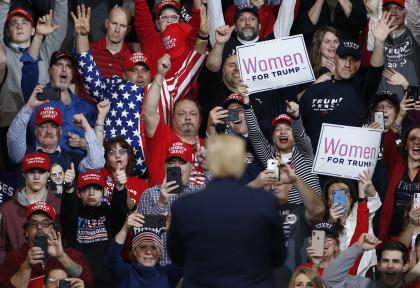
If you had told me three years ago that I would ever attend a Donald Trump rally, I would have laughed and assured you that was never going to happen. Heck, if you had told me I would do it three months ago, I probably would have done the same thing. So, how did I find myself among 11,000-plus Trump supporters in Manchester, New Hampshire? Believe it or not, it all started with knitting.
You might not think of the knitting world as a particularly political community, but you’d be wrong. Many knitters are active in social justice communities and love to discuss the revolutionary role knitters have played in our culture. I started noticing this about a year ago, particularly on Instagram. I knit as a way to relax and escape the drama of real life, not to further engage with it. But it was impossible to ignore after roving gangs of online social justice warriors started going after anyone in the knitting community who was not lockstep in their ideology. Knitting stars on Instagram were bullied and mobbed by hundreds of people for seemingly innocuous offenses. One man got mobbed so badly that he had a nervous breakdown and was admitted to the hospital on suicide watch. Many things were not right about the hatred, and witnessing the vitriol coming from those I had aligned myself with politically was a massive wake-up call.
You see, I was one of those Democrats who considered anyone who voted for Trump a racist. I thought they were horrible (yes, even deplorable) and worked very hard to eliminate their voices from my spaces by unfriending or blocking people who spoke about their support of him, however minor their comments. I watched a lot of MSNBC, was convinced that everything he had done was horrible, that he hated anyone who wasn’t a straight white man, and that he had no redeeming qualities.
But when I witnessed the amount of hate coming from the left in this small, niche knitting community, I started to question everything. I started making a proactive effort to break my echo chamber by listening to voices I thought I would disagree with. I wanted to understand their perspective, believing it would confirm that they were filled with hate for anyone who wasn’t like them.
That turned out not to be the case. The more voices outside the left that I listened to, the more I realized that these were not bad people. They were not racists, nazis, or white supremacists. We had differences of opinions on social and economic issues, but a difference of opinion does not make your opponent inherently evil. And they could justify their opinions using arguments, rather than the shouting and ranting I saw coming from my side of the aisle.
I started to discover (or perhaps rediscover) the #WalkAway movement. I had heard about #WalkAway when MSNBC told me it was fake and a bunch of Russian bots. But then I started to meet real people who had been Democrats and made the decision to leave because they could not stand the way the left was behaving. I watched town halls they held with different minority communities ( all available in their entirety on YouTube), and I saw sane, rational discussion from people of all different races, backgrounds, orientations, and experiences. I joined the Facebook group for the community and saw stories popping up daily of people sharing why they are leaving the Democratic Party. This wasn’t fake. These people are not Russian bots. Moreover, it felt like a breath of fresh air. There was not universal agreement in this group — some were Trump supporters, some weren’t — but they talked and shared their perspective without shouting or rage or trying to cancel each other.
I started to question everything.
How many stories had I been sold that weren’t true? What if my perception of the other side is wrong? How is it possible that half the country is overtly racist? Is it possible that Trump derangement syndrome is a real thing, and had I been suffering from it for the past three years?
And the biggest question of all was this: Did I hate Trump so much that I wanted to see my country fail just to spite him and everyone who voted for him?
Fast-forward to the New Hampshire primary, and we have all the politicians running around the state making their case. I’ve seen almost every Democratic candidate in person and noticed that their messages were almost universally one of doom and gloom, not only focusing on the obvious disagreements with Donald Trump, but also making sure to emphasize that the country is a horribly racist place.
Now, I do believe there are very real issues when it comes to race that we as a society have yet to reckon with. I believe that everyone from every background of every gender should have equal access to opportunities, and that no one is inherently more or less valuable or worthy than anyone else. And while the 2017 protests in Charlottesville, Virginia, led to a tragedy precipitated by real racists and real nazis and real white supremacists, I started to see that those labels simply don’t apply to most people who support Trump.
But with all of this, I was still reticent to even consider attending a Trump event. I do not believe that Trump’s attitude is worthy of the highest office in the land. I abhor his Twitter. I am vehemently opposed to so many of his policies. But still, I wanted to see for myself.
I’m not going to lie, I was nervous, so I thought I would start my day in familiar territory: at an MSNBC live show that was taking place a few blocks away from the rally. I decided to wear my red hat that looks like a Trump hat but with one small difference - it says “Make Speech Free Again” - as my small protest against cancel culture. I even got a photo with MSNBC host Ari Melber while I was wearing it, just for kicks.
The funny thing about that hat is that it’s completely open to interpretation. When I wear it around left-leaning people, they think I’m talking about the right. When I wear it around right-leaning folks, they think I’m talking about the left. It’s a stark reminder of how much our own perspectives and biases play into how we view the world.
In chatting with the folks at the taping, I casually said that I was thinking about going over to the Trump rally. The first reaction they had was a genuine fear for my safety. I had never seen people I didn’t know so passionately urge me to avoid all those people. One woman told me that those people were the lowest of the low. Another man told me that he had gone to one of Trump’s rallies in the past and had been the target of harassment by large muscle-bound men. Another woman offered me her pepper spray. I assured them all that I thought I would be fine and that I would get the heck out of dodge if I got nervous.
What they didn’t know is that they weren’t the only ones I had heard from who were afraid. Some of my more right-leaning friends online expressed genuine fear at my going, but not because they were afraid of the attendees. They were afraid of people on the left violently attacking attendees. This was one day after a man had run his car through a Republican voter registration tent in Florida, and there was a genuine fear that there would be a repeat, or that antifa would bus people up from Boston for it. Just as I had assured those on the left, I told them I thought I would be fine, because we don’t really have antifa in New Hampshire.
But I’m not going to say it didn’t get to me a bit. When everyone around you is nervous for your safety, it’s hard not to question if they have a point. But it also made me more determined to see it through, because it was a stark reminder that both sides view each other exactly the same way. They are both afraid of the other side and what they are capable of. I couldn’t help but think that if they could just see the world through the lens of the other for a moment or two, it would be a stark revelation that they don’t know as much as they think they do.
So, I headed over an hour and a half before the doors were scheduled to open—which was four hours before Trump was set to take the stage—and the line already stretched a mile away from the entrance to the arena. As I waited, I chatted with the folks around me. And contrary to all the fears expressed, they were so nice. I was not harassed or intimidated, and I was never in fear of my safety even for a moment. These were average, everyday people. They were veterans, schoolteachers, and small business owners who had come from all over the place for the thrill of attending this rally. They were upbeat and excited. In chatting, I even let it slip that I was a Democrat. The reaction: “Good for you! Welcome!”
Once we got inside, the atmosphere was jubilant. It was more like attending a rock concert than a political rally. People were genuinely enjoying themselves. Some were even dancing to music being played over the loudspeakers. It was so different than any other political event I had ever attended. Even the energy around Barack Obama in 2008 didn’t feel like this.
I had attended an event with all the Democratic contenders just two days prior in exactly the same arena, and the contrast was stark. First, Trump completely filled the arena all the way up to the top. Even with every major Democratic candidate in attendance the other night, and the campaigns giving away free tickets, the Democrats did not do that. With Trump, every single person was unified around a singular goal. With the Democrats, the audience booed over candidates they didn’t like and got into literal shouting matches with each other. With Trump, there was a genuinely optimistic view of the future. With the Democrats, it was doom and gloom. With Trump, there was a genuine feeling of pride of being an American. With the Democrats, they emphasized that the country was a racist place from top to bottom.
Now, Trump is always going to present the best case he can. And yes, he lies. This is provable. But the strength of this rally wasn’t about the facts and figures. It was a group of people who felt like they had someone in their corner, who would fight for them. Some people say, “Well, obviously they’re having a great time. They’re in a cult.” I don’t think that’s true. The reality is that many people I spoke to do disagree with Trump on things. They don’t always like his attitude. They wish he wouldn’t tweet so much. People who are in cults don’t question their leaders. The people I spoke with did, but the pros in their eyes far outweighed the cons. They don’t love him because they think he’s perfect. They love him despite his flaws, because they believe he has their back.
As I left the rally - walking past thousands of people who were watching it on a giant monitor outside the arena because they couldn’t get in - I knew there was no way Trump would lose in November. Absolutely no way. I truly believe that it doesn’t matter who the Democrats nominate: Trump is going to trounce them. If you don’t believe me, attend one of his rallies and see for yourself. Don’t worry, they really won’t hurt you.
Today, I voted in the New Hampshire Democratic Primary for Pete Buttigieg. I genuinely feel that Pete would be great for this country, and maybe he’ll have his opportunity in the future. But tomorrow, I’ll be changing my voter registration from Democrat to Independent and walking away from the party I’ve spent the past 20 years in to sit in the middle for a while. There are extremes in both parties that I am uncomfortable with, but I also fundamentally believe that most people on both sides are good, decent human beings who want the best for the country and have dramatic disagreements on how to get there. But until we start seeing each other as human beings, there will be no bridging the divide. I refuse to be a part of the divisiveness any longer. I refuse to hate people I don’t know simply because they choose to vote for someone else. If we’re going to heal the country, we have to start taking steps toward one another rather than away.
I think the Democrats have an ass-kicking coming to them in November, and I think most of them will be utterly shocked when it happens, because they’re existing in an echo chamber that is not reflective of the broader reality. I hope it’s a wake-up call that causes them to take a long look in the mirror and really ask themselves how they got here. Maybe then they’ll start listening. I tend to doubt it, but I can hope. |



