SI
SI
discoversearch

We've detected that you're using an ad content blocking browser plug-in or feature. Ads provide a critical source of revenue to the continued operation of Silicon Investor.  We ask that you disable ad blocking while on Silicon Investor in the best interests of our community.  If you are not using an ad blocker but are still receiving this message, make sure your browser's tracking protection is set to the 'standard' level.
Strategies & Market Trends : 2026 TeoTwawKi ... 2032 Darkest Interregnum -- Ignore unavailable to you. Want to Upgrade?


To: carranza2 who wrote (154152)3/10/2020 4:51:49 PM
From: TobagoJack1 Recommendation

Recommended By
Dr. Voodoo

  Respond to of 218471
 
Did not have time to look at the issues, but this VET finance.yahoo.com which i have owned enough times and at times over long-stretch of times is no longer recognizable to me

Nuts, for a 2 billion dollar royalty company that pays out every month.

The beast fell so far so fast that the option market did not even have time to adjust to new reality and have puts below the current share price


To: carranza2 who wrote (154152)3/10/2020 5:19:53 PM
From: TobagoJack  Read Replies (2) | Respond to of 218471
 
Dunno, but now that i have a direct though at-distance stake in oil industry i read up different opinions

edition.cnn.com

Why Russia and Vladimir Putin are waging an oil war with America

New York (CNN Business) — Vladimir Putin knows America's fragile oil industry is built on a mountain of debt. So when Saudi Arabia called for production cuts to mitigate oversupply, Putin decided to pounce.

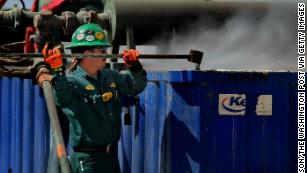
Russia shocked the world last week by blowing up its shaky alliance with OPEC. Moscow's refusal to join with the cartel is aimed in part at drowning US shale oil companies that rely on higher prices in a sea of cheap crude.

Putin's goal is to wrest market share back from American frackers, whose debt-fueled growth caused Russia to lose its title in 2018 as the world's largest oil producer.
Russia's strategy seems to be targeting not simply US shale companies -- but the coercive sanctions policy that American energy abundance has enabled."

RBC Capital's Helima Croft


"This is a response to try to cripple the US shale industry," said Matt Smith, director of commodity research at energy research firm ClipperData.

Oil prices crashed Monday after Saudi Arabia said it would slash oil prices, launching a ferocious response against Russia's move. US crude plummeted 26%, its worst day since 1991, to a four-year low of $31.13 a barrel.

Crude is now so cheap that many US shale companies will be forced to cut production. Bankruptcy fears are already rippling through the oil patch, sending the SPDR S&P Oil & Gas ETF ( XOP) to its lowest price on record going back to 2006.

Shares of major oil companies like ExxonMobil ( XOM) and Chevron ( CVX), whose business models were built to withstand cheap crude, each plunged 12%. Exploration and production companies got clobbered, with Pioneer Natural Resources ( PXD) down 37% and debt-ridden Occidental Petroleum ( OXY)losing 52%.
The energy meltdown threatens to cause a repeat of the 2014-2016 oil crash that bankrupted dozens of American oil and gas companies and caused hundreds of thousands of layoffs. Although the industry survived, the experience proved to be very painful.

"Russia sees US shale as particularly vulnerable at the moment," said Ryan Fitzmaurice, energy strategist at Rabobank. "It is our view that Russia was targeting debt-laden US shale producers."

'Caught in the crossfire'

Saudi Arabia retaliated to Russia's gambit by launching a price war over the weekend. The kingdom slashed its April official selling prices by $6 to $8 and pledged to dramatically ramp up production, exactly the opposite of what's needed.

Saudi Aramco vowed Tuesday to pump 12.3 million barrels per day in April. Not only is that 27% above recent levels, but it would exceed the company's maximum capacity by 300,000 barrels. In other words, Aramco is going all-out.
"There is a staring contest between the Russia and Saudis, and everybody else is getting caught in the crossfire," said Michael Tran, director of global energy strategy at RBC Capital Markets.

It's no secret that Russia and its oil companies have grown impatient with OPEC's efforts to rebalance the oil market. For years, Russia has joined OPEC in cutting production to put a floor beneath oil prices. Yet each production cut forced Russia to cede market share to America's booming energy industry -- much to the ire of Russian oil executives.

Rosneft, Russia's state-owned oil company, called the OPEC alliance "masochism" that allowed US shale oil to thrive.

"By yielding our own markets, we remove cheap Arab and Russian oil to clear a place for expensive US shale oil and ensure the effectiveness of its production," a spokesperson for Rosneft said on Sunday, according to state media.

Payback for sanctions?

Beyond the market share battle, analysts said that Russia could be retaliating for Washington's recent campaign of energy sanctions -- penalties made possible by the shale oil revolution.

For instance, just three weeks ago the Trump administration announced sanctions against a subsidiary of Rosneft in response for its support of the Maduro regime of Venezuela.
"Russia's strategy seems to be targeting not simply US shale companies --but the coercive sanctions policy that American energy abundance has enabled," Helima Croft, head of global commodity strategy at RBC Capital Markets, wrote in a note to clients Monday.

Croft said that Igor Sechin, the CEO of Rosneft and a close Putin confidante, appears to have convinced Moscow to take on the US shale industry.

"Like Putin, Sechin hails from the Russian intelligence services and is a strong nationalist," Croft wrote. "Undercutting American energy dominance therefore most likely appeals not only to his bottom line but also to his ideological affinities."

Putin also has a big financial advantage over Saudi Arabia. Russia relies on oil revenue for only 37% of its budget, compared with 65% for the kingdom, according to Argus Global Markets. Analysts said Russia can balance its budget at just $42 a barrel oil, compared with around $80 for Saudi Arabia.
"Everybody will be hurt by this, including Russia," said Bjornar Tonhaugen, head of oil markets at Rystad Energy. "The extra benefit from this decision is that it will of course hurt others, including the US."

Officials in Washington have taken note of the chaos in the energy market.

The Energy Department said in a statement Monday evening that "state actors" are attempting to "manipulate and shock" oil markets. However, the administration expressed confidence that the United States "can and will withstand this volatility."

During a meeting on Monday with Russian ambassador Anatoly Antonov, US Treasury Secretary Steven Mnuchin "emphasized the importance of orderly energy markets."

'Horror movie' for America's oil industry

Whatever is fueling the motivation, the oil price war couldn't have come at a worse time for an industry already suffering from a bear market in crude.

Big Oil has been shunned by investors for years because of persistent supply gluts, excessive spending and rising climate change concerns. The energy sector was the biggest loser in the S&P 500 last year as well as for all of last decade. And the sector is leading the way lower during the recent market mayhem.
The coronavirus has posed an even deeper challenge to the oil industry. Countless flight cancellations, factory closures and a slowdown in commuting has seriously weakened the world's appetite for oil. Global oil demand is expected to drop this year for the first time since 2009, according to the International Energy Agency.
"The last two months have been a horror movie for energy investors," Stewart Glickman, energy analyst at CFRA Research, wrote in a note to clients Monday. "We have both a demand shock (coronavirus) and a supply shock (OPEC-Plus breakdown) happening at the same time. In other words, two boogeymen, not one."

Who will blink first?

That frightening backdrop explains why more than just oil companies are tumbling. Banks with heavy ties to the energy sector got punished Monday, too, as investors brace for an inevitable wave of loan defaults.
Dallas-based Comerica ( CMA), Cullen/Frost Bankers ( CFR) and Texas Capital Bancshares ( TCBI) plunged around 20% apiece.
The shale oil companies with the weakest balance sheets will have to save cash by abandoning expensive drilling projects and furloughing their workers. Some of oil companies won't survive.

"These guys were already in pain. Now we are going to start to see bankruptcies, perhaps widespread," said ClipperData's Smith.

The big question is how long oil prices remain depressed -- and how much lower they go. And the answer could lie in Riyadh and Moscow.

A source involved in the discussions between OPEC and Russia said that efforts were being made to restore dialogue after the acrimonious rift on Friday. And speaking on state channel Russia 24, Russian energy minister Alexander Novak said the "doors are not closed" to a production agreement with OPEC in the future.

If Saudi Arabia's price war forces Russia to agree to production cuts, the oil market could quickly rebound, bringing relief to teetering shale oil companies.

But Putin is not known for backing down, suggesting the American oil industry should brace for more pain ahead.

"Hope remains that this battle will be short," RBC's Croft wrote, "but preparations are seemingly being made for a protracted war of attrition that could have brutal economic consequences for all involved."

— John Defterios and Mary Ilyushina contributed to this article.


To: carranza2 who wrote (154152)3/10/2020 8:47:54 PM
From: sense  Respond to of 218471
 
It's not like there isn't some history to consider here.

The Saudi's have tried already... twice in my estimation... to put American shale out of business. But it is very widely agreed that the last time the Saud's opened the spigots that was their direct purpose. The effort failed... but likely would have worked, too... if not for the suddenly greater availability of loan facilities that enabled the frackers to reschedule debts and extend their planning time horizons from months to years... The time functions of the facilities that were made available helped to remove short term drivers of equity funding.

OPEC is an intentional monopoly... and it is driven by a core who coordinate and intend to exploit that monopoly power... which pre-dates fracking, of course... the first oil shock of 1973 also being tied to OPEC's agreed intent to use oil as a weapon, not just coordinate to support prices. Every time the effort in coordination struggles... as it always does when market demand slacks off and the producers cheat to sustain or grow market share... some will declare it to be the death of OPEC... which is nonsense. Then came the rise of Russia as a producer... a non-OPEC producer... enabled and supported by the west as a counterpoint to dependence on OPEC... but that also introduced new challenges, because Russia's ($, oil and power) interests in the middle east are in direct conflict with both the west's, and OPEC members, as you can see in Syria today. The wars ongoing in the region... hot and cold... are about ownership or control of the oil and gas fields... but just as much about control of the real estate in those nations that are the most obvious routes for oil and gas pipelines. Russia wants to make Europe dependent on Russian oil, not OPEC's... so they can do to Europe with oil what they''ve already done to extort Ukraine by shutting off access to energy there. The Russians want OPEC like control of Europe's energy. So, Russia has been fomenting unrest everywhere there might be a competing pipeline built to allow OPEC (or former Soviet Republic) oil to flow to Europe... to ensure the only pipeline that are completed are ones that work because of Russian protection and control.

The U.S. just succeeded in shutting down the pipeline project Russia was planning to use to accomplish that... only right before they finished it... only after letting them sink massive piles of Russian money into it. And, the U.S. has disrupted Russian designs for control over European gas by accelerating the development of LNG terminals, and changing rules to make fracked gas available to Europe. That's already been driving European energy prices down to near parity with world prices... even while the Europeans stubbornly refuse to accept the gift being handed them by refusing to build the terminals to receive the gas... that would ensure their diversity in sourcing. The lower prices... are driven by Russia... trying to prevent it working.

Look at charts for successful pure play frackers and you'll see they've survived a couple of "Perils of Pauline" type market situations already... when it wasn't at all clear that any of them would survive. Where you see big down drafts occurring... yes, they tend to overlap with "interesting" periods in the market... which doesn't mean the influences apparent are a demonstration of "free market functions" ? That's just the players in this game using the tilt of the field to advantage their inputs... so you will tend to see oil shocks occur every time the economy tips toward a demand deficit... The timing isn't an accident.

What's different this time... is that Saudi Arabia and Russia are working together to impose that impact... while trying to posture like the market imbroglio is a result of a "war" between them rather than a result of cooperation... which was absent the last time the Saudi's tried to do this on their own...

Chart for NOG gives a good picture of the timing element... with the prior downdrafts clearly indicated...


To: carranza2 who wrote (154152)3/10/2020 9:35:28 PM
From: sense1 Recommendation

Recommended By
ggersh

  Respond to of 218471
 
The logic of the situation...

Isn't logic that's driven by free market functions... but by what you always see when there are monopolists enabled in destroying free markets by altering free market underpinnings...

A free market requires "no fraud, no monopoly, and no obstacles to participation"...

But the world oil market is all about fraud ( just look at compliance with OPEC production quotas, but not seeing that as a limit ?), all about monopoly as assumed in my prior post... and all about imposing obstacles to others market participation... as I outlined in my prior post.

So, given the market reality... which is "not a free market"... what does drive the market ?

There's a conflict in interest that occurs between $ and power... and between $ and control...

If there weren't "power and control" issues involved... and it was all about the money ?

Then, what would make sense for the lowest cost producers ? Saudi's costs used to be under $10 a barrel... are probably getting closer to $18 to $25 now as: the Gwahar Field is now becoming depleted, and now exploits American technology to extend field life... the way Texas did when the easy oil ran out. That technology, now, can double the potential for extraction... but does so at higher cost over time, and it will remain a closely guarded secret... what the remaining potential is... how much they can pump flat our without doing real damage to the future potential... and how much theater is involved in sustaining the perception that Saudi can coat the world in an endless sea of cheap oil ? Gamesmanship ? You need to apply game theory to the games being played...

What would make the most financial sense, then... would be to allow the highest cost producers to set the price... so the lowest cost producers would extend the life of their resource the most, at the highest market price... as that is set by the highest cost producers.

But, the problem is... there really isn't any shortage of oil. There's only a shortage of cheap oil when the price is set at a particular price point. American frackers have disabused the market of the bogus "peak oil" concept... making it clear enough that the only "peak" involved... is a peak in prices, not supply. And, if you doubt that... note the same analysis applies to Canadian "oil sands"... which occupy the next rung higher on the price ladder... with a large enough reserve even to begin competing with coal... at the right price. But, then... why not just use coal ? There's enough coal to run the world for a very long time at low cost... even without imposing on us the need for all the drama inherent in the oil markets ? The politics of coal... of course... have nothing to do with the fiction that CO2 drives climate change... and everything to do with the geopolitics of control over the global energy markets... including controlling the diversions of profits to the "preferred" participants... who are cooperating in the political game of control... by helping to impose control.

American energy independence... disrupts the game. Not only does it put the lie to the price manipulations of low cost producers restricting deliveries to drive prices well above those that high cost producers can easily make good money from... it also disrupts the various schemes for imposing control... whether on the regional level... as you see Russia trying to impose on Europe (and on China, although no one is talking about that right now)... or on the "bigger picture" global level... in which the globallist left seeks to enable themselves in imposing world domination by structuring the "allowed" flows of $ in energy markets... to those channels they control. So, no coal allowed... but someone is going to be making a WHOLE lot of money from the totally fictional market trading in carbon credits ? LOL!!! Who is going to be the Super OPEC of the world's energy... controlling the global energy distribution with a tax... when you need a carbon credit to allow you buy or sell ?

Its still useful to keep an eye on the big picture view of things... when the noise in the mud pit where the gladiators are slogging it out... gets loud enough to distract from it. Because the distraction, created intentionally or not... is likely to be exploited...


To: carranza2 who wrote (154152)3/11/2020 5:37:47 AM
From: TobagoJack  Respond to of 218471
 
comments from Armstrong

ask-socrates.com

BlogGold & the March 2020 Rally

The gold is up about 10% this year and of course, they are calling for testing its record high of $1,900, set in 2011. Naturally, they goldbugs claim that the bullion is the anti-Christ to stocks, as investors around the world gravitate toward a sector for safe harbor. They always tout that “gold is responding to systemic financial risk” which they are now redefining as no longer inflation and quantitative easing, but more simply as financial risk, geopolitical, and the impact of Covid-19. As always, they just make up excuses to fit the movement. What they never address is the fact that during the Great Depression that they rely upon to make claims that gold rose when stocks declined, what they are oblivious to is the fact was gold was MONEY (CASH) back then because we were on a gold standard. If that reasoning were correct, then silver should have risen as well. However, silver decline from 1919 into 1932, because it was a commodity and cash, was king - or at that time gold.


It is important to understand the real reasons and not nonsense. Far too many people buy the nonsense and then lose their shirt. We are no longer on a gold standard so gold will respond like silver did during the Great Depression since it is no longer cash. The rally into yesterday touched the top of the Breakout Channel which stood at 1703.12 and the market peaked at 1704.30.

Gold was above two of our Monthly Bullish Reversals in February and then crashed for the close to avoid both. We still see that the market can test the mid-1750 level perhaps in May. But a sustained breakout would have been indicated by electing the two Monthly Bullish Reversals in February after exceeding them intraday.

We have a Directional Change this week and then the next key turning point should arrive the week of 03/23. As long as gold holds the 1445 level on a monthly closing basis, then we may yet see new highs in the May period. Keep in mind that 1699 will remain as important monthly closing resistance.

The ultimate sustainability for gold long-term is not as the anti-Christ to equities. Because we are NOT on a gold standard, we should expect gold to rise with equities as capital flees government debt on a global scale. That is when we will see gold really take off. This has nothing to do with the coronavirus or the decline in equities. Those are NOT things that will make a sustainable bull market in gold.


To: carranza2 who wrote (154152)3/11/2020 5:39:48 AM
From: TobagoJack  Respond to of 218471
 
One more Armstrong

ask-socrates.com

BlogThe Nature of the Debt Crisis

QUESTION: Martin; Am I correct this sell-off is for problems abroad, not U.S.? The currency/share markets reflect it yes?
The U.S. bond markets had a wild day Friday as well, so no lack of interest there.
Thank you for showing me this amazing domino set;

RH

ANSWER: We have a very serious global crisis unfolding and capital is very confused as to what the unlying problem has been. This is also a problem impacting central banks as they are realizing that they have lost control. The problem is they need political coordination and that is just not happening. I have explained that when the Fed was originally designed, it was subscribed to by the banks who became the shareholders. It was intended ONLY to be a bailout system for the banking system. It was authorized to create elastic money, but to issue paper money it was to be backed by government bonds. Therefore, it was not simply creating helicopter money.

The problem which has emerged is the government keeps changing the authority. With the advent of Keynesian Economics, suddenly the Fed was the tool to "manage" the economy by controlling demand through manipulating the interest rates. Then they added Monetarism where inflation was supposed to be generated by increasing the money supply. That relieved Congress of all responsibility and it then became the central bank's job to neutralize inflation they create by spending and borrowing.

We are now on the cliff where Keynesian Economics is failing and central banks can no longer manipulate the economy. This will only lead to a major confrontation with politics and with the demands for more social programs, the entire system is cracking at the foundation which nobody wants to even talk about.

