SI
SI
discoversearch

We've detected that you're using an ad content blocking browser plug-in or feature. Ads provide a critical source of revenue to the continued operation of Silicon Investor.  We ask that you disable ad blocking while on Silicon Investor in the best interests of our community.  If you are not using an ad blocker but are still receiving this message, make sure your browser's tracking protection is set to the 'standard' level.
Strategies & Market Trends : 2026 TeoTwawKi ... 2032 Darkest Interregnum -- Ignore unavailable to you. Want to Upgrade?


To: Julius Wong who wrote (154525)3/17/2020 12:07:06 AM
From: TobagoJack  Read Replies (2) | Respond to of 219517
 
Besides the virus, there are a bunch of other vectors at work, and few helpful

USA election 2020
Trade war 2020
and a few other minor happenings ...

Do all add up to erasing the entirety of the Trump rally? Dunno, but certainly happening.

Do all add up to prospect of 1929 in era of fiat money? Shouldn't but not out of the question, as monetary intervention measures surely destroys as well as constructs; what we do not know but shall find out, whether we want to or otherwise

Master class by Mr Market in real time. Mandatory attendance.

artberman.com

Saudi Oil-Price Blunder: Tipping Point for a Global Depression

Saudi Arabia has repeated the blunder it made in November 2014 by increasing oil production during an oil-price collapse. In 2014, it led to a depression in the oil industry. This time, it may be the tipping point for a global economic depression.

On Saturday March 7, discussions between Saudi Arabia and Russia ended with no agreement to cut production. On Sunday, Saudi Arabia announced price cuts and its intention to boost production. The largest single-day fall in oil prices occurred the next day (Figure 1).

Figure 1. The largest single-day Brent price decrease on March 9, 2020 showing standard deviation (SD) limits above and below the norm.
Source: Quandl and Labyrinth Consulting Services, Inc.Things were not looking good for oil prices before then. Prices had peaked in early January with the assassination of Iranian General Soleimani, the announcement of a U.S. – China trade agreement and an OPEC+ production cut. As I wrote in late December, the price rally was doomed because it was based on sentiment and not market fundamentals.

Then the Coronavirus outbreak became public. I wrote in early February that Coronavirus would crush oil prices. It did. The Saudi price cut in March compounded and accelerated the collapse of oil prices and of broader markets.

Why It Happened

Mohammed bin Salman (MBS), the Crown Prince of Saudi Arabia delivered an ultimatum to Vladimir Putin, the president of Russia, to cut oil production on his terms. Mr. Putin doesn’t accept ultimatums so he ignored it. MBS cut prices and announced a production increase.

The events of the past week were an axiomatic response by Saudi Arabia taken from earlier playbooks. Between 1981 and 1985, the Saudis cut their production by 6.8 mmb/d hoping to stop the decline of oil prices in the face of new supply from the North Sea, Siberia and Mexico (Figure 2). King Fahd got tired of cutting without much help from OPEC allies and with no resulting price relief. He fired oil minister Ahmed Yamani, cut prices and increased production.

Figure 2. Saudi Arabia oil production fell by 6.5 mmb/d from 1981 to 1985.
Source: EIA, BP and Labyrinth Consulting Services, Inc.In 2014, world oil prices were again collapsing. Saudi oil minister Ali al Naimi asked Russia to join OPEC in cutting production. Russia refused. Saudi Arabia cut prices and increased production. See the pattern?

The guiding principle of Saudi oil strategy over the last three decades has been to never again make the mistake it made by cutting production alone in the early 1980s. Analysts and journalists who say that there is a price war or a war on shale should study history instead of inventing mindless memes.

Global Depression

“The coronavirus epidemic will lead to “a global recession of a magnitude that has not been experienced before.”
Li Edelkoort

The prolonged hiatus in economic activity particularly in the United States and China makes a global depression practically unavoidable.

Energy is the economy and most of the world’s energy comes from oil. The present devaluation of oil will spread to other commodities and currency. Although oil-price devaluation was inevitable because of coronavirus, the recent Saudi price cut and production increase have accelerated and compounded its effect on the global economy. It may become a Lehman moment.

GDP will fall as less oil is consumed. That is empirical–GDP and oil consumption have an R2 correlation of 0.96 (Figure 3). What may not be well understood is how much the U.S. and China dominate this relationship.

Figure 3 shows two charts using the same data. The graph on the left has logarithmic scales and the graph on the right has cartesian scales.

Figure 3. Gross Domestic Product (GDP) is proportional to oil consumption.
The graph on the left has logarithmic scale and the graph on the right has cartesian scales.
Source: EIA, World Bank and Labyrinth Consulting Services, Inc.The left-hand graph shows the correlation. The right hand graph shows the disproportionate weighting of China and the US on both GDP and oil use. Together, they account for 32% of world GDP and 34% of oil consumption.

China’s oil consumption is probably down 4 mmb/d for the first quarter of 2020. If it returns to normal by Q2 (unlikely), that implies ~1% drop in annual global GDP. Things won’t normalize in China and the U.S. contraction will compound lower consumption well beyond Q1 not to mention lower consumption in the rest of the world. There are lots of reasonable objections to using this correlation deterministically but it offers a high-level perspective about where the economy is probably going. That’s why it is difficult to imagine an outcome other than depression.

The last time that there was a global surplus of this magnitude was never

There will be a lag between falling prices and demand, and a corresponding decrease in production. Meanwhile, inventories will build and some expect that global storage capacity will be exhausted by summer. Is that reasonable?

Figure 4 shows the accumulation of comparative inventory accompanying the last oil price collapse in 2014. 5 months elapsed from the beginning of price decline until C.I. reached the 5-year average. It was another 18 months before peak storage and minimum price were reached. Despite analyst expectations, neither U.S. nor global storage capacity were filled.

Figure 4. Eighteen months from five-year average to comparative inventory peak, October 2014 to February 2016.
Source: EIA and Labyrinth Consulting Services, Inc.Comparative inventory is just below the 5-year average currently. Assuming a similar rapid fill rate, maximum storage levels would not be reached until July 2021. Today’s WTI settle price of $28.70 is almost as low as the minimum level reached 4 years ago suggesting that price may have much farther to fall before finding a bottom.

It seems unlikely that the virus will be contained before the second half of 2020 at the earliest. That is why I expect an economic depression and oil-prices of $20 or lower before long.

Tipping Point

When the normal spread of a disease transforms into an epidemic, it is called a tipping point. It is that moment when a small change tips the balance of a system and brings about a large change.

We are there. I’m not talking about coronavirus. I’m talking about the tipping point of our civilization.

Humans have not evolved emotionally since hunter-gatherer times on the African savanna. We believe that the planet’s space and resources are ours to use however we want regardless of implications for the earth and its other species.

We have developed an economic system that values economic growth above all else. Oil, more than any other factor, has super-charged our economic growth over the last century. When growth began to slow as oil became more expensive, we turned to debt, a call on some future energy surplus. The Financial Collapse of 2008 was a signal that we needed to de-leverage our debt. Instead, we devised clever ways of papering over the debt problem with more debt.

Now, the coronavirus has abruptly stopped the machinery of growth. Contagion–man’s primordial fear–is spreading. Markets are collapsing and there are no solutions in sight. The most social of species is facing isolation.

We have crossed a threshold. It cannot be successfully crossed in fear. The virus will pass and this is not the end of times. Still, things will not return to the way they were before the tipping point was reached. We must finally seek balance with each other and with the planet, and, hopefully learn to live with less.


To: Julius Wong who wrote (154525)3/17/2020 3:25:37 AM
From: TobagoJack  Read Replies (1) | Respond to of 219517
 
Experience not taken in would be learned up closer and more personal

bloomberg.com

Europe’s Doctors Repeat Errors Made in Wuhan, China Medics Say
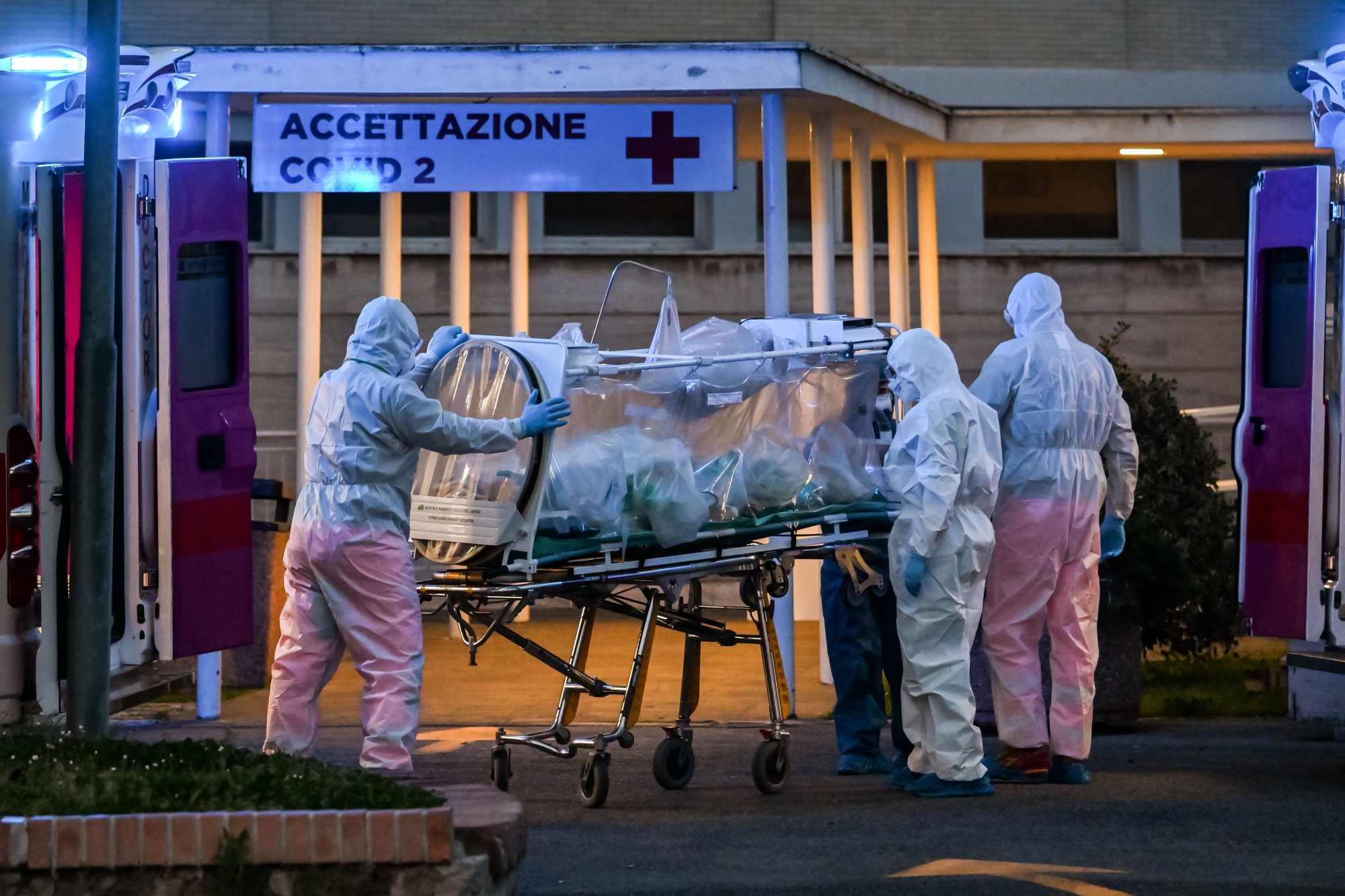


Medical workers stretch a patient under intensive care into the newly built temporary hospital in Rome on March 16.Photographer: Andreas Solaro/AFP via Getty ImagesAs Europe’s daily new cases of the coronavirus now eclipse China’s at the peak of its epidemic, doctors in Wuhan -- the city in central China where the pathogen first emerged -- are seeing worrying signs of similar mistakes unfolding.

Key among them is inadequate protection for medical workers, leading to a high infection rate among doctors and nurses. In Wuhan, a lack of understanding of the disease and a shortage of protective equipment in the early weeks of the outbreak in January led to thousands of health-care workers being infected while treating patients. At least 46 have died.

“Our European colleagues are contracting the disease in their daily practice, and the proportion is quite similar to the earlier situation in Wuhan,” said Wu Dong, a gastro-enterology professor at the Peking Union Medical College Hospital. Wu spoke from Wuhan with journalists in Beijing on Monday, alongside three other top Chinese doctors. “We need to protect our medical staff.”

What Doctors Treating Covid-19 in Wuhan Say About The Virus

The toll on medical workers is an emerging crisis faced by major western countries where the virus has now taken hold. From Italy to the U.S., countries are reporting a shortage of protective medical supplies like masks in hospitals, while the rapidly growing patient load is overwhelming doctors and nurses. The highly-contagious nature of the virus means that it has shown signs of being transmitted in unusual ways, like through the eyes.

Read more on doctors being infected in the epidemic:
Death of a Hero Doctor Sparks Crisis of Confidence in Xi’s China China Doctor Dies as Virus Takes Toll on Medics at Ground Zero China’s Sick Doctors Show How Infection Breaches Fan Coronavirus

In Wuhan, ear, nose and throat (ENT) and eye doctors were infected at higher rates than colleagues in the same hospitals, Du Bin, director of the intensive care unit at Peking Union Medical College Hospital, said at the same briefing.

“My personal interpretation is these doctors have very close contact with the patients, that’s the major reason that they got easily infected,” he said. “It’s important to get doctors educated and trained on how to protect themselves.”

The epidemic has now sickened over 170,000 globally and killed over 7,000. While it’s slowed in China -- only 21 new domestic case of infectionwere reported on Tuesday -- it’s accelerating in Europe and the U.S., cutting a particularly deadly swathe in countries like Italy, where the reported mortality rate is currently almost twice that of China’s.

In China, where the population is cautiously resuming their daily activities, the death of prominent doctors during the course of the crisis has been a lightning rod for public anger over the government’s handling of the outbreak. The death of Li Wenliang, a 34-year-old doctor who was one of the first whistle-blowers about the disease in December and was sanctioned by local authorities, ignited a wave of rare public fury against the Communist Party.

The Chinese doctors at Monday’s briefing had other insights into treating the disease:

Prioritize TestingUnlike previous pandemics like the 2003 one caused by SARS, the coronavirus causes only mild or even no symptoms in some infected people at first, which means they’re unknowingly spreading the virus to others. Administering nucleic acid tests, which identify the virus’ genetic sequence in patient samples, is essential, said the doctors.

“Test, test, test,” said Du. “Apart from testing, I just have no idea how you can identify the suspected cases, and how to quarantine the close contacts.”

Virus-Test Divide Exposes Government Successes -- and Failures

Testing has become a barometer of competence for the world’s governments and health-care systems. The U.S. government is facing widespread public anger for the slow roll-out of tests, while nations from Indonesia to India are being criticized for not testing much at all. South Korea, which had the second-biggest number of cases in Asia, has gotten its epidemic under control largely through testing tens of thousands of people daily.

Adults, KidsWhile the population most at risk is over 60, children can be infected by Covid-19 and some cases have been fatal, the head of the World Health Organization said at a briefing Monday.

Adults are 2.7 times more likely to get the disease than children, according to a study published in the Nature Medicine journal on Monday of 745 children and 3,174 adults. Most of the infected kids had close contact with confirmed patients or were part of family clusters.

Du said the majority of children infected have only mild symptoms, and all have survived so far. In the Journal of the American Medical Association, another study showed that among nine infants, none required intensive care or had severe complications.

Traditional Chinese MedicineWhile no drugs have yet been approved to treat the virus, there’s been a lot of attention within China on the use of Traditional Chinese medicine, or TCM, by patients. The herb-based treatments are being used in some 87% of cases in the country, the official Xinhua News Agency reported on Feb. 17.

“TCM works quite well in patients with mild diseases, and in those who have recovered from their critical illness,” said Du. But it’s hard to judge the efficacy of the treatment from a western medical point of view. The evaluation system for the TCM could be “futile or invalid”, because it has a different philosophy or evaluation system for efficacy from western medicine, he added.

China’s ApproachThe doctors said that it seemed to them that China’s domestic outbreak has come to an end, but that the country still needs to be vigilant.

“Even in Wuhan, we should remain alert, we should prepare for future sporadic cases and future imported cases,” said Du.

China is now providing assistance to other affected countries. Last week, a Chinese plane carrying medical professionals and about 30 tons of medical supplies landed in Italy.

“Every nation has its own COVID-19 situation. We are not saying this is China’s example and you should follow, we totally respect that you take your own actions,” said Wu, “But everyone of us should take it seriously, take necessary actions, change your behavior, and be responsible.”

— With assistance by Claire Che

