Was That A Black Swan Yesterday?
"If what they say is true, that the economy will be crippled until 2022"
That is very optimistic.. how does any small or midsize company come back from these
current numbers? Airport passenger traffic down 98%. I know I will not be flying for a while
when it resumes. Airports are large shopping centers.
Wuhan’s 11 Million People Are Free to Dine Out. Yet They Aren’t
An entrepreneur struggles in a coronavirus-ravaged city where consumer habits may forever be changed.
Bloomberg News
April 15, 2020, 5:47 PM EDT Updated on April 16, 2020, 10:12 AM EDT
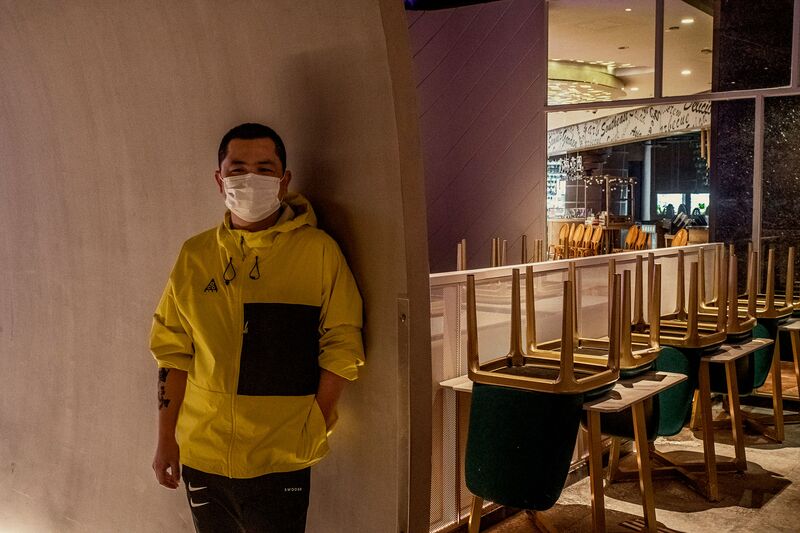
Xiong Fei at one of his restaurants in Wuhan, China, on April 14. PHOTOGRAPHER: GILLES SABRIE FOR BLOOMBERG BUSINESSWEEK
LISTEN TO ARTICLE
5:02
SHARE THIS ARTICLE
Share
Tweet
Post
Email
After more than two months of being confined to their homes, most of Wuhan’s 11 million residents are now free to venture out, with infections dwindling from thousands of new cases a day in mid-February to just a handful a week. But for restaurant owner Xiong Fei, the end of the lockdown in the Chinese city where the coronavirus pandemic began hasn’t brought relief, just a new set of challenges.
While factories around Wuhan are working around the clock to get back up to speed, the recovery of consumer-focused businesses such as Xiong’s won’t be so straightforward. Although people are cautiously taking to the streets again, they remain subject to curbs on their movements aimed at keeping the virus at bay. Residents are encouraged to stay home and still must have their temperatures checked before entering any building. In other words, it’s far from business as usual, stoking fears among small businesspeople like Xiong that the lockdown has changed customers’ behavior, maybe for good. “People in the past dined out with their colleagues in their lunch hour, now they’re all getting lunchboxes,” he says, sitting in a booth at an empty Sichuan restaurant he operates. “They’re more likely to cook at home than go out.”
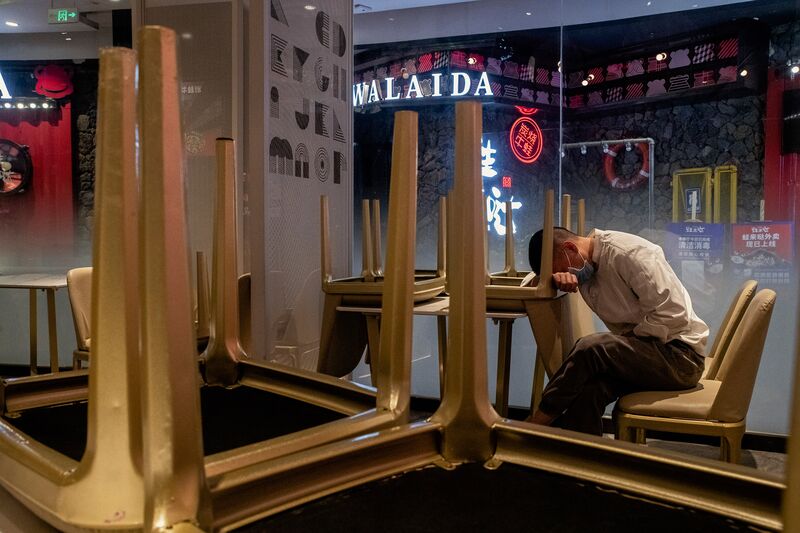
A cook takes a nap. Because of the pandemic, the restaurant operates only for food delivery.
PHOTOGRAPHER: GILLES SABRIE FOR BLOOMBERG BUSINESSWEEK
Of the 10 restaurants Xiong’s company, Bainianfeng Catering Management Co., operated before the outbreak, none have reopened for dining in. And while three have resumed making food deliveries, Xiong has already decided to shutter three other locations for good because he expects fewer customers. Now the 40-year-old entrepreneur and his business partners are trying to decide what to do long term. Half of Bainianfeng’s restaurants were hotpot joints, where groups of diners cook raw meat and vegetables in communal pots of boiling broth—the sort of places customers now are likely to avoid. “There will be a significant downturn in consumption,” Xiong says, predicting the city’s hospitality scene will see a shakeout.
Xiong’s experience provides a window into the uncertain future facing small-business owners around the globe as they contemplate life after lockdowns. While many hope to pick up where they left off, Wuhan’s cautious emergence shows it likely won’t be that easy. The city, once a bustling hub for steel and auto manufacturing, remains gripped by fear of reinfection. Companies are testing employees before they’re allowed back to work and disinfecting their premises daily. If a customer or worker gets the virus, businesses typically have to shut down again for weeks of quarantine—something even the most painstakingly prepared business plan can’t predict.
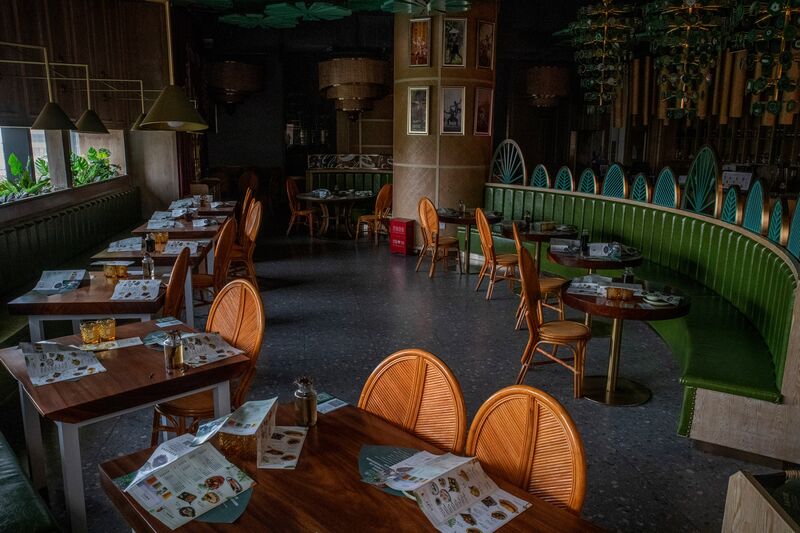
A shut-down restaurant at the same mall.
PHOTOGRAPHER: GILLES SABRIE FOR BLOOMBERG BUSINESSWEEK
It’s a cycle of stress and worry that hasn’t let up for Xiong since Jan. 23, when his phone started buzzing at 2 a.m. with the news: Wuhan would be locked down in eight hours to contain the deadly virus. While 5 million people left before the city was cut off at 10 a.m., Xiong and his family never considered doing so. He’s from Wuhan, and the very existence of his business was at risk. “I knew restaurants would be the most heavily affected,” he says. “I also worried about our workers’ health.”
Most of Xiong’s restaurants had already been closed before the lockdown, as rumors about the mysterious pneumonia that would go on to kill more than 2,500 people in Wuhan had been circulating since late December. It was a painful decision that saw his company basically write off 1 million yuan ($142,000) worth of fresh food.
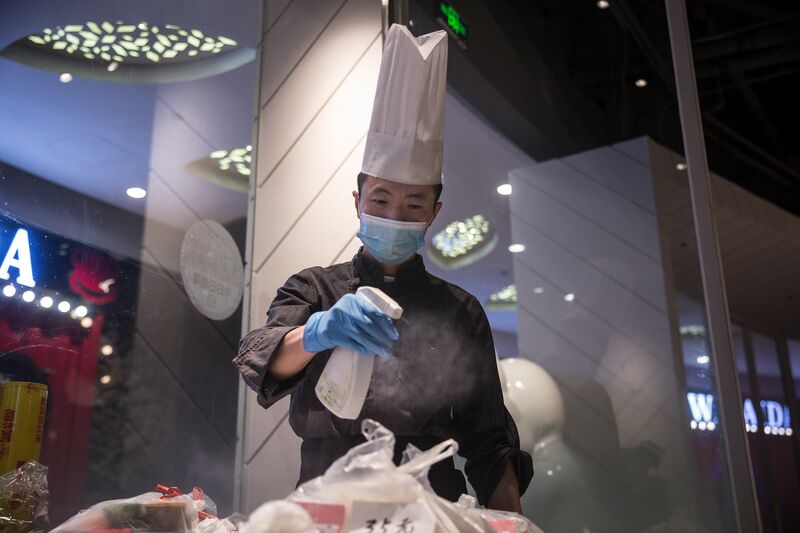
A chef sprays alcohol on packaged food.
PHOTOGRAPHER: BLOOMBERG
As the quarantine began, Bainianfeng, like restaurateurs from New York to Sydney, sought refuge in meal deliveries. But Wuhan had turned into a ghost town overnight, and Xiong had to figure out how to source and transport ingredients that grew more expensive as supplies ran low. Meanwhile, his staff—greatly reduced because most were too scared to report to work or restricted from leaving their housing compounds—spent much of their time sanitizing the kitchen of the one restaurant he managed to keep open during lockdown.
Before the outbreak, people would stand in line for 40 minutes on weekends to get a seat at Xiong’s more popular spots. But under lockdown, he was lucky to get 20% of the orders he used to receive via delivery apps such as Alibaba Group Holding Ltd.’s Ele.me and Meituan Dianping, another backed by Tencent Holdings Ltd. To draw more diners, Xiong’s three operating restaurants are offering to deliver food to any location in the huge city, even if it takes hours. The online platforms take 20% of sales, but “we don’t dare to increase our prices because people will complain,” Xiong says.
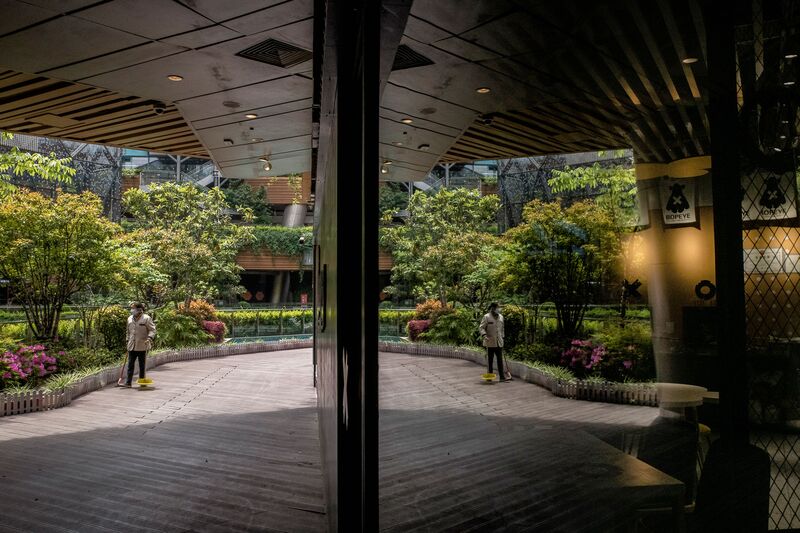
A cleaning lady at the deserted mall.
PHOTOGRAPHER: GILLES SABRIE FOR BLOOMBERG BUSINESSWEEK
Xiong was already under pressure from rents that have doubled over the past five years, reducing his profit last year by 3 million yuan. This year he expects to lose 2 million more because of the shutdown. The total operating cost for all of Xiong’s restaurants is about 50,000 yuan a day, he says, of which about 23,000 yuan is rent. He’s had to let at least 40 employees go.
Xiong is trying new ways to keep his business afloat. Betting the trend to order in will continue, he’s begun importing high-tech food packaging machines from Taiwan to sell to other restaurants. He’s also trying to start a livestreaming channel featuring his cousin—a former model—cooking in one of the restaurants and eating the food. “There definitely will be restaurants sifted out,” he says. “The market just follows natural selection, and only the fittest will survive.”
BOTTOM LINE - Millions of residents of Wuhan are again able to venture from their homes. But small businesses fret that the lockdown may have altered consumer behavior permanently.
Before it's here, it's on the Bloomberg Terminal.
LEARN MORE
|



