SI
SI
discoversearch

We've detected that you're using an ad content blocking browser plug-in or feature. Ads provide a critical source of revenue to the continued operation of Silicon Investor.  We ask that you disable ad blocking while on Silicon Investor in the best interests of our community.  If you are not using an ad blocker but are still receiving this message, make sure your browser's tracking protection is set to the 'standard' level.
Strategies & Market Trends : 2026 TeoTwawKi ... 2032 Darkest Interregnum -- Ignore unavailable to you. Want to Upgrade?


To: Julius Wong who wrote (160474)7/23/2020 8:26:01 AM
From: Pogeu Mahone  Read Replies (1) | Respond to of 219940
 
Update on the WTF-Collapse of Consumption of Gasoline, Jet Fuel & Dieselby Wolf Richter • Jul 23, 2020 • 2 Comments
Folks started driving again – including those who used to take mass-transit. But jet fuel demand is still in collapse-mode. And overall consumption remains way down.
By Wolf Richter for WOLF STREET.Ridership on San Francisco’s Bay Area Rapid Transit (BART) trains was still down 89% in June, compared to June last year, according to BART. Not because the Bay Area economy has collapsed by 89% — it has not — but because many people are working from home, and those people who do go to work are driving to avoid the infection risks associated with riding on a commuter train. Driving-instead-of-taking-mass-transit is playing out across the US. And we’re seeing some of that in gasoline demand. But jet fuel consumption is still in collapse mode. And diesel consumption has been down sharply for over a year.

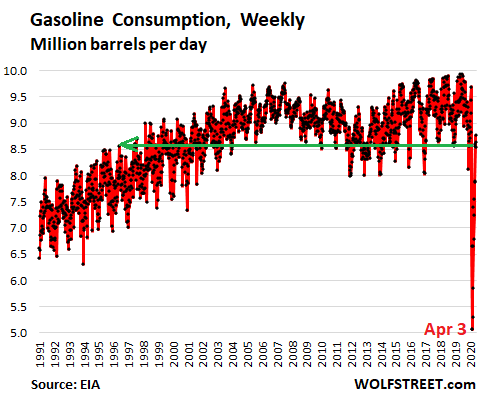
Starting in mid-March, demand for gasoline collapsed in a historic manner. By now 32 million people are claiming unemployment compensation under state and federal programs, and many others switched to work from home, and both groups quit driving to work. Gasoline consumption at the low point in the week ended April 3 plunged by -48% year-over-year, to just 6.7 million barrels per day, the lowest in the EIA’s data going back to 1991.

Folks started driving again, bit by bit, to go to work, and because it’s summer driving season. In the week ended July 17, gasoline consumption, at 8.55 million barrels per day, was down 11.6% year-over-year, according to EIA data. Consumption of gasoline has been in the minus-6% to minus-12% range now for the fifth week in a row, with the latest week being the steepest decline:
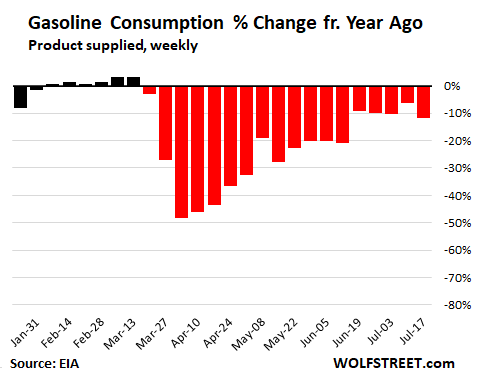


The EIA tracks consumption in terms of product supplied by refineries, blenders, etc., and not by retail sales at gas stations.

At 8.55 million b/d in the latest week, gasoline consumption was back near the low end of the past few years, a volume first reached in the mid-1990s, which shows that selling gasoline in the US is not a growth business, even during the Good Times. Gasoline consumption has now left nearly all of that historic WTF-collapse in March and April behind:


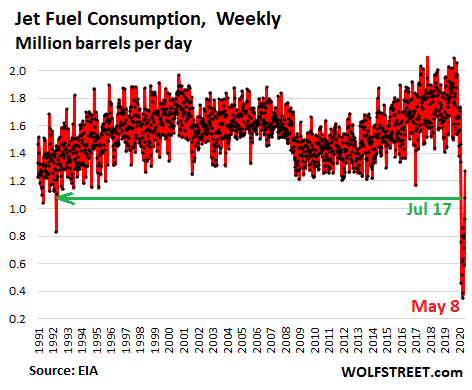
Jet fuel.Kerosene-type jet fuel consumption in the week ended July 17 was still down 41.3% year-over-year. As huge has this decline is, it’s only about half of the worst declines in this crisis, which maxed out at -80% in the week ended May 8, when consumption collapsed to just 352,000 b/d, by far the lowest in the data going back to 1991. At 1.08 million b/d in the latest week, a big drop from the prior week, consumption was still at multi-decade lows:


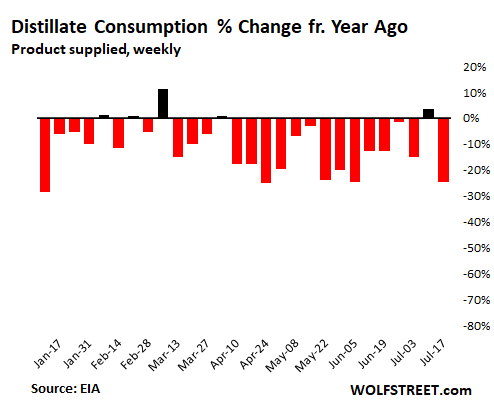
Distillate.This category of fuel includes diesel fuels used by trucks and some cars, railroad engines, equipment for agriculture, oil-and-gas drilling, construction, diesel generators, etc. And it includes fuel oils, such as for space heating and utility-scale power generation, where demand is very seasonal and impacted by the weather.

The trucking and railroad business has suffered through a year-and-a-half long downturn in the freight sector. And the pandemic sharpened that downturn.

In the week ended July 17, distillate consumption, at 3.22 million b/d, was down 24.4% year-over-year, after an uptick in the prior week (3.69 million b/d). But these declines pale compared the 48% plunge at the worst week in demand for gasoline and the 80% collapse in demand for jet fuel in early May. The drop in distillate consumption never got anywhere near that:


Gasoline, jet fuel, and distillate combined.Combined, consumption of gasoline, jet fuel, and distillate in the week ended July 17 dropped from the prior week to 12.85 million b/d, still down by 18.5% year-over-year:
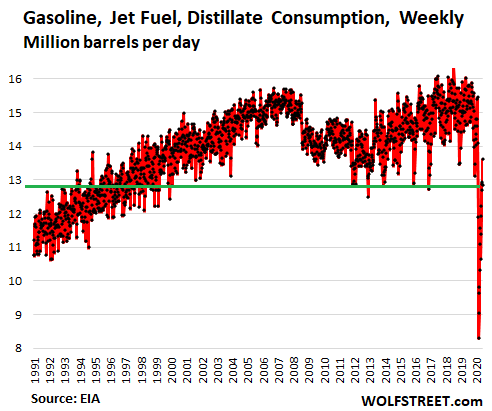


As far as the US oil industry – and the global oil industry – is concerned, this decline in demand in the US, though it has abated from the fall-off-the-cliff weeks, remains huge.

In addition to the short-term challenges, the US oil industry now faces several structural issues, including work-from-home that is becoming an established practice for an increasing number of jobs, a new corporate reticence to send employees willy-nilly on business trips and to conferences, and the increasing sales of EVs. All automakers now have models on the market and are aggressively pursuing this segment. The petrochemical industry will continue to use petroleum and petroleum products. But for petroleum-based transportation fuels in the US, demand may not return to the highs established in 2018 and 2019.

Enjoy reading WOLF STREET and want to support it? Using ad blockers – I totally get why – but want to support the site? You can donate. I appreciate it immensely. Click on the beer and iced-tea mug to find out how:



To: Julius Wong who wrote (160474)7/23/2020 8:55:52 AM
From: TobagoJack1 Recommendation

Recommended By
zamboz

  Read Replies (1) | Respond to of 219940
 
Tesla is a Chinese company, for now, and it appears that Team Shanghai is doing for Tesla what it did for VW Santana, making it the go-to EV. Should it be ordained as taxi fleet car, watch out above

The quarter was marked by a “step change” in China, where Shanghai accounted for a sharply higher proportion of Tesla’s global production and deliveries, according to Morgan Stanley’s Adam Jonas. Cash flow was also impressive, he said.

bloomberg.com

Tesla’s ‘Home-Run Quarter’ Leaves Even the Bears Praising Elon Musk

Joe Easton


Tesla Inc. electric vehicles charge at the Tesla Supercharger station in Fremont, California.

Photographer: Nina Riggio/Bloomberg Tesla Inc. shares extended their meteoric gains in U.S. pre-market trading as even the most pessimistic analysts struggled to find faults in the electric carmaker’s quarterly earnings report.

It was a “home-run quarter” for Elon Musk’s firm, according to Wedbush’s Dan Ives, as the company reinstated its original delivery target of 500,000 units in fiscal 2020 and reported its fourth consecutive profit. Cowen’s Jeffrey Osborne upgraded his rating to market perform, removing the underperform recommendation he has held since initiating coverage of the stock in 2016.

The quarter was marked by a “step change” in China, where Shanghai accounted for a sharply higher proportion of Tesla’s global production and deliveries, according to Morgan Stanley’s Adam Jonas. Cash flow was also impressive, he said.

“Bears really would have to nit pick at the release to construct a materially negative narrative,” Jonas wrote in a note.

Tesla shares rose 5.2% in pre-market trading. The stock has almost quadrupled this year and is up more than sixfold in the past 12 months.

MORE: Tesla Growth Is Musk’s Goal After Profit Positions Stock for S&P


Here’s a summary of what analysts have to say:

Cowen, Jeffrey OsborneUpgrades to market perform from underperformPrice target to $1,100 from $300Execution on margins, cost control, lower capital spending and a faster ramp-up of factories and new vehicles have exceeded expectations. New factories, vehicle platforms and in-house batteries seen driving sentiment toward the stock.

Goldman Sachs, Mark DelaneyNeutralTesla has met the most important criteria investors were looking for: profit for the second quarter and commentary that 500,000 deliveries are achievable for the year.

The positive free cash flow result for the second quarter was an “upside surprise.”

Compared with Goldman estimates, the primary driver of profit upside was from regulatory credit sales and the release of deferred revenue.

Loup Ventures, Gene MunsterThe most important takeaway from the earnings report is that Tesla is “following Amazon’s playbook” by building a cycle of reinvesting profit to drive growth, scale and innovation.

It will be difficult for peers to build a vehicle that is feature and price competitive with Tesla, as the company has around 80% of the electric vehicle share in the U.S.

Sees Tesla adding energy as a central theme and this is where the long-term value will lie.

Wedbush, Daniel IvesNeutral, price target $1,800 from $1,250Second-quarter results were much better than expected and Elon Musk delivered a “home-run quarter” that defied skeptics.

Electric vehicle demand in China is accelerating and Tesla is competing with domestic and international competitors for market share.

China growth was a major source of strength in the second quarter and the growth story in the country is “worth $400 in a bull case” to Tesla, with electric vehicle penetration set to rise.

Morgan Stanley, Adam JonasUnderweight, price target $740Bears would have to “nitpick” at the results to find negatives.

Highlights include China production being positive for margins and outstanding free cash flow management.

Positive results show that comparisons between high scale electric vehicle companies and established internal combustion engines are becoming less meaningful.

— With assistance by Kit Rees, William Canny, and Beth Mellor

Before it's here, it's on the Bloomberg Terminal.
LEARN MORE

Sent from my iPad

