Monthly Temperature: August 2020

August 2020 Blended Land and Sea Surface
Temperature Anomalies in degrees Celsius

August 2020 Blended Land and Sea Surface
Temperature Percentiles
The month of August marks the end of the Northern (Southern) Hemisphere's meteorological summer (winter). August 2020 was characterized by warmer-than-average conditions across much of the globe. The most notable temperature departures from average were observed across Alaska, eastern Canada, the western contiguous U.S., Europe, northern Russia, central South America, Western Australia, eastern Antarctica, and across the North Pacific, the Bering Sea, and the Barents Sea, where temperatures were at least 2.0°C (3.6°F) above average. Cooler-than-average conditions were present across the Far East Russia and across parts of the southern Indian Ocean, and the central and eastern tropical Pacific Ocean.
Record-warm August temperatures were observed across parts of the southwestern contiguous U.S., northern South America, Africa, northern Russia, southern Asia, and across the western Pacific Ocean, the Indian Ocean, and the Atlantic Ocean. Overall, August 2020 had 7.74% of the world's land and ocean surfaces with a record high August temperature. This was the fourth highest percentage for any record warm August temperature across the globe since 1951. However, no land or ocean surface had record cold temperatures.
Averaged as a whole, the August 2020 global land and ocean surface temperature was 0.94°C (1.69°F) above average and the second highest August temperature since global records began in 1880. Only August 2016 was warmer with a temperature departure from average of +0.98°C (+1.76°F). The 10 warmest Augusts have all occurred since 1998; however, the five warmest Augusts have occurred since 2015. August 2020 also marked the 44th consecutive August and the 428th consecutive month with temperatures, at least nominally, above the 20th-century average.
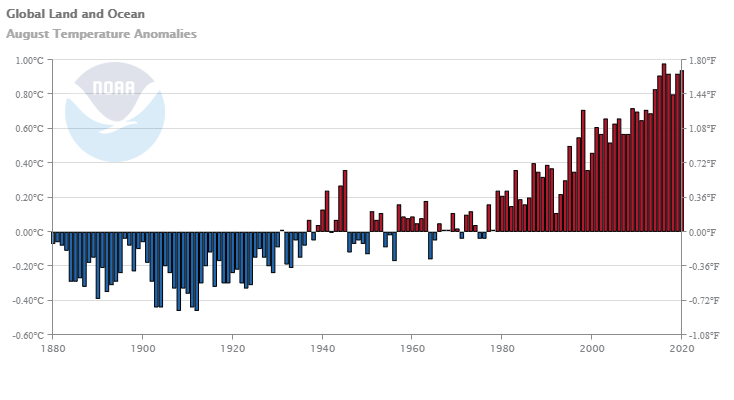
The global land-only surface temperature for August 2020 was the third highest on record at 1.26°C (2.27°F) above average. Meanwhile, the global-ocean surface temperature tied with 2016 as the second highest in the 141-year record at 0.82°C (1.48°F) above average.
The Northern Hemisphere land and ocean surface temperature for August 2020 was the highest August temperature on record at 1.19°C (2.14°F) above average. This value surpassed the now second highest August temperature set in 2016 by 0.03°C (0.05°F). Meanwhile, the Southern Hemisphere had its sixth highest August temperature on record.
Regionally, North America had its warmest August on record, with a temperature departure from average of +1.52°C (+2.74°F). This exceeded the previous record set on August 2011 by 0.13°C (0.23°F). Europe and the Caribbean region had their third-warmest August, while South America and Oceania had their fourth warmest August on record.
ncdc.noaa.gov
August Temperature
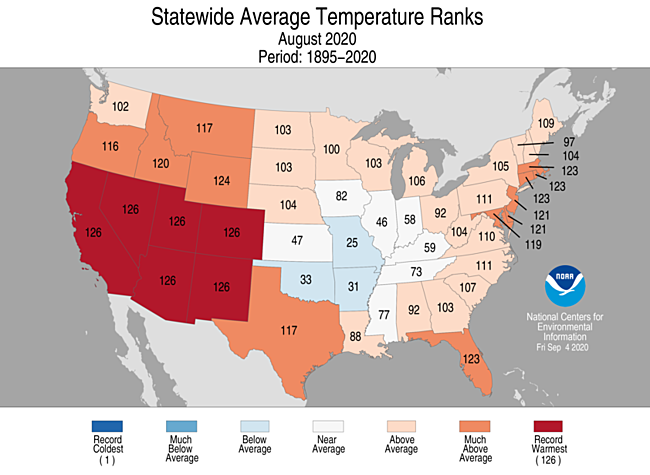
August 2020 Statewide Temperature Ranks
The August contiguous U.S. temperature was 74.7°F, 2.6°F above the 20th century average and ranked third-warmest August on record.An unusually strong ridge of high pressure during mid-August across the western contiguous U.S. drove the record heat seen across much of the Southwest.Above- to much-above-average August temperatures were observed across all but an area from the central Plains to the Ohio Valley with widespread record warmth across the western U.S. California, Nevada, Arizona, Utah, New Mexico and Colorado each had their warmest August on record. Arizona shattered its previous warmest August of 2011 by 2.1°F. The predominance of warmth across the West can be attributed to record and near-record warm daytime high temperatures.On August 16, the Furnace Creek Visitor Center in Death Valley, California, reported a high temperature of 130°F. If verified, this temperature would be the warmest August temperature on record and the third-warmest temperature on record for any month across the U.S.August was the hottest month on record for Phoenix, with an average temperature of 99.1°F. This broke the previous record, 98.3°F, which was set just last month.Below-average temperatures were observed across parts of the central Plains and middle to lower Mississippi Valley.The Alaska average August temperature was 52.1°F, 2.6°F above the long-term mean, ranking in the warmest third of the 96-year period of record for the state. Above-average temperatures were present across most of Alaska. Cooler-than-average conditions were present across much of the rain-soaked Panhandle.Significant sea ice melt across the Chukchi Sea occurred during August, leaving the waters 99% open. This is the lowest sea ice extent since 2012.The nationally averaged maximum (daytime) temperature was warmer than average during August at 87.9°F, 2.8°F above average, ranking fifth warmest in the 126-year record. California, Nevada, Utah, Arizona, New Mexico, Colorado and Wyoming ranked record warmest for maximum temperatures in August, while parts of the Great Plains as well as the Mississippi and Ohio valleys saw cooler than average daytime high temperatures.The nationally averaged minimum (nighttime) temperature during August was 61.5°F, 2.5°F above average, also ranking fifth warmest in the 126-year record. California, Nevada, Arizona and Utah ranked warmest on record while Oklahoma and Missouri ranked below average for overnight low temperatures during August.As of September 11, there were 10,378 warm daily high (4,632) and low (5,746) temperature records tied or broken during August. This was roughly ten times the 1,072 daily cold high (666) and low (406) temperature records set during the month.Based on NOAA's Residential Energy Demand Temperature Index (REDTI), the contiguous U.S. temperature-related energy demand during August was 204 percent above average and ranked sixth highest in the 126-year period of record.
ncdc.noaa.gov |



