SI
SI
discoversearch

We've detected that you're using an ad content blocking browser plug-in or feature. Ads provide a critical source of revenue to the continued operation of Silicon Investor.  We ask that you disable ad blocking while on Silicon Investor in the best interests of our community.  If you are not using an ad blocker but are still receiving this message, make sure your browser's tracking protection is set to the 'standard' level.
Strategies & Market Trends : 2026 TeoTwawKi ... 2032 Darkest Interregnum -- Ignore unavailable to you. Want to Upgrade?


To: carranza2 who wrote (163178)9/29/2020 7:19:39 PM
From: TobagoJack  Respond to of 218790
 
chiming w/ Pfennig ...
bloomberg.com

Gold-Buying by Central Banks Seen Climbing From Near Decade Low

Ranjeetha Pakiam
Gold buying by central banks, an important driver of bullion’s advance in recent years, is forecast to pick up in 2021 after a slowdown this year.

Citigroup Inc. sees demand from the official sector rising to about 450 tons after a drop to 375 tons this year, which would be the lowest in a decade. HSBC Securities (USA) Inc. expects a slight up-tick to 400 tons from an estimated 390 tons in 2020, potentially the second-lowest amount in 10 years.


Demand may increase in 2021, but previous highs are unlikely

Sources: World Gold Council (2010-2019), Citi (estimates)

While the forecasts are far from the near-record purchases of more than 600 tons a year seen in both 2018 and 2019, increased central bank activity will help bolster bullion. Russia could return to the market next spring and China’s central bank may resume adding to reserves after the U.S. elections, Citi said in a report this month.

This development may have a bigger impact on the market if exchange-traded funds -- key drivers of demand in 2020 -- slow their buying as global economies recover from the coronavirus pandemic.

“Although official sector gold demand was quite robust in 2019 and 2018 and is softer this year, it is not necessarily weak by historical standards,” said James Steel, chief precious metals analyst at HSBC. “While the influence of central bank activity should not be discounted, it is taking a backseat to ETFs and other forms of demand this year.”

Bullion prices and ETF assets surged to a record in 2020 as investors sought havens amid the pandemic, looser monetary policy and the potential debasement of fiat currencies.

Read more on why central banks’ gold-buying spree has slowed

Colombia and Uzbekistan have been among countries that reduced their gold reserves in recent months, and the Philippines has said it’s considering selling. Russia announced it would cease purchases from April, while it’s been almost a year since China disclosed any moves.

“Net central bank purchases have slowed down but are still positive, so there is no risk that central banks become a source of downward pressure on prices like they were in the 90s,” said Bernard Dahdah, senior commodities analyst at Natixis SA.

While central banks were net buyers for a 10th straight year in 2019, demand has become more concentrated, with fewer banks adding to reserves in 2020, according to the World Gold Council. Purchases dropped 39% to 233 tons in the first half from the same period a year ago.

Each central bank determines the gold allocation that is optimal for its own situation, according to Shaokai Fan, head of Central Banks Relationships at the WGC. Some may have reduced holdings because the percentage of bullion in their reserves has become high, particularly as prices increased or because they’ve had to draw down on the non-gold portion of their reserves to maintain currency stability, he said.

Standard Chartered’s precious metals analyst Suki Cooper also expects central banks to remain net buyers despite the selling that has emerged, but sees purchases easing to 400 tons next year from 417 tons in 2020. Citigroup’s projections are more optimistic, basing it’s forecast for a rebound on expectations for higher oil prices and stronger global growth.

“The broader push to buy gold is clear amid a longer-term de-dollarization trend and a bias toward reserve diversification,” said Aakash Doshi, head of commodities for North America at Citi Research.

— With assistance by Terrence Edwards

Before it's here, it's on the Bloomberg Terminal.
LEARN MORE


To: carranza2 who wrote (163178)9/29/2020 8:12:17 PM
From: TobagoJack  Respond to of 218790
 
Armstrong re gold

ask-socrates.com

The Gold Fake News
TUESDAY, 29 SEPTEMBER 2020 BY: MARTY ARMSTRONG


As we head into the end of the tumultuous quarter, the future does not look much brighter. Everything we have believed over the years is coming to test those hardened beliefs. Gold has penetrated the August low and despite all the chanting, drum beating, and the same old stories of hyperinflation, those scenarios pale in comparison to the facts. In January 1975, M1 money stock was 273.4 billion (see Fed St Louis). That rose to 385.5 in January 1980 - a gain of about 141%. Gold rose from nearly $200 in 1974 to $875 which was a gain of about 437% - obviously greater than the increase in the money supply. Now the M1 reached 5,574 billion as of September 14, 2020. If the entire theory that gold rises in proportion to inflation were true, then it should be trading at $12,668.00.

All of these scenarios are just sophistry - they are just a gold mask to hide the true face behind. They sell newsletter and are in search of a new crop of unsuspecting investors to keep the scene going. I was a bullion market maker during the 1970s. The scenarios put out today are the very same they have been using all along for decades.


Gold will rise not because of the money supply, but because of a collapse in confidence in the government. These people have everything ass-backward, as they say. It is NOT the hyperinflation that causes gold to rise, the hyperinflation takes place because people no longer trust the government, have hoarded their wealth in gold, tangible assets, or converted to another currency when the problem is isolated as with Zimbabwe or Germany during the 1920s post the Communist Revolution of 1918.

The future rise in gold will have NOTHING to do with the money supply, hyperinflation, or any of that nonsense. These people do not understand that the central banks cannot increase the money supply enough to even match the destruction in capital formation which has taken place on a global scale with over 300 million unemployed. We are in the midst of a real live invasion, but this is not an army landing on the beaches, this is money being used to bribe our pretend "representatives" who run government no different from the collapse of the Roman Republic that forced Julius Caesar to cross the Rubicon. But the fake news back then painted him as the tyrant as they do today with Trump. The people cheered Caesar and the senators had to flee Rome because they were the corrupt oligarchs. Once more, this invasion of our future is being carried out by American oligarchs.

Do not expect gold to rise for any of these nonsensical scenarios that are up there with Global Warming creating confusion and just false narratives. Gold will rise BECAUSE of a collapse in the confidence of governments on a global scale. Just as the Roman Republic fell and became Imperial Rome, we face the same crisis on a grand scale post-2032.


To: carranza2 who wrote (163178)9/29/2020 8:15:10 PM
From: TobagoJack  Respond to of 218790
 
Armstrong on gold mining

ask-socrates.com
Gold Miners
TUESDAY, 29 SEPTEMBER 2020 BY: MARTY ARMSTRONG


QUESTION #1: Dear Marty,

I just read your recent blog mentioning Gold and am looking forward to purchasing your forthcoming Precious Metals Report. I have a few questions and was hoping you could address them in your report?

Gold hasn't backed our currency since 1971 and Silver has not been currency since 1964 - yet because of inflation both precious metals have performed very well.

If we are not returning to a Gold Standard - is it still possible for Gold, Silver, and Miners to still continue performing well?

Do you see Silver and Silver miners performing well in New Green World order because of Silver uses as a industrial/techno metal?

Thank you,

TC

QUESTION #2: Marty, you were correct that the gold ratio was going to flip and buy silver v gold. That was an amazing call that the gold bugs never saw. My question is, do you see this ratio continuing to expand as these crazy people focus to regulating gold but not silver?

HT

ANSWER: There was no way a bull market would continue with gold rising and silver trailing. I pointed out that all bull markets have the ratio moving in the opposite direction which has now come into play. We need to close September below 8170 to confirm that the high on this ratio is established and overall, silver will gain on gold.


A lot of people have put faith in Buffett buying about 21 million shares of Barrick Gold. Buffett is an old school and a value investor. That is not very credible for the future nor does that work short term. True, value investing pays off in the long-term. Those who tried that during the Great Depression still went bust because stocks get overvalued and undervalued over time. Nevertheless, the main overhead resistance stands now at the 41 and 45 levels. We need a closing for September above 28.50 to keep the upward momentum or we will retest support.

Needless to say, I do not see this New Green World Order succeeding. It will unleash huge civil unrest and this can lead to a revolution in many countries. International war seems highly likely because the LEFT's core philosophy is a dictatorship and they do not believe in freedom. It is their way or war. They cannot tolerate and exception or their grand plans fails. Hence, they are determined to get control of the USA so they can then threaten China and Russia to submit to their agenda.

The risk for gold is more regulation because these people need to control the monetary system but using MMT. They are canceling currency and if the Democrats win, they already have proposed a digital dollar. They will not tolerate gold and private cryptocurrencies to circumvent their grand plan.

If Trump wins, there will be a flight to the dollar as the overseas elections next year become crazy. But even a Trump win on November 3rd, the Democrats are counting on mail-in ballots their studies show will be 40% more Democrats who vote in that manner which seem to be because they believe that COVID is life-threatening. Ther4efore, between now and January, it seems there will be political fighting and allegations of fraud and probable petitions to the Supreme Court.

That all said, assuming the New Green World Order with their cancellation of currency will most like to restrict gold and could even use FDR to justify confiscation. They could get away with that along the lines of the theory behind Eminent Domain. On June 23, 2005, in a 5-4 decision, the court ruled that Connecticut’s law allowing private land to be taken for private use did not violate the Fifth Amendment’s public use clause because the land was taken in order to “promote economic development.’’ The land was New London’s to give to the NLDC.

Under that theory, they could confiscate gold, but they would have to pay you the fair market value. There is an absurd risk that since the gold was NEVER demonetized in 1971 when Nixon simply closed the gold window under Bretton Woods, extreme leftist Democrats could pass a law that you must turn over your gold and they would compensate based upon the office rate of gold which remains $42. This would be really nuts, and I would not expect that without fierce opposition. If Congress enacted such a statute, then the Supreme Court would have nothing to say. Without such a move, then they would have to pay fair market value as in Eminent Domain.

Consequently, the miners would not be in the same position as they were in 1934. There, the government took the gold for we were on a gold standard. The Democrats will adopt MMT - not gold. The question of gold miners could be twisted into aiding money laundering if they outlaw gold but if gold is restricted and still legal, then the miners will be regulated since gold was not formally demonetized and the government could then argue they are a bank.

It all depends on the craziness we see under this New Green World Order. They are obsessed with reducing the population and all money should be digitized to end "crime" in the underground economy.


To: carranza2 who wrote (163178)10/1/2020 5:44:33 AM
From: TobagoJack  Respond to of 218790
 
some positive news, that we are not yet running dry, but penned by tickling, a suspect

bloomberg.com

We're a Long, Long Way From Running Out of GoldThere’s still good reason to invest in it, though.
David Fickling
1 October 2020, 15:00 GMT+8


A high bar.

Photographer: David Gray/Bloomberg

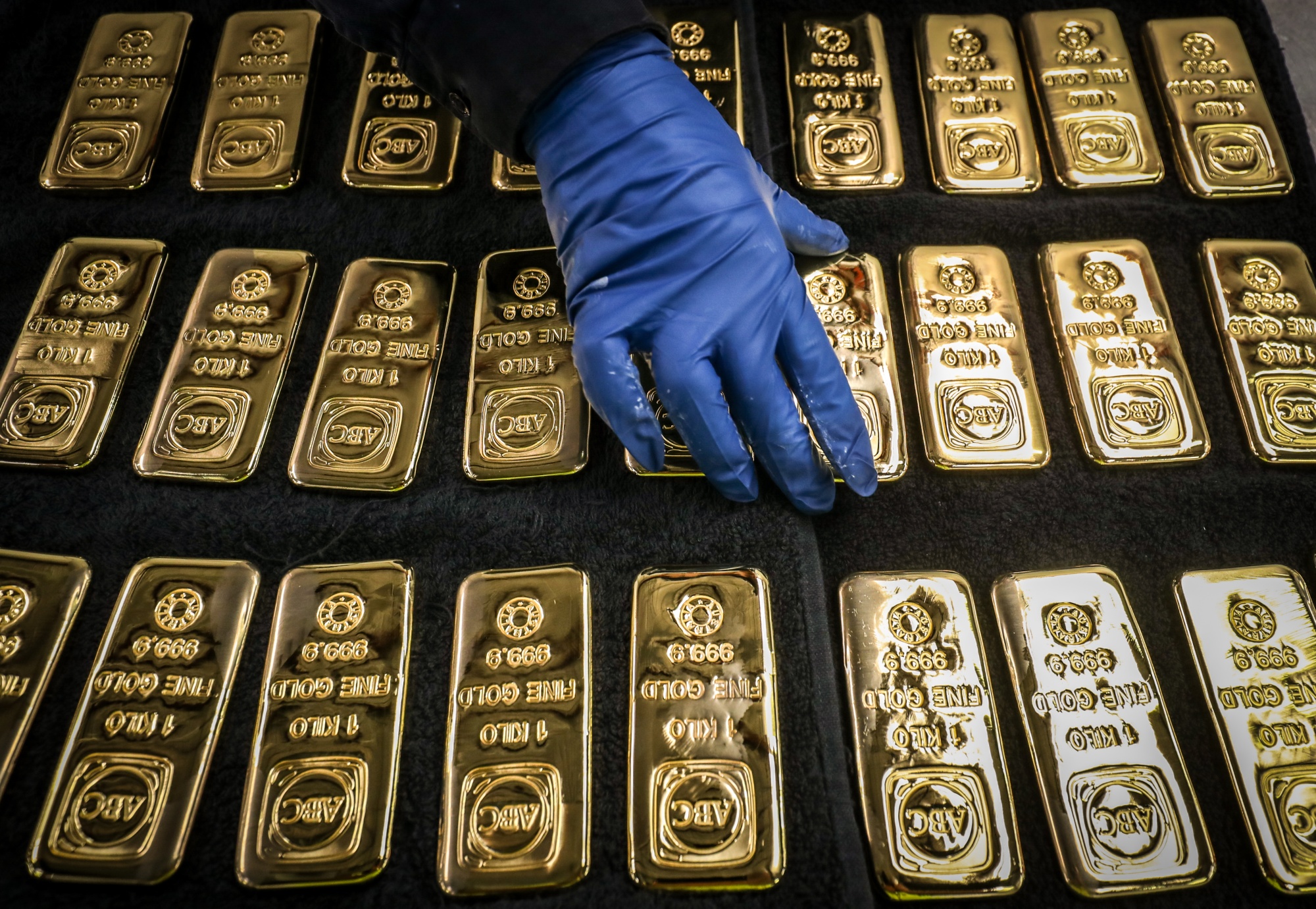
Here’s one potential reason to add some bullion coins or bars to your investment portfolio: They’re not making any more of them.

All the gold that’s ever been mined would fit into a cube with edges 22 meters long — small enough to fit into three Olympic-sized swimming pools. Each year, miners and pawnbrokers add another 4,000 to 5,000 metric tons to an existing 197,576 ton pile, but jewelry demand alone uses up about half of that.
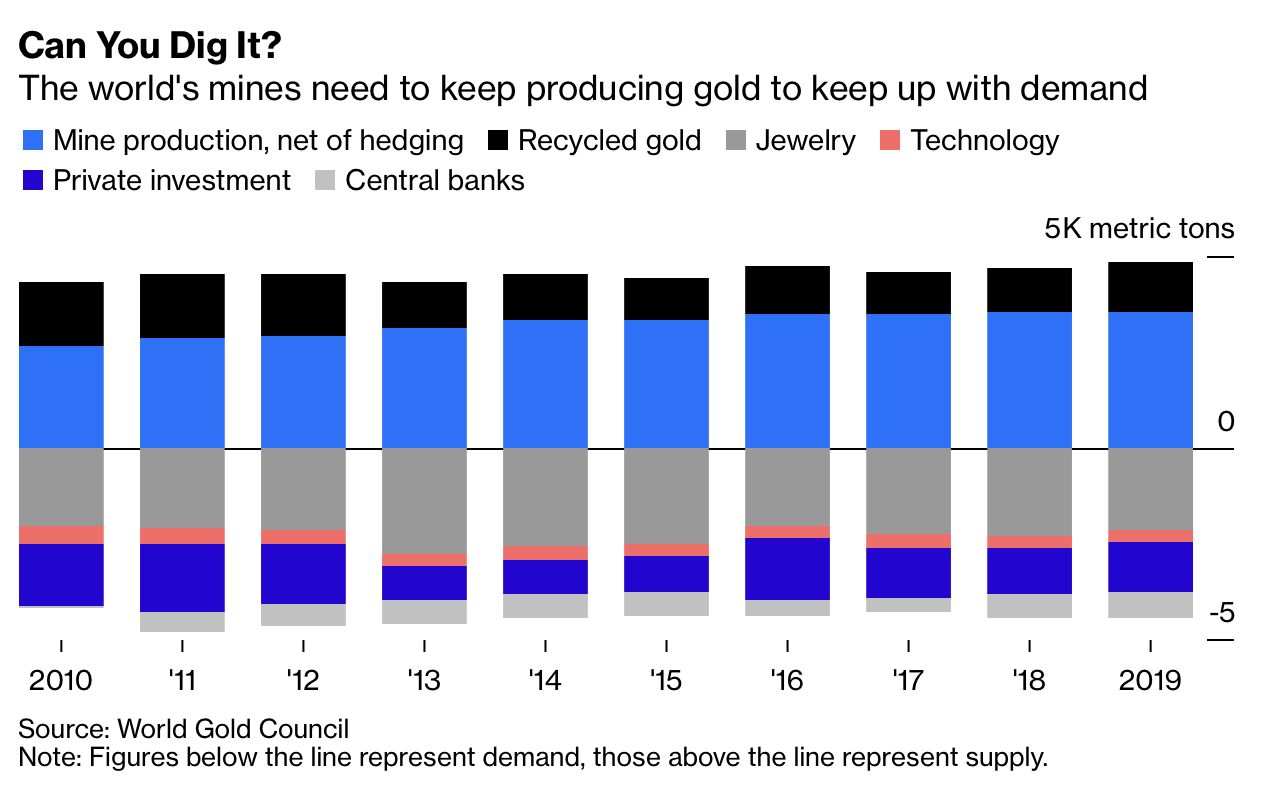


With the metal hitting a record $2,075 a troy ounce in August, the concern we’re heading toward peak gold has reared its head again. The industry needs to commission 8 million ounces of projects by 2025 to maintain last year’s production levels, consultants Wood Mackenzie wrote in June, requiring some $37 billion of capital investment. Mine production fell last year for the first time in more than a decade. Even the British Broadcasting Corp. has been asking whether we’re at risk of running out.

At the core of the concern is a longstanding trend in the gold mining industry: The percentage of gold in ore reserves is falling, from more than 10 grams per ton in the late 1960s to barely more than 1 gram per ton nowadays. Those concentrations are extraordinarily low — equivalent to grinding up and separating a Statue of Liberty’s-worth of ore to recover a teaspoon of precious metal. At some point, the grade must get so poor that it becomes impossible to recover the gold economically.

The thing is, we don’t know when that will be — and all the evidence indicates that we’re still a long way from finding out.

Take Newcrest Mining Ltd.’s Cadia East mine 200 kilometers (124 miles) to the west of Sydney. The grade there is just 0.45 grams per ton — more than two Statue of Liberty’s-worth per teaspoon — and yet the mine is one of the world’s most profitable, with costs of $160 per ounce, which would deliver a margin of more than 90% at current gold prices 1 .
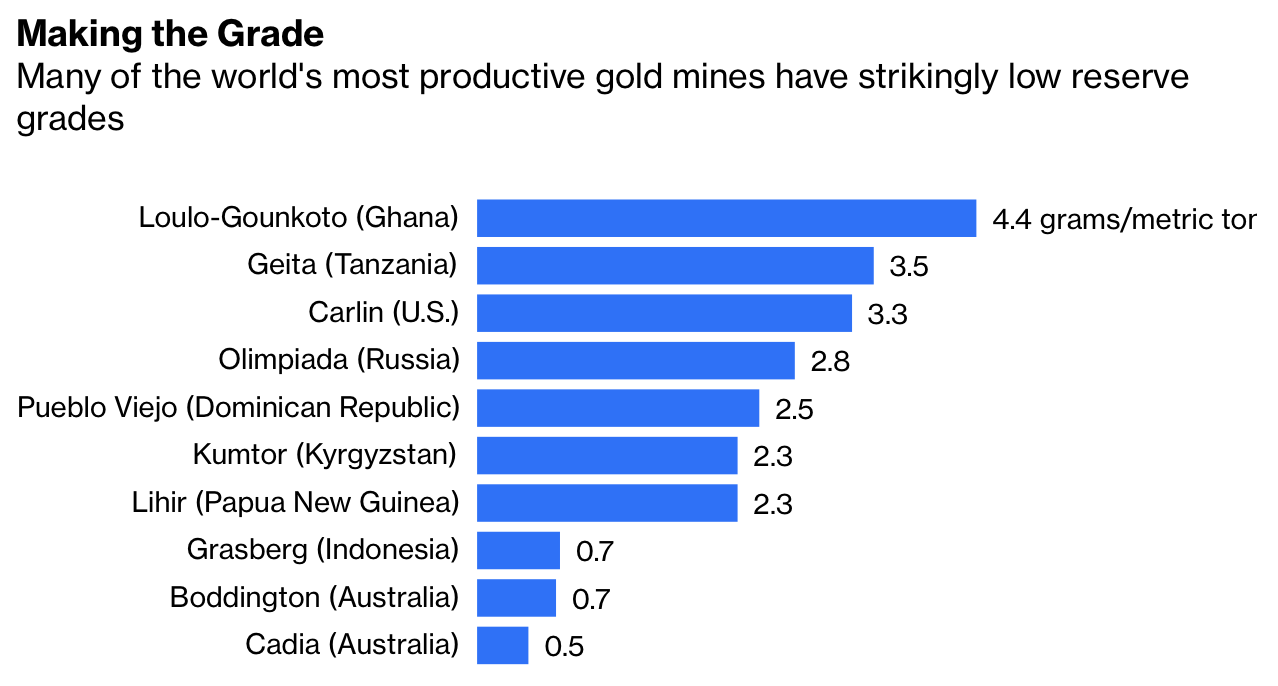


Two factors drive that. One is economies of scale: Cadia is one of the world’s top 10 gold mines measured by output. Since the dawn of the mining industry, grades of almost every mineral have been falling because, by definition, the highest-grade, most easily discovered resources are the ones that get exploited first. The growth of the sector has always depended upon better, higher-volume extraction technologies offsetting this fact.

The place where many of the highest-grade major gold deposits are still found, South Africa, is increasingly a backwater. That’s because it’s simply so difficult to extract ore from sweltering tunnels kilometers underground using hand-operated tools. By comparison, the immense blasting and dump-truck operations used to exploit lower-grade mines in Siberia, Oceania and Nevada are far more efficient.

The other factor is that most gold doesn’t occur on its own. Indeed, the best deposits globally are porphyry, a mineral that’s also one of the world’s biggest sources of copper. The operator of the world’s biggest gold mine isn’t a gold miner at all but copper producer Freeport-McMoRan Inc., whose Grasberg pit on the Indonesian side of New Guinea produced nearly twice as much gold in 2018 as its nearest rival, Polyus PJSC’s Olimpiada. At Newcrest’s Cadia, production costs are so low because for every ounce of gold that’s mined you get about 140 kilograms (309 pounds) of copper, worth $900 or so at current prices.

While the issues of mine depletion highlighted by Wood Mackenzie are real, high gold prices like those we’re seeing at the moment are exactly the circumstances that will encourage more exploration and development activity to make up the shortfall. Though people have been digging up gold for seven millennia, it’s constantly being discovered in the most unexpected places.


Mining of the yellow metal in Australia’s Victoria state all but ceased a century ago after the veins that drove its nation-building 19th-century gold rush were tapped out. Then in 2015 Kirkland Lake Gold Ltd. discovered a new ore bodynear its uninspiring Fosterville mine site, and realized it was sitting on top of one of the world’s highest-grade deposits, causing its market capitalization to grow nearly 100-fold in five years.

The same year, a unit of Zhaojin Mining Industry Co. discovered a new deposit two kilometers below the surface of the Bohai Sea off the coast of northeast China’s Shandong province. With some 212 metric tons of proven and probable reserves, it’s now one of the world’s largest gold deposits.

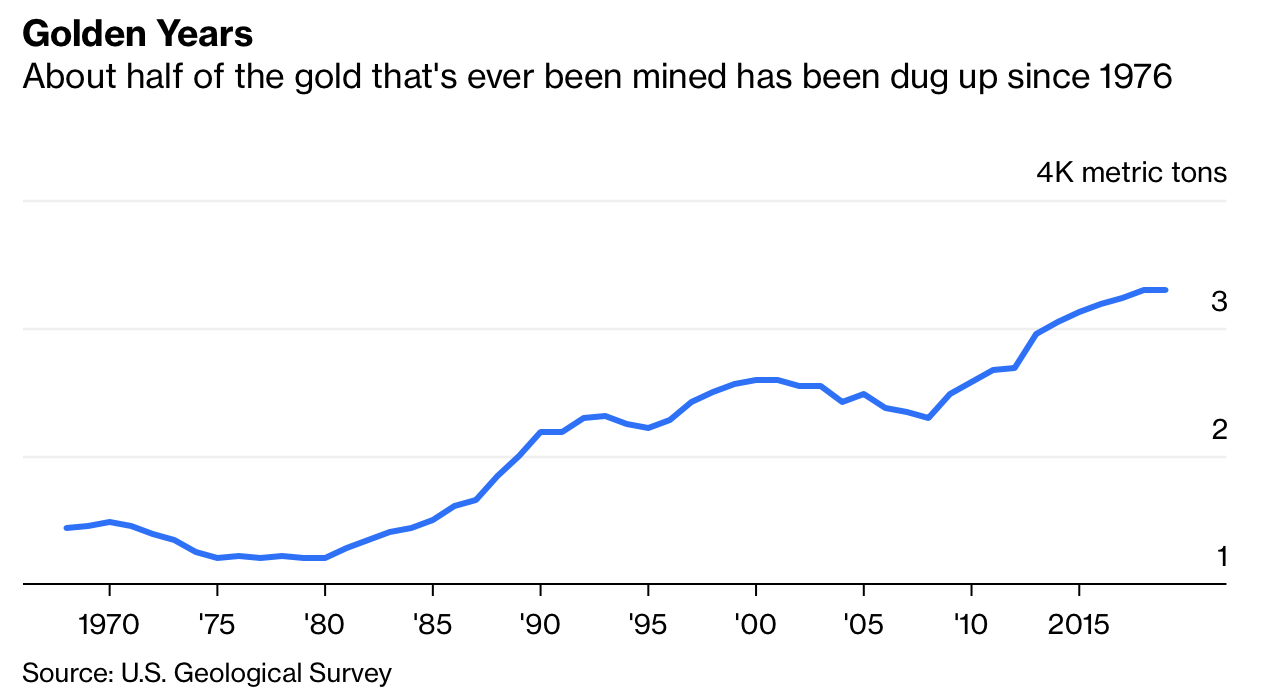
There’s no reason to think that trend is about to break. About half of the world’s gold has been mined since 1976, and if anything the pace is accelerating as grades fall. Worldwide, gold production is up by about a third over the past decade, far more than the 15% increase in oil output. The best reason for investing in gold is still that it provides diversification to an investment portfolio— not that the world doesn’t have enough of it. One day, we may run out of gold. We’re a long, long way from that moment now.

The costs are for both Cadia East and the adjacent Ridgeway mine combined -- but Ridgeway is similarly low-grade, at 0.54 grams per ton.

This column does not necessarily reflect the opinion of the editorial board or Bloomberg LP and its owners.

To contact the author of this story:
David Fickling at dfickling@bloomberg.net

To contact the editor responsible for this story:
Rachel Rosenthal at rrosenthal21@bloomberg.net

Before it's here, it's on the Bloomberg Terminal.
LEARN MORE

