In the meantime Team China export is up, the opposite of down
and folks are getting ready to again complain that Team China is not printing to support demand
“I think over time the surplus will raise concerns that in some sense China isn’t pulling its fair share in supporting global demand amid a pandemic.”
Bottom lines, that if Trade War is a war, the war is going about as expected, better for one side as opposed to another, and
if CoVid is a weapon designed in a lab and weapons-freed, some weapon.
My take? Trade War is a war.
CoVid is a flu.
A lot of somebodies got bum-rushed by a few other bodies into a corner that burned a lot of money, for a lot of domestic political reasons, because folks did not depend on science and thought w/ slogans.
ft.com
China’s export machine comes roaring back to life
China’s export machine was under pressure from all directions last year. A trade war with the US was weighing on demand and competition from other manufacturing hubs was heating up.
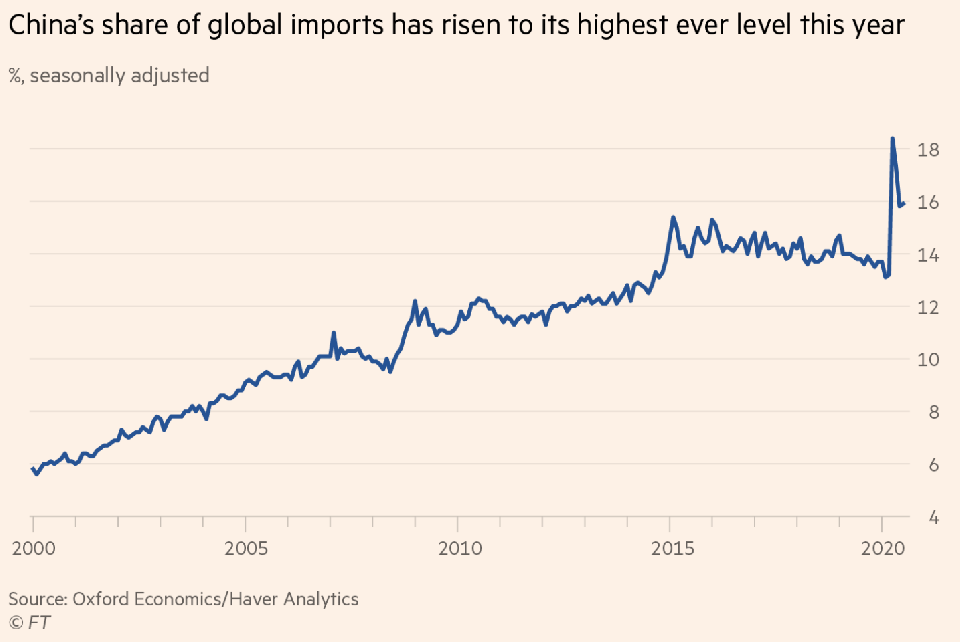
Fast-forward to mid-2020 and, thanks largely to a pandemic that originated within its borders, China’s dominance of global exports has surpassed levels seen in any other year.
The same coronavirus that hammered global trade has increased the appetite for goods made in China, such as electronics products and medical equipment. That boom in exports is supporting the country’s early recovery as other big economies flounder, raising the question of whether China’s recent trade advantage will outlive the pandemic.
Data from Oxford Economics and Haver Analytics show that while overall volumes have fallen, China’s share of global exports compared with other large exporters leapt to more than 18 per cent in April, before falling back slightly to 15.9 per cent in July.
“It is too early to write off China’s role in global supply chains,” said Louis Kuijs from Oxford Economics, who pointed to the “fundamental competitiveness” of Asian economies.
He added that the market share effect was in part temporary but suggested that “there will be some permanent shift?.?.?.?and that should benefit certain countries".
Partly a function of declining activity elsewhere, China’s recent success is also a result of a wider resilience of exports in east Asia, fuelled by a shift in global demand towards products suited to a world working from home.
Taiwan’s exports, the majority of which are electronics components and IT and communications products, reached their highest ever monthly level in August. In South Korea, exports of information and communications technology products rose year on year in each of the past three months after a sharp fall in April.
Such economies have benefited from much lower reported coronavirus infections since the second quarter. Lockdown restrictions in China were already being eased in April, when other countries were plunged into chaos from the spread of the pandemic. New cases have remained lower in China, Taiwan and South Korea than in the US and Europe.
That paved the way for enough manufacturing activity to take advantage of a shift in global consumption patterns. In addition to the kind of soaring exports of electronics also seen in Taiwan and South Korea, Chinese exports of medical equipment leapt in the first seven months of the year. China’s trade surplus with the US in August reached $34.2bn, its highest level since November 2018.
Trinh Nguyen, senior economist at Natixis, points to a “bifurcation of performance globally”. That is reflected in South Korea, where electronics and medical consumer products have performed well but “heavy industries” such as shipping and autos have struggled. In Japan, exports fell year on year for the sixth straight month in August.
In China, the state has provided support for manufacturing in a way that Mr Kuijs said was “unimaginable” in the US. But he added that the export response in China was also down to “entrepreneurial and agile” companies. “Virtually none of these companies is state owned,” he said.
While overall exports have been able to adapt to changing demand, the mood in its manufacturing hubs is mixed.
Kexin Chen, a sales manager of a toy factory in Guangdong, said export orders from Europe were improving but admitted that her business was still struggling. “We are counting on [orders for] Black Friday and Christmas,” she said.
Elsewhere, there are signs that aspects of the east Asian export boom may be driven by short-term fears over supply chains. Taiwan Semiconductor Manufacturing Corporation, the world’s largest contract chipmaker, told investors last month that technology companies were building larger stockpiles because they were worried new Covid-19 infection waves could disrupt supply chains again.
In Taiwan and South Korea, experts suggest exports were also supported by demand from Huawei ahead of the latest US sanctions against the Chinese company.
Some experts suggest the boom, particularly in China, is a temporary effect of the pandemic. Economists at Nomura point to stimulus packages in the west, which they said helped prop up consumption demand for imported goods such as laptops.
Those measures contrast with more muted stimulus efforts in China, which has focused on supply. Retail sales data returned to growth last month but remain weak compared with industrial production.
“China has stimulated less and relied more on exports to drive its own recovery,” said Brad Setser, senior fellow at the Council on Foreign Relations, a think-tank, who points to a “huge shift in the global surplus towards Asia”.
“I think over time the surplus will raise concerns that in some sense China isn’t pulling its fair share in supporting global demand amid a pandemic.”
Additional reporting by Wang Xueqiao in Shanghai |



