In the meantime am intending to increase shorts against Tesla, for Tesla-specific reasons and for Nasdaq-particular rationale
Deployment of weaponised REEs all done, just awaiting signal for weapons-free
Inside of 12 months, a guess, unless something happens
an opportunity to play, only issue is how best to play
bloomberg.com
How Chinese Chip Giant SMIC Can Evade Trump’s Newest Crackdown
Donald Trump’s latest headline-grabbing action against China is aimed at negating the Asian power’s push toward self-sufficiency in the $400 billion semiconductor industry. But its effectiveness is being questioned almost before the ink is dry, according to a growing chorus of voices in Washington and interviews with Chinese technology executives.
The U.S. is blacklisting Semiconductor Manufacturing International Corp. along with more than 60 of its peers deemed a threat to national security, depriving them of the American inputs from software to chemicals required to make their products. The key provision of the action against China’s largest chipmaker is a restriction on selling equipment and other items used to fabricate advanced chips, an area U.S. suppliers dominate.
But in a letter to Commerce Secretary Wilbur Ross Tuesday, Senator Marco Rubio and Representative Michael McCaul warned the action was “utterly ineffective” and fell short of crippling Beijing’s drive into next-generation semiconductors.
The pair echo the concerns of industry executives and government officials who argue the White House should do more to hamstring SMIC, one of several companies instrumental to Beijing’s ambitions of supplanting American dominance in a plethora of spheres including semiconductors. Arguably one of the world’s most important industries, the ability to manufacture semiconductors is crucial for everything from artificial intelligence and data centers to autonomous cars, smartphones, and advanced weapons systems.
Stockpiling materials For more on the U.S.-China conflict over chips, click here
In his bid to halt China’s semiconductor ambitions, Trump is turning to some of the same tools deployed against Huawei Technologies Co. Those measures succeeded in stunting Huawei’s growth, but failed to decisively undermine its lead in 5G networking or kill its giant smartphone division. Like its larger compatriot, SMIC anticipated the U.S. action, stockpiling as much as 18 months’ worth of chemicals and other raw materials to keep its machines humming, people close to the company said. And it hiked its capital spending budget twice this year to $6.7 billion before taking it back citing U.S. regulatory uncertainty.
“We are deeply concerned that the rules pursuant to the Entity Listing for the Semiconductor Manufacturing International Company (SMIC) will be utterly ineffective in addressing this growing national security threat,” Rubio and McCaul wrote. “We are deeply concerned that SMIC’s placement on the Entity List by the Bureau of Industry and Security was done for show.”
Read more: U.S. Blacklists More Than 60 Chinese Firms, Including SMIC
Beijing has long worried a concerted White House campaign to contain the nation’s tech ascendancy -- which has already shaken up the supply chain for everything from iPhones to laptops -- will kneecap its rapidly developing chip industry. Washington had already targeted Huawei’s secretive HiSilicon division, while SMIC was grappling with rules introduced earlier this year designed to cut off supply to China’s military. In response, Beijing is said to be preparing broad support for so-called third-generation semiconductors and conferring the same kind of priority on the effort it accorded to building its atomic capability.
Advanced ChipsWhite House officials didn’t immediatley respond to a request for comment on whether the U.S. measures were too narrow.
A representative for SMIC, which has repeatedly denied supplying the People’s Liberation Army, declined to comment beyond a statement this week warning of “major adverse impact” on its plans.
Within the company, engineers are scrambling to assess the fallout and figure out workarounds to secure the equipment it needs, much like Huawei did two years prior, another person familiar with the matter said. At issue is the administration’s focus on drawing a line at 10-nanometer technology, banning the sale of equipment intended for use in more advanced processes. SMIC could conceivably repurpose 80% of older-generation gear to crank out more advanced chips, but that tactic won’t sustain production for the longer term and much depends on how far President-elect Joe Biden decides to take the rules, a third person close to the situation said, asking not to be identified discussing sensitive matters.
“The company has already got critical equipment and materials needed to continue production,” said Xiang Ligang, Beijing-based director-general of the Information Consumption Alliance. “In the past, China wasn’t too sensitive about the technological bottlenecks it has. But now, Beijing is fully aware of the potential damage and is determined to solve these issues.”
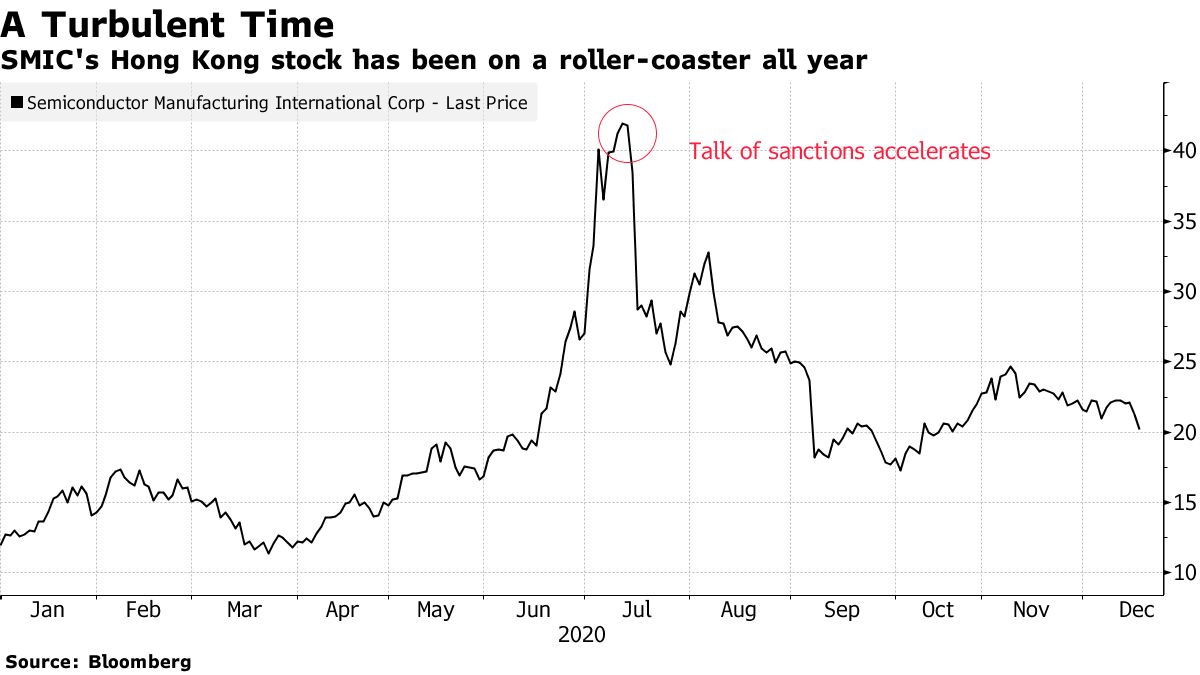
Chinese government-backed SMIC, a manufacturer of chips for global names from Qualcomm Inc. to Broadcom Inc., relies on U.S. gear for its longer-term technology road map. While its engineers may be able to sustain research and output in the short run, the latest sanctions basically freeze its capabilities while the industry advances. If a Biden White House takes it to the max, SMIC could be blocked from 7nm or more advanced technology while overseas rivals like Taiwan Semiconductor Manufacturing Co. dominate the market. The heightened scrutiny may also discourage clients leery of dealing with the uncertainty.
Entity ListBut while that rule seems hard and fast, it misses the point that much of the equipment needed for 10nm or better is already in use for less advanced production, meaning SMIC may already have the gear it needs to keep its plants ticking over for a while. McCaul and Rubio argue SMIC can re-purpose as much as nearly 95% of available, older-generation tools.
“Without question SMIC deserves to be on the Entity List, but the lawyerly language of the tool rule undermines the intent of the designation,” said James Mulvenon, director for intelligence integration at SOS International and the author of a book on forced technology transfers to China.
Read more: Huawei Outhustles Trump by Hoarding Chips Vital for China 5G
The debate highlights the difficulty for U.S. policy makers of choosing such a globalized and technical industry to project geopolitical aims. That follows a series of assaults against some of China’s most recognizable names, with varying levels of success: ByteDance Ltd.’s TikTok and Tencent Holdings Ltd.’s WeChat have tied up Executive Order bans in court, while video surveillance giant Hangzhou Hikvision Digital Technology Co. is up 37% this year despite joining Huawei on the Entity List.
Largest marketChina is by far the largest market for semiconductors and heavily reliant on imports. Gear suppliers such as Applied Materials Inc. and KLA Corp. with production facilities in Asia could argue that machines made there aren’t subject to U.S. jurisdiction, though Commerce officials have said companies exporting parts made outside of the U.S. to SMIC will still face restrictions depending on how much of their technologies are of American origin.
The legality of that seeming loophole remains unclear, particularly as U.S. officials pressure allies to cut off Chinese clients.
Another concern is the fundamental complexity of the industry, which means that Washington decision-makers must rely on the companies themselves to explain the intricacies of their products. That’s partly why the process of applying to the Commerce Department for export licenses has dragged on.
Entegris Inc. Chief Executive Officer Bertrand Loy, who is also chairman of the industry’s largest trade group, SEMI, said no one quite knows yet how the latest sanctions will play out. “Which products exactly are targeted is not entirely clear,” he told Bloomberg News this week.
— With assistance by Ian King, Peter Martin, Debby Wu, Yuan Gao, and Jordan Fabian
Before it's here, it's on the Bloomberg Terminal.
LEARN MORE |



