let's see what and how Team Biden tries to do
I believe this sentence is correct
The real challenge they face is not China, but restoring these values at home. ft.com
Containing China is not a feasible option
Unlike with the Soviet Union, the US and its allies have to co-operate and compete with its rising power
8 hours ago

© James Ferguson
How should the US respond to a rising China? This is among the biggest questions facing the new US administration. Many Americans argue that a form of containment is feasible. Indeed, this is one of the few points on which Joe Biden’s administration and its predecessor tend to agree. One can also see the political advantage: common enemies may unify a divided country. But is this really a feasible policy? I believe the answer is: no.
Such an essentially zero-sum view of the US-China relationship is contained in The World Turned Upside Down by Clyde Prestowitz. He insists that: “There is no contest between the Chinese people and those of the United States.” His objection is rather to the Communist party. A similar view infuses The Longer Telegram: Toward A New American China Strategy, written by an anonymous “former senior government official” (in reference to George Kennan’s celebrated long telegram of February 1946, which proposed containment of the Soviet Union). This also states that: “The single most important challenge facing the United States in the 21st century is the rise of an increasingly authoritarian China under President?.?.?.?Xi Jinping.” The challenge, it argues, is not China but its despotic state.
I sympathise with the anxiety that infuses these publications. China’s actions in Xinjiang and Hong Kong underline its contempt for human rights and international agreements. Beijing threatens Taiwan’s de facto autonomy and is expanding its sway over the South China Sea. In brief, China increasingly behaves like a rising great power ruled by a ruthless and effective despot.
The Longer Telegram argues that the threat from China’s attempt to achieve global dominance must be met by defending a long list of vital US interests: retaining collective economic and technological superiority; protecting the global status of the US dollar; maintaining overwhelming military deterrence; preventing Chinese territorial expansion, especially forcible reunification with Taiwan; consolidating and expanding alliances and partnerships; and defending (and, as necessary, reforming) the rules-based liberal international order. Yet, simultaneously, the paper calls for addressing shared global threats, notably climate change.
Is all this achievable? No, I think not.
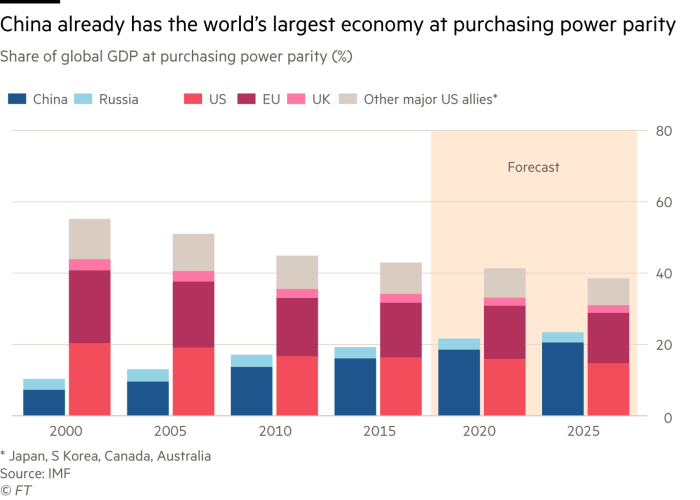
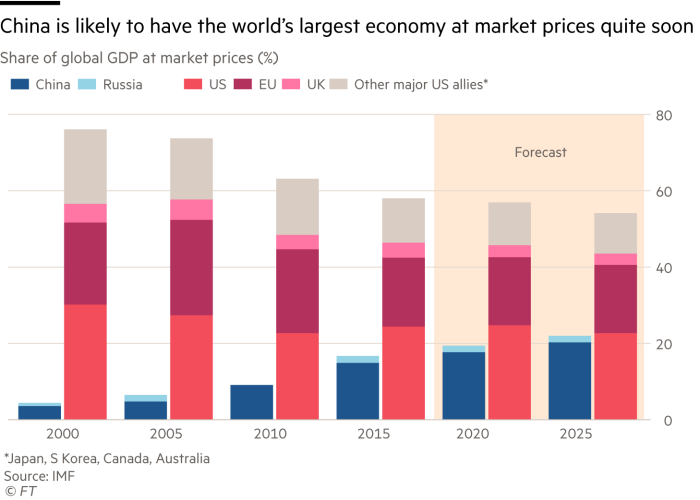
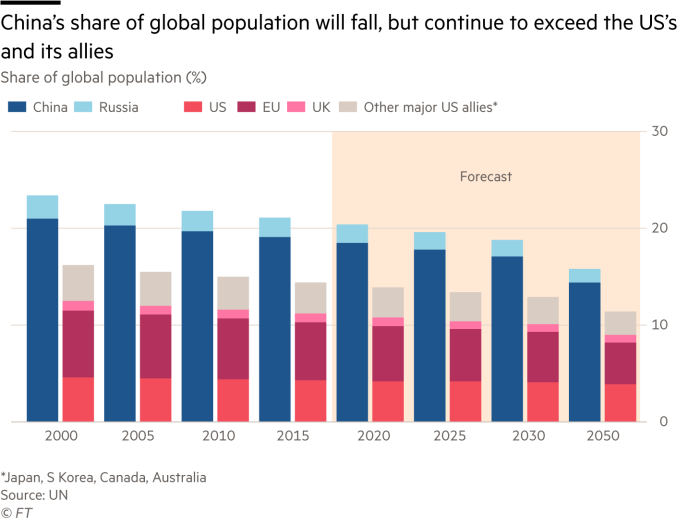
First, China is a far more potent adversary than the Soviet Union. It has a far more successful economy, a more dynamic technology sector, a far larger population, a more cohesive polity and a much more competent government. China’s relative economic performance has been stunning.
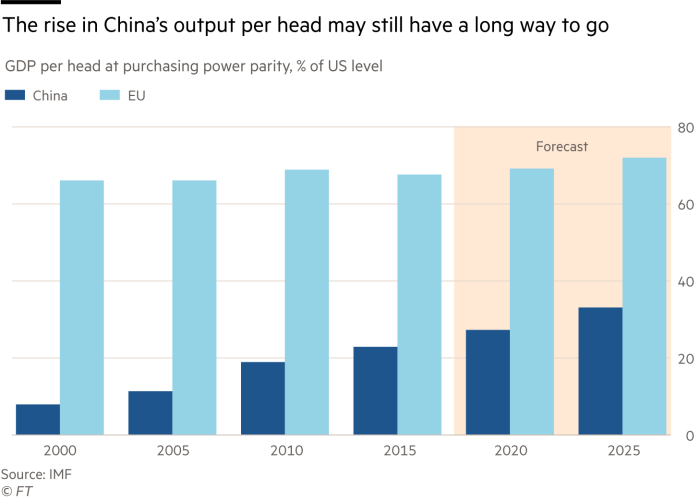
More important still is its potential. China faces huge economic challenges. But it need not manage them all that well to have much the world’s largest economy. At present, China’s output per head (at purchasing power parity) is a third of the US’s (up from 8 per cent in 2000) and half of the EU’s. Suppose that this rises to only half of the US level by 2050. China’s economy would then be as big as those of the US and EU, together.
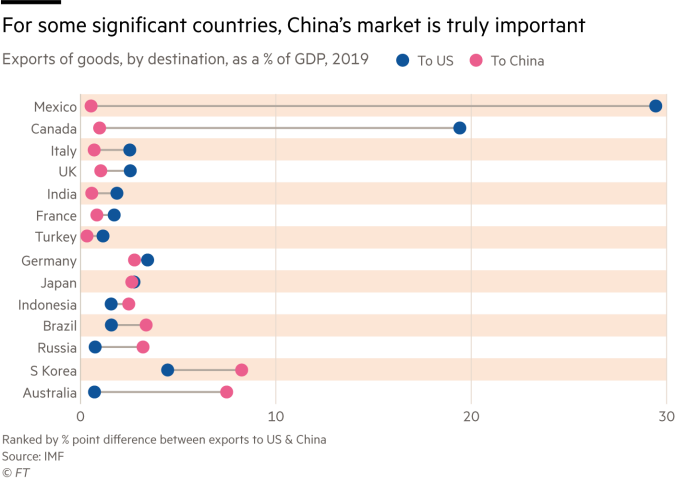
Second, China’s economy is highly internationally integrated. Although this is a source of vulnerability for China, it is also a source of influence. The Chinese market exerts a magnetic pull on a host of countries across the globe. As the Singaporean scholar Kishore Mahbubani stresses, most countries want good relations with both the US and China. They will not willingly choose the US over China.
Finally, over the last two decades and especially the last four years, the US has devastated its reputation for good sense, decency, reliability and even adherence to basic democratic norms. This matters, because its allies will be crucial in the envisaged contest. As Jonathan Kirshner states in Foreign Affairs, “the world cannot unsee the Trump presidency”, especially its disgraceful end. Worse, that aspect of the US is evidently still alive. The US used to talk about the need for China to be a “responsible stakeholder”. But after the hubris of the “unipolar moment”, the Iraq war, the financial crisis and Donald Trump’s presidency, is the US a responsible stakeholder?
This is not meant to counsel despair. It is to recognise reality. So what might be done?
First, the US and its allies have to revitalise their democracies and their economies. On the latter, they must indeed protect their technological autonomy. But the most important way to do this is by revitalising their scientific and technological infrastructure, including by refurbishing education and encouraging immigration of talented people.
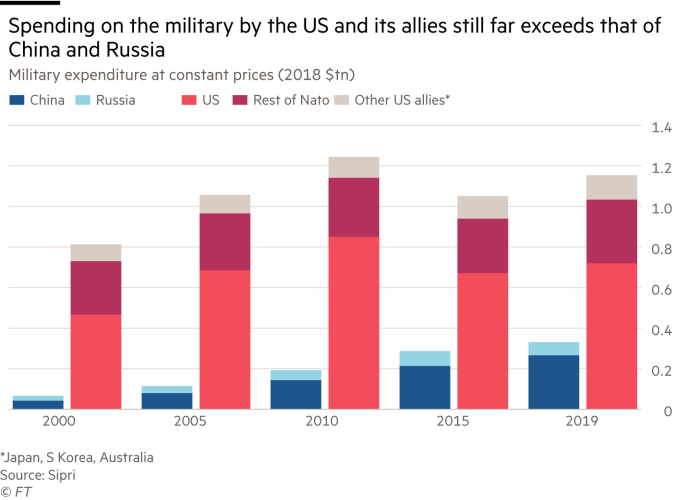
Second, they have to defend the core values of adherence to truth and freedom of speech against all enemies, domestic and foreign (including China). They must, moreover, unite in doing so. China should not be allowed to pick off and bully smaller countries, one by one.
Third, they need to refurbish the institutions of the global economy they created, and propose new multilateral rules that bind China’s behaviour and by which they too will be bound.
Fourth, the US and its allies need to make clear which core interests they will defend, if necessary by force.
Last and most important, they must focus attention, as Mr Biden has now done, on the shared project of protecting the global commons for us all.
The relationship of the US with China is not like that with the Soviet Union. Yes, there will be much competition, but there must also be deep co-operation. To the extent that there is a war of ideologies, the west’s freedom and democracy remain more attractive. The real challenge they face is not China, but restoring these values at home.
martin.wolf@ft.com |



