SI
SI
discoversearch

We've detected that you're using an ad content blocking browser plug-in or feature. Ads provide a critical source of revenue to the continued operation of Silicon Investor.  We ask that you disable ad blocking while on Silicon Investor in the best interests of our community.  If you are not using an ad blocker but are still receiving this message, make sure your browser's tracking protection is set to the 'standard' level.
Strategies & Market Trends : 2026 TeoTwawKi ... 2032 Darkest Interregnum -- Ignore unavailable to you. Want to Upgrade?


To: Snowshoe who wrote (168316)2/9/2021 7:25:31 AM
From: TobagoJack  Read Replies (1) | Respond to of 218898
 
Re <<Short squeeze>>

It could be argued that all who are not long BTC even if a sliver, is effectively short BTC, and the biggest squeeze possibly on.

But never mind all that.

bloomberg.com

Markets Bet the Fed Really Does Like It Hot

Real yields have stayed anchored despite a surge in inflation expectations. Are investors right?
John Authers

February 9, 2021, 2:28 PM GMT+8



The inflation mercury is climbing.

Photographer: artpartner-images/Getty Images

Point Break?

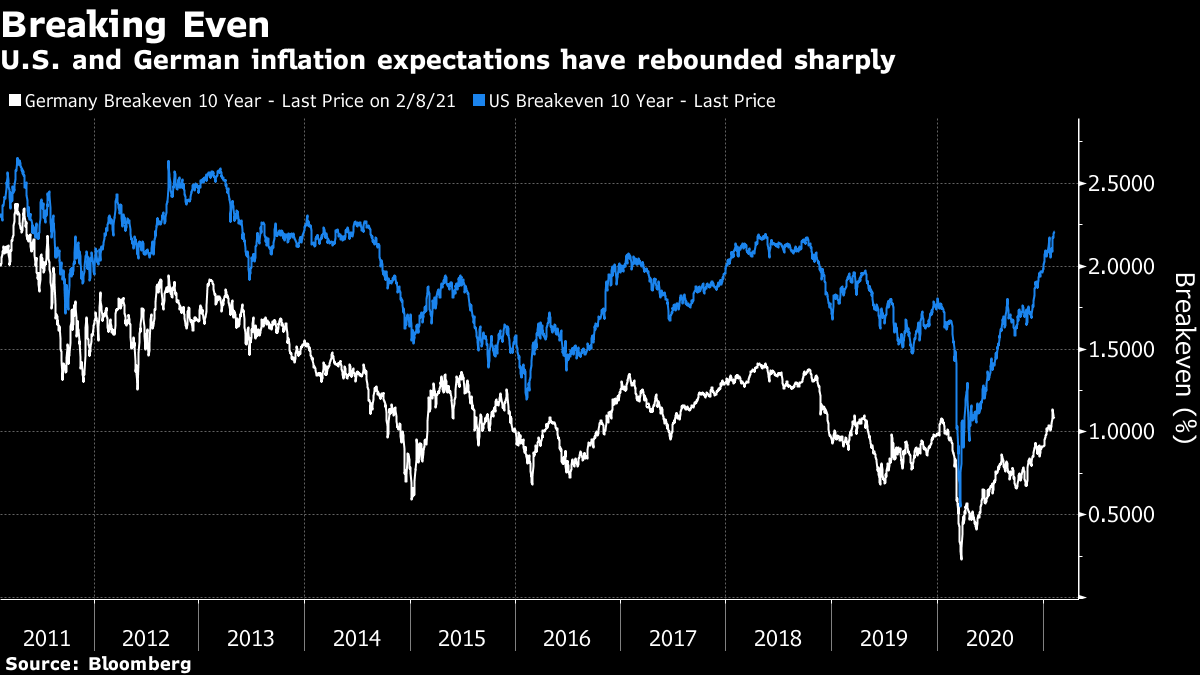
Expectations for inflation are breaking upward, as are stock markets. In the U.S., 10-year inflation expectations are their highest since 2014, at just above 2.2%. German inflation expectations are also rising sharply, but the gap between the two is now the widest it has been since the global financial crisis in 2008:


Rising inflation can be a problem, but it can also be a symptom of growth. The strength of the stock market suggests that investors are looking solely at the good side for now. And that, as ever, can be explained by the bond market, which continues to give equity investors room to operate. As Brian Chappatta notes elsewhere, the yield on the 30-year bond is now above the round number of 2%; but what really matters is the way that real yields, taking account of inflation, have moved. And they have barely moved at all. This is the yield on 10-year Treasury inflation-protected securities:
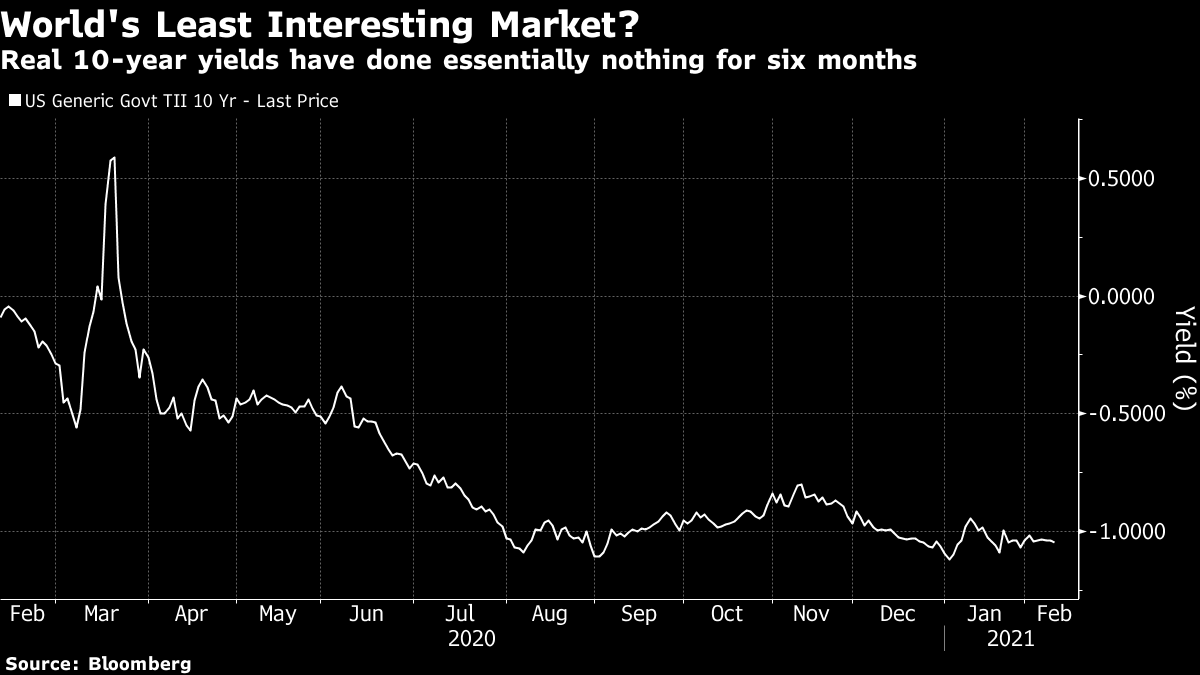


There has been a huge change in inflation expectations since last summer, and it has had no effect whatever on real yields. This allows stocks and alternative assets like bitcoin to flourish. The reason inflation-protected yields can stay stable is that investors are confident the Fed really will allow inflation to “run hot” — meaning that it will average above 2% for a while — and that inflation in turn won’t take off in a serious way to levels of or 4% or 5% or beyond. If that were to happen, the Fed would have to raise rates, and people buying bonds at current prices would lose a lot of money.

If the market is correct about this set of assumptions, then we have about as perfect a set of conditions for equities and risk assets in general as one could ask. Are they right?

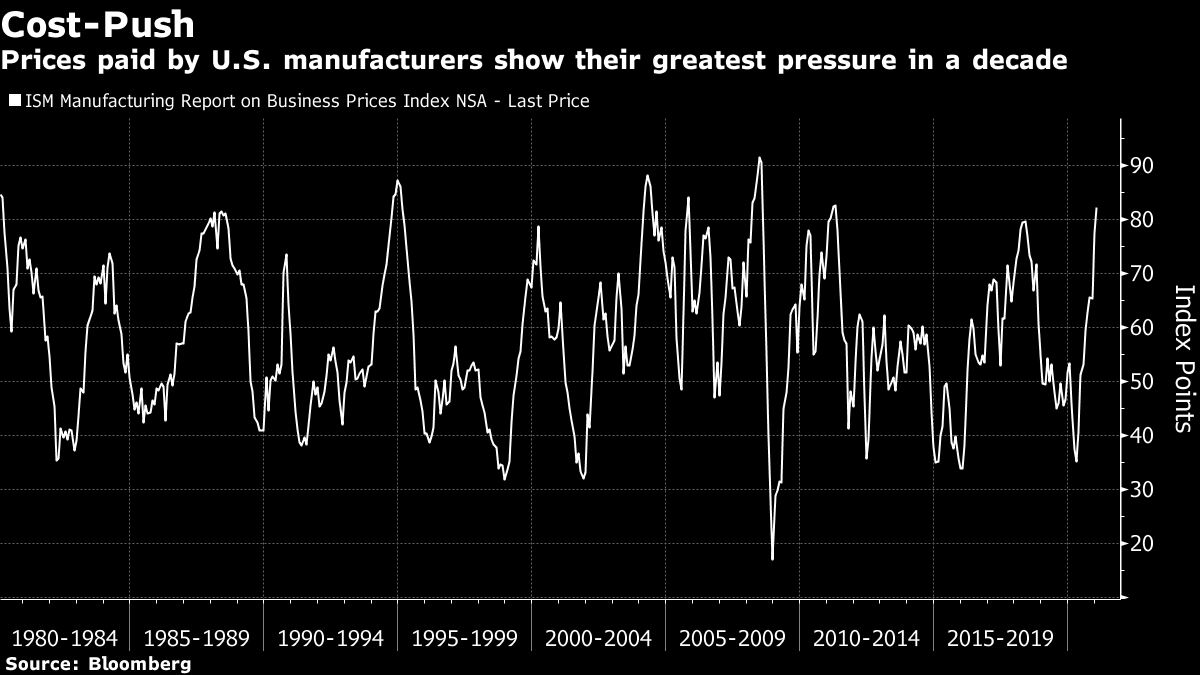
Recent macro numbers suggest that inflation pressures are worryingly high, even if they have not yet broken out. Prices paid by manufacturers, as measured by the ISM survey, are showing the greatest pressure in almost a decade:


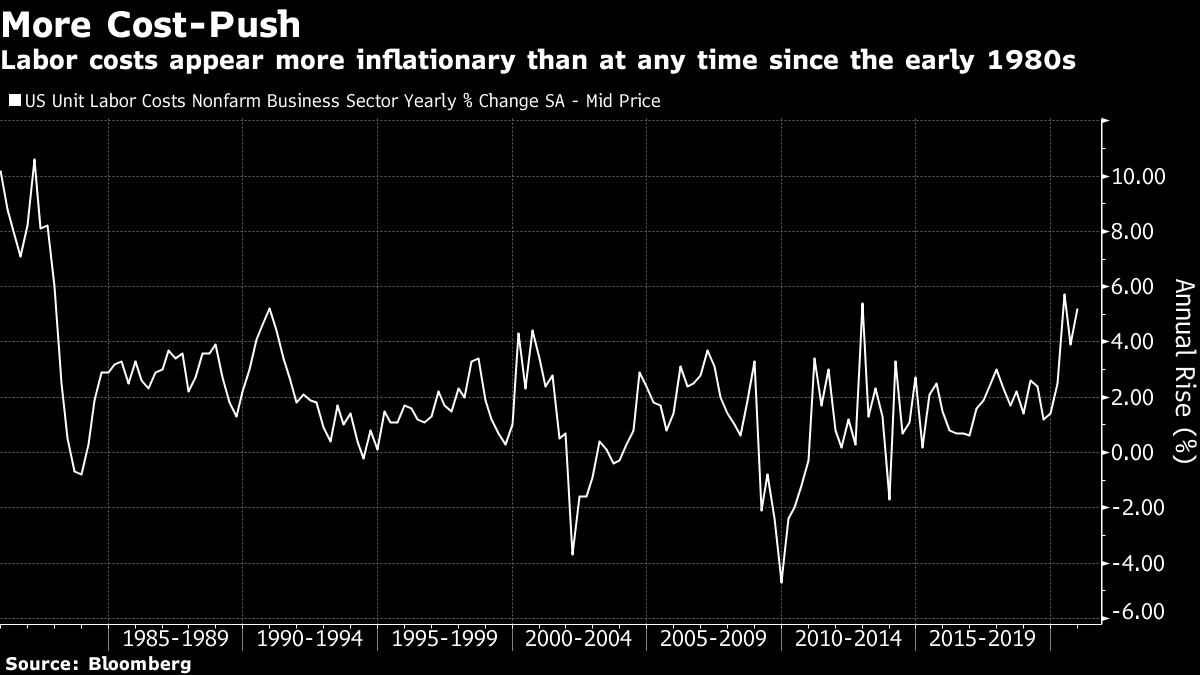
Meanwhile, unit labor costs, measured quarterly, also suggest that labor is getting more expensive, in a way that hasn’t been seen in decades:


So is the market really right to be so confident that inflation will remain under control?

Handily, the next installment of the Bloomberg book club will be addressing the issue in a live blog on the terminal tomorrow at 4 p.m. London time/11 a.m. New York time. We will be discussing The Great Demographic Reversal by Charles Goodhart and Manoj Pradhan, which makes a long and persuasive argument that the market has it wrong, and inflation is due for a secular increase.
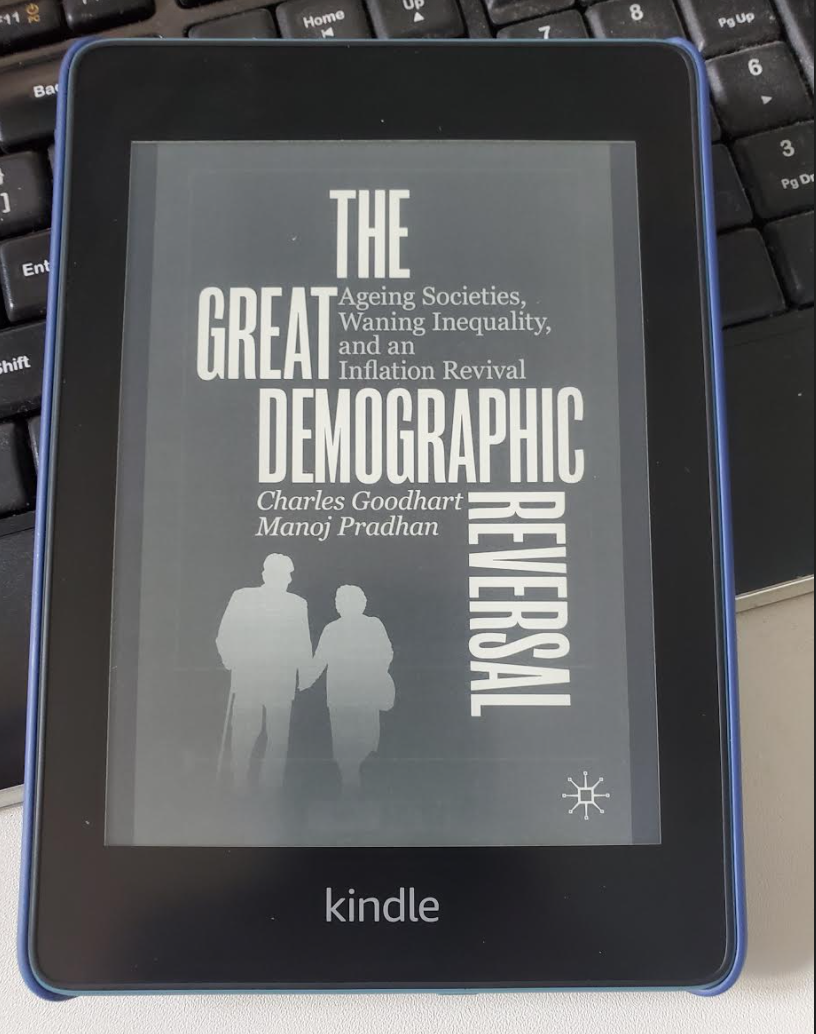


If you haven’t read it yet, you won’t have time to complete it, but it will still be worth following the discussion, which will involve Pradhan, along with me, my colleague Stephanie Flanders, and Barclays Plc’s chief U.S. economist Blerina Uruci. If you have time, try to pick up a copy and read just chapter five. That has the kernel of their argument that the current demographic shift, which is seeing the relative number of retirees and dependents increasing after several decades in which the world’s working age population steadily rose, will lead to higher inflation.

Their case is that with fewer workers, labor will have greater negotiating power. As the employed will have to pay more and more in taxes to look after the elderly, they will use that negotiating power to gain higher wages, which will lead to inflation.

The main reason others differ from the Goodhart and Pradhan thesis, I think, is that there is a belief that the retired won’t be allowed to become so expensive. Pension benefits will be trimmed back, the retirement age will rise, and the working generation will win a little back from the older generation, rather than having to take it from their employers through collective bargaining. If this happens, the effect of aging will be yet more disinflation, as the workforce continues to expand and everyone feels an even greater need to save.

Arguing against the Goodhart/Pradhan thesis is the intergenerational fury that is widespread at present, and obvious in the attempt by the Redditors who took part in the short squeeze of GameStop Corp. to get back at “boomers.” With good reason, millennials feel a simmering sense of injustice when they look at the luck of the baby boomers. This could lead to higher retirement ages and so on.

Arguing in favor of Goodhart and Pradhan is the extreme difficulty countries around the world have found when they have tried to reduce pension benefits. The recent sudden breakdown of social order in Chile was largely triggered by anger over inadequate pensions, for example. Last year, Emmanuel Macron in France tried and failed to raise retirement ages, giving up in the face of widespread protests.

Here is perhaps the crucial passage in the book:

If we are right in our political economy assumption that the social safety net will remain in place, then the age profile of consumption will continue to be flat or even upward sloping. The elderly will depend on (and vote for) government support and continue to save too little for the longer life they have inherited. The ineluctable conclusion is that tax rates on workers will have to rise markedly in order to generate transfers from workers to the elderly.

Workers, however, would not be helpless bystanders. Labour scarcity… will put them in a stronger bargaining position, reversing decades of stagnation… They will use that position to bargain for higher wages. This is a recipe for recrudescence of inflationary pressures.

The world is still not ready to think about the inflation that is likely to rise structurally. Central banks will, soon enough, have to revert to their normal behavior. The zero lower bound is largely consequences of a combination of a China effect, an unprecedented demographic backdrop and the deepest cyclical shocks since the Great Depression, once during the financial crisis and more recently during the pandemic.

Are they right? To follow as Pradhan defends this thesis, go to TLIV on the terminal on Wednesday. Send any questions beforehand or during the live blog by email to authersnotes@bloomberg.net.

Mario to the RescueMaybe this is what Mario Draghi meant when he said he would do “whatever it takes” to save the euro. Back in 2012, as a freshly installed chairman of the European Central Bank, Draghi’s promise finally convinced the markets that the euro zone could muddle through its sovereign debt crisis. By the time a populist Greek government attempted to call the European Union’s bluff, three years later, enough order had been restored that the EU could cow them into submission.

What was surprising was that the markets never attempted to call Draghi on his pledge. The chart below shows the spread of Italian over German 10-year bond yields, the clearest measure of the perceived extra political risk attached to Italy. The yellow line marks Draghi’s speech. Italian spreads have never since approached their level of the summer of 2012; as ECB chairman, Draghi was spared from having to show whether he was prepared to go through with his vow in the event of a speculative attack.
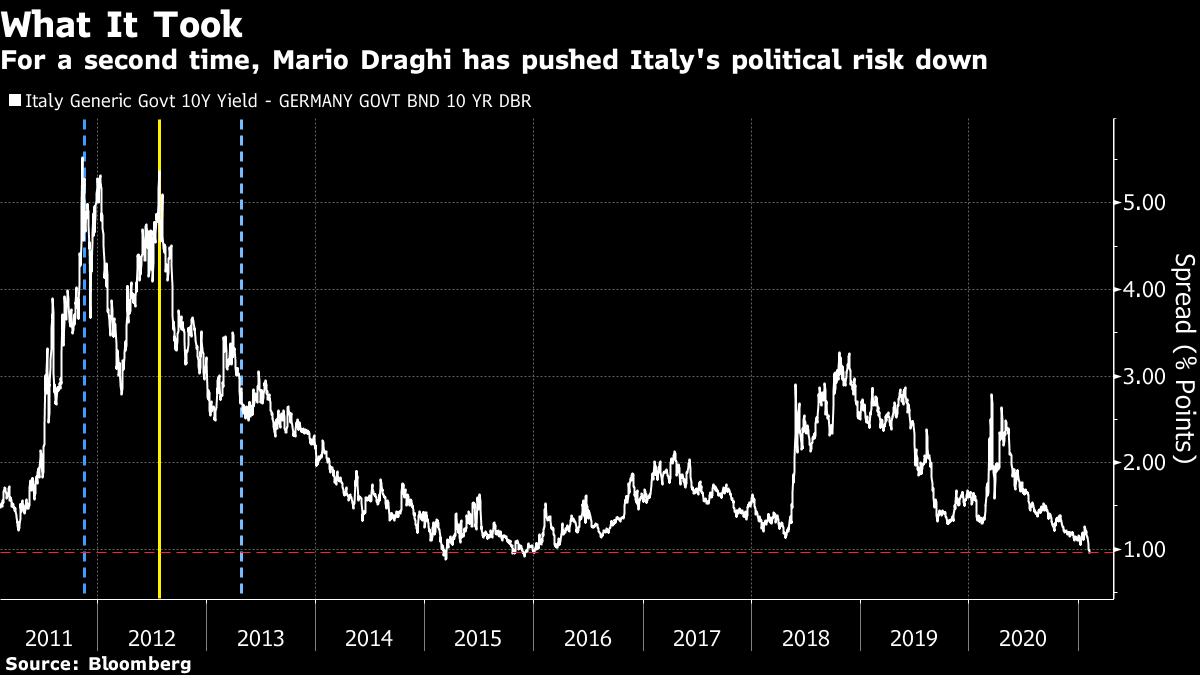


Now, however, it looks as though the debt is coming due. Italy’s last general election was in 2018, and resulted in a bizarre coalition between the left-populist Five Star Movement, and the right-populist Lega. That sent the spread over bunds flying higher, as one of the few things the two parties had in common was their anti-Europeanism. Now, after a botched confrontation with the EU over Italy’s budget deficit, the exit of the Lega from the coalition, and a dreadful pandemic, we are in the outlandish position where Giuseppe Conte, prime minister since 2018, has resigned, and the only person all parties seem to agree on as a new premier is Draghi. While he may be one of the most famous and internationally respected of living Italians, Draghi also happens to be one of the most strongly pro-European. He also happens not to be an elected politician.

Some thoughts on this. First, political science and particularly political institutions are more important to investing than many realize. What has just happened is the equivalent of President Biden and Vice President Kamala Harris standing down because they can’t get their policies through, and the parties in Congress coming together to make Ben Bernanke president. In other words, this just couldn’t happen in the U.S. Whether that is a good or a bad thing, I leave up to you.

Is it good for Italy? The country has done this kind of thing before. The blue lines show the premiership of another Mario, Monti, who had previously been a European commissioner, and was called in to act as premier in the wake of the toppling of the populist Silvio Berlusconi. His appointment briefly calmed the markets; but he still needed Draghi’s intervention to vanquish the speculators, and his premiership was over within two years.

Draghi has the job of spending money that the country receives in Covid relief, rather than Monti’s miserable task of overseeing austerity. And his presence at the center of the EU sharply increases the chances that it can thrash out a way to make some kind of a common fiscal policy work. This will be seen as a sharp reduction in risk for the euro zone as a whole, and with some justification.

Investors might remind themselves, however, that Italy’s voters will get their say in 2023, if not before. Draghi might not be able to face them down as easily as he faced down the markets in 2012.

Survival TipsYou never know what music will raise your spirits. My daughter Andie has persuaded me to listen to the music of Hozier, the young Irish musician best known for his debut hit Take Me to Church, an angry attack on intolerance in general, and the Catholic church in particular. Some of his other songs, however raise a smile. My favorite is Jackie and Wilson; it’s infectious. For an explanation of the underlying philosophy, Hozier handily explains it here. Alternatively, there is Someone New, or Moment’s Silence, which sounds religious, and isn’t. He has a soulful and original voice and I’ve enjoyed listening to him.

This column does not necessarily reflect the opinion of the editorial board or Bloomberg LP and its owners.

To contact the author of this story:
John Authers at jauthers@bloomberg.net

To contact the editor responsible for this story:
Matthew Brooker at mbrooker1@bloomberg.net

Before it's here, it's on the Bloomberg Terminal.
LEARN MORE

Sent from my iPad


To: Snowshoe who wrote (168316)2/9/2021 7:34:00 AM
From: TobagoJack  Respond to of 218898
 
Re <<Short squeeze>>

Of course, it can also be argued that anyone not long DOGECOIN is effectively short it

bloomberg.com

Dogecoin Hits Another Record After Musk, Snoop Dogg Tweets
Eric Lam
February 8, 2021, 1:38 PM GMT+8
Dogecoin, the tongue-in-cheek cryptocurrency featuring a Shiba Inu dog as a mascot, briefly touched a record Monday after billionaire Elon Musk, rapper Snoop Dogg and Kiss bassist Gene Simmons tweeted about it.

The token climbed to a peak of about 8.2 U.S. cents and a market capitalization of $10.5 billion Monday before pulling back, according to pricing data from CoinGecko. The coin was ranked among the top 10 cryptocurrencies by market value, the figures showed. Bitcoin surged to a record after Tesla Inc. disclosed that it had purchased $1.5 billion of the cryptocurrency.

Wealth For You

Help us deliver more relevant content for you by telling us about yourself. Answer 3 questions to tailor your experience.

Dogecoin’s surprising social media-fueled rally is just one instance of the revival in cryptocurrencies over the past year. The two biggest tokens, Bitcoin and Ether, both scaled fresh peaks in recent weeks amid a debate about whether they’re blipping onto the radar of long-term investors or being lifted by waves of speculative buying in a world awash with stimulus.

Famed fund manager Bill Miller has reserved the right for one of his portfolios to indirectly invest in Bitcoin via the Grayscale Bitcoin Trust, according to a filing with U.S. regulators. Miller is one of Bitcoin’s earliest proponents among well-known investors, saying in 2014 he owned the cryptocurrency personally.

Bitcoin was trading at about $43,824 as of 10:04 a.m. in New York, after surging to a record $44,795. Ether traded near an all-time high amid the start of trading in CME Group Inc. futures contracts.


Musk, the richest person in the world, has tweeted multiple times about Dogecoin recently. Snoop Dogg pinned a tweet with “Snoop Doge.” Simmons, a member of the American rock band Kiss, pointed out how much people could have made if they had purchased Dogecoin earlier.

Speaking on social audio app Clubhouse on Feb. 1, Musk said he’s a supporter of Bitcoin and thinks it’s “a good thing.” He added that his comments on Dogecoin were meant as jokes.

(Adds Tesla purchase of Bitcoin in the third paragraph.)

Before it's here, it's on the Bloomberg Terminal.
LEARN MORE

Sent from my iPad


To: Snowshoe who wrote (168316)2/9/2021 7:37:13 AM
From: sense  Respond to of 218898
 
Charts should make it pretty obvious that shorts who are forced out of a trade... will simply reverse the field... thus help drive the price irrationally higher than it would be otherwise... and then seek to short it back down from the artificially higher peak ? How much money is actually lost... by the shorts... on a trade like that ? Probably depends only on how deep the shorts pockets are. Get caught without sufficient liquidity to enable reversing field in the trade, running the stock up, instead of down... and then you might see shorts... taking it in the shorts. But, smart traders won't be caught left that ill-liquid... that they can't bail out of a blown up trade... and still win the trade by reversing field ?

Otherwise, unless it does take a player out, I don't see much evidence that a squeeze thus engineered actually changes anything ? All it really does is increase volatility in the short term... and increase the profits of traders with the skills to navigate the volatility and win their trades ? I think "the little guy beating Wall street" narrative... helps them line up more sheep for the fleecing... as the Robinhood traders fight for social justice by buying high and holding... losing all their money to better traders... but still lose money while feeling good about having done it ?

What a remarkable new wrinkle in trading... having the losers think they won something important... by losing.


To: Snowshoe who wrote (168316)2/9/2021 7:41:20 AM
From: TobagoJack  Read Replies (1) | Respond to of 218898
 
Re <<Short squeeze>>

Back to the drawing board ...

bloomberg.com

Redditors’ Plan to Use GameStop Playbook for Glove Makers Unravels

Abhishek Vishnoi
February 9, 2021, 1:23 PM GMT+8

A bid by Malaysian amateur investors to pull off a short squeeze-fueled rally in glove makers is fizzling out, just like the one by their American peers in GameStop Corp.

Shares in Top Glove Corp., the sector’s bellwether and Malaysia’s most shorted stock, have given up the gains it made since some investors started Bursabets, a Reddit community idealized after r/wallstreetbets to defend Malaysian stocks. Top Glove topped the sell list for retail investors for the week ended Feb. 5, a report by CGS-CIMB Securities Sdn. showed. And short positions have started inching up again.

From its start on Jan. 28, the online forum was up in arms with a rallying call: support medical glove makers whose shares had come under pressure from short sellers following their meteoric gains in 2020. The forum now has almost 13,000 members.


Now those calls to buy and hold them are falling on deaf ears for three key reasons.

Slowing virus infections and global vaccine rollouts are instilling confidence that the pandemic’s end is in sight and therefore the extraordinary demand for gloves is set to ease.The frenzy in American stocks popular with Reddit crowds has itself started to come crashing down. GameStop’s shares dropped 5.9% in New York trading, adding to last week’s 80% plunge, a drop that followed three weeks of dizzying gains.Malaysia, like many other Asian markets, limits the amount of short selling that can happen on a stock. So technically there weren’t any gigantic short positions in glove makers to begin with.Top Glove fell below its pre-Bursabets level in Kuala Lumpur trading as of 3:59 p.m., set for a fifth day of declines, its longest losing streak since Nov. 4. Among its peers, Supermax Corp. fell below that level on Monday while Hartalega Holdings Bhd. is about 2.4% away from reaching that zone. These stocks had been one of the biggest beneficiaries of the pandemic last year.

(Updates stock performance in second and last paragraph.)

Before it's here, it's on the Bloomberg Terminal.
LEARN MORE

Sent from my iPad


To: Snowshoe who wrote (168316)2/9/2021 8:08:20 AM
From: TobagoJack1 Recommendation

Recommended By
sense

  Read Replies (1) | Respond to of 218898
 
Re <<Short squeeze>>

bloomberg.com
Disappointed GameStop Traders Should Take These Lessons to the Next Mania
Suzanne Woolley
February 8, 2021, 9:09 PM GMT+8

To judge by the Reddit-fueled rollercoaster ride in shares of GameStop Corp., AMC Entertainment Holdings Inc. and silver, you might think investing is supposed to be exciting, the financial world’s equivalent of a stadium packed with screaming Super Bowl fans. And financial planners are killjoys — diversify holdings, don’t chase hot stocks, don’t try to time the market. Where’s the fun in that? The sense of being part of something bigger?

The advice may not seem quite so fuddy-duddy now that GameStop’s shares have fallen rudely back toward earth. That said, investors who have entered the stock market for the first time in the past year or so do remain part of something greater: They have written themselves into financial history books, for better or worse. One unfortunate fact that history shows us, however, is that we humans have a long pattern of not really learning from our mistakes.

With that in mind, Bloomberg asked financial planners — and Robinhood traders — what long-term lessons they took from the short-term mania.

If you were left holding the bag when GameStop shares closed at $63.77 on Friday, here are some things to keep in mind next time:

Don’t get greedy. “Be the blackjack player who says: ‘You know, I’ve been doing quite well tonight. I’m going to go to the cashier right now, cash in two-thirds of my chips, and then come back and play some more, though with fewer stakes on the table,’” said financial planner George Gagliardi of Coromandel Wealth Management in Lexington, Mass. “Be the person who gets up before the movie is over and quietly makes their way to the exit door before everyone else does.”

Put another way: “You never go broke taking a profit,” said Ian Weinberg of Family Wealth & Pension Management in Woodbury, N.Y. You do, however, pay capital gains taxes. If that’s stopping you, Weinberg suggests at least rebalancing tax-deferred accounts like IRAs or 401(k)s. Rebalancing distances you a bit from the herd instinct, since if your stock position has gone way up, you’re selling while the stock is on an upswing. Which is the opposite of what many newer investors do, which is buy near a top and sell near a low.

Beware of trying to time the market. Market timing requires not just picking a top but knowing when to get back in. Market timers who pulled their money out of the stock market at or near the March 6, 2009, market bottom and stayed in cash for a year or two paid a big price. One year later, the S&P 500 was up 66.6% and by March 2011, it was up 93.4%.

“Understand that market volatility is the cost of long-term capital growth,” said Ajay Kaisth of Princeton Junction, N.J.-based KAI Advisors. “Who would have guessed that in 2020 we would have experienced the fastest bear market in history — 16 days for the S&P 500 to close down 20% from a peak — only to be followed by the best 50-day rally in history?”

Get real about risk. Our perception of how much risk we can stomach can be colored by our recent circumstances. “This is especially true when markets are on the upswing,” said financial adviser Peter Palion of Master Plan Advisory in East Norwich, N.Y. “It’s like, yesterday the Dow was up, and it was up a week ago, and up a month ago, and therefore it will continue ad infinitum, and it makes me forget how I really feel about risk.” The technical term for how our brains tend to project short-term results onto the future: “recency bias.”

A good litmus test for how much risk you can tolerate is to weigh the impact of any missed upside versus potentially devastating losses. Think about how you’d feel if you had a less aggressive portfolio and missed out on some potential upside of a booming market, versus how you’d feel if your portfolio fell 40%, Gagliardi said. If you’re young, that may not faze you: You could pick up some bargains, after all. If you’re nearing retirement, though, you might have to move your retirement date out 10 years to make up for the loss.

Being overly conservative could mean missed opportunities. Jacob Remian, who began trading a year ago on Robinhood, said his biggest regret was looking at GameStop in June and July when it was trading near $4 a share and convincing himself that the company was dead. “Had I let my inner child ride, I might not have missed a big opportunity for growth,” said the 34-year-old graphic designer. “Sometimes our brains get the better of us for the sake of security, but with no risk there’s no reward.”

Don’t fall in love with a stock. Some investors in GameStop are now lamenting the fact that they got pulled into a “cult mentality” and hung on to the stock for too long. Professor Terrance Odean, of the University of California-Berkeley’s Haas School of Business, ran a classic study in the late 1990s looking at the “disposition effect,” which he described as “the tendency of investors to hold losing investments too long and sell winning investments too soon.” With the exception of December, when people are thinking about the end of the tax year, Odean’s paper found that individual investors “realize their profitable stocks investments at a much higher rate than their unprofitable ones.”

Going with the herd on a popular stock can be fun, but figuring out when to sell is hard if you haven’t set any rules. “I regrettably dabbled into the hype train, and while I haven’t lost big like some, I realized how important exit strategies can be,” Remian said. Some people sell when a stock has appreciated beyond a certain amount or has underperformed compared with peers for a few quarters in a row.

Focus on what you can control. Markets are unpredictable, but you can diversify across asset classes, industries and geographies, rebalance your portfolio regularly and trade in a tax-smart way. Not keeping short- and long-term capital gains in mind when trading can lead to unhappy realizations come tax time.

Also, if you invest in funds, really know what you own: Look at the top stocks in your funds to see if there’s a lot of overlap with your other funds. With a handful of mega-cap tech stocks making up 25% of the S&P 500, many people may have a lot riding on just a few stocks in essentially one industry.

Not understanding how your funds are invested can bring nasty surprises. In 2008, investors who were just a few years from retirement saw their 2010 target-date funds fall more than 20%. The funds, it turned out, were more heavily invested in stocks than many savers realized.

Before it's here, it's on the Bloomberg Terminal.
LEARN MORE

Sent from my iPad

