this is funny, w/ backdrop of fiat money inflation in France bellowing by the fan
bloomberg.com
Dogecoin’s Creator Is Baffled by Meteoric Rise to $9 Billion
Brandon Kochkodin
12 February 2021, 02:19 GMT+8
Imagine you’re the founder of a multibillion-dollar enterprise. Got a big house? Check. Vacation on an exclusive Caribbean island? Keep the drinks coming. Fast cars? Yeah, got to have those.
How about a used Honda Civic instead?
That’s what Billy Markus, the software engineer who created Dogecoin, the cryptocurrency based on the meme of a smiling Shiba Inu, bought when he cashed in his chips in 2015 after growing weary of harassment from the crypto community’s zealots. Unlike Bitcoin, there is no limit to the amount of Dogecoin that can be created in the so-called mining of the coin.
Now that Dogecoin has reached an unfathomable market capitalization of $9.1 billion -- about as much as Dropbox Inc. or Under Armour Inc. -- on the back of a dizzying 1,400% year-to-date Reddit-fueled rally from half a penny to seven cents, Markus just wishes people would realize he’s no longer part of the project and can’t limit the coin’s supply to help make them rich.
Markus took to the Dogecoin subreddit forum Monday to clear up his involvement, or lack thereof, in the project.
“I’m no longer part of the Dogecoin project, I left around 2015 as the community started to strongly shift from one that I was comfortable with,” Markus wrote in an open letter. “I don’t currently own any Dogecoin except what has been tipped to me recently, I gave away and/or sold all the crypto I had back in 2015 after being laid off and scared about my dwindling savings at the time, for about enough in total to buy a used Honda Civic.”
Markus, 38, who now works as a software engineer for an education company in the San Francisco Bay Area, told Bloomberg Wednesday that Dogecoin and the mania it’s spawned is surreal to witness considering he and fellow co-founder Jackson Palmer created the token as a joke.
“I see this random crap on the internet saying I have all this money. That’s cool, but where is it?” said Markus. “I’m a normal working person. I’m not in trouble or anything, but I’m not rich.”
That he hasn’t participated in the craze that has engulfed his creation has left Markus in a unique position to assess what exactly it is that’s going on. Which isn’t to say that he can explain it either.
“I’m half detached, but it’s weird that something I made in a few hours is now part of internet culture,” said Markus. “It’s amusing to see Elon Musk talk about it. It feels silly, but there’s this huge upwelling behind it.”
Musk has repeatedly tweeted support -- perhaps in jest, perhaps part of his cultivating an image as a real-life James Bond villain -- for the coin. The Tesla Inc. chief executive officer’s tweet on Wednesday informed his followers that he bought some of the coin for his young son so that he can be a “toddler hodler.”
How and why the cryptocurrency has run so far, so fast is a mystery even to Markus. The frenzy, the tweets of support from the world’s richest person, none of it makes sense to Dogecoin’s creator.
“Maybe it’s that Dogecoin can be a good barometer for how far from reality things can get,” said Markus.
Lindy EffectBut for all the silliness surrounding Dogecoin’s rise -- owners of the coin banded together to sponsor a Nascar entrant back in 2014 -- and the head-scratching attempts to explain it, one rationale stands out: The Lindy effect, a phenomenon popularized in the works of Nassim Nicholas Taleb.
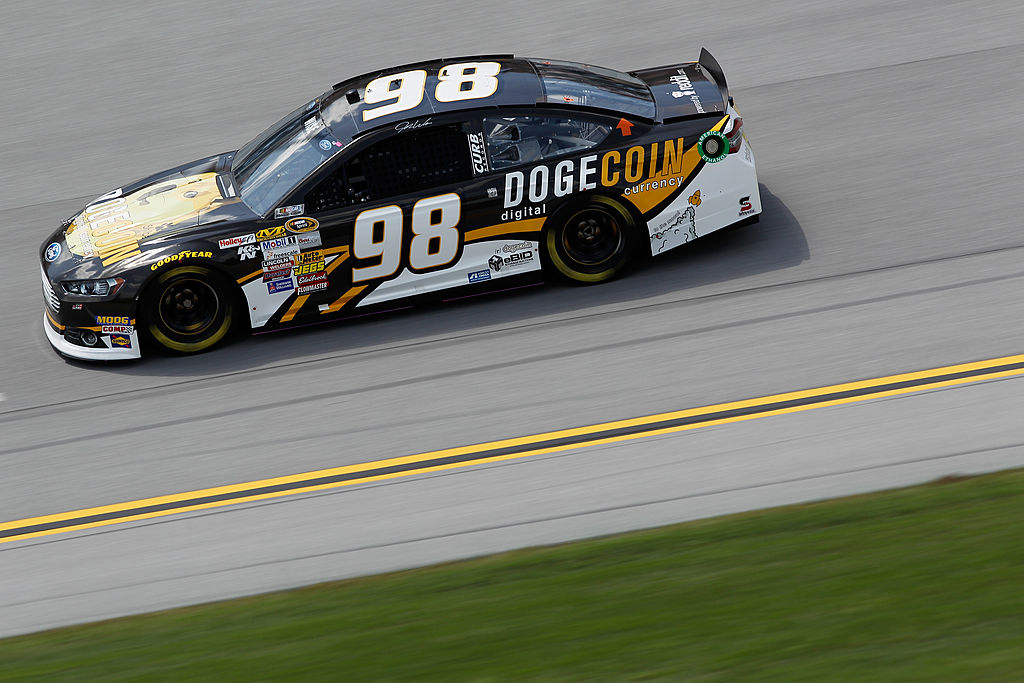
Josh Wise, driver of the #98 Dogecoin / Reddit.com Ford, on track during practice at Talladega Superspeedway.
(Photo by Brian Lawdermilk/Getty Images)
The Lindy effect is a rule of thumb that says the remaining lifespan for a non-perishable item, like say how long a book will remain in print, is equal to how long it has been in existence. The idea boils down to this: the older something is, the more likely it is to continue to survive the tests of time.
Dogecoin was created in 2013, making it downright elderly in crypto-terms. According to the Lindy effect, its more than seven years of survival, with much of that coming through the so-called crypto-winter when prices plunged in 2018, is a sign of resilience and evidence that it’s more than just a fad.
Mania or not, Markus is happy with the good that has come from the Dogecoin community. In addition to the Nascar sponsorship, individual owners raised funds for the Jamaican bobsled team to attend the 2014 Winter Olympics in Sochi, Russia, and helped reimburse those who lost money in a 2013 Christmas day wallet hack.
“If this is my contribution to the world, it’d be nice to offset all the burning of fossil fuel used to mine the currency,” he said about Dogecoin enthusiasts’ philanthropic efforts.
As for his own personal finances, Markus stays clear of get rich quick schemes, opting for a far more vanilla strategy.
“I’m pretty risk averse, I just put everything in an S&P 500 Index fund or Wealthfront,” said Markus.
(Adds Dogecoin price in fourth paragraph.)
Before it's here, it's on the Bloomberg Terminal.
LEARN MORE |



