SI
SI
discoversearch

We've detected that you're using an ad content blocking browser plug-in or feature. Ads provide a critical source of revenue to the continued operation of Silicon Investor.  We ask that you disable ad blocking while on Silicon Investor in the best interests of our community.  If you are not using an ad blocker but are still receiving this message, make sure your browser's tracking protection is set to the 'standard' level.
Strategies & Market Trends : 2026 TeoTwawKi ... 2032 Darkest Interregnum -- Ignore unavailable to you. Want to Upgrade?


To: Follies who wrote (169535)3/16/2021 3:43:13 PM
From: Maurice Winn  Read Replies (2) | Respond to of 218842
 
While planning my Cybermoney 20 years ago, the first assumption I made was that murder, war, hacking, seizure, illegality etc would all be brought to bear without a qualm by USA and subordinates.

It seemed very like Christianity vs the Roman Empire = crucifixion and feeding to lions would be the primary method of enforcing the state against peer to peer people.

My initial criticism of bitcoin included the waste of energy and processing power required and the unecessary data entranced in the blockchain.

Those criticisms proved valid. And even more so than I expected because the mining operation is increasingly focused on huge megawatt mining supercomputer centres which can be identified and bombed easy peasy. If spread over millions of Cyberphones, resilience would go full Christian or Jihad = individual versus totalitarian state.

Mqurice


To: Follies who wrote (169535)3/16/2021 4:18:31 PM
From: TobagoJack  Respond to of 218842
 
It is a USA national security issue, according to some, w/r to TikTok, and therefore BTC, presumably

It is a India national competition issue, according to others, w/r to BTC, but a security issue w/r to TikTok

Etc etc

Would say there is definitely a mess, understandably

What fun :0)

bloomberg.com

What’s India’s Beef With Bitcoin, Really?New Delhi is sending confusing signals on its long-awaited cryptocurrency policy, which could leave it trailing way behind China’s virtual money plans.
Andy Mukherjee
March 16, 2021, 7:00 AM GMT+8
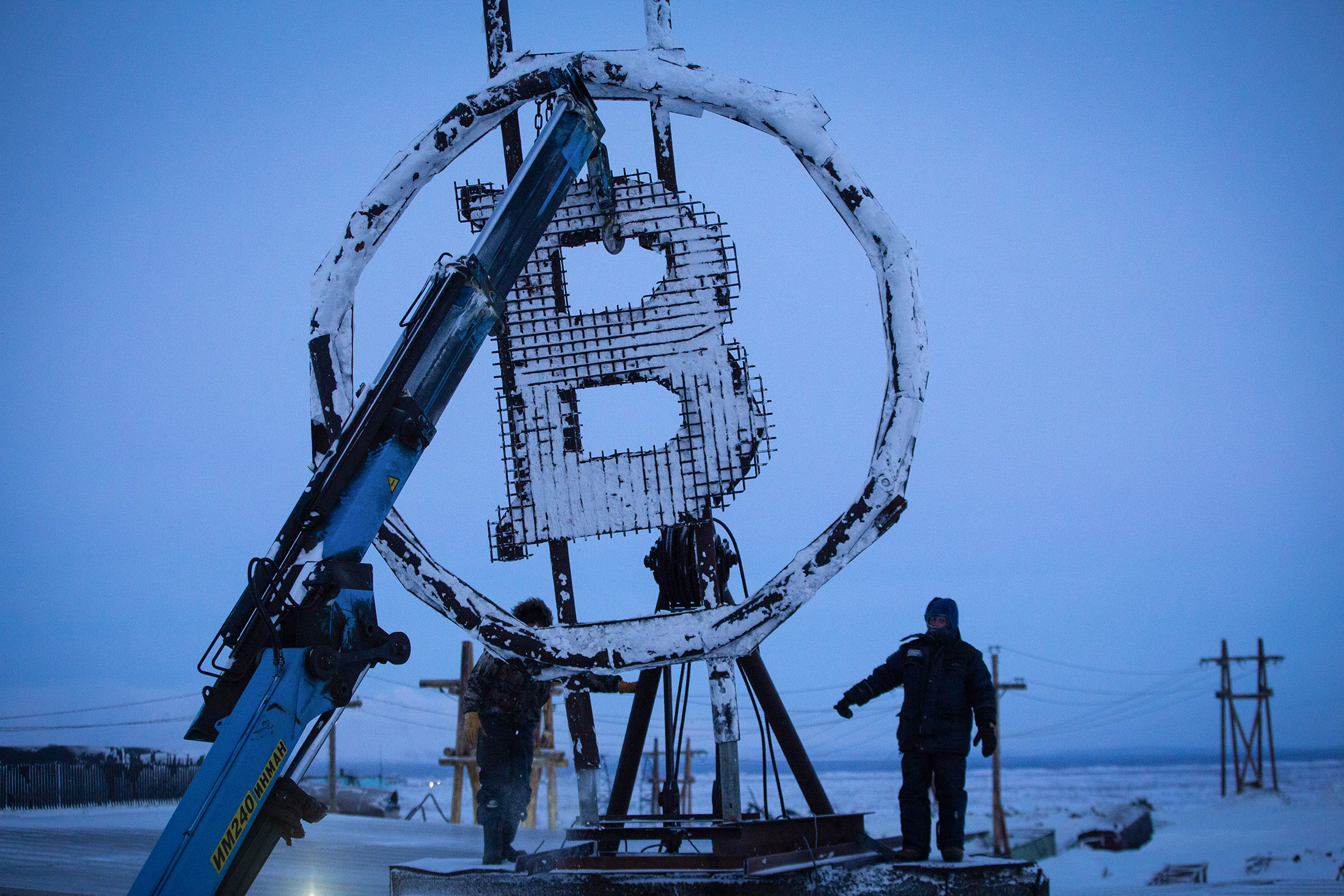


Installation of Bitcoin art object at BitCluster cryptocurrency mining farm in Norilsk, Russia, Dec. 20.

Photographer: Andrey Rudakov/BloombergContradictory statements and media leaks are making it impossible to get a handle on India’s soon-to-be-unveiled cryptocurrency policy. The uncertainty is throwing young blockchain firms and programmers into a paroxysm of anxiety: Should they leave or stay? If they hang back, should they do something else with their lives?

On Sunday, the global crypto industry heaved a sigh of relief when Finance Minister Nirmala Sitharaman categorically ruled out a much-feared blanket ban, promising to allow a window for people “to do certain experiments” using distributed ledger technologies, Bitcoin and other virtual currencies, she said at an India Today conclave.

But before the ink could dry on the congratulatory press releases from entrepreneurs, Reuters cited an official with direct knowledge of the plan as saying that the new law will “criminalize possession, issuance, mining, trading and transferring crypto-assets.”

That will be nothing short of a second existential crisis in three years. India’s crypto evangelists fought a brave legal fight — a couple of them even went behind bars for a short while — against the monetary authority’s 2018 diktat to banks, telling them not to allow anyone dealing in digital assets to operate an account. Last year, the nascent blockchain industry won when the country’s highest court set aside the Reserve Bank of India’s order.

Optimism started to rebuild, and surging Bitcoin prices began to lure millennials. When it comes to transferring Bitcoin and other digital assets, India is of late providing more volume than China on popular peer-to-peer platforms.

The risk that India would hit back with a new law to make criminals out of crypto professionals and investors was always present. So practitioners tried to educate policymakers, appealing for sensible regulation starting with definitions for what is a utility token, which digital asset is to be viewed as a security, and which is to be treated as a currency.

The Smaller Market Has Caught UpIndia's weekly volume share of peer-to-peer transfer of cryptocurrencies on the Paxful platform is slightly more than China's now

Source: Coin Dance

*The price of 1 BTC on March 15 was approximately $60,000

The trouble is with bureaucrats. They say they want blockchain, but not cryptocurrencies. It’s as silly as wanting airports with duty-free shops but no flights. From the Reuters story, it doesn’t appear that the final regulation will be much different from what a draft bill had recommendedin 2019. A government panel report, which had provided the backdrop for the draft legislation, said that authorities would be fine with distributed ledger technologies for delivery of any services, or “for creating value,” without involving cryptocurrencies “for making or receiving payment.”

Such a dichotomy will be messy in practice. Take international money transfers, where costs pile up because of payment messages that have to laboriously jump national borders by using correspondent banks. To provide value, the service provider will need to employ virtual payment tokens, something that the Philippines and Bangladesh are already allowing. India, the world’s largest recipient of overseas remittances, won’t want to miss out.

To see where India might be going with its policy flip-flops, consider something else Sitharaman said at the conclave. A lot of the experiments that fintech firms are doing in blockchain, she said, will be taken up “in a big way” in the offshore financial center in Gift City in Gujarat, Prime Minister Narendra Modi’s home state. A startup meet is planned there, she said.

Opinion. Data. More Data.Get the most important Bloomberg Opinion pieces in one email.

Now, it may be an excellent idea to fill up a ghost town with 20-something programmers since 40-something Mumbai bankers won’t go there. Perhaps even the code writers don’t have to leave behind the city lights of Bangalore and Hyderabad and head for the boondocks. As long as resident Indian investors are allowed to freely park in Gift City some of the $250,000 they’re permitted to take overseas annually, the offshore center could in theory channel some dollar liquidity to the crypto industry. The domestic banking system will steer clear of crypto. The central bank’s sway over the rupee would remain intact.

Such a compromise solution will leave the blockchain industry cold. Yes, there’ll be a sandbox for local fintech to play and learn. But there will be no pathway for enterprises to grow into mature businesses. That’s because when they want to graduate from segregated dollar accounts and enter the mainstream of the domestic economy, they’ll bump up against the crypto ban — if there’s one in place.

It’s unclear how exactly authorities will catch people in possession of virtual currencies. The two obvious chokepoints are banks and the telecom network. If someone is using a VPN service to access the internet, and not buying or selling Bitcoin using an Indian bank account (but earning and spending it peer to peer), the prohibition won’t be enforceable.

Today, the popular person-to-person payment choice is Bitcoin, which isn’t surprising given its $60,000 price tag. After Beijing rolls out its digital yuan in 2022, even the e-CNY could gain international acceptance as a means of payment and store of value. Rather than complain then about Chinese incursions in India’s monetary sovereignty, New Delhi should enact a practical crypto law now.

A regulatory sandbox in Mumbai, where most of India’s financial industry resides, would give the authorities ideas for designing a smart official paperless currency. If they adopt a draconian law out of a fear of money laundering or loss of control on the capital account, transactions will simply go underground. Nobody is asking New Delhi to make Bitcoin legal tender or accept tax payments in it. Just a little tolerance of cryptocurrencies will be enough.

This column does not necessarily reflect the opinion of the editorial board or Bloomberg LP and its owners.

To contact the author of this story:
Andy Mukherjee at amukherjee@bloomberg.net

To contact the editor responsible for this story:
Ruth Pollard at rpollard2@bloomberg.net

Before it's here, it's on the Bloomberg Terminal.
LEARN MORE

Sent from my iPad


To: Follies who wrote (169535)3/17/2021 5:54:10 PM
From: TobagoJack  Read Replies (1) | Respond to of 218842
 
Looks like folks had a good day at the market and bid up BTC whilst at happy hour, and into dinner followed by after-dinner buy

Thanks to your side for a nice handover. Looking bleak for a bit.

Whether silver / gold hit bottom or not is not as important as quickergold not die, simply because of the general setup of the arena. Could all be deck chairs on the Titanic, but the music playing in the ballroom, so must party.

I am not sold on ‘interest rate up to stay there’ even as I subscribe to the theory of monetary inflation, for the empire cannot afford to let any bonds w/ 10 or less years to experience sustained ‘high’ but not-actually-risk-adjusted-high rates, and therefore must at some juncture and might already have tee-ed up curve-control.

Who knows until they allow Powell to say it?

In any case, might the HK boyz locked in home offices deliver back to the NY boyz 59,2xx by my dinner time? Only 5:53 am now. Should be able to.

deribit.com


To: Follies who wrote (169535)3/17/2021 6:08:20 PM
From: TobagoJack  Read Replies (2) | Respond to of 218842
 
The biggest worry re BTC ETF, we are told, is its price volatility, which doesn’t quite ring true, because people buy BTC when they wish for volatility, its draw.

China China China might have something to do w/ it ala TikTok, but unclear to me how exactly BTC governance is actually done

As BTC ‘democratizes’, and the ETFs would help, its price would be pinned at high, then higher, until highest, and volatility would be the almost the same as CHF currency, or more likely, gold.

If no BTC ETF, then why allow ARKK ETF? It is also volatile.

bloomberg.com

Why a U.S. Bitcoin ETF Could Be a Real Thing in 2021
Claire Ballentine
Looking for the adrenaline rush of investing in Bitcoin but without the bother of crypto-exchanges and digital wallets? An exchange-traded fund might appeal, except an investor won’t find one tracking Bitcoin in the $5.9 trillion U.S. ETF universe -- at least not yet. While exchange-traded crypto-tracking products exist in Europe and a Bitcoin ETF opened in February in Canada, U.S. regulators have repeatedly batted down attempts to introduce them, citing concerns about potential manipulation and thin liquidity. Yet with the world’s largest digital coin rallying to new heights and a change of leadership at the Securities and Exchange Commission, the prospect of a first U.S. Bitcoin ETF appears to be rising.

1. What would a Bitcoin ETF look like?ETFs are part of a broader family known as exchange-traded products, though people frequently use “ETFs” to refer to all of them since they are by far the largest and most popular contingent. ETPs trade like stocks and can track (almost) any asset class by directly acquiring the securities or replicating the performance through derivatives. Niche ETPs track everything from cannabis stocks and uranium miners to space-related investments and regular currencies. The largest Bitcoin ETP -- the $2.7 billion Bitcoin Tracker EUR, listed on the Stockholm Stock Exchange -- invests in swap contracts to mirror the cryptocurrency’s returns. The Purpose Bitcoin ETF (ticker BTCC), which debuted in Toronto, invests directly in “physical/digital Bitcoin,” its issuer, Purpose Investments Inc., said. Meanwhile, several U.S. investment trusts follow Bitcoin and are similar to ETFs but with certain restrictions. The Grayscale Bitcoin Trust(ticker GBTC) is physically backed, meaning that it holds Bitcoin. An ETF planned by VanEck Associates Corp. also intends to physically hold the cryptocurrency.

2. Is there demand for an ETF?There’s good reason to think so. GBTC has swelled in size during Bitcoin’s bull run into early 2021, with total assets soaring to more than $36 billion from $1.6 billion a year earlier. The recently launched Bitwise 10 Crypto Index Fund’s (ticker BITW) market capitalization swelled to $1.6 billion in mid-March following its December launch. In Canada, where regulators approved the first Bitcoin ETFs in February, demand has been robust. The Purpose Bitcoin ETF (ticker BTCC), the first of its kind in North America, saw more than $165 million worth of shares change hands at its launch. The ETF accumulated about $530 million in assets less than a month after its debut, according to Bloomberg data.

3. Why would investors pay such premiums?Because buying investment trusts is easier than purchasing the coins themselves. Shares can be bought and sold on brokerage platforms, without the need to set up digital wallets or move money to a crypto exchange. Industry experts argue that the premiums on trust products would dwindle if a Bitcoin ETF were approved. The problem with trusts is, unlike ETFs, new shares can’t be quickly created. For example, only accredited investors can create BITW shares with a minimum initial stake of $25,000. A lockup period bars the sale of new shares for 12 months. The supply constraints helped contribute to those soaring premiums.

4. Why have regulators shunned a Bitcoin ETF?

What's moving marketsStart your day with the 5 Things newsletter.

As well as worries that prices can be manipulated and liquidity is insufficient, there’s also concern that Bitcoin’s famous volatility may be too much for regular investors. Bitcoin’s last three full-year returns were a 74% loss followed by gains of 95% and 306%. The regulator also questioned whether funds would have the information necessary to adequately value cryptocurrencies or related products. There have also been questions about validating ownership of the coins held by funds and the threat from hackers.

5. Who is interested in launching one?After SEC received a request for the VanEck Bitcoin Trust in December, at least three more funds (Valkyrie, NYDIG, WisdomTree) applied within months. Bitwise Asset Management is also seeking to launch a broader cryptocurrency ETF. It’s one of numerous issuers who have already tried to start a Bitcoin ETF, beginning with the Winklevoss twins in 2013. Other attempts were made by Direxion, ProShares, First Trust, Grayscale, WisdomTree and GraniteShares, all without success.

6. What are the current hurdles to approval?The wild price swings -- in early 2021 Bitcoin rose more than 40% then fell 24% before almost doubling -- have reignited worries about exposing ETF investors to such volatility. Furthermore, Treasury Secretary Janet Yellen noted that Bitcoin is an area of concern for terrorist and criminal financing. Critics also say the issues involving industry manipulation have yet to be effectively addressed. Because the amount of Bitcoin is finite, the fear is large holders would be able to move the market.

7. So what are the chances of an ETF this year?Market watchers say they’re improving as Wall Street heavyweights such as Paul Tudor Jones and Stan Druckenmiller adopt the cryptocurrency and the likes of Robinhood and PayPal make it it easier to use and trade Bitcoin. Some crypto fans were encouraged by President Joe Biden’s nomination of Gary Gensler as SEC chairman; Gensler once taught a class at MIT’s Sloan School of Management called “Blockchain and Money.” But he has also acknowledged industry issues with fraud and light regulation. Don’t expect a decision until the new chairman is in place between now and July.

Reference ShelfA beginner’s guide to buying Bitcoin.A QuickTake explainer on Bitcoin and another on the its origin and blockchain. More detailed Q&As cover halving, new flavors of crypto, Bitcoin lingo, security tokens, central banks and digital currencies, China’s moves toward a digital currency, yield farming and decentralized finance applications.Economist Nouriel Roubini argues that the recent rise is a bubble.An article on the rise in Bitcoin ownership concentrated among so-called whales.Two explainers, one aimed at kindergartners and the other a you-too-can-mine-Bitcoin project, plus an exploration of the double-spending problem.A Gensler-Led SEC may end the wait for a Bitcoin ETF.It looks like Wall Street is running Bitcoin -- at least for now.

Before it's here, it's on the Bloomberg Terminal.
LEARN MORE

Sent from my iPad


To: Follies who wrote (169535)3/17/2021 10:46:18 PM
From: TobagoJack  Respond to of 218842
 
Following up Message 33245978 <<In any case, might the HK boyz locked in home offices deliver back to the NY boyz 59,2xx by my dinner time? Only 5:53 am now. Should be able to.>>

now 10:44am tea break

looking promising - only 180 to go

deribit.com


To: Follies who wrote (169535)3/18/2021 3:31:34 AM
From: TobagoJack  Respond to of 218842
 
it is a good thing that Team India is democratic, and the people give expression to yearning to remain free

Let us see if Modi wishes to again tempt fate, first w/ cancelling large denomination cash, then p*ssing off the farmers, and now, on the cusp of antagonising the youth

bloomberg.com

Crypto Fever Has Oldest Indian Exchange Seeking to Double Volume
Suvashree Ghosh18 March 2021, 12:25 GMT+8

India’s oldest exchange for trading cryptocurrencies aims to double monthly transactions after an explosion in demand, despite concerns of looming curbs from the nation’s authorities.

ZebPay, a platform with about 4 million customers, expects to churn $2 billion worth of trades per month, said chief executive officer, Rahul Pagidipati. While that’s still less than one fifth of trades handled by top U.S.-based exchange Coinbase Global Inc., there is a vast untapped market in India, he said.

“India holds less than 1% of the world’s crypto currencies and its potential investor base is 100 million,” Pagidipati, 43, who started investing in digital coins about 10 years ago, said in a phone interview from Durham, North Carolina.

The future for crypto trading in India is highly uncertain after the central bank and government’s expression of concern fueled speculation that an out-right ban of private coins may come into force. Bitcoin, the largest cryptocurrency, soared to a record high this month amid more signs of adoption from institutional finance organizations.

While possible changes to the regulatory framework do raise concerns and risks, those will fade in time with clearer rules, said Pagidipati, who owns two-thirds of ZebPay together with his wife. India will not ban crypto currencies given the strong user base and demand, he added.

“When an airplane is first invented you would not want to fly as it might not be safe,” he said. “But with each year it gets safer.” His Singapore-headquartered firm follows strict anti-money laundering regulations for its customers who operate through banks, he said.

ZebPay was founded in 2014 in the western Indian state of Gujarat, home of Prime Minister Narendra Modi. He expects ZebPay trading volumes to generate $25 billion in 2021.

Read: What’s India’s Beef With Bitcoin, Really?

India had banned banks and other regulated entities from supporting crypto transactions in 2018. The Supreme Court removed the curbs last year in response to a petition by cryptocurrency exchanges.

Pagidipati, a lawyer-turned-entrepreneur, doesn’t expect the demand for Bitcoin to wane despite it looking pricey, and sees it worth $100,000 before the end of this year.

“There is a massive demand for cryptocurrencies,” he said. “It is like Apple stock, expensive but valuable.”

Before it's here, it's on the Bloomberg Terminal.
LEARN MORE

