REE: Chinese demand to fuel market demand for years to come
Few industrial commodities have the exotic appeal of Rare Earth Elements (REEs), a group of 17 elements referred to as the lanthanide series in the periodic table of elements. They are widely used in a variety of industrial applications, with the manufacturing of permanent magnets representing the single largest and most important end use for REEs. This market segment alone accounts for 38% of total forecasted demand.
Permanent magnets are an essential component of modern electronics including cell phones, televisions, computers, automobiles, wind turbines, jet aircraft and many other products. Electric motors that have permanent magnets, such as neodymium magnets, tend to provide better induction, save energy, are light in weight, and generate more power.
REEs also have a strategic role in such military applications as guidance and control, targeting and weapon systems, and communication platforms. As a matter of fact, the typical F-35 fighter contains nearly 1,000 pounds of REEs.
A recent report in the Financial Times alleged that China is considering the placement of export controls on REEs in order to damage U.S. industry and more specifically defense production. Perhaps with this threat in mind, during the last days of the Trump administration over US$800 million was allocated for REE and strategic minerals research in a pandemic stimulus package.
Under President Biden, the Pentagon awarded a US$30 million contract to Australian REE company Lynas to begin operations in Texas, with feed stock coming from Australia. Last year the Australian government announced that it will provide financial solutions, loans, guarantees and bonds to companies in the strategic metals space via the Export Finance Australia agency.
China is the world’s largest producer and exporter of REEs, controlling more than 90% of the global supply base with a virtual monopoly. REEs are complex metaurgically and China’s extraction expertise remains unchallenged although some observers believe that China’s refining strengths reflect its higher tolerance for pollution as opposed to any technological edge.
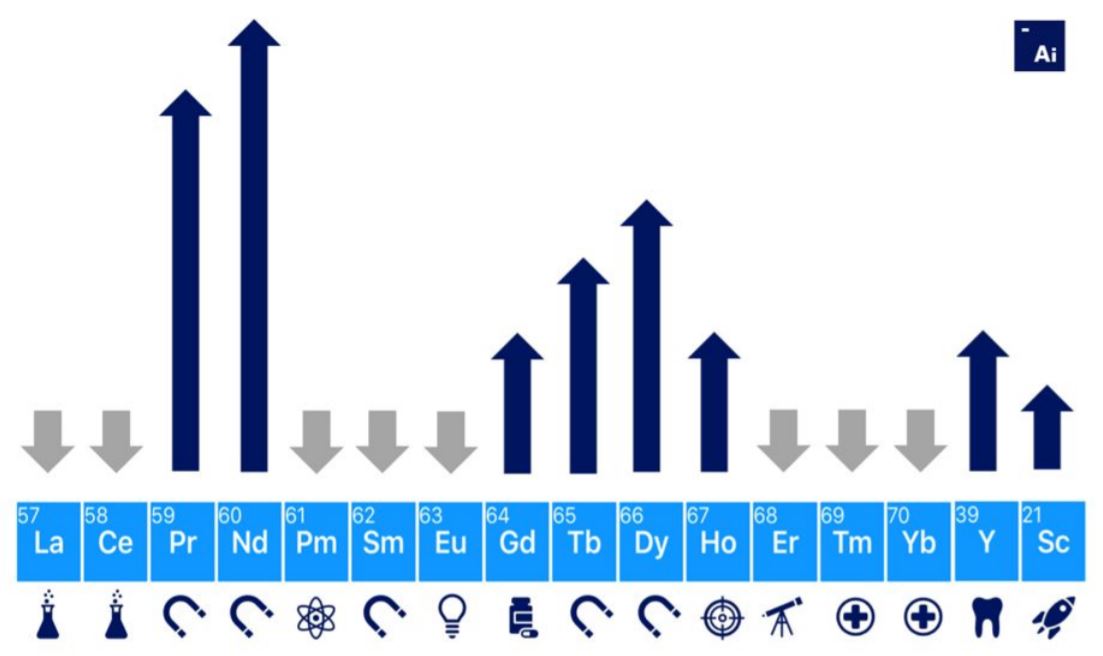
Source: Adamas Intelligence In addition, the necessary production capacities, infrastructure and distribution channels all exist in China within a fairly lax environmental framework including work place safety regulations and low labor costs.
The most rapid growth in REEs has been in demand for new applications including magnets, phosphors, catalysts and batteries. These now account for over 60% of demand and will continue to grow, fueled by heavy investments in clean energy. Canada has some of the largest known reserves and resources (measured and indicated) of REEs in the world, estimated at over 15 million tonnes of rare earth oxides.
There are at least two notable trends in REE markets worth reviewing: the first is China’s continued dominance of the industry while the second is high growth in demand from magnet applications – particularly neodymium-iron-boron magnets, which offer the highest magnetic field per unit of volume.
Analysts predict that domestic production in China will likely flatten from 2022 onwards, the result being that some leading Chinese-based rare earths processors will require increasing quantities of imported mineral concentrates.
China is expected to increase global production of REEs from internal sources, resulting in an overall surplus, however, shortfalls are expected in certain elements, particularly in neodymium and europium, and the heavy REEs such as terbium and dysprosium. Demand for REEs is likely to increase between 7–8% annually some analysts are forecasting.
Internal reports by the Chinese government note that demand for REEs has continued to exceed domestic supply over the past five years which has prompted a surge of imports from miners in the US and Myanmar to satisfy domestic demand.
Neodymium and praseodymium are some of the most sought-after light rare earth elements and they are crucial in products such as motors, turbines and medical devices. High quality speakers use powerful neodymium magnets for that big bass sound. Demand has exploded in recent years with the growth of technology and that demand is expected to climb amid the ongoing race to create a large electric vehicle market.
Owing to low production costs in Asian countries, backed with rising industrialization, manufacturers are investing in economies such as India and China which is propelling the market growth. The positive outlook for the automobile and electronic sectors, coupled with rapid industrialization across developed and emerging economies, will drive the Rare Earth Magnet market size in particular.
David Merriman, an expert on rare earths at Roskill, expects the 2020 China FOB price of US$50,000 per tonne of neodymium oxide to rise to above US$60,000 per tonne by the end of the decade. “As we transition to a low-carbon global economy, the demand for permanent magnets will only grow and is expected to reach about 40% of total demand for rare earths by the end of the decade,” he said.
“Overall, we do expect REE prices for magnet materials to settle at higher levels than in 2019 and 2020, as a result of underlying demand growth and a tight market for neodymium oxide,” he added.
Adams Intelligence believes markets for the magnet rare earths – neodymium, praseodymium, dysprosium and terbium – will remain tight in 2021, especially if China’s State Reserve makes stockpile purchases in the near term.
resourceworld.com |



