ultra bullish, more well-rested people having more time to spend their effortless UBI
am sure Spain shall sign on as a like-minded and answer Ms Yellen's call to up corporate taxation
zerohedge.com
Siestanomics? Spain's Ruling Socialists Launch Nationwide Test Of 4-Day Work Week
As corporations ponder the future of work in the post-pandemic era, labor economists have been bandying about the possibility that the four-day work week might be one legacy of the pandemic. In the US, data on job postings advertising a four-day work week have surged since the start of the pandemic, according to Zip Recruiter.
[url=]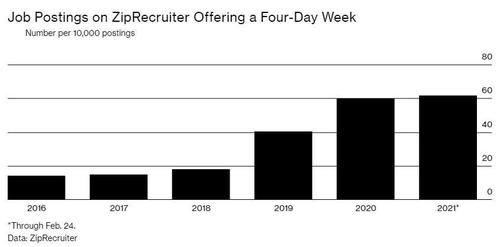 [/url] [/url]
When we first shared the chart above, Will Stronge, director of research at Autonomy, an enterprise software company, said: "The four-day week is picking up momentum. For the large majority of firms, reducing working hours is an entirely realistic goal."
Now, as some popular billionaires like Jack Ma have hailed a six day a week work week as "vital for long-term success", some countries and companies are experimenting with the possibility. During last year's election in the UK, the Labour Party listed reducing the work week to a 32-hour (or 4 day) standard over a decade as part of its platform.
[url=] [/url] [/url]
Unilever is running a trial of the 4-day work week in New Zealand, and Japanese lawmakers are considering a proposal to grant an extra day off to all workers. As we have noted, German technology firm Arwin has started cutting hours.
To wit, Bloomberg reports that Spain is about to ask 100s of domestic companies to join in one of the biggest-ever tests of whether a four-day workweek can be implemented without harming the economy. To hasten this, left-wing Spanish PM Pedro Sanchez has decided to invest €50 million ($59 million) of public money into a three-year, nationwide program.
Spain's pilot program is the brainchild of Mas Pais, a small left-wing part that managed to persuade Sanchez's ruling socialists to give the program a change. Mas Pais leader Inigo Errejon said he expects 200 employees to sign up for the program, with a start date set for the fall. The ruling socialists reportedly agreed to the trial in exchange for securing Mas Pais's votes for the administration's budget, which includes allocations under the EU's COVID recovery fund. Bloomberg stressed that for the ruling socialists, the 4-day week isn't a policy priority.
But since remote work has reportedly strained work-life balance for office workers has become an important issue for left-wing politicians. "What’s important isn’t how many days are worked but rather work-life balance," said Joaquin Perez Rey, Secretary of State at Spain’s Labor Ministry. "That won’t be resolved with one day less."
Under Errejon’s program, employees will get the same salaries despite putting in fewer hours. Unless they significantly boost their productivity, companies will pay their workers more to do less.
"A hundred years have passed since we last shortened the working day,meaning when we won the right to eight hours," Errejon told Bloomberg. "In the past 100 years, we’ve continued to produce more with fewer hours of labor, and yet this ability to produce more thanks to technology hasn’t generated more free time for people."
Opponents of a mandatory 4-day week, however, insist that Spain's economy simply isn't ready for such a policy, as its productivity and innovative capacity lag the rest of Europe.
[url=]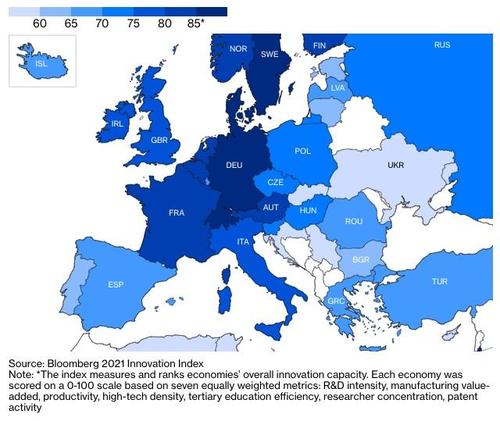 [/url] [/url]
Spain’s challenge is that it has long been plagued by high unemployment, low productivity, and one of the highest proportions in Europe of workers on precarious, temporary contracts. The Bank of Spain has criticized the country's labor market - which, at one point during the European sovereign debt crisis 8 years ago, sported youth unemployment at a staggering 50% - as "dysfunctional."
[url=]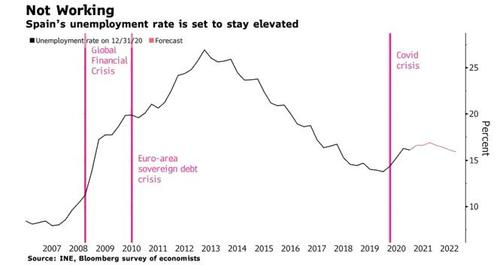 [/url] [/url]
Source: Bloomberg
Successive Spanish governments have tried tweaking labor rules, but in practice, the country's labor laws contain many loopholes allowing people to work more than 35 hours, especially with a shift toward services and freelance jobs.
While Errejon's plan is being financed with government money to compensate employers by allowing them to hire more workers, a four-hour work-week would almost certainly dampen Spain's already weak competitiveness.
The risk is that Spanish companies, already relatively uncompetitive within Europe, fall even further behind. Maria Jesus Fernandez Sanchez, an economist at Spanish think tank Funcas, notes that there’s nothing stopping businesses from implementing a four-day workweek now.
"If they wouldn’t do it without these funds, then that probably means it’s not feasible," she said. "If this were Switzerland or Japan, it could work perfectly. But not in Spain."
Right now, Spain's ruling socialists say they're focused on making sure workers furloughed during the pandemic are all able to return to steady jobs as the economy reopens. |



