Re <<CCP>>
likely a misnomer but never mind, tagged a suspect Bloomberg piece for information
I leave history to judge, in time, as the issues involved might be quite complicated. Am agnostic.
“If you just check the surface, actually the party for many ordinary people has done quite well,” he said. “But you actually achieve this with a cost. It’s just that right now, the cost is still maybe smaller than the benefit.”
... that is what a domestic critic can best say, because anything more would likely invited dire blowback especially given that probably clearly not true, and would be Singapore-d or IRS-ed at the very least, and can be worse, cancelled American style.
Given that the party encompasses ~7% of the population, about on par with the voting population of Ancient Greece, and is apparently very selective, perhaps the members actually want to do well for the greater good
With such total control, the party can be picky about who it accepts: Xi himself wrote ten application letters before he was let in. The acceptance rate of new cadres in 2019 was around 12%, making it almost as tough to get into as some Ivy League universities. Applicants must submit personal essays, undergo regular evaluations and attend training sessions in a process that can last years.
bloomberg.com
China’s Communists Face Daunting Future as Party Marks 100 Years
President Xi Jinping looks stronger than ever, but succession questions and growing apathy among China’s youth are looming challenges
Bloomberg News
28 June 2021, 18:06 GMT+8
Updated on 29 June 2021, 05:12 GMT+8
In Shanghai, where China’s Communist Party was founded 100 years ago, signs of celebration are everywhere: Red buses ferry visitors to historical sites, billboards declare “Never Forget Why You Started” and skyscrapers are lit each night with the hammer and sickle.
Next to the modest two-story building where the First Party Congress was held, a state-of-the-art museum draws large crowds jostling to take selfies while waving party flags and chanting the admission oath. “You guys need to take a hard look at how great our country is,” said one woman waiting to get inside.
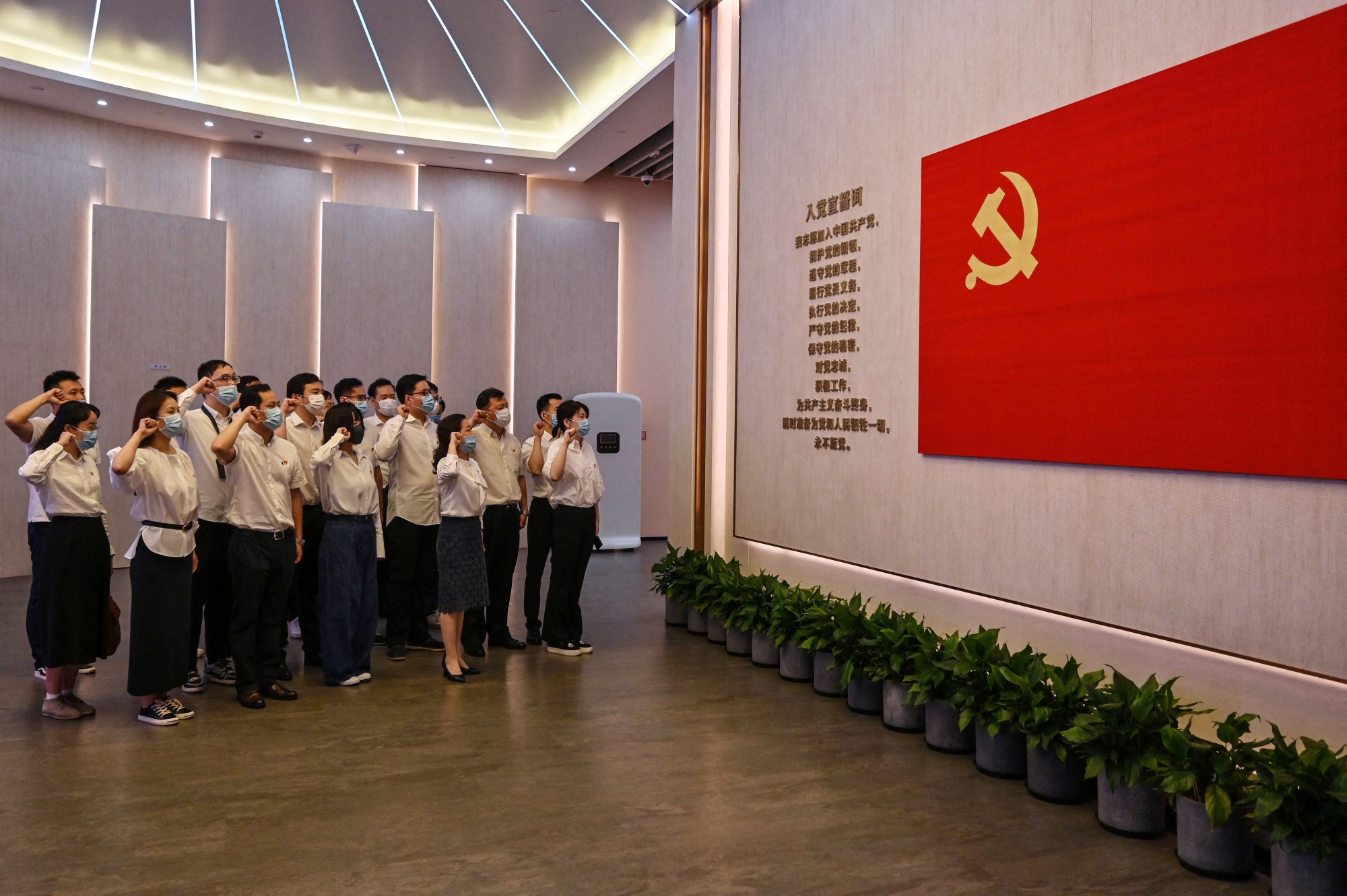
Oath-taking in front of the party flag at the museum in Shanghai.
Photographer: Hector Retamal/AFP/Getty Images
Yet at a swanky hotel just a short walk away, the sense of triumph around the 100-year anniversary celebrated on July 1 wasn’t shared by a former senior editor at a state-backed media outlet. Speaking softly over breakfast, the journalist -- who asked not to be identified along with more than a dozen others Bloomberg spoke to for this article -- reeled off a list of challenges facing the party as it seeks to stay in power for another century and beyond.
While hailing the party’s many achievements, including overseeing an economic miracle that transformed China into a global power in just a few decades, the editor also noted some worrying trends. Under President Xi Jinping, who in 2017 declared China “stands tall and firm in the East,” the party has upended presidential succession norms, clamped down on internal discussion and seen a rising wealth gap prompt more young people to embrace “lying flat” -- effectively opting out of the rat race and adopting a minimalist lifestyle.
China's Communists Bet on Young People
China's Communists Bet on Young People
China's Communists Bet on Young People
What’s worse, he said, is that China has already reaped a lot of easy economic gains in the past few decades. The tougher policy changes that lie ahead will directly hit key power centers in the party, from state-owned enterprises to energy interests to the automobile sector.
“It’s a hard question: Can you reform yourself?” the editor said. “You need to surgically operate on yourself. Do you dare?”
Over the past century, perhaps the Communist Party’s greatest strength has been its ability to adapt and change. From the Long March that propelled Mao Zedong’s rise to Deng Xiaoping’s economic reforms following famines during the Cultural Revolution, leaders of the CCP have thrown ideology aside when necessary to stay in power.
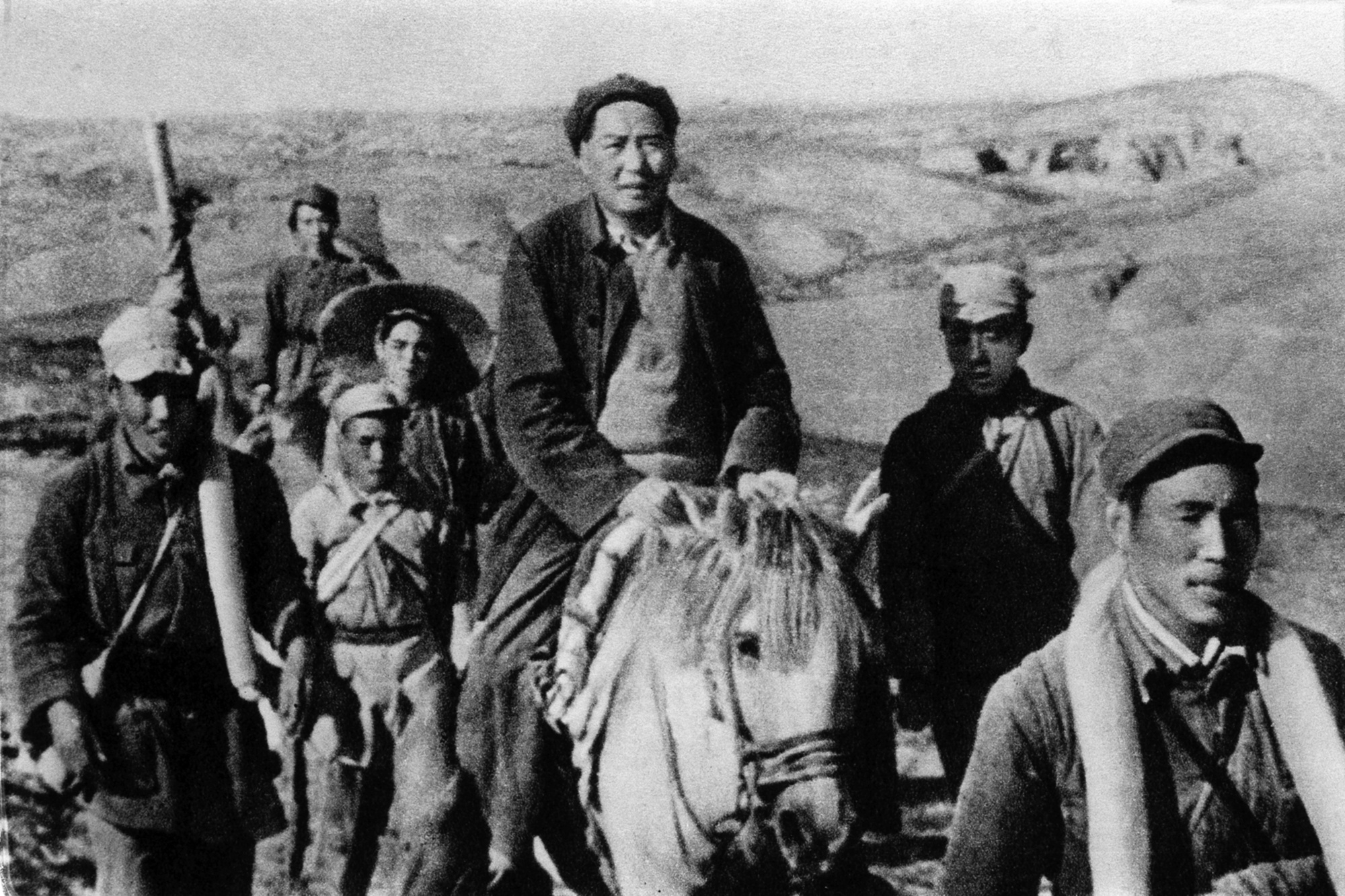
Mao Zedong in northern Shaanxi province, circa 1934-1935.
Photographer: Fototeca Storica Nazionale./Getty Images
That pragmatism, particularly on economic policy, ushered in a wave of investment that helped gross domestic product grow nearly 50 times since Mao’s death in 1976. China’s economy is now poised to overtake that of the U.S. within the decade, eradicating extreme poverty and creating a new ultra-rich class: At the end of 2019, China had 5.8 million millionaires and 21,100 residents with wealth above $50 million -- more than any country except the U.S.
This wealth, however, also brought new risks for the party that Xi has sought to address since taking power in 2012. In studying the demise of the Soviet Communist Party, which lasted 74 years, Xi concluded that to weed out corrupt officials, China needed more ideological purity and a loyal military.
Beyond a popular anti-corruption campaign that also helped Xi consolidate power, he has also sought to entrench the party into all aspects of life, from education to social gatherings to the workplace. Local cells regularly hold “party-building” events consisting of chorus-singing, party-history contests and sessions to study Xi’s speeches.
The goal of these events is to neutralize any potential dissent, according to a Shanghai-based social worker who has attended numerous 100th anniversary gatherings. “The party worries more about challenges from within rather than from outside,” the person said. “I don’t think there is any possibility to topple the CCP rule in at least 50 years. The CCP is so deeply embedded in all walks of life, in the whole society.”
With such total control, the party can be picky about who it accepts: Xi himself wrote ten application letters before he was let in. The acceptance rate of new cadres in 2019 was around 12%, making it almost as tough to get into as some Ivy League universities. Applicants must submit personal essays, undergo regular evaluations and attend training sessions in a process that can last years.
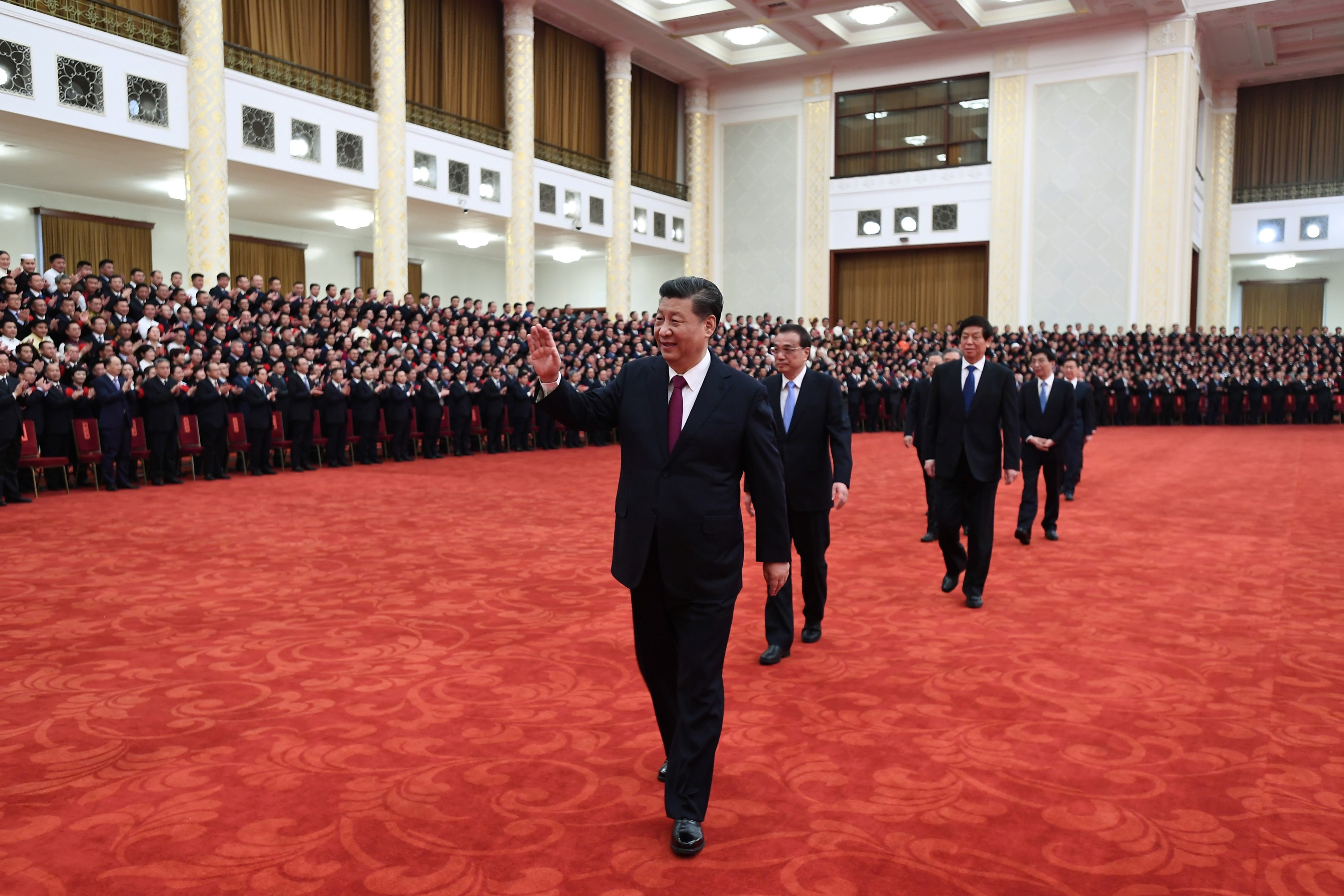
Xi Jinping at the Great Hall of the People in Beijing in February.
Photographer: Xie Huanchi/Xinhua/Getty Images
Party membership was once seen as essential for career advancement. A 69-year-old retired veterinarian in northern China joined in 1979 to gain respect among his colleagues. “These days it doesn’t matter much if you’re a party member or not because people don’t care,” he said.
The rise of China’s private sector, led by tech giants like Alibaba Group Holding Ltd. and Tencent Holdings Ltd., has provided alternative routes to climb the ladder -- as well as potential threats to the Communist Party’s power. Officials have responded by slapping down tech companies and testing the loyalty of party members.
“The most practical challenge could be when your personal interests are in conflict with the collective interests -- what’s your first choice?” Zhu Fenglian, a spokesperson from State Council’s Taiwan Affairs Office, told a group of reporters recently. “As a journalist you may have your work ethics, but the CCP goes beyond that. It requires you to be ready to make the right choice at your first instinct.”
The Seven PercentChina's Communist Party members total over 90 million, nearly 7% of the population in 2019
Source: Organization Department of the Central Committee of the CCP
While China stifles dissent and doesn’t hold democratic elections, its leaders still face pressure to improve living standards. Scholars at Harvard University’s Ash Center, which tracked public opinion in China from 2003 to 2016, found that satisfaction with the government “increased virtually across the board” during that time -- and that attitudes corresponded to real changes in material well-being.
“The aspirations of the people to live a better life must always be the focus of our efforts,” Xi said at the 2017 Party Congress, a once-in-five-year event that constitutes China’s most important political gathering.
Just as the 2008 global financial crisis altered views of the supremacy of the U.S. economic model, Beijing’s ability to quickly reduce Covid-19 cases boosted faith in the party -- even as the West calls on China to allow a transparent investigation into its early handling of the outbreak in Wuhan.
“After the pandemic, the public indeed feels confident about the future,” said Deng Yuwen, a former editor at the party-run journal, the Study Times. “But everything can change with time. The road will be harder for the next 100 years.”
Major challenges are looming. Within China, the number of births last year fell to the lowest level since 1961, adding pressure to boost productivity and keep growth humming. Skyrocketing real estate prices, rising debt and increased competition for the best schools and jobs are prompting younger people -- particularly the “flat-liers” -- to lose hope in Xi’s “Chinese dream.”
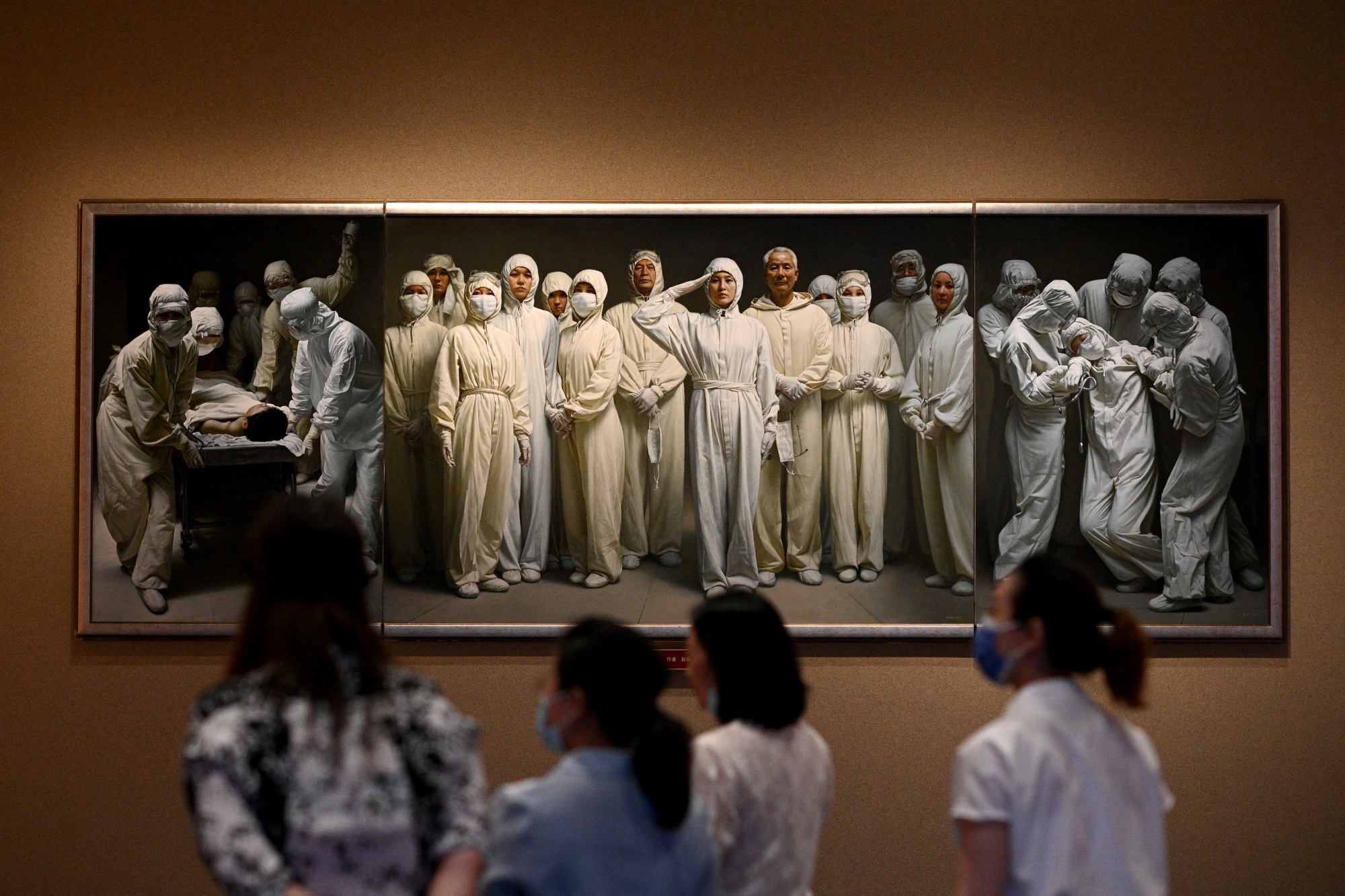
A painting depicting healthcare workers displayed at the Museum of the Communist Party of China in Beijing on June 25.
Photographer: Noel Celis/AFP/Getty Images
Xi’s moves to threaten Taiwan and crush dissent in places like Xinjiang and Hong Kong have prompted more Western politicians to view China’s all-pervasive surveillance state as a threat to free societies everywhere. U.S. President Joe Biden has followed Donald Trump in blocking China from obtaining advanced computer chips that will drive the modern economy, prompting Xi to mobilize resources to develop them on par with the push to build an atomic bomb in the early 1960s.
That quest to produce so-called third-generation chips -- used in everything from artificial intelligence to electric vehicles -- will be a key test of whether the party can both maintain absolute control and spur innovation. Jack Ma, Alibaba’s billionaire founder, saw the government pounce on his financial company Ant Group Co. after he publicly lambasted regulators for stifling creativity.
High BarThe acceptance rate of new members in 2019 was around 12%, nearly as tough as some Ivy League schools
Source: Organization Department of the Central Committee of the CCP
*Note: Acceptance rate is calculated as new members divided by the number of applicants in a given year. The rate is an estimate as applicants undergo a probation period before becoming full members.
So far, none of these challenges have seriously challenged the party’s grip on power. Indeed, leaders have become adept at stoking nationalism to their advantage, whether it be diplomats lashing out at the West or social-media users raging against tech billionaires.
But while China has near-absolute control on information, its citizens are also more connected to the outside world than ever before through virtual private networks that skirt the Great Firewall and international travel -- at least before Covid-19 hit. In times of crisis, like at the early stages of the pandemic, China’s censors allowed a rare deluge of online criticism.
Zhang Shiyi, an official at the Communist Party’s Institute of Party History and Literature, dismisses any suggestion the party has lost the ability to shift course when needed, saying it remains as flexible as ever. “We still have to keep moving,” he said.
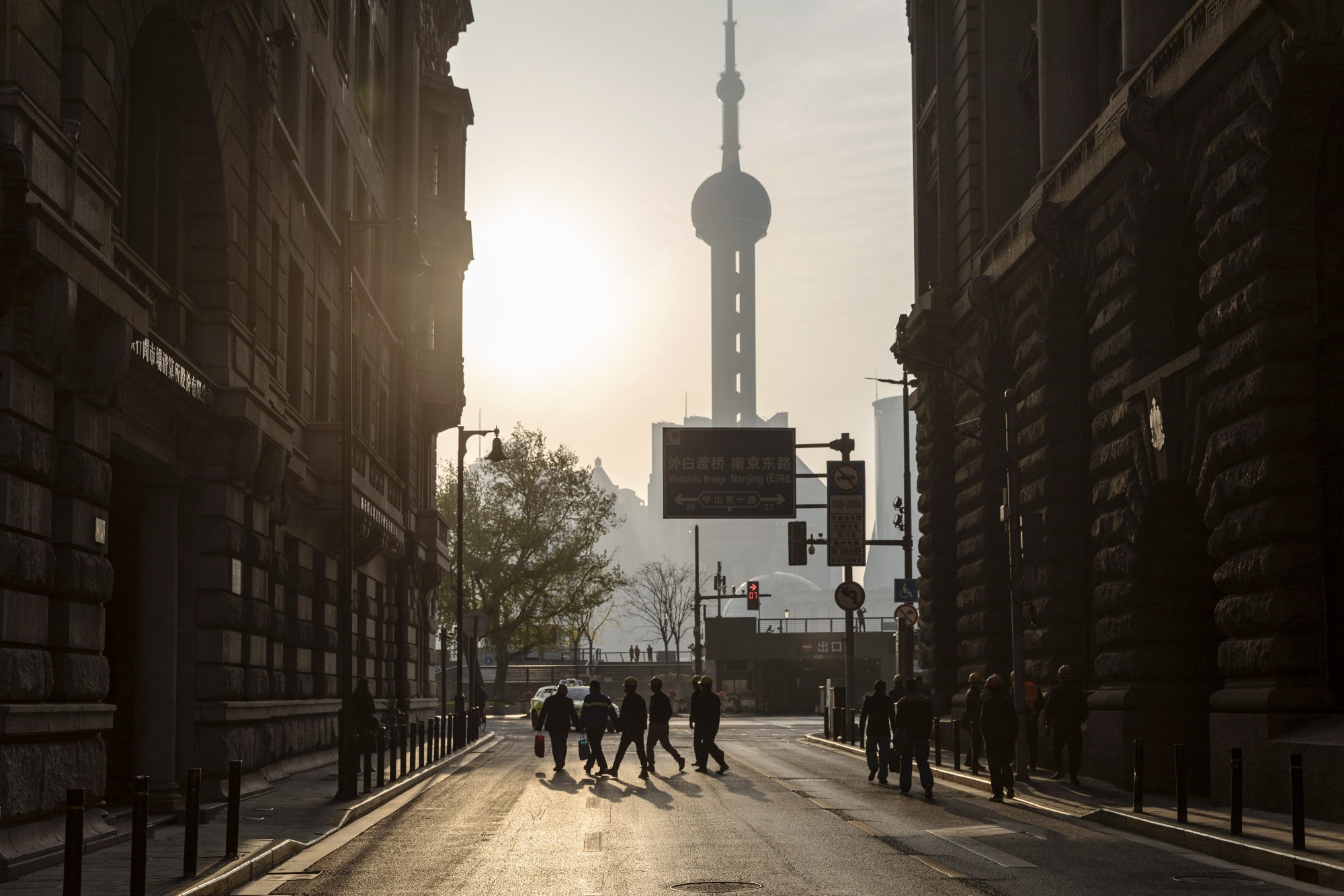
While China stifles dissent and doesn’t hold democratic elections, its leaders still face pressure to improve living standards.
Photographer: Qilai Shen/Bloomberg
In Shanghai, the former state-backed media editor is skeptical. These days, he said, there’s virtually no discussion about perhaps the biggest question mark hanging over the party: Whether Xi will get a third term at next year’s Party Congress. Whereas previously people placed bets on different candidates, now it’s taboo to even raise the topic with friends.
While Chinese state-run media regularly blasts the West as dysfunctional, he said, their systems have endured over time -- even when Trump’s supporters threatened to scupper a peaceful transfer of power. China’s system, by contrast, is relatively young.
“If you just check the surface, actually the party for many ordinary people has done quite well,” he said. “But you actually achieve this with a cost. It’s just that right now, the cost is still maybe smaller than the benefit.” |



