It appears CNN likes to pick its China-China-China stories and diss those of others
edition.cnn.com
MyPillow magnate Mike Lindell's latest election conspiracy theory is his most bizarre yet
(CNN) — Since the presidential election, Christina Jensen says she's been stopped on the street several times by acquaintances who wanted to share troubling news: hackers from Beijing had switched nearly 24,000 votes for Donald Trump in their rural, GOP-leaning Wisconsin county.
Jensen, the Clark County clerk and a Republican herself, has patiently explained that the local election computer system isn't connected to the internet -- and the county has less than 17,000 registered voters overall.
But she finds herself unable to convince those constituents of the simple fact that the election wasn't stolen: "They are like, 'Well, Mike Lindell says this,'" Jensen said.
Lindell, the MyPillow CEO and a close ally of former President Donald Trump, has emerged as one of the most vocal boosters still pushing false claims about the 2020 election. In a series of so-called documentaries, Lindell has advanced an increasingly outlandish theory that foreign hackers broke into the computer systems of election offices like Clark County to switch votes -- in what he has described as the "biggest cyber-crime in world history."

My Pillow CEO Mike Lindell speaks as President Donald Trump listens during a briefing in the Rose Garden of the White House on March 30, 2020.
Election officials at more than a dozen counties that Lindell has claimed were hacking targets told CNN that the pillow magnate's claims are utterly meritless. They noted that their voting machines are not connected to the internet, that the results are confirmed by paper ballots, and in some cases that official audits, recounts, or reviews have verified their vote tallies.
In addition, CNN interviewed nine cybersecurity experts, all of whom said the "proof" Lindell has released so far is nonsense -- and that there is zero evidence of any kind of successful hacking of last year's election results.
But many Americans are buying into baseless claims of vote fraud: polls have found that roughly two-thirds of Republicans believe President Joe Biden was not legitimately elected. And while Lindell isn't as prominent as other right-wing figures denying the election results -- including the former President himself -- his rhetoric has broken through among some of the Trump faithful.
Jensen said she watched Lindell's video "Absolute Proof" -- which claims that 23,909 votes for Trump had been switched in her county -- after a concerned voter emailed her a link to it.
"It made me angry," she said. "He has created a lot of doubt in a lot of peoples' minds, even though the count was accurate." Trump won the county with a margin of more than 5,000 votes.
Lindell -- who once considered running for Minnesota governor or other elected office -- has become persona non grata in mainstream conservative circles. He's been booted from Twitter for violating its policy on sharing election fraud claims, and his videos have been swiftly removed from YouTube and other platforms. His pillows have been taken off the shelves at retailers such as Bed Bath & Beyond and Kohl's. And he and his company are facing a $1.3 billion defamation lawsuit from the voting machine company Dominion, which Lindell has falsely accused of being involved in voter fraud.
Now, Lindell is resorting to a last-ditch attempt to promote his theory, planning a "cyber symposium" this month in Sioux Falls, South Dakota, where he says he will release 37 terabytes of data showing election hacking.

Dominion spokesman: Mike Lindell is begging to be sued 04:29
In a rambling and combative interview with CNN, Lindell insisted that he had proof the election was stolen.
"I'm not wrong. I've checked it out. I've spent millions," he claimed. "You need to trust me and come there."
Election officials say Lindell's conspiracies are undermining faith in the voting system. Scott McDonell, the clerk for Dane County, Wisconsin -- another county where Lindell has claimed hacking switched thousands of votes from Trump to Biden -- said that out of all the election theories he's heard, Lindell's is "the worst one because it's the dumbest."
The county conducted a hand recount of every ballot, paid for by Trump's campaign, which verified Biden's win. And every ballot in the state has a paper trail.
"It's damaging to our democracy," McDonell said of Lindell's claims. "Spurious allegations spread on the internet because they affirm what you want to believe."
From pillows to conspiracies

President Donald Trump speaks alongside MyPillow CEO Mike Lindell, during a "Made in America" event with US manufacturers at the White House on July 19, 2017.
Since Trump's loss last fall, Lindell has been a superspreader of election misinformation.
A Minnesotan who often talks about his journey from recovered crack cocaine addict to CEO, Lindell made a name for himself with cheery infomercials showing him hugging his trademark pillow. He fell into Trump's orbit during the 2016 election, attending his election night watch party and later showing up at White House events.
Even as many Republican politicians acknowledged Biden's victory, Lindell stuck with Trump's lies about his loss. Lindell has shared a wide range of theories of why the election was stolen, from ballots cast by dead voters to Biden votes being counted multiple times -- all of which have been debunked.
His latest and most operatic theory involves a sweeping conspiracy in which hackers from China and other foreign countries broke into elections office computer systems around the country to reduce the number of votes for Trump. The claim is supported, he says, by "heroes" who supposedly captured data proving the hacking and then leaked it to Lindell in January.
 Lindell included a snippet of the data in one of his videos and sent CNN a half-dozen additional screenshots he said were examples of the data. He said he has spent millions of dollars to verify the data by hiring unnamed experts -- some of whom he has included, with their faces blurred out and voices changed, in his videos. Lindell included a snippet of the data in one of his videos and sent CNN a half-dozen additional screenshots he said were examples of the data. He said he has spent millions of dollars to verify the data by hiring unnamed experts -- some of whom he has included, with their faces blurred out and voices changed, in his videos.
But Lindell's claims don't hold water. The first block of data from Lindell's "Absolutely 9-0" video, released in June, was a dramatic scrolling video of a long series of numbers in hexadecimal format, a numeric system used by some programmers. When the data is converted to text, it becomes clear that it is not evidence of hacking but a version of Pennsylvania's voter file, listing every voter registered in the state -- a copy of which can be purchased from the state government for $20. The Washington Post first reported the voter file connection.
In the video, one of Lindell's anonymous experts says that the data he was showing was "raw, encrypted data" proving election hacking. But Lindell later claimed that the data was simply "B-roll," a placeholder for the actual evidence.
The other snippets of data Lindell sent to CNN -- which he says are the real deal -- are also far from proof, according to nine cybersecurity experts who reviewed them. The screenshots are other blocks of hexadecimal numbers. When converted to text, they appear to be a list of IP addresses and coordinates, but nothing proving hacking or even the nature of any traffic between them.

Jimmy Kimmel is worried about MyPillow's Mike Lindell 02:54
In his videos, Lindell has called his data "PCAPs," or packet captures -- a technical format for capturing web traffic. But the experts CNN consulted agreed that the data he has released so far are not PCAPs. Some of the IP addresses listed appear to be associated with public county and city websites -- but not computers involved in vote casting, tallying or other critical election infrastructure, the experts said.
"These are not PCAP files," said Harri Hursti, a computer programmer who organizes voting machine hacking tests and has assisted with election audits. Lindell "has shown no evidence that he has PCAP files and he has shown no evidence that these files have anything to do with elections," he said.
J. Alex Halderman, a professor of computer science and engineering at the University of Michigan and expert in voting machines, called Lindell's antics "completely ridiculous."
"When security experts produce evidence, we don't send around video of hex-encoded files -- that's entirely Hollywood," he said. "What we do is share the original data (along with information to support its provenance and authenticity) and explain our interpretation so that other experts can verify or dispute it."
Lindell claims that he will release his full dataset showing election hacking at his so-called symposium. "Nobody has seen what I have," he said. "No judge, nobody, until I sent you guys a piece of it."
But notably, experts said the vast majority of votes in the US -- including in battleground states -- are cast by paper ballot or supported by a paper trail. That means that if hacking did occur, it could be proven by looking back at the ballots. And recounts or audits in several of the counties Lindell says were hacked have verified the results based on those paper ballots.
"The ballots are ink on dead trees," said Dan Wallach, a Rice University computer science professor who has researched electronic voting system security. "Nothing that happens in China can change the ink on those dead trees."
The 'election that never ends'

MyPillow CEO Mike Lindell waits outside the West Wing of the White House before entering on January 15, 2021.
Numerous election officials in the counties that Lindell has identified as purported targets for hacking told CNN they were baffled and frustrated by his claims. The officials said that their vote-tallying machines are not connected to the internet at all -- and that the specifics of Lindell's allegations simply don't add up.
Take Adams County, Pennsylvania, the home of the Gettysburg battlefield. Trump won the county with 37,567 votes, compared to 18,254 for Biden. Data included by Lindell in one of his videos and in court documents allege that 33,111 votes had been stolen from Trump after a hack on November 4 or November 5.
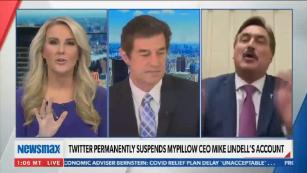
Watch Newsmax anchor walk off set during MyPillow CEO interview 02:03
Molly Mudd, the county solicitor, said that nearly all of the county's ballots had been counted and reported by Election Night, November 3, before Lindell alleges the hack took place. And if Lindell's claim about that many votes being swapped were correct, Mudd said in an email, "then it would mean that Biden actually won Adams County (a heavily Republican-leaning county) by an unprecedented landslide, which is probably not the outcome that Mr. Lindell and his associates are fishing for."
Some officials said they were seeing the impact of election conspiracy theories spread by Lindell and others among their communities and neighbors.
In Houghton County, Michigan, near the northern tip of the state's Upper Peninsula, election officials have been deluged by emails from voters who believe their ballots were switched, said clerk Jennifer Kelly -- even though the county's machines are separate from the internet. Some voters have complained at monthly county board meetings, and others have demanded to view the ballots themselves, she said.
"It's the election that never ends," Kelly said.
And across the state in Oakland County, a Detroit suburb, election officials say they get regular phone calls from people claiming their votes were stolen, even after a canvass and two audits of the paper ballots verified the results.
"It's very convenient to say after the fact, 'oh, you know, it was hacked,'" said Lisa Brown, the county clerk. "This is a guy who sells pillows... I don't know why anybody would want to listen to him as an expert on anything related to elections."
Vote-flipping theory has questionable origins
Lindell's vote-flipping theories have striking similarities to a thoroughly debunked conspiracy theory -- advanced by a group of right-wing bloggers who have cited a former intelligence contractor with a checkered past -- that a supercomputer was used to steal votes from Trump across the country.
In "Absolute Proof," Lindell includes a video of a map showing colorful lines and dots connecting the United States to other countries around the world -- which he claimed illustrated hacking election attempts from those countries.

Mike LIndell appearing in a scene from his video, "Absolute Proof."
A nearly identical graphic previously appeared on a website connected to Dennis Montgomery, a former intelligence contractor who has been the subject of multiple exposes detailing exaggerated claims and alleged cons involving junk data.

A screen grab from a video called "Foreign Interference - Coordinated Hack" posted on Blxware.org, a website connected to Dennis Montgomery.
Starting in 2013, Montgomery convinced former Maricopa County, Arizona, Sheriff Joe Arpaio to pay him more than $100,000 for data that supposedly showed an illegal conspiracy involving a federal judge. A detective for the sheriff's office wrote in a 2014 email that the data contained "no evidence to support" Montgomery's claims. And Montgomery and his associates previously received more than $20 million in federal government contracts for terrorism-fighting software that appeared to have been a hoax, The New York Times reported in 2011.
Lindell co-produced "Absolute Proof" with right-wing online broadcaster Brannon Howse and a blogger who goes by the name Mary Fanning, both of whom were early promoters of the supercomputer conspiracy theory. In the video, Fanning calls Lindell as he shows the map graphic, and talks through what she claims were attempted and successful cyber attacks.
In multiple articles on her blog, The American Report, and discussions on Howse's show, Fanning has attributed her beliefs about vote-flipping to Montgomery.
Lindell said in "Absolutely 9-0" that his unnamed sources gave him the data on January 9. And Howse said during an episode of his show that he and Fanning called Lindell on January 9 and shared their theory with him that same day.
"We were talking, we're like, who can we get some of this information to that has the courage and the guts to talk about this, take on this cause, bring it to the president?" Howse said on the podcast. "I said there's only one guy in my Rolodex I know that has that kind of access, that kind of popularity and the guts to do it. And that's Mike Lindell."
In a January interview with Howse, Lindell said Howse and Fanning were the people who alerted him to "the answers I was looking for" about mass vote switching.
In the interview with CNN, Lindell said he hadn't met Montgomery or Fanning and that he had multiple sources for his data. Montgomery, Fanning and Howse did not respond to CNN's requests for comment.
Election lies and pillow promos

Mike Lindell departs from federal court in Washington, DC, on June 24, 2021.
According to Lindell, his advocacy for overturning the election has cost him millions of dollars in lost business. After his pillows were dropped by major retailers earlier this year, "that's 40% of my whole business wiped out in a blink of an eye," Lindell told CNN.
Still, right-wing podcasts and shows that feature him often include promo codes for MyPillow. Voting machine company Dominion argued in its defamation lawsuit that Lindell used his prominence in pushing false election claims to bring in new business from Trump supporters -- although there are no public records about how the controversy has truly affected MyPillow's finances.
Last week, Lindell said MyPillow planned to stop advertising on Fox News, where its pillow ads are a common sight, because the channel won't run a promo for his August event.
Trump has continued his ties to Lindell, speaking via video at a Wisconsin rally headlined by the MyPillow CEO in June.
Lindell has said that after his big reveal this month, he expects the Supreme Court to rule 9-0 in favor of reinstating Trump as president -- even though there's no constitutional mechanism for that to happen.
Experts agree that Lindell's fanciful claims are fanciful and unsupported -- and are eroding trust in our democracy.
"Extraordinary claims require extraordinary evidence," said Wallach, the Rice University professor. "This ain't that."
CNN's Yahya Abou-Ghazala, Audrey Ash and Jeffrey Winter contributed to this report.
Sent from my iPad |



