From the faction of folks who see everything as a race, instead of an opportunity for win-win cooperation. Chinese Exclusionary 'Artemis Accord' against Sino-Russian collaboration. One or both might turn out to be technological dead-end. Very exciting.
Both countries are also seeking to bring international partners along. The United States has already added a dozen signatories to the "Artemis Accords," including Australia, Italy, Japan, South Korea, and the United Kingdom. China has reached a deal with Russia to build a lunar research station and is also courting European partners. arstechnica.com
China may use an existing rocket to speed up plans for a human Moon mission
China may seek to leapfrog NASA in its return to the Moon.
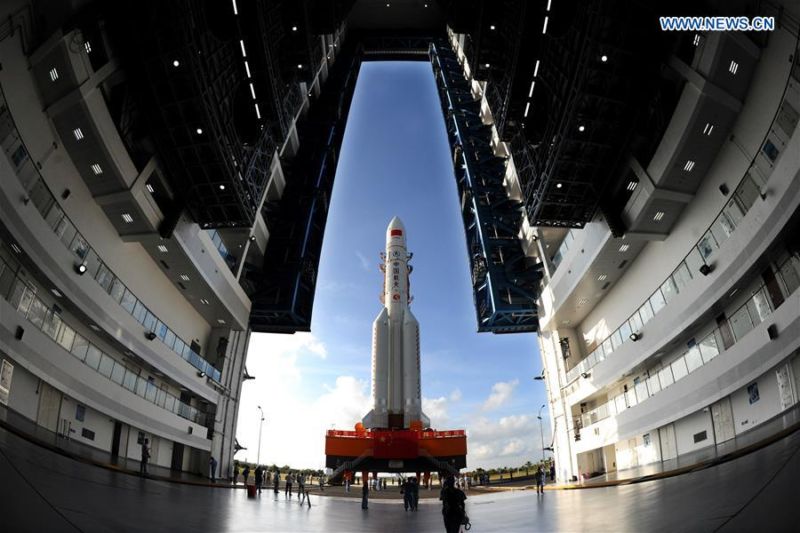
Enlarge / China's Long March 5 rocket made its debut in November, 2016.
Xinhua/Sun Hao
China appears to be accelerating its plans to land on the Moon by 2030 and would use a modified version of an existing rocket to do so.
The chief designer of the Long March family of rockets, Long Lehao, said China could use two modified Long March 5 rockets to accomplish a lunar landing in less than a decade, according to the Hong Kong-based online news site, HK01. He spoke earlier this week at the 35th National Youth Science and Technology Innovation Competition in China. The full video can be found here.
During Lehao's speech, he said one of these large rockets would launch a lunar lander into orbit around the Moon, and the second would send the crew to meet it. The crew would then transfer to the lander, go down to the Moon's surface, and spend about six hours walking on its surface. Then part of the lunar lander would ascend back to meet the spacecraft and return to Earth.
Lehao's talk does not carry the official imprimatur of Chinese space policy—at least not yet. But he remains an influential figure in Chinese space policy, said Andrew Jones, a journalist who tracks China's space program. "It's a good indication of China working towards that plan to some degree," he told Ars. "There will apparently be an announcement on this rocket at the Zhuhai Airshow in late September or early October."
The Chinese Moon plan would require several technology developments. The Long March 5 rocket, which has a capacity similar to that of a Delta IV Heavy rocket, would be upgraded to become the "Long March 5-DY." Lehao has previously described these upgrades, which would improve performance for lunar missions. China would also need a lunar lander and a next-generation spacecraft capable of deep space missions.
Advertisement Nevertheless, the use of an existing rocket that has already launched seven times would simplify the mission for China. Although the country's aerospace engineers are in the early stages of developing a super-heavy lift rocket named Long March 9, it probably won't be ready for test flights before 2030. By modifying an existing rocket, China could get to the Moon faster.
This only adds further fuel to the idea that NASA and China are in something of a race to the Moon. The United States has created the "Artemis Program" for a lunar return. While this program has a nominal date of a 2024 human landing, that seems infeasible due to the lack of a finished lunar lander, space suits, and other technical problems. The year 2026 seems like the earliest possible date for a lunar landing, and of course that could slip further to the right.
Both countries are also seeking to bring international partners along. The United States has already added a dozen signatories to the "Artemis Accords," including Australia, Italy, Japan, South Korea, and the United Kingdom. China has reached a deal with Russia to build a lunar research station and is also courting European partners.
Former NASA Administrator Mike Griffin, who served under the George W. Bush administration, has long warned US policymakers that China could accelerate its Moon plans and beat NASA by using an existing heavy lift rocket.
Speaking at a 2018 Users Advisory Group meeting of the National Space Council, Griffin said, "They never seem to be in a rush. They seem to be playing the long game. So I’m not saying they will be on the Moon in six to eight years, but if they wanted to be they could. And for them to be back on the Moon when the United States can’t get back on the Moon is a travesty."
Now, China be in a rush.
Divorce certainly seemed possible in June when Rogozin made headlines for threatening to withdraw from the station unless US sanctions on Russia's space sector were lifted. Rogozin is also under personal US sanctions for his role as Russia's deputy prime minister of defense during his country's 2014 annexation of Crimea from Ukraine.
edition.cnn.com
'Divorce is not possible' with US over space station, says Russian space chief who threatened to pull out
Sign up for CNN's Wonder Theory science newsletter. Explore the universe with news on fascinating discoveries, scientific advancements and more.
(CNN) — Despite threatening to pull Russia out of the International Space Station prematurely, the head of the country's space agency is now promising to remain NASA's partner at least until the orbiting outpost is eventually retired.
"This is a family, where a divorce within a station is not possible," Dmitry Rogozin told CNN in his first interview with western media since becoming Roscosmos' director general.
Divorce certainly seemed possible in June when Rogozin made headlines for threatening to withdraw from the station unless US sanctions on Russia's space sector were lifted. Rogozin is also under personal US sanctions for his role as Russia's deputy prime minister of defense during his country's 2014 annexation of Crimea from Ukraine.
Dmitry Rogozin, Roscosmos director general, is shown during the launch of a Soyuz-2.1b carrier rocket at Vostochny Cosmodrome, in Amur region, Russia.
"Either we are working together and then sanctions should be lifted immediately, or we won't work together" and Russia will deploy its own space station, said Rogozin in June, according to Russian state-owned media TASS.
Now Rogozin appears to deny ever making those threats in front of Russia's lower house of parliament.
"I think there is a problem in interpretation. I, most likely, did not say that," Rogozin told CNN, speaking Russian. His words were translated by an interpreter hired by CNN.
"It's just that we're talking about how we can continue our comradery, our friendly relations with our American partners, when the US government is implementing the sanctions against the very same organizations which supply the International Space Station."
Another test for the US-Russia space partnership
It's a relationship that's being tested politically and in orbit.
In July, Russia's newly docked Nauka module accidentally fired its thrusters, spinning the space station out of control. At the time, three NASA astronauts, two Russian cosmonauts, a Japanese astronaut and an astronaut with the European Space Agency were on board. Rogozin admits "we did have a problem," and he blames it on human error.
The Nauka module is seen prior to docking with the International Space Station on July 29 in a photo taken by Russian cosmonaut Oleg Novitsky and provided by Roscosmos.
"The equipment does not break down on its own," Rogozin said. "For 21 years, we have not done anything like this. An older generation, who knew how to dock a complex structure like this, has retired."
The incident has raised questions about Roscosmos' reliability as NASA's top partner on the International Space Station. But now that the 23-ton Nauka -- which adds Russian laboratory space and sleeping quarters -- is there and working, Rogozin says it is "the guarantee" that Russia will have the "technical capacity for station operation up until the time when it will reach the end of its service life."
The US and Russia have been partners in space ever since the Apollo-Soyuz Test Project in 1975, when an American Apollo spacecraft docked with a Soviet Soyuz capsule, signaling the end of the first space race.
"I think that the cooperation with the Russians, which has been there ever since 1975, will continue," said NASA Administrator Bill Nelson, speaking at the annual Space Symposium in Colorado Springs on August 25.
The US tried to extend this partnership in space to the moon with NASA's new Artemis program. But so far, Russia has refused to participate.
"For this to happen, we request dignified conditions from NASA. We don't want to be assistants or servants," Rogozin said. "The main condition is equal rights when discussing issues and joint decision making. That's what we have today at the International Space Station."
A relationship with another country too
Rogozin insists Russia wants to preserve its partnership in space with the United States. "We respect our partners in the US," Rogozin said. "We are friends."
But in June, Russia also announced plans to build a base on the moon with the world's newest superpower in space: China.
Republican Sen. Jerry Moran of Kansas, the ranking member on the Commerce, Justice, and Science Appropriations Subcommittee, says actions speak louder than words.
"Russia sent a clear signal in creating an alliance with China for lunar exploration rather than continuing its historical partnership by joining the United States," said Moran, speaking at the Space Symposium.
Pressed if Roscosmos is prepared to potentially throw away this decades-long partnership with NASA, Rogozin was noncommittal.
"We are pleased that you are looking at us as some sort of bride, who is trying to cheat on one groom and pick another one, but this is not the situation as it appears," Rogozin said.
Rogozin wants Roscosmos to partner in space with both the US and China. "If we are not able to work with the US -- not because of our fault, and I think this can be changed -- but if this is not taking place, in order to divide the responsibility, risks, money, we need, naturally, another partner," Rogozin said.
Nelson is planning to meet with Rogozin, likely in Russia, sometime later this year.
Asked to respond to Rogozin's comments, Nelson said, "I look forward to continued cooperation with Roscosmos on the International Space Station until 2030 and into the future." But Nelson did not address the specific conditions Rogozin is demanding before Russia will sign on to the Artemis program.
At the end of a nearly hour-long interview, Rogozin said he had one final "big request" for the United States to preserve this decades-long experiment in space diplomacy.
"America is a large country. As a big country, it must be kind and wholehearted. It must propose conditions for its Russian partner, far smaller by the size of its population, and by the size of its economy. If these conditions will be dignified to us, we will accept it. The ball is in NASA's hands, the US' hands now." |



