The <<link>> is interesting and I definitely did not cite it. Learned something. Thank you.
It was good that someone thankfully saved Napoleon from his campaign in Egypt, enabling his ascension to be Emperor of the French, as opposed to Emperor of France.
Below also may turn interesting as Kathy Tai abut to make her speech soonest.
I do not believe the CCP China China China shall truly engage in discourse with the Biden administration as CCP likely sees the Biden administration as a lame duck, at best, and at worst, Kamala + DNC unable to effectively rule USA in any case, so discourse has no point.
Besides, when China signalled and continue to signal to Canada, Australia and Europe, therefore in effect to USA that relationships are wholistic, and there shall be no such thing as cooperate on this and war on that. Generally, and more generally than other nation-states, what China says China means.
For how can one buy Boeing passenger aircraft when one has to guard against and facedown F35s, etc etc, and have ones supply line to Boeing parts in control by the nice folks on Capitol Hill. Surely USA politicians are not as naive as all appear.
Other folks on the thread might feel differently and so guess otherwise, and that is what makes a market.
nytimes.com
U.S. Signals Little Thaw in Trade Relations With China The Biden administration said it would not immediately remove the Trump administration’s tariffs and would require that Beijing uphold its trade commitments. Oct. 4, 2021, 5:00 a.m. ET

Keith Bradsher/The New York Times
WASHINGTON — The Biden administration offered its strongest signal yet that the United States’ combative economic approach toward China would continue, with senior administration officials saying that President Biden would not immediately lift tariffs on Chinese goods and that he would hold Beijing accountable for trade commitments agreed to during the Trump administration. The comments, in a call with reporters on Sunday, provided one of the first looks at how the Biden administration plans to deal with a rising economic and security threat from China. They indicated that while Mr. Biden may have criticized the Trump administration’s aggressive approach, his White House will continue trying to counter China’s economic threats with trade barriers and other punitive measures. That includes requiring China to uphold commitments it agreed to as part of the Phase 1 trade deal that it signed with the United States in January 2020. So far, China is on pace to fall short of its 2021 purchasing commitments by more than 30 percent, after falling short by more than 40 percent last year, according to Chad P. Bown, a senior fellow at the Peterson Institute for International Economics, who tracks the purchases. However, in a move that would offer some relief to businesses that import Chinese products, the administration said it would re-establish an expired process that gives some companies a reprieve by excluding them from the tariffs. Trade officials would make those decisions based on the priorities of the Biden administration, officials said, without elaborating further. Katherine Tai, the United States trade representative, is expected to begin talking with her Chinese counterparts in the coming days about the country’s failure to live up to its agreements, senior administration officials said. Officials did not rule out the possibility of imposing further tariffs on China if talks with did not produce the desired results, warning Beijing that they would use all available tools to defend the United States from state-directed industrial policies that harm its workers. China denies that it has failed to live up to the Phase 1 agreement, contending that the pandemic has created unique circumstances. The Biden administration has been drawing up an investigation into China’s use of subsidies under Section 301 of U.S. trade law. If it is carried out, that inquiry could result in additional tariffs on China, according to people familiar with the plans. In excerpts that were released on Monday morning in Washington from a planned speech later in the morning, Ms. Tai said that, “For too long, China’s lack of adherence to global trading norms has undercut the prosperity of Americans and others around the world.” “We continue to have serious concerns with China’s state-centered and nonmarket trade practices that were not addressed in the Phase 1 deal,” she added. Last week, Gina Raimondo, the commerce secretary, pointed to China’s blocking of its airlines from buying “tens of billions of dollars” of products from Boeing. “The Chinese need to play by the rules,” Ms. Raimondo said in an interview with NPR last week. “We need to hold their feet to the fire and hold them accountable.” The Biden administration has given no indication that it plans to lower the hefty tariffs that President Donald J. Trump placed on Chinese goods anytime soon, despite protests by economists and some businesses that they have dragged on the U.S. economy. Mr. Biden has frequently criticized Mr. Trump’s 18-month trade war with China as erratic and counterproductive. But more than eight months into his presidency, Mr. Biden has announced few policies that differentiate his approach. In addition to the tariffs on Chinese goods, the president has maintained restrictions on the ability of Chinese companies to access U.S. technology and expanded the list of Chinese officials under sanctions by the United States for their role in undermining Hong Kong’s democratic institutions. Mr. Biden’s hard-line approach to China comes at a moment of extraordinary tension between the world’s largest and second largest economies, and remarkably little interchange between their governments. In the past month, the United States has announced a new deal to provide nuclear-powered submarines to Australia, an effort to push back on Beijing’s military modernization and its claims of territory in the South China Sea. Mr. Biden also met at the White House with the leaders of Japan, Australia and India, aiming to put the major democracies of the region in accord on how to deal with China’s influence and authoritarianism. And the United States and China are both seeking technological advantage, even if it means cutting off each other’s access to key goods. China, having repressed dissent in Hong Kong and essentially wiped away its guarantees to Britain about keeping its hands off the territory for decades, is now regularly threatening Taiwan. The United States formally protested some of China’s actions on Sunday, after dozens of military aircraft flew on Friday and Saturday into Taiwan’s air defense identification zone, although not over the island itself. While U.S. officials do not expect Beijing to move against Taiwan, they are increasingly concerned about the possibility of an accidental conflict. Trade was one area — along with climate — where mutual interest might steer the two countries to some agreements, even as they compete in other areas. But it is unclear whether they can find a way to reach an accord amid other tensions. Mr. Trump’s deal halted the trade war, but it did not put an end to economic hostilities. China still maintains tariffs on 58.3 percent of its exports from the United States; the United States imposes tariffs on 66.4 percent of the products it brings in from China, according to Mr. Bown. Some Biden officials, like many economists, have made clear that they see the tariffs as counterproductive and taking a toll on American consumers and manufacturers as well as Chinese businesses. Treasury Secretary Janet L. Yellen said in July that the China deal had “hurt American consumers.” Asked if they would consider additional tariffs on China, officials said the Biden administration would not be taking any tools off the table. The administration planned to use the enforcement mechanism established in the trade deal, they said, which would allow the United States to resort to further tariffs if consultations were unsuccessful. In a planned speech on Monday at the Center for Strategic and International Studies, a Washington think tank, Ms. Tai is set to highlight how some of Beijing’s unfair practices have affected U.S. workers and how the United States is building global coalitions to counter them. The Biden administration could face an even more difficult task in reaching any trade agreement with China than the Trump administration did four years ago. Republican lawmakers are ready to pounce on any perceived weakness on China from Mr. Biden, and diplomatic and economic relations between the two countries have deteriorated. “Against the backdrop of worldwide opposition against Cold War and division, the United States blatantly violated its policy statement of not seeking a new Cold War and ganged up to form an Anglo-Saxon clique,” Wang Yi, the Chinese foreign minister, said on Sept. 28 in response to the Australian submarine deal. The U.S. release of Meng Wanzhou, a Huawei executive who had been detained in Canada at the request of the United States, and China’s subsequent release of two Canadians and two Americans, have done little to cool tensions. Mr. Trump’s tariffs have discouraged imports of some Chinese goods, but exports to the United States have grown strongly through the coronavirus pandemic, as Americans purchased workout equipment, furniture, toys and other products during lockdown. China’s leaders have also doubled down on the kinds of domestic industrial subsidies that the United States has long objected to. They have greatly expanded programs, started more than a decade ago, aimed at eliminating their need to buy computer chips and passenger jets — two of the United States’ main exports to China — among other industrial products. The Biden administration has been exploring ways to persuade China to limit its broad industrial subsidies, but that will be difficult. The George W. Bush, Obama and Trump administrations all tried with little success for ways to coax China to abandon its long-running use of subsidies to domestic producers as a tool to wean itself from any reliance on imports. China’s leader, Xi Jinping, has called for making sure that other countries remain dependent on China for key goods, so that they will not threaten to halt their own sales to China. The United States has done so over issues like surveillance, forced labor and the crackdown on democracy advocates in Hong Kong. “The dependence of the international industrial chain on our country has formed a powerful countermeasure and deterrent capability for foreign parties to artificially cut off supply,” Mr. Xi said in a speech last year. In the call on Sunday, Biden administration officials acknowledged that talks might not persuade China to abandon its increasingly authoritarian, state-centered approach. So instead, they said, the administration’s primary emphasis will be on building the competitiveness of the U.S. economy, working with allies and diversifying markets to limit the impact of Beijing’s harmful trade practices. Keith Bradsher reported from Shanghai, and David E. Sanger contributed reporting from Washington.
ft.com
Up to a quarter of US equity ETF revenues derived from China
Bank of America analysis shows how difficult it is to avoid fallout from Beijing’s crackdown
Up to a quarter of the revenues generated by the constituent companies of exchange traded funds focused on US stocks are derived from sales to China, according to research by Bank of America.
The analysis demonstrates how difficult it is for investors to avoid the fallout from Beijing’s crackdown on a swath of private sector activities.
“What happens in China doesn’t stay in China,” BofA said, with the correlation between earnings per share growth in the US S&P 500 and Chinese economic growth surging from zero in 2010 to 90 per cent, exceeding the importance of US gross domestic product growth for US-listed stocks.
About 30 per cent of global GDP growth over the past two decades has come from China, greater than the 21 per cent from the US, while almost 80 per cent of the S&P 500’s margin expansion since 1990 has been driven by globalisation, the bank added.
BofA found that 79 S&P 500 companies generate at least 5 per cent of their revenues from China, a figure rising to 63 per cent for casino operator Las Vegas Sands and 70 per cent for rival Wynn Resorts, both heavily focused on the Macau gaming market.
Next highest were chipmakers Qualcomm, at 60 per cent, and Texas Instruments (55 per cent), followed by laser developer IPG Photonics (42 per cent).
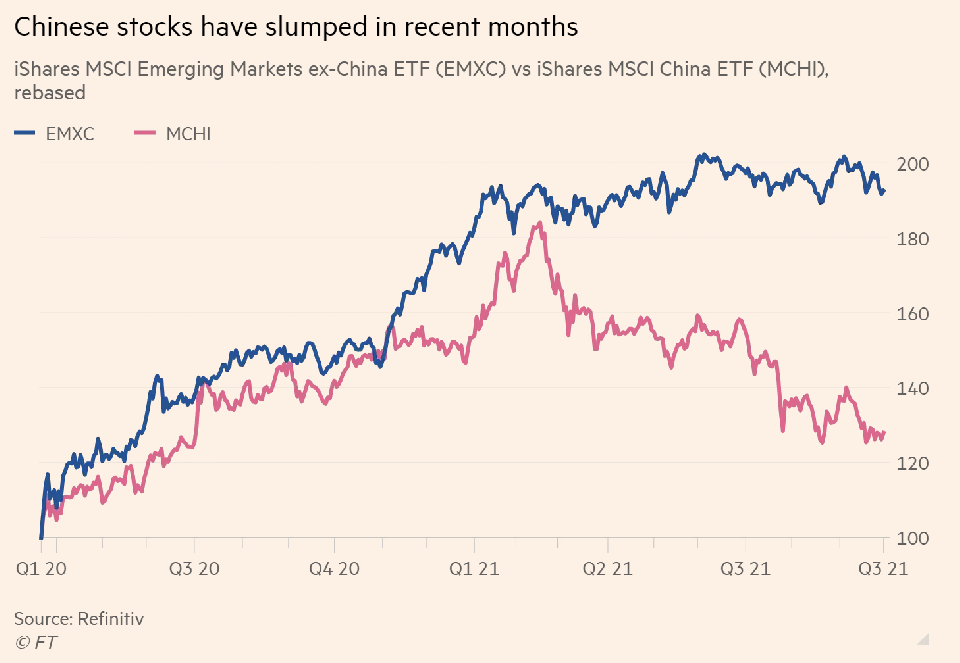
Globally, it identified 303 listed companies, with total market capitalisation in excess of $19tn, that generate at least 5 per cent of their revenue from China.
Separate analysis by Jared Woodard, head of the research investment committee at BofA, found that — based on their holdings of these 303 companies — 138 of the 251 ETFs the bank covers generated at least 3 per cent of their underlying revenue from China.
Apart from China-focused funds, emerging market ETFs were the most exposed, with their constituents typically deriving between 25 and 45 per cent of their revenues from the country.
However, even some ETFs focused purely on US-listed stocks were found to have high exposures, led by the iShares Semiconductor ETF (SOXX), whose constituents generate 27.9 per cent of their revenues from China, according to BofA’s numbers.
The VanEck Semiconductor ETF (SMH) is not far behind, at 25.8 per cent, with VanEck Low Carbon Energy ETF (SMOG), which tracks a global index, at 19.1 per cent, and the First Trust Nasdaq 100 Technology Sector Index fund (QTEC), at 16.6 per cent.
“A lot of US companies have built up quite a lot of dependence on revenues from China,” Woodard said. “Investors may not be aware. People know the mandates of the funds they buy usually, but what they might not know is that companies around the world have become increasingly dependent on China.”
The figures might even understate ETFs’ exposure to China. Some funds will hold companies that derive some revenue from China, but less than the 5 per cent threshold used in BofA’s analysis, meaning their contribution is missed. In addition, not all companies disclose the full geographic breakdown of their sales, Woodard said.
The research also only covered revenues emanating from China, not other potential vulnerabilities such as supply chains.
“Revenue exposure is something we can measure [but] that is just one reflection of their relationship. [Via] broader trade, labour pools, there are a host of ways that means economies around the world are more connected than before,” Woodard added.
His analysis found that some of the ETFs with little exposure to China have outperformed comparable China-centric funds by as much as 37 percentage points since the onset of the pandemic in March 2020.
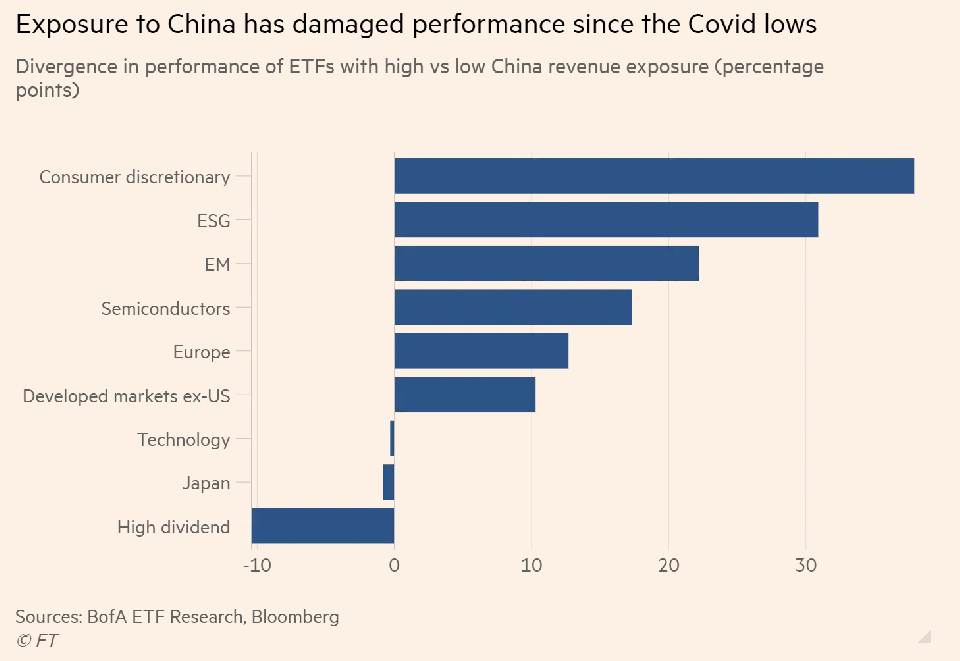
The gaps are particularly large for consumer discretionary funds, where some ETFs hold China-dependent casino, education and luxury stocks, while others do not.
The gaps are also notable for funds following an environmental, social and governance mantra and those focused on emerging markets.
While every stock market has its ups and downs, Woodard argued that China’s current combination of long-term concerns around issues such as demographics and potential growth, cyclical headwinds such as tight monetary policy, and “political interventions in the name of common prosperity” means “the risk may be greater than the rewards”.
Kenneth Lamont, senior fund analyst for passive strategies at Morningstar, said the analysis underscored the need for investors to be aware of what is in the funds they hold.
“The geographical location of a company is somewhat arbitrary. It’s not necessarily linked with where it makes its money. Shell and BP are listed in the UK but that’s not where the bulk of their revenues are coming from,” Lamont said.
“American companies tend to have a fairly large domestic footprint because they have a large internal market, but in a globalised world we are all dependent to some degree on how well China is doing.”
BofA also noted that, since 2017, mutual funds had gone from having an equal weight position in the US companies with top decile exposure to China to being more than 10 percentage points underweight.
ETFs, being overwhelmingly passive, do not have the scope to follow suit, even though these stocks trade at near-record 25 per cent premium to their peers, according to BofA.
Rahul Sen Sharma, managing partner of Indxx, an index provider, said “only time will tell,” whether active managers’ decision to underweight US stocks heavily exposed to China pays off.
“We will have to see how the returns stack up over the long term. Passive investment usually wins out over active,” he said. Lamont agreed, saying “next week something might change and these active managers will be caught off guard.
“Sometimes [active management] pays off and sometimes it doesn’t. Maybe it will pay off this time but most active managers don’t make enough calls right over time.” |



