SI
SI
discoversearch

We've detected that you're using an ad content blocking browser plug-in or feature. Ads provide a critical source of revenue to the continued operation of Silicon Investor.  We ask that you disable ad blocking while on Silicon Investor in the best interests of our community.  If you are not using an ad blocker but are still receiving this message, make sure your browser's tracking protection is set to the 'standard' level.
Strategies & Market Trends : 2026 TeoTwawKi ... 2032 Darkest Interregnum -- Ignore unavailable to you. Want to Upgrade?


To: marcher who wrote (180269)11/12/2021 9:39:50 PM
From: TobagoJack1 Recommendation

Recommended By
alanrs

  Respond to of 218246
 
Re <<what do you think about the future of woke?>>

I think the original woke was likely okay, in the grand scheme of ism

but along the way the movement attracted tag-alongs and hijackers

now we pray that the new ism slows down, stops, and reverses

however, 'we' usually do not get what we pray for

we do not even get what we think we deserve

we get what's coming


To: marcher who wrote (180269)11/12/2021 9:56:00 PM
From: TobagoJack  Respond to of 218246
 
Re <<what do you think about>>

I think some folks truly know serious marketing ways & means


seems to go well with other meme concepts


I thought it would be hilarious if what 'some' say about Guo is true, that he is a deep-plant spy Message 33077534
"In Princeton Junction, a Chinese dissident faces harassment as part of a disinformation campaign by a billionaire with close ties to Steve Bannon"

Message 33014409
"Their First Try Backfired, but Giuliani and Allies Keep Aiming at Biden"

Message 32986987
would be hilarious should Mr Guo turn out to be a double agent, per enough of Sun Tzu's stratagems

Message 32892895
Guo Wengui: ‘Dissident-hunter, propagandist, and agent in the service of the … Chinese Communist Party’


A $27 Billion Token Loved by Exiled Billionaire and Steve Bannon
Zijia Song
13 November 2021, 07:12 GMT+8


Steve Bannon greets Wengui Guo in 2018. Photographer: Don Emmer/AFP/Getty ImagesLike so much in cryptocurrencies, there’s a lot to unpack with Himalaya Coin, which has quietly zoomed to an apparent $27 billion valuation in less than two weeks.

For starters, there’s the music video, “ Hcoin to the Moon,” featuring exiled Chinese billionaire Wengui Guo smoking a cigar, hanging out on a yacht and driving a red sports car.

The song’s lyrics, most sung in Chinese, describe a bleak world: “Freedom, such a familiar word/But it’s unknowingly getting further and further away from me.” Other verses list the virtues of Himalaya Coin and the related Himalaya Dollar, a stablecoin tracking the U.S. dollar:

Security guarded by the most advanced encryption technology
No one can take your wealth away from you
Stablecoin, floating coin, unparalleled in the world
And 20% gold reserve attached to the value


The chorus screams over and over: “Welcome to the world/To the new world/Welcome to the world/Hcoin to the moon.”

“To the moon” is notable because that has become a rallying cry, the guiding hope among crypto traders that the price of a holding will surge enormously.

But support from Guo and Steve Bannon, the former Donald Trump adviser, suggests there’s more than just crypto-cheerleading at work with Himalaya Coin.

Guo and Bannon have waged a public campaign against the Chinese government for years, and comments last week from Bannon indicate this is the latest front in that battle. Himalaya Coin’s debut this month also stands out because, in September, China widened its crackdown on the use of cryptocurrencies.

Guo has touted the digital token on social media, and has a business relationship with the exchange where it trades, according to the chief executive officer of that marketplace. Bannon, during an interview last week, called Himalaya Coin’s debut “monumental” and put it in the context of his fight against China. “If you look at the institutionalization of the counteroffensive to the Chinese Communist Party, it’s pretty impressive,” Bannon said.

Himalaya Coin only appears to trade on the Himalaya Exchange. It’s not included in CoinMarketCap’s long list of global cryptocurrencies, which has become the de facto source for digital token valuations. On the Himalaya Exchange, its price has jumped from 10 cents when it started trading at the beginning of the month to about $27 now.

Himalaya Exchange CEO Jesse Brown says one billion of the coins have been issued. That equates to a market value of about $27 billion, similar to what CoinMarketCap says Shiba Inu, a dog-themed coin that’s recently surged in popularity, is worth.

Read More: Shiba Inu Coin Craze Drives Demand for Less-Than-Ideal Dog Breed

Guo has an agreement with the Himalaya Exchange allowing his business clients to buy products from firms linked to the billionaire using the Himalaya Dollar stablecoin, Brown said in an interview. The trading platform has amassed 20,000 accounts, more than half of which are owned by Mandarin-speaking investors, Brown said.

People in the U.S., Canada and Japan cannot use the exchange, he added, though there are plans to get U.S. access.

Guo is “using his platform to to get people to get involved in crypto and financial freedom,” Brown said. “I think it speaks to his whistleblower program in China and how he’s looking to get more independence.”

A representative for Guo couldn’t immediately be reached. An email sent to Bannon’s attorney and public relations representative after he was indictedFriday by the U.S. Justice Department for defying congressional subpoenas wasn’t immediately returned.

Guo, anticipating corruption charges, fled China in 2014 and has since railedagainst the government. After moving to the U.S., he’s alleged high-level officials from China’s Communist Party engaged in political corruption.

Although the Chinese government has been reticent about Guo, Interpol issued a red notice -- an alert to law enforcement officials worldwide about a fugitive -- for him in 2017 “at Beijing’s request,” the South China Morning Post reported at the time.

GTV Media Group Inc., which has ties to Guo and Bannon, in September settledU.S. Securities and Exchange Commission allegations it participated in an illegal sale of shares and digital securities referred to as either G-Coins or G-Dollars. Neither Guo nor Bannon were named by the SEC. GTV and two other entities involved didn’t admit or deny wrongdoing. The firms paid more than $539 million to resolve the case.

Guo has been an avid cheerleader for H-Coin on his YouTube channel, which has about 425,000 subscribers, and on conservative social media outlet Gettr. The price of the coin has jumped 270-fold since launching Nov. 1.

“We’ve got a lot of diamond hands,” Brown said, using slang meaning traders who hold onto an investment regardless of volatility.

Or, as “Hcoin to the Moon” puts it:

Destroy the machine that sucks you dry
Never be a slave to money again
The door to Himalaya Federal Reserve will always be open for you
A bright future lies in Himalaya Coin


Before it's here, it's on the Bloomberg Terminal.
LEARN MORE


To: marcher who wrote (180269)11/16/2021 10:34:10 AM
From: Pogeu Mahone  Read Replies (1) | Respond to of 218246


To: marcher who wrote (180269)1/18/2022 6:30:16 PM
From: TobagoJack  Read Replies (1) | Respond to of 218246
 
Following up to the curious Mr Guo Wengui Message 33571769 <<deep-plant spy>>

It seems that Team China managed to get a lot of runaways to 'voluntarily' return, or otherwise, but has singularly failed to persuade Mr Guo to do same, and be Assange-d from continuing w/ Snowdon-ed.

I call that curious. Let us see what if anything he does to engage w/ 2022 and 2024

bloomberg.com

China’s Global Dragnet Grinds On After Bringing Back 10,000 Overseas ‘Fugitives’

Campaign relies on coercion and kidnapping, report says Worldwide effort continues to be source of diplomatic tensions

18 January 2022, 19:00 GMT+8
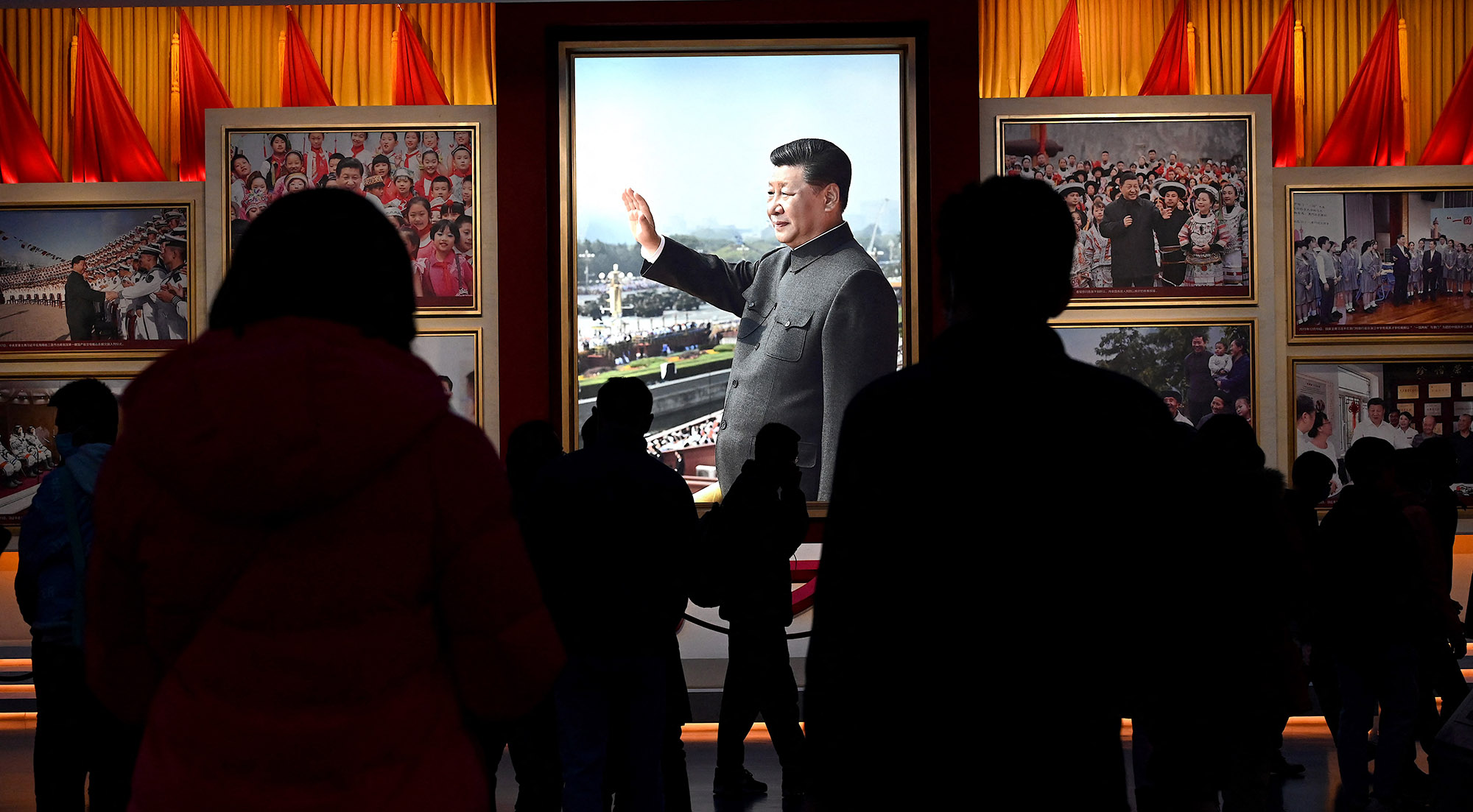

Visitors walk in front of a picture of Xi Jinping at the Museum of the Communist Party of China in Beijing.

Photographer: Noel Celis/AFP/Getty ImagesChina has relied on coercion, including kidnapping and pressuring families, to force some 10,000 “fugitives” to return from overseas, according to a new report that sheds light on a campaign that has stoked diplomatic tensions around the globe.

Chinese efforts to repatriate accused criminals netted 9,946 people since President Xi Jinping launched the initiative more than seven years ago, official data compiled by Safeguard Defenders show. The statistics were released Tuesday as part of a broader report on the program by the Madrid-based human rights group, which found most returns China calls “voluntary” relied on covert or extrajudicial means to force those targeted to come back.

The repatriation push peaked at 2,041 in 2019 before the pandemic curbed travel and diplomatic exchanges around the globe, according to data released by anti-corruption authorities and published by state media. Nonetheless, the returns have continued, with 1,114 reported by the National Supervisory Commission in the first 11 months of last year.

The campaign has spanned more than 120 countries, including Australia, Canada and the U.S. -- destinations popular among those sought by Beijing because of their perceived reluctance to cooperate with Chinese law enforcement demands. Disputes over such repatriation efforts have occasionally emerged, something that could increase as Western governments push back against what they view as human rights abuses intended to quash political opposition.


Safeguard Defenders urged nations to take efforts to better track and prevent what the group argues would be more accurately described as “involuntary” returns within their borders. The group is calling on governments to suspend extradition treaties with China to protest the “clear violation of international norms and national sovereignty of target countries.”

“Involuntary returns are a cornerstone in the expansion of China transnational repression, yet the phenomenon is little known in the West,” said Safeguard Defenders. The group’s director, Peter Dahlin, was held in a “black jail” -- an extralegal detention center -- for more than three weeks in 2016 on accusations of spreading “negative information about China” and was released after making a confession on state television.

China has rejected criticism of its methods to bring Chinese nationals home for punishment, with a Foreign Ministry spokesman saying in July that “repatriating corrupt fugitives and recovering illegal proceeds” are just causes to “uphold and promote” the rule of law. Beijing has dismissed U.S. efforts to question its practices as an attempt to smear China.

The 68-page report represents one of the most comprehensive looks yet at a campaign that Xi launched under the name “Operation Fox Hunt,” originally focused on capturing some 18,000 officials believed to have fled overseas. The campaign has since been institutionalized and taken over by the NSC, an anti-graft body created in 2018 with oversight of millions of Communist Party members and public employees.

While China has secured some targets through extradition, deportation and other agreements with the countries where they were living, many have been brought back by three extra-judicial methods. Those include pressuring family in China, sending agents overseas to directly intimidate the target and kidnapping.


The report details 62 individual cases that illustrate the various approaches, including some that have fueled diplomatic controversy:

- Daniel Hsu, a U.S. citizen, was barred from leaving China for four years in what he described as an effort to pressure his father to return and face allegations of embezzlement. He was released in November, in a move that coincided with Xi’s video summit with U.S. President Joe Biden.

- Zheng Ning, a former executive of a state-owned enterprise, agreed to return from France in 2017 after visits from undercover Chinese agents. France complained that the agents were acting without the country’s knowledge or a formal extradition request.

- Gui Minhai, a Swedish-Chinese writer, went missing in Thailand in 2016 as part of string of disappearances related to group of Hong Kong booksellers that sold works critical of the Communist Party. He later resurfaced in Chinese custody, where he made videotaped confessions, and was imprisoned for 10 years for “illegally providing intelligence overseas.”

Although it was unclear what share of the individuals were brought back by such tactics over the entire period, an official breakdown for 2018 showed that “voluntary returns” accounted for almost two-thirds of cases that year. An official legal interpretation of the law that outlined the NSC’s powers listed“persuasion” as a method that could “avoid the complicated legal procedures and long judicial cooperation procedures of the countries where fugitives hide.”

Commission agents can also employ “irregular methods,” according to the 2018 interpretation published by the agency. “In practice, kidnapping or trapping and capturing are rarely used,” the document said, noting that such actions prompt diplomatic disputes.

“The main purpose of Xi isn’t just to get these people back to China -- it’s to prevent Chinese high-level government officers from escaping from China,” said Gao Guangjun, a New York-based attorney who has represented people targeted by Beijing’s exit bans and Interpol red notices. “He wants to show even if you escape to the U.S., I can still get you back to China.”

Safeguard Defenders said what was initially billed as an anti-corruption operation has increasingly been used to pursue political dissidents such as Falun Gong practitioners. The report cited a 700% increase in asylum requests from China between 2012 and 2020, according to data from the UN High Commissioner for Human Rights, as evidence that many sought by China might be fleeing political crackdowns.

“Foreign governments must ensure all diplomatic discussions on these issues take place in an open, transparent and public space and, where possible, expose activities carried out on its soil by overseas agencies that violate its judicial sovereignty,” the report said. “Without transparency, violators are encouraged to continue and expand their activities. Silence will increase the transgressions, not reduce them.”

— With assistance by Colum Murphy, and Blake Schmidt

