Food Shortages coast to coast:
America Is Running Out of Everything
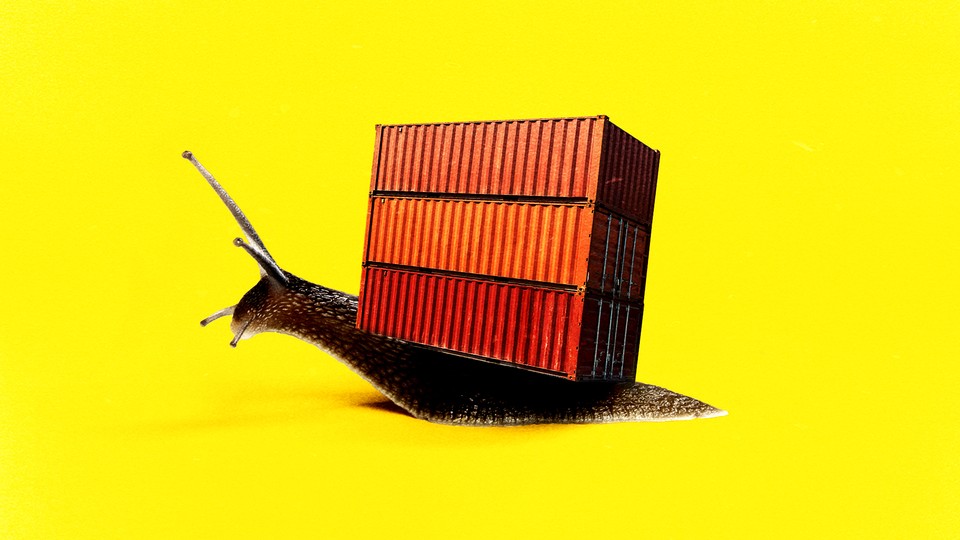
The global supply chain is slowing down at the very moment when Americans are demanding that it go into overdrive.
By Derek Thompson
Getty; The Atlantic
OCTOBER 7, 2021
SHARE
About the author: Derek Thompson is a staff writer at The Atlantic and the author of the Work in Progress newsletter. He is also the author of Hit Makers and the host of the podcast Plain English.
Is it just me, or does it feel like America is running out of everything?
I visited CVS last week to pick up some at-home COVID-19 tests. They’d been sold out for a week, an employee told me. So I asked about paper towels. “We’re out of those too,” he said. “Try Walgreens.” I drove to a Walgreens that had paper towels. But when I asked a pharmacist to fill some very common prescriptions, he told me the store had run out. “Try the Target up the road,” he suggested. Target’s pharmacy had the meds, but its front area was alarmingly barren, like the canned-food section of a grocery store one hour before a hurricane makes landfall.
This is the economy now. One-hour errands are now multi-hour odysseys. Next-day deliveries are becoming day-after-next deliveries. That car part you need? It’ll take an extra week, sorry. The book you were looking for? Come back in November. The baby crib you bought? Make it December. Eyeing a new home-improvement job that requires several construction workers? Haha, pray for 2022.
The U.S. economy isn’t yet experiencing a downturn akin to the 1970s period of stagflation. This is something different, and quite strange. Americans are settling into a new phase of the pandemic economy, in which GDP is growing but we’re also suffering from a dearth of a shocking array of things—test kits, car parts, semiconductors, ships, shipping containers, workers. This is the Everything Shortage.
The Everything Shortage is not the result of one big bottleneck in, say, Vietnamese factories or the American trucking industry. We are running low on supplies of all kinds due to a veritable hydra of bottlenecks.
Read: Americans have no idea what the supply chain really is
The coronavirus pandemic has snarled global supply chains in several ways. Pandemic checks sent hundreds of billions of dollars to cabin-fevered Americans during a fallow period in the service sector. A lot of that cash has flowed to hard goods, especially home goods such as furniture and home-improvement materials. Many of these materials have to be imported from or travel through East Asia. But that region is dealing with the Delta variant, which has been considerably more deadly than previous iterations of the virus. Delta has caused several shutdowns at semiconductor factories across Asia just as demand for cars and electronics has started to pick up. As a result, these stops along the supply chain are slowing down at the very moment when Americans are demanding that they work in overdrive.
The most dramatic expression of this snarl is the purgatory of loaded cargo containers stacked on ships bobbing off the coast of Los Angeles and Long Beach. Just as a normal traffic jam consists of too many drivers trying to use too few lanes, the traffic jam at California ports has been exacerbated by extravagant consumer demand slamming into a shortage of trucks, truckers, and port workers. Because ships can’t be unloaded, not enough empty containers are in transit to carry all of the stuff that consumers are trying to buy. So the world is getting a lesson in Econ 101: High demand plus limited supply equals prices spiraling to the moon. Before the pandemic, reserving a container that holds roughly 35,000 books cost $2,500. Now it costs $25,000.
RECOMMENDED READING

America’s Favorite Flimsy Pretext for Limiting Free Speech JEFF KOSSEFF

The U.S. Is Naive About Russia. Ukraine Can’t Afford to Be. ANNE APPLEBAUM

The Myth of Tribalism DOMINIC PACKER AND JAY VAN BAVELJ.P. Morgan’s Michael Cembalest wrote that this has created strong incentives for container owners to ship containers to China—even if they are mostly empty—to expedite the packing and shipping of freights in Shanghai to travel east. But when containers leave Los Angeles and Long Beach empty, American-made goods that were supposed to be sent across the Pacific Ocean end up sitting around in railcars parked at West Coast ports. Since the packed railcars can’t unload their goods, they can’t go back and collect more stuff from filled warehouses in the American interior.
And what about the truckers who are needed to drive materials between warehouses, ports, stores, and houses? They’re dealing with a multidimensional shortage too. Supply-chain woes have backed up orders for parts, such as resin for roof caps and vinyl for seats. But there’s also a crucial lack of people to actually drive the rigs. The Minnesota Trucking Association estimates that the country has a shortage of about 60,000 drivers, due to longtime recruitment issues, early retirements, and COVID-canceled driving-school classes.
In short, supply chains depend on containers, ports, railroads, warehouses, and trucks. Every stage of this international assembly line is breaking down in its own unique way. When the global supply chain works, it’s like a beautifully invisible system of dominoes clicking forward. Today’s omnishambles is a reminder that dominoes can fall backwards too.
And then there’s the labor market. In the U.S., job openings have hit record highs in restaurants, hotels, and other leisure and hospitality sectors. But companies are struggling to fill these roles—and to keep factories and some other businesses operating at full capacity when Delta infections roll through.
You can see these problems from a variety of angles. From workers’ perspective, unemployment insurance and several rounds of stimulus have allowed laid-off workers to be picky about jobs, instead of desperately lunging for the first paycheck available. That doesn’t sound like such a bad thing. But from many employers’ perspective, government programs have exacerbated a terrible labor shortage. Staffing up a business has become difficult. The result, from consumers’ perspective, is more of the same Everything Shortage. Since finding, hiring, and training hundreds of thousands of people in new roles at the same time is hard during a pandemic, we should all expect a bit of slowness across the service sector for a while—a bit more time for that cappuccino, a bit longer of a wait for that appetizer, a bit of confusion at the convenience store when you ask where the nail-polish remover is and the new employee who had to Zoom in for her training program needs a moment to remember the aisle numbers.
Finally, as if those slowdowns weren’t enough, there’s the mail. As of this month, the U.S. Postal Service is reducing its use of air transportation to save money. The USPS estimates that deliveries outside your local area will likely be delayed by one or two days. But as we’ve seen, relying on rail and truck means leaning on systems that are dealing with their own mess.
Read: The question at the heart of the Postal Service crisis
This has not yet added up to a recession. But it portends a massively frustrating holiday-shopping period, especially for households with a habit of buying presents at the last minute. “I’ve been doing this for 43 years and never seen it this bad,” Isaac Larian, the founder and CEO of the toy maker MGA Entertainment, told Bloomberg. “Everything that can go wrong is going wrong at the same time.” USPS has already announced price hikes for the winter holidays. To avoid paying those surcharges and suffering the yuletide wrath of disappointed children, the recommended course of action is clear: If you want it by December 25, start placing those orders soon. Everyone complains when stores start playing carols and advertising holiday sales in October. This year, “Christmas creep” is your best shopping strategy. Either that, or prepare the kids to celebrate Christmas morning some time in January.
How will the everything shortage be resolved? One possibility is that Americans adopt a sustainable, ascetic, and homespun lifestyle that reduces our dependency on goods that activate the global supply chain. If you can seriously envision such a world, I envy your gift of imagination.
The best solution to the Everything Shortage is to have a policy to make more of just about everything. Containers, which carry more than 90 percent of the world’s traded goods, are overwhelmingly manufactured in China. Why doesn’t America make more? Car parts, semiconductors, and home goods have been offshored, making the U.S. sorely reliant on overseas factories. Why can’t America make more? At-home COVID-19 tests, which could illuminate household infections and prevent community spread, were only just authorized by the FDA, almost two years into this pandemic. Why hasn’t America made more?
For decades, many U.S. companies moved manufacturing overseas, taking advantage of cheaper labor and cheaper materials across the oceans. In normal times, America benefits from global trade, and the price of offshoring is borne by the unlucky few in deindustrialized regions. But the pandemic and the supply-chain breakdowns are a reminder that the decline of manufacturing can be felt more broadly during a crisis when we run out of, well, damn near everything. That’s why Joe Biden's Build Back Better plan includes billions of dollars to reshore manufacturing, invest in basic research, and beef up domestic supply chains.
Lizzie O’Leary: The modern supply chain is snapping
Our dearth of manufactured parts and containers is part of a broader crisis of manufactured scarcity in America. A protectionist and anti-growth instinct runs through government, yielding not only a flat-footed CDC and a tardy FDA but also sharp restrictions on housing construction, immigration, and the licensing of new professionals and tradespeople. Focusing on the redistribution of income and goods is natural for today’s progressives, who tend to emphasize the virtue of equality. One lesson of the Everything Shortage is: You cannot redistribute what isn’t created in the first place. The best equality agenda begins with an abundance agenda.

13 Retirement Investing Blunders to Avoid in Your 60s
SPONSORED BY FISHER INVESTMENTS
See More

Today’s crisis is an opportunity to emphasize a new philosophy of what The New York Times’ Ezra Klein calls “ supply-side progressivism,” which sees value in this across-the-board abundance. This approach might start by prioritizing policies that reduce the cost of housing and health care, and reshoring the production of materials that we deem essential to national security during a pandemic or an unrelated supply-chain calamity. Decades from now, we might look at the legacy of the pandemic, and see that it took a global crisis of choke points to teach us that real progress begins by removing the choke points at home.
Derek Thompson is a staff writer at The Atlantic and the author of the Work in Progress newsletter. He is also the author of Hit Makers and the host of the podcast Plain English.
Twitter |



