“Putin Is Not Stupid”: This Expert Spent 182 Days on the Russia-Ukraine Battlefields

By
Phillip Karber
Published
January 12, 2022

Image of Russian TOS Unit. Image Credit: Creative Commons.
American Who Spent 182 Days on the Battlefield Speaks Out on Ukraine and Russia: One US civilian has been to Ukraine and seen the border skirmish between Moscow and Kyiv up close and personal. Policy institute president and defense and national security expert Dr. Phillip Karber has visited Ukraine 36 times in the last eight years and has spent a total of 182 days at the front lines of various battlefields observing combat.
1945 caught up with Karber, who heads the Potomac Foundation, for a wide-ranging, detailed, and insightful interview about the situation in Ukraine and Russia. 1945 Defense Editor Brent Eastwood conducted the interview.
You have traveled to Ukraine many times over the years after Russia’s annexation of Crimea. Can you tell us the overall state of readiness when it comes to Ukraine’s military?
Considering the terrible shape the Ukrainian forces were in at the beginning of 2014 after two decades of utter neglect, their resurrection as a fighting force has been nothing short of miraculous.
At the beginning of the conflict on paper, they had 15 ground force brigades with an authorized strength of 55 maneuver battalions. In reality only 16 of the latter were “ready” (defined as having at least two-thirds of required manpower and operable equipment). Moreover, only 25 percent of the ready battalions were deployed on the east side of the Dniepr River opposite Russia (and two of those were lost with the occupation of Crimea).
Neither Western analysts nor Russian planners expected the Ukrainian Army to be able to fight for more than several days. But they mobilized, redeployed their forces to the east, repaired and upgraded old weaponry, and have been fighting for eight years. They have lost some battles and won some battles, but in the process inflicted as many casualties as they have suffered.
Today, Ukraine fields the strongest active Army in Europe — it is larger, more ready with more combat experience than the armies of the last ten countries to join NATO — combined.
The active force equals 40 Battalion Tactical Groups (BTGs), backed up by 100,000 reservists with experience at the front, and units at every level led by a new generation of young aggressive officers who have fought the Russians, know their weakness and are not afraid to exploit them.
Ironically, in terms of stabilizing Eastern Europe, providing a bulwark to Russian revanchism, and significantly improving the defense of Romania, Poland, and the Baltics — NATO would gain more from having Ukraine on its side than Ukraine would get from being in NATO.
We do not appreciate their contribution now, but we will miss them when they are gone.
There is a common line of thinking in Washington that Kyiv would be beaten very quickly by Moscow. What is your take?
If the Washington, DC “desk-commandos” would get off their derrières and go to the front, they would get a more realistic perspective.
The Ukrainians can hold the current 500km line of engagement until the cows come home — in terms of the area covering the Donbas front against the 1st Donetsk and 2nd Luhansk proxy Corps and the causeways from Crimea against its 22nd Corps. And, in defending those prepared positions, they will stack Russian body bags like cordwood.
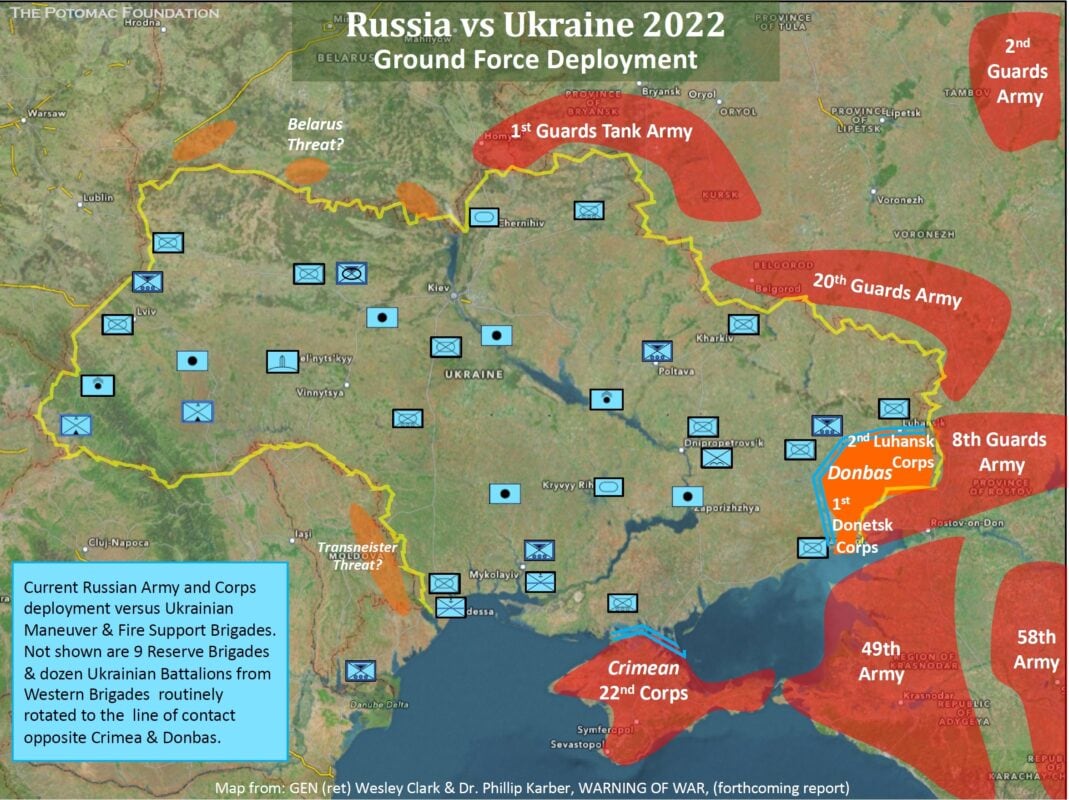 Map of Military Forces In and Around Ukraine. Image Courtesy of Dr. Karber. Map of Military Forces In and Around Ukraine. Image Courtesy of Dr. Karber.
The difficulty they face is not at the current line of contact but from a multi-directional threat on a six times larger perimeter and exacerbated by danger of multi-domain attack from the air and sea, as well as a large second-echelon backed up by chemical and tactical nuclear weapons. It is this wider and more intense threat that endangers Ukraine’s defensibility.
First, Putin has reinforced his front-line units with three additional Armies:
— the 8th Guards Army (8GA) at Rostov as a second-echelon behind the Donbas.
— the 20th Guards Army (20GA) at Voronezh opposite the city of Kharkiv.
— the 1st Guards Tank Army (1GTA) to the northeast of Kursk, aimed directly at Ukraine’s capital Kyiv.
These three armies — with reinforcements brought in last spring and this fall plus the existing front-line Donbas and Crimean Corps (plus available Airborne/Air Assault Divisions) — are equal to about 60 Battalion Tactical Groups (BTGs) and available to fight now.
While the aggressor would not have more than a 50 percent advantage in quantity of units, Russian weapons have a qualitative edge and the area north of Kharkiv favors the offense — it is classic tank country with few terrain obstacles and wide opportunity for rapid maneuver.
Moreover, in the current build-up, the second shoe has yet to drop. It appears that units from the Central and Southern Military Districts (2nd, 41st, 49th & 58th Armies) may be loading up for forward movement which could bring the Russian invasion force up to 100 BTGs giving them more than a two-to-one force ratio by the end of January.
Second, Ukraine’s small air force with Cold War-era aging fighters and helicopters is overshadowed by Russia’s larger and modernized air offensive potential. If preceded by a “shock and awe” strike with missiles (as done in Syria) followed up by bombers against key airbases and fixed air defenses, Russian fighters, and attack helicopters will own the skies and be able to not only add disproportionate attrition to the Ukrainian ground forces but seriously interdict their forward movement and counter-maneuver on the battlefield.
Third, to the north, Russia’s large exercise against NATO last September – Zapad 2021 – involved a Russian Army deployed forward into Belarus, which could drop down and cut Ukraine off in the West. Even without crossing the frontier, the prospect of an attack on the rear or flank draws off defenders that are badly needed in the East and South.
Fourth, to the south, Russia’s large fleet in the Black Sea along with amphibious ships brought into the Sea of Azov from the Caspian pose the threat of landings along the coast supported by Air Assault troops from Crimea, while Russian “peacekeeping” units in Transnistria could conduct sabotage and small unit raids. Another flanking danger tying down additional Ukrainian ground forces.
Lastly, and not to be ignored, Russia has already deployed along Ukraine’s border, the 400-500km range SS-26 Iskander-M missiles as well as heavy caliber long-range self-propelled guns (2S7 Pion and 2S7M Malka 203mm), and self-propelled mortars (2S4 Tyulpan 240mm) — all of which can deliver both tactical nuclear weapons and chemical warheads. Given the utility Russian chemical agents demonstrated in Syrian urban fighting their use cannot be ruled out if stiff resistance is met in Ukrainian cities.
Do You Think Russia Would Use Thermobaric Weapons Like the TOS-1?
We should not be surprised to see them use those fire-weapons because they favor an offensive breakthrough and are deadly even to entrenched infantry.
Russia has already fielded the TOS-1 in the 27th Nuclear/Biological/Chemical (NBC) Regiment near the Ukraine border, and similar TOS systems are in NBC units to the north and east of that. Interestingly, south of Rostov the enhanced/longer-range TOS-2 has been introduced.
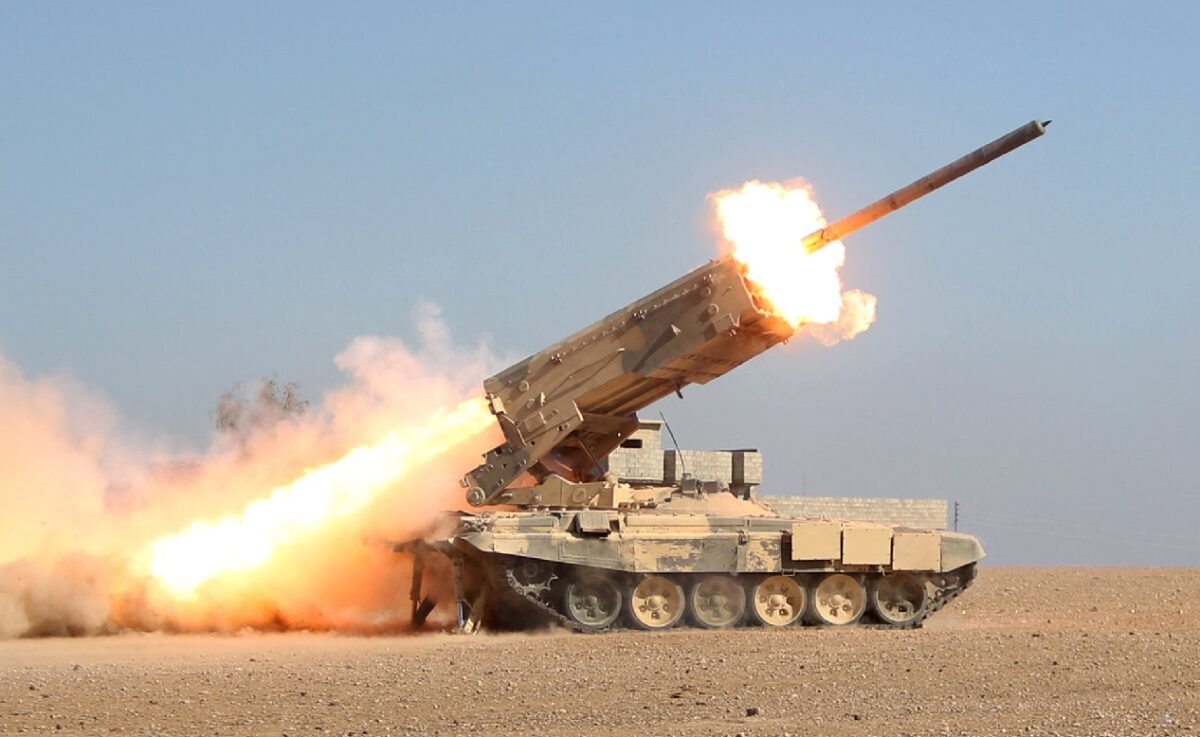 TOS-1 Rocket Launch. Image Credit: Creative Commons. TOS-1 Rocket Launch. Image Credit: Creative Commons.
They also have deployed opposite Ukraine with several hundred multiple rocket launchers and the new versions are capable of firing both thermobaric warheads, as well as submunitions and scatterable mines. Combined with accurate targeting by UAVs, they produce a highly lethal battlefield.
Can Ukraine mount a successful insurgency if Moscow does invade and annex new territory?
Yes, and they will.
Today all over Ukraine, territorial units are being formed and civilians preparing to resist. However, insurgencies are by their nature an indecisive and attritional form of war. So realistically, while they may make an occupation miserable, their impact will not significantly impede an armored invasion. Given the civilian fear and loathing of Russia, what will be immediately pressing on NATO is five to ten million refugees streaming West across the border to escape into Europe.
What is Russia’s goal when it comes to Ukraine and this latest buildup of forces? Does Putin really intend to invade?
Clearly, Putin manufactured this crisis to achieve something, but it remains vague as to what it is. Surely he knows:
— That Ukraine will fight if he renews the aggression he started in 2014 and he is undoubtedly aware that the highest percentage of enlistments in the Ukrainian Army are soldiers from the east, who despite Russian ethnic and linguistic background, do not want to be forced to live in Putin’s kleptocracy.
— That the more massive the attack and heavier the damage caused, the greater the number killed, and deeper the territory conquered — the greater and longer-lasting enmity he will engender in the Ukrainian people and more costly the occupation to subdue them.
— That his demands on the US and NATO are outrageous and he is unlikely to get them all.
But, if one of his objectives was to convince Ukrainians that the West would not come to their aid with military support — he has already achieved that with the pre-emptive declarations of President Biden not to commit U.S. forces or even send military aid.
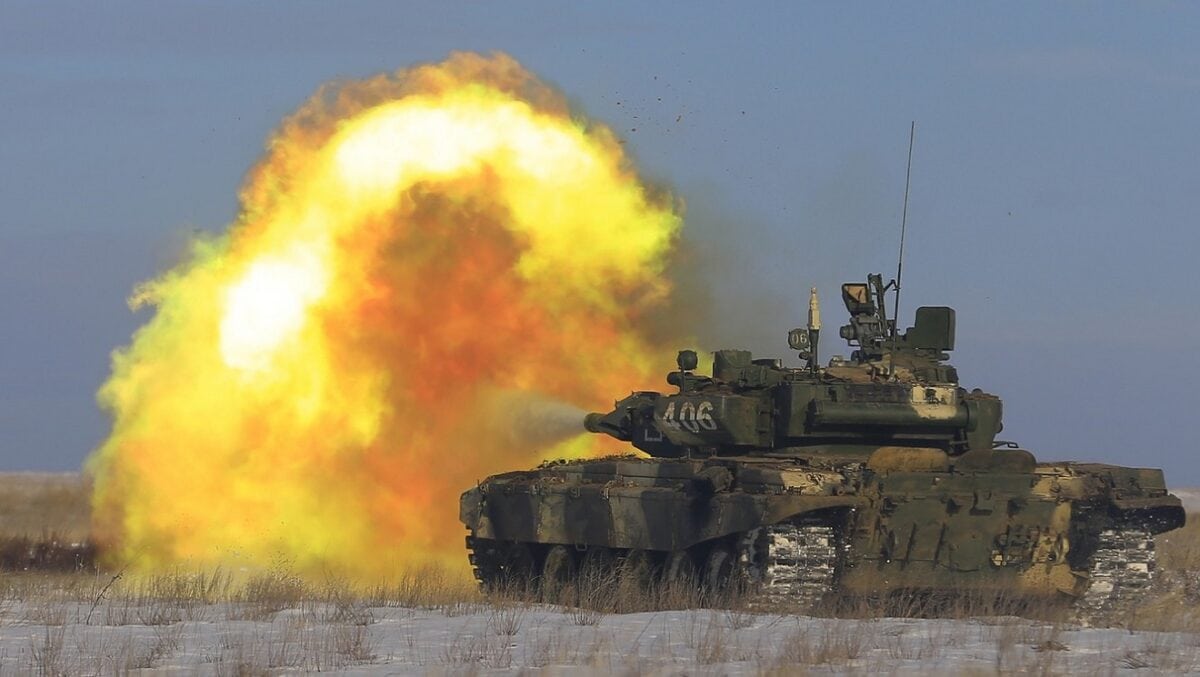 Russian T-90 Tank Firing. Image Credit: Creative Commons. Russian T-90 Tank Firing. Image Credit: Creative Commons.
How impactful would tough financial sanctions like kicking Russia out of SWIFT be on Moscow?
Whatever else you say about him, Putin is not stupid.
If he thought that the diplomatic and economic costs of renewed aggression against Ukraine outweighed the gain of getting Ukraine back under control and demonstrating U.S. and NATO impotence to East Europeans and former Soviet Republics, he would already have been deterred from fielding a force he is not willing to employ. He knows that previous sanctions caused substantial pain to our European allies and that there is no stomach for the dislocation a SWIFT ban will cause the global financial sectors.
He also knows that his “strategic ally” China would like to fill in the gap by creating an alternative monetary system to the dollar. Likewise, threats to reduce energy purchases from Russia will literally leave Europe in the cold.
What sorts of help can the US and NATO provide Ukraine if Moscow does attempt an invasion? For example, would more Javelin missiles help?
The U.S. has sent Ukraine about 120 Javelin launchers, which should give them enough to help hold the current line of engagement. Clearly, evidence of Russia adding make-shift covers for their tank turrets demonstrates that Javelin has both a tactical and deterring impact disproportionate to the small numbers delivered.
But, to cover a frontage six times larger, Ukraine will need a hell-of-a-lot more Anti-Tank Guided Missiles (ATGM) than they have now or what we have supplied. The U.S. Army is putting M-2 Bradley infantry fighting vehicles in storage and the U.S. Marine Corps is replacing armored Humvees — both mounting TOW-2 anti-tank missiles which, while not Javelins, remain potent anti-armor weapons. Sending 500 Bradleys and TOW-2 Humvees along with another couple hundred Javelins would be a fast and cost-effective means of coping with the Russian threat of horizontal escalation.
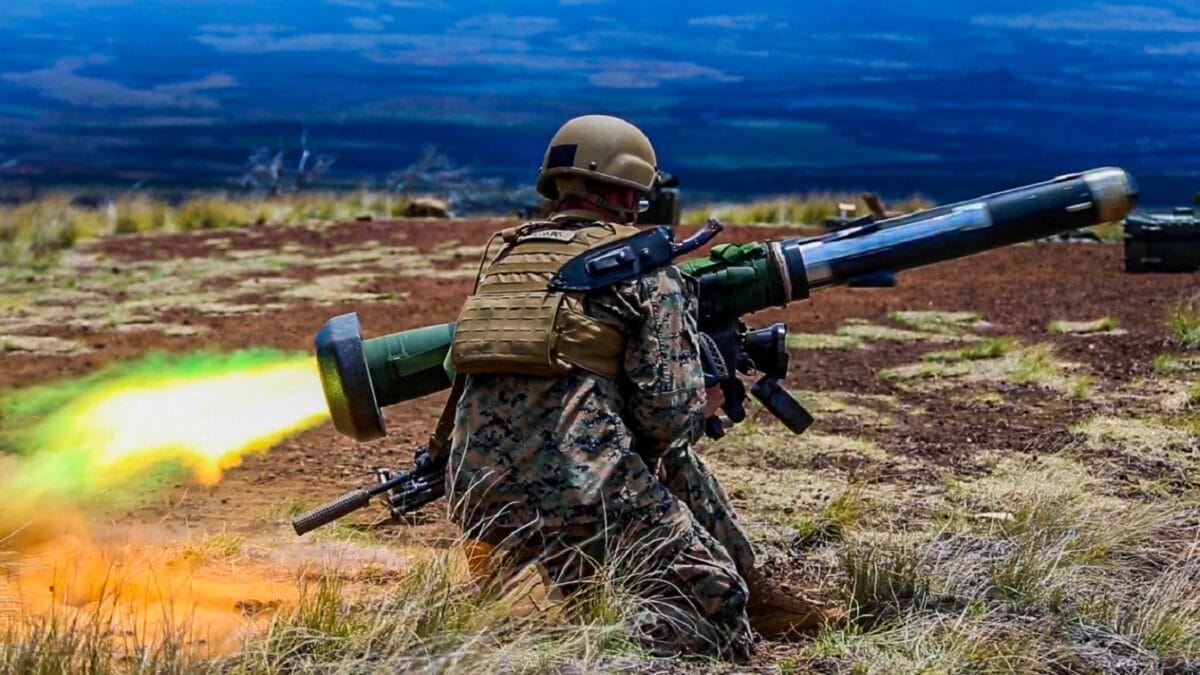 A U.S. Marine with 1st Battalion, 3rd Marines, fires a shoulder-fired Javelin missile during exercise Bougainville II at Pohakuloa Training Area, Hawaii, April 18, 2021. Bougainville II is the second phase of pre-deployment training conducted by the battalion designed to increase combat readiness through complex and realistic live-fire training. (U.S. Marine Corps photo by Cpl. Jacob Wilson) A U.S. Marine with 1st Battalion, 3rd Marines, fires a shoulder-fired Javelin missile during exercise Bougainville II at Pohakuloa Training Area, Hawaii, April 18, 2021. Bougainville II is the second phase of pre-deployment training conducted by the battalion designed to increase combat readiness through complex and realistic live-fire training. (U.S. Marine Corps photo by Cpl. Jacob Wilson)
Likewise, the Russians learned to fear the Stinger man-portable air-defense system (MANPADs) in Afghanistan. Supplying several hundred Stingers as point-defenses for key positions (like airfields and bridges) as well as for mobile protection of Ukrainian maneuver forces would add a lot to offset Russia’s aerial dominance over the battlefield. While the U.S. has sent surveillance aircraft flying over Ukraine air space to monitor the daily Russian buildup, they have not been backed up by deploying F-15/F-22 fighters to Romania and Poland or F-18s with Harpoon anti-ship missiles to Bulgaria. In combination, that would help counter Russia’s aerial and naval multi-domain bullying along with sending a powerful message of U.S. commitment to East European peace and security.
In the Obama Administration, it was popular to say as an excuse for not sending lethal aid to Ukraine, that they were deterring a 19th Century threat with 21st Century methods that minimize the risk of military escalation. But that gambit did not stop the aggression, end the conflict, or inhibit the current crisis Putin has unleashed. Now, the same mantra is repeated once again extolling “Diplomacy” and “Sanctions.” Putin is a bully whose strategy is based on the 20th Century currency of deployable armed force and does not seem to be impressed with post-millennial epiphenomenalist rhetoric.
The people of Ukraine stood up to Russian domination in order to be part of the West. They have had the courage and endurance to hold the bully at bay for eight years of war. With the US and NATO now refusing to support them militarily in this crisis…how long can they hold on?
Tragically we have left them dangling in the wind with nowhere to go and their survival dependent on Putin’s whim.
Dr. Phillip A. Karber is President of the Potomac Foundation. Dr. Karber is an internationally recognized authority on defense and national security matters; an accomplished business executive; and a university professor. He has prepared studies and recommendations on defense strategy for the highest levels of the U.S. government; advised many NATO governments on defense issues; headed BDM Corporation’s International Division; served as JFK International Air Terminal’s Chairman of the Board; and teaches courses in national security and military affairs at Georgetown University. |



