SI
SI
discoversearch

We've detected that you're using an ad content blocking browser plug-in or feature. Ads provide a critical source of revenue to the continued operation of Silicon Investor.  We ask that you disable ad blocking while on Silicon Investor in the best interests of our community.  If you are not using an ad blocker but are still receiving this message, make sure your browser's tracking protection is set to the 'standard' level.
Strategies & Market Trends : 2026 TeoTwawKi ... 2032 Darkest Interregnum -- Ignore unavailable to you. Want to Upgrade?


To: Maurice Winn who wrote (187885)5/25/2022 5:28:39 PM
From: sense1 Recommendation

Recommended By
Maurice Winn

  Read Replies (2) | Respond to of 219490
 
The virtues are always virtues... as is true in any time period. They just don't come pre-packaged as a stand-alone option, free of error or myopia, that is available to be selected from a menu. As "you are what you think you are, so be careful what you think you are"... is always paired with a reality check that occurs in a social context... it requires there will always be conflict between society's choices... and those of a person, who has to be making choices as an intrinsically individual element within society, with the unique choices made by individuals necessary for progress.

But, while progress is not the only potential outcome of the lack of restriction on individual choice... neither is the enforced lack of individual choice in the interest of greater social cohesion... purely virtuous... rather than an openly institutionalized evil requiring by force that it be accepted.

How to resolve the conflict that must exist between the expression of different virtues... in different contexts... and between individuals right of self expression and the "social good"... that might not be "good" at all ?

The two prevailing "theories" appear to be... "law and order"... or "anarchy"... as the only options.

But, of course... that's a fallacy... adopted for purpose... as institutions like individuals tend to be self-aggrandizing.

Balancing the two... is not that complex in reality... demanding limits on government... and limits on individuals... defined at particular "red lines"... beyond which neither the empowerment of the individual nor the "social" is of benefit to either individuals or societies.


Clearly, there's a role for society in fostering understanding of virtue... and that role seen in context of the particular value of social cohesion...ideally is one that elevates individuals within a social context that is aware of, values and emphasizes the value of the "personal" virtues in the education fostering its citizens ability to realize their individual potential... within a context that also imposes limits... on both the individual and the aggregate power of society to impose on an individual beyond those well defined limits.


To: Maurice Winn who wrote (187885)5/25/2022 7:39:36 PM
From: TobagoJack  Read Replies (1) | Respond to of 219490
 
Re <<pushing Russia into the possession of China>>

... perhaps there be a deeper level of Washington & Co strategic direction that we plebs missing because we are foolish?

Anything is possible

In the meantime, the situation on the ground per FT

that the previous 'winning' is now less 'winning'

or we are to gather and curate, by detecting a change in tune and inflection in tone

if so, worrisome, presumably

in context that the rouble is at 7-years high

ft.com

Military briefing: battle for Sievierodonetsk shows Russian strategy in Donbas

Moscow may struggle to sustain offensive but Kyiv lacks enough heavy weapons for effective counter-attack

yesterday
© Reuters | Pro-Russian troops drive a tank in the Donetsk region Just 25km of terrain remains before Russia completely encircles a fiercely contested pocket of Ukrainian resistance in the eastern Donbas region, where Moscow has stepped up its offensive over the past month.

For days, punishing artillery strikes have crumbled Ukrainian defences around the city of Sievierodonetsk, the area where “the greatest activity of hostilities is taking place”, according to the Ukrainian army.

If the occupying forces succeed in surrounding the Ukrainian troops there, it would be Russia’s second successful military encirclement — the first came at the port of Mariupol, which fell last week after a three-month siege — and so would have symbolic significance for Moscow. Russia would then control all of Luhansk province, which together with neighbouring Donetsk makes up the Donbas.

But it is also a small area, signalling how Russian ambitions have shrunk since mid-April, when its military shifted focus after fierce Ukrainian resistance forced it to abandon attempts to take Kyiv. Russian-backed separatists already controlled parts of the Donbas before Moscow ordered the full-blown invasion of its neighbour three months ago.

The battle for Sievierodonetsk illustrates the way the fighting is likely to continue over the summer: a grinding war of attrition where the decisive factors will be the size of each force and how well equipped they are, western officials and analysts said.

Serhiy Haidai, Ukraine’s military governor of Luhansk, told local television over the weekend that Russia’s “scorched-earth tactics” sought to “wipe Sievierodonetsk off the face of the earth”. Russian shelling killed four civilians in bomb shelters at the Azot chemical plant on Monday and four more in the city itself, Haidai said.

Russian forces also this week captured the industrial town of Svitlodarsk in the south of Donbas. Serhiy Hoshko, head of Svitlodarsk’s military administration, told Ukrainian website Free Radio that the Russians had raised their country’s flag over the mayor’s office and were conducting patrols to check locals’ documents. Russian-backed separatists claimed they were “purging” the town of “hostile elements”.

“The Russian army is not a spent force yet,” said Samuel Cranny-Evans, a military analyst at the Royal United Services Institute, a London think-tank. “It is still fighting, still making advances and still causing Ukrainian losses.”

Those losses could be significant. Volodymyr Zelensky, Ukraine’s president, has said 50 to 100 of its soldiers may be dying every day. In general, about three times more fighters are wounded than are killed in battle, so Ukraine could be losing about 1,000 soldiers every three days, said Cranny-Evans.

Yet by holding back the Russians instead of retreating, these troops are buying time for the rest of Ukraine’s forces to be supplied with western weaponry, including long-range artillery that would allow them to shell Russian artillery positions behind the front lines.

The US has sent 90 M-777 long-range howitzers to Ukraine but only a dozen have reportedly reached the front and Ukrainian soldiers are still being trained to use the rest. Zelensky has said Russia’s weapons outnumber Ukraine’s by 20 to one.
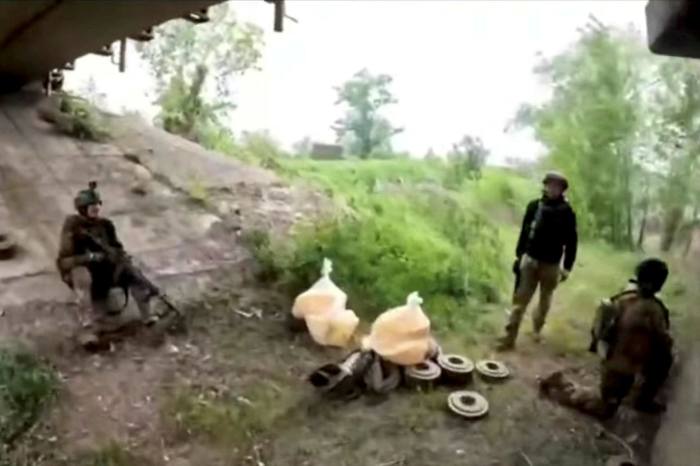
Ukrainian forces prepare to blow up a bridge in the Sievierodonetsk region © Reuters“By having those forces continue to fight, they are fulfilling an important military function,” a western official said. “Degrading Russian capability?.?.?.?and creating time for Ukrainian forces to improve their defences elsewhere.”

Meanwhile, Russian casualty rates appear to have fallen from their high initial levels. According to Ukrainian figures, 23,000 Russian troops were killed in the first two months of the attack, falling to 6,000 in the third month.

That suggests Russian troops are avoiding engaging as directly as before and are largely leaving the attack to artillery barrages, analysts said. The capture of hilly ground around the town of Popsana, for example, has enabled Russian artillery to dominate the area around Sievierodonetsk.

Russia has also deployed 10 so-called BMP-T “Terminator” armoured vehicles, which are mounted with heavy cannon and are designed to provide suppressing fire to help extract soldiers that may be pinned down.

Recommended


Even so, Russia’s army has its own personnel and equipment problems. According to the Ukrainian army, Moscow has withdrawn old T-62 tanks from storage to re-equip partially destroyed battalions.

It has also had to reconstitute battalion tactical groups, the army’s primary fighting unit, from other partially destroyed BTGs.

This “highlights serious manpower issues and the inability to create?.?.?.?formations to exploit gaps made by advancing units”, said Rochan Consulting, a Poland-based military consultancy.

But while Russian forces may struggle to sustain the offensive, analysts say, western and Ukrainian officials warn that Kyiv lacks enough heavy weapons to counter-attack effectively. Until Ukraine’s military is reinforced — on Tuesday Ukraine’s defence minister Oleksii Reznikov said he would soon announce some “unpleasant” surprises for Ukraine’s enemy — the result is likely to be a stalemate.

“Imagine that Russian forces finally take Sievierodonetsk, then what?” said Pavel Luzin, a Russian-based military analyst. “Strategically, it changes little?.?.?.?[and] most of the Russian army’s artillery range is less than 25km. So [Russian president Vladimir] Putin can’t destroy all of Ukraine’s cities, everywhere.”


To: Maurice Winn who wrote (187885)5/25/2022 7:47:58 PM
From: TobagoJack  Respond to of 219490
 
Re <<pushing Russia into the possession of China>>

perhaps a better idea is to push China into the possession of Russia
Russia still provides engines for up to 40 percent of China’s air force fleet


airforcemag.com

Dependence on Russian Aircraft Engines Could Prompt China to ‘Fix Their … Problem’

May 19, 2022 |
By Abraham Mahshie
China’s dependence on Russian fighter aircraft engines may soon affect the People’s Liberation Army Air Force fleet if Russia can’t service or provide engines or parts for up to 40 percent of the Chinese fighters, experts at the China Aerospace Studies Institute conference said May 17.

China has yet to wean itself off Russian engines by mastering the technology, experts explained during a panel discussion on military cooperation between China and Russia. If Russia must resupply its own military over the course of a protracted war, that competing demand for parts could prompt China to focus more intently on building up internal expertise.

“China is still quite dependent on Russian components and probably will be for the foreseeable future,” said David R. Markov of the Institute for Defense Analysis.

Russia delivered nearly 4,000 engines for Chinese helicopters and other military aircraft between 1992 and 2019. China has also received Russian S-300 and S-400 air defense systems.

“I think they’re going to continue to buy engines from the Russians, though it’ll be interesting to see whether Russia can now supply these engines in light of the international sanctions,” Markov said, referring to economic blocks imposed by U.S. and European countries that limited Russia’s acquisition of technologies such as semiconductors, used by the Russian defense industry.

The situation gives China a much greater incentive to apply national resources to “fix the engine problem that they have,” he added.

Markov discussed China-Russia aerospace cooperation, tracing the history of Russia’s dual-use and military sales to China, including its technology transfer over the decades since the fall of the Soviet Union.

While China has made significant gains in acquiring key military technologies that helped develop its stealthy J-20 and J-31 fighters, Markov argues that, in the area of fighter engine production, China is still lagging because Russia withheld advanced secrets. China’s struggle in this area isn’t due to a lack of resources devoted to the effort but a lack of domestic expertise, he said.

Many of China’s scientists, engineers, designers, and production managers are in their late 20s and early 30s, and they lack the know-how that comes from apprenticeship programs and decades of specialized experience. To make up for that, China has contracted Russian specialists to work inside Chinese factories.

However, “This isn’t a ‘throw money at the problem’ solution,” he said.

“What they still have yet to understand is, modern aviation engines, particularly supercruise fighter engines, are more art than science,” Markov explained.

Engine workers at producers such as Rolls-Royce, Pratt & Whitney, and General Electric have “tacit knowledge” that the Chinese are still lacking, he added.

“There’s a lot of phenomenology that takes place in an engine that we still do not … understand … with our qualitative computing technology,” Markov explained. “But there’s a guy named Joe who works at Cincinnati Milacron, who’s been working that thing for 30 years, [who] just knows, through experimentation, time, and experience, that you do this thing to make the engine get this outcome. And that’s the part where China just doesn’t have that capability yet.”

Markov believes China’s purchase of Su-35 aircraft from Russia was meant at least in part to get access to the type’s advanced engine and ancillary support and digital control system.

China has made strides, however, developing the WS-10 engine that powers its J-20 stealth fighter.

“The big game changer in much of this was the J-20,” Markov said. “It was the wake-up call to a lot of people following China: of how far they had come, and particularly with Russian talent.”

But China has struggled to develop its WS-15 engine that would give the J-20 supercruise capability, a defense analyst told Air Force Magazine during a sideline interview.

Russia still provides engines for up to 40 percent of China’s air force fleet, the analyst noted, posing the question: “Are they going to be able to sustain current readiness and flying operational capabilities in light of potential spare parts disruptions with this engine manufacturer?”


To: Maurice Winn who wrote (187885)5/25/2022 8:20:47 PM
From: TobagoJack1 Recommendation

Recommended By
Secret_Agent_Man

  Respond to of 219490
 
In Europe we can bet on EU / Nato or Russia Russia Russia

in Asia we can wager on QUAD / AUKUS or Russia Russia Russia China China China

in Africa

in Latin America

in cislunar space

in in in

lots of wagers to play with

or just do gold, the one and only win-win trade

