SI
SI
discoversearch

We've detected that you're using an ad content blocking browser plug-in or feature. Ads provide a critical source of revenue to the continued operation of Silicon Investor.  We ask that you disable ad blocking while on Silicon Investor in the best interests of our community.  If you are not using an ad blocker but are still receiving this message, make sure your browser's tracking protection is set to the 'standard' level.
Politics : Formerly About Advanced Micro Devices -- Ignore unavailable to you. Want to Upgrade?


To: golfer72 who wrote (1359944)5/25/2022 7:59:53 AM
From: Brumar892 Recommendations

Recommended By
rdkflorida2
sylvester80

  Read Replies (1) | Respond to of 1576329
 
The election wasn't stolen and Raffensberger was right in not manufacturing votes for the disgusting Trump.

Get out of my country, you commie. Go to Russia!


To: golfer72 who wrote (1359944)5/25/2022 8:19:53 AM
From: sylvester80  Respond to of 1576329
 
LOSER POS tRUMP LOSES FOR 6tth TIME IN GEORGIA: Brad Raffensperger, Who Blocked Trump From Stealing Georgia, Wins GOP Sec. Of State Race
Raffensperger's victory over Trump-endorsed election skeptic Rep. Jody Hice delivered a stinging rebuke to the "big lie" in Georgia's GOP primaries.
May. 25, 2022, 12:30 AM EDT | Updated 8 hours ago
huffpost.com

Brad Raffensperger, the Georgia secretary of state who thwarted Donald Trump’s efforts to steal the state’s election in 2020, won his Republican primary on Tuesday night, delivering a thorough rebuke to the former president who spent the last year trying to unseat him.

NBC, CNN and other major networks projected early Wednesday morning that Raffensperger had defeated Rep. Jody Hice, a conservative House member who twice voted against the certification of the 2020 election results in Congress and received Trump’s endorsement in the secretary of state race, and two other candidates.

With more than 95% of ballots counted, Raffensperger had won roughly 52% of vote, just enough to cross the majority threshold necessary to avoid a runoff.

He will proceed to a general election in which Democrats who cheered his efforts to thwart Trump will hope to unseat a Republican they still criticize for supporting new laws that restrict voting rights and grant Georgia’s GOP-controlled legislature more partisan power over the state’s elections.

Raffensperger’s refusal to “ find” nearly 12,000 nonexistent votes to turn President Joe Biden’s victory in Georgia into a win for Trump made him the chief target of the former president’s Make America Great Again movement within Georgia. Hice launched his primary bid in the wake of the Jan. 6 insurrection at the U.S. Capitol, alleged that Raffensperger had “compromised” Georgia’s elections, and immediately received Trump’s blessing.
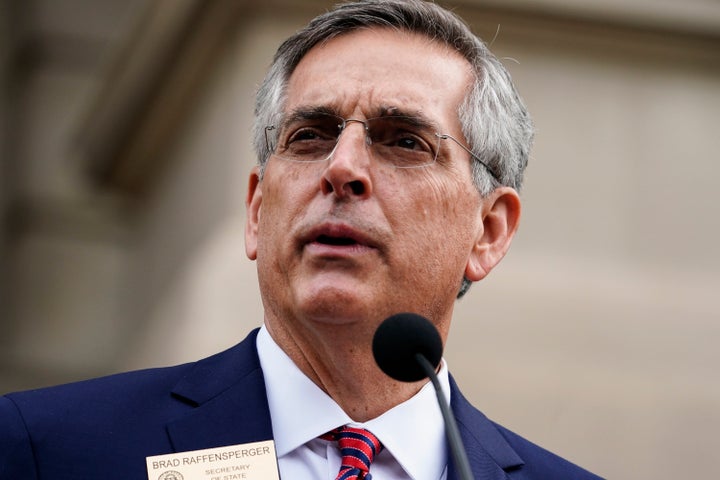


Georgia Secretary of State Brad Raffensperger prevailed in Tuesday's Republican primary despite former President Donald Trump's efforts to defeat him.

Trump held multiple rallies in Georgia over the last year, appearing with Hice and other candidates he endorsed in statewide primary challenges to Georgia incumbents, including former Sen. David Perdue, who sought to unseat GOP Gov. Brian Kemp, and John Gordon, who ran against Attorney General Chris Carr.

Early in the race, many Georgia Republicans considered Raffensperger especially vulnerable to a primary fight, particularly one from such a close ally to Trump. Hice was a relentless purveyor of the lie that Georgia’s election had been rife with fraud and stolen from the president, despite multiple reviews, audits and investigations finding no evidence to back those claims.

On the morning of Jan. 6, 2021, Hice tweeted that GOP congressional efforts to overturn the election in Congress amounted to a “ 1776 moment” for the country. He also participated in strategic discussions about how to pressure then-Vice President Mike Pence to toss out legitimate electoral college votes during the congressional certification process. He ultimately voted to contest the election results twice on Jan. 6, and was among the 147 Republicans who challenged the results even after a riotous mob of Trump supporters stormed the Capitol that day.

Democrats and democracy experts saw the GOP secretary of state primary as a crucial fight for the future of American elections, and its democracy as a whole, given that a Hice victory would put him one step away from becoming the top elections official in a key swing state ahead of the 2024 presidential election.

But unlike other election deniers who have prevailed in recent Republican primaries, Hice fell short in Georgia, where voters ultimately rejected all three of the Trump-backed candidates running against GOP incumbents who helped thwart the former president’s efforts to overturn his election loss in the state. The losses suggest that at least in Georgia, Trump’s “big lie” about the 2020 election is not powerful enough to defeat the trio of candidates who have consistently refuted it.

Hice won counties across Georgia’s 10th Congressional District, which he has represented since 2015. But he was demolished in nearly every other part of the state, including and especially within the Atlanta metro area, where Raffensperger racked up huge margins that pushed him across the 50% threshold necessary to avoid a runoff.

Raffensperger may have benefited from Georgia’s open primary system on Tuesday: During early voting, an estimated 7% of ballots cast in this year’s GOP races were submitted by Georgians who had participated in the Democratic primaries in 2020, according to an analysis conducted by the Atlanta Journal-Constitution. At least some of those voters appeared motivated to thwart Hice and the other Trump-backed candidates, but said they would support Democrats again in the fall.

“Democrats that want to send a clear message to David Perdue and Donald Trump are voting against all of Trump’s endorsements,” Larry Weiner, a Democrat who voted in the GOP primary, told the Journal-Constitution. “Come November, we vote for Democrats.”

He may also have prevailed simply because of his inherent advantages as an incumbent, and because other primaries received more attention: One pre-election poll found that support for Hice increased sharply ? from 30% to 60% ? once voters learned that he had Trump’s backing, suggesting that he may have won had he been able to improve his name identification among Georgia voters before Tuesday’s vote.

The defeat may be a significant one for Trump’s MAGA movement, but it will not put an end to the threats Republicans pose to the country’s electoral system: Hice-like candidates who have contested or questioned the 2020 election results are pursuing secretary of state positions in other major battleground states, including Arizona, Colorado, Michigan, Minnesota and Nevada, where GOP primaries have not yet been held.

Pennsylvania state Sen. Doug Mastriano, meanwhile, last week won the Republican gubernatorial primary in his state. Mastriano, who sought to undermine Biden’s win in Pennsylvania, bussed supporters to Washington on Jan. 6 and was in attendance at the protest that turned into an insurrection that afternoon, would assume control of a key swing state ahead of the 2024 election should he win in November. He would also have the power to appoint a similar election-denying conspiracy theorist as Pennsylvania’s secretary of state.

Despite his rebuke of Trump in 2020, Raffensperger will likely face a tough reelection fight in November against whomever emerges from a crowded Democratic primary.

Georgia Democrats are eager to replicate their success from two years ago, when Biden became the first Democratic presidential candidate to win the state since 1992 and Sens. Raphael Warnock (D) and Jon Ossoff (D) prevailed in a pair of runoff contests.

With Warnock and gubernatorial candidate Stacey Abrams at the top of the ticket, Democrats believe they have a shot to sweep Republicans out of major statewide offices, and they have keyed on the secretary of state race as a way to protect and expand voting rights after Georgia’s GOP-controlled legislature passed a sweeping new elections law that restricted ballot access and created new election-related crimes in 2021.

Raffensperger, who before 2020 supported prior efforts to create new restrictions on voting in Georgia, also backed SB 202, as the new law was known. And he has defended it from claims that it will it will disproportionately impact Black voters, disabled Georgians and other minority communities that helped spur Democratic victories in 2020.

Democrats see that law, one of the first of more than 30 restrictive pieces of legislation Republican legislatures passed across the country last year, as an extension of the false fraud claims Trump and his allies made about the previous election, and Democratic candidates up and down the ballot have vowed to defeat Republicans who supported it.

Raffensperger has also refused to totally break from Trump, despite the fact that his spurning of the former president led to death threats against his family and other election officials across the state. In an interview with HuffPost last year, Raffensperger did not answer a question about whether he would vote for Trump if he runs for president again in 2024.

And although the national environment appears poor for Democrats, the party’s voters in Georgia seem motivated: They turned out in high numbers for early voting ahead of Tuesday’s primary, even though the top two races on the party’s ticket were uncontested.

Voting rights were one of the animating factors for voters who spoke to HuffPost outside of Atlanta polling precincts last week, many of whom were determined to overcome the barriers SB 202 placed in front of them ? and to defeat the Republicans, Raffensperger included, who helped create them.


To: golfer72 who wrote (1359944)5/25/2022 8:22:59 AM
From: sylvester80  Respond to of 1576329
 
LOSER POS tRUMP LOSES FOR 7th TIME IN GEORGIA: Brian Kemp Easily Wins GOP Nomination Despite Being Trump’s No. 1 Revenge Target
The incumbent Georgia governor will now face Democrat Stacey Abrams in a rematch of their 2018 election.
By S.V. Date
May. 24, 2022, 08:33 PM EDT | Updated 9 hours ago
huffpost.com
Georgia Gov. Brian Kemp cruised to an easy victory Tuesday, winning the Republican nomination in his bid for reelection by handily defeating the challenger that former President Donald Trump had recruited to end Kemp’s political career for refusing to overturn Trump’s 2020 election loss in the state.

Trump, who tried to overthrow American democracy in a last-ditch attempt to remain in power after the 2020 election, had made Kemp his top target in his effort to punish Republicans who did not support those efforts.

Brian Kemp *check_circle877,14673.69%
David Perdue259,53921.80%
Kandiss Taylor40,7383.42%
Catherine Davis9,6570.81%
Tom Williams3,1980.27%
* = Incumbent

1,190,278 votes.
Estimated > 95% in.

Updated 5/25/2022, 5:20:41 AM

He talked former U.S. Sen. David Perdue into getting into the race, persuaded another supporter to run for a congressional race instead of governor to clear the field for Perdue, and staged two rallies for him in addition to spending millions from his own political committee on Perdue’s behalf, something he has not done for any other candidate.

Despite this, Kemp won with a staggering margin of victory over Perdue, 73% to 22%, with 82% of the vote counted.

That margin is well over the simple majority he needed to avoid a runoff next month. He will now face Democrat Stacey Abrams, who had no significant opposition in her primary, in the November general election — a rematch of the 2018 race, when he narrowly defeated her in a year that Democrats did well across the country.

Kemp had been secretary of state, in charge of administering elections, for nine years prior to his 2018 run for governor, and Abrams accused him of using his position to help himself win by suppressing the vote of her supporters.

Kemp said in a news conference Monday that he has been expecting a tough reelection race ever since.

He incurred Trump’s wrath in November and December of 2020 when he refused Trump’s demands that he somehow reverse Trump’s 11,779-vote loss in Georgia by calling a special legislative session so lawmakers could nevertheless award Trump the state’s 16 electoral votes.

Trump’s ire hurt Kemp’s standing with some Georgia Republicans, but most approved of his end to business COVID shutdowns, his reopening of schools, his tax cuts and his “heartbeat” abortion law.

At the Monday news conference ? just hours before a final pre-election rally with former Vice President Mike Pence, with whom Trump is also angry for refusing to help him remain in office despite losing — Kemp said he understands that Trump could continue to attack him in the general election campaign, but that is something he has no ability to influence.

“I had a great relationship with President Trump,” Kemp said. “I’ve never said anything bad about him. I don’t plan on doing that. I’m not mad at him. I think he’s just mad at me. And that’s something that I can’t control.”


To: golfer72 who wrote (1359944)5/25/2022 8:34:10 AM
From: sylvester80  Read Replies (1) | Respond to of 1576329
 
FACT CHECK: LIAR Herschel Walker falsely claims he never falsely claimed he graduated from University of Georgia
By Daniel Dale and Andrew Kaczynski, CNN
Updated 7:08 AM ET, Wed May 25, 2022
cnn.com


U.S. Senate candidate Herschel Walker speaks with the media after a campaign rally at the Georgia Sports Hall of Fame in Macon, Ga., Wednesday, May 18, 2022.

(CNN)Herschel Walker, the former football star who is now the Republican nominee for a US Senate seat in Georgia, is piling dishonesty upon dishonesty on the subject of his college education.

In December, Walker's campaign website falsely claimed that he had graduated from the University of Georgia, the school he left after his junior season to play professionally. (Walker's campaign deleted the claim after the Atlanta Journal-Constitution inquired about it.) In April, CNN's KFile team revealed that Walker himself had made the false graduation claim for years -- and that Walker had even asserted that he graduated in the top 1% of his University of Georgia class.
But when Walker was challenged about his graduation deception in an interview last week with FOX 5 Atlanta anchor Russ Spencer, Walker declared he had never once said he graduated from the University of Georgia.

Spencer told Walker that he has a "phenomenal life story," but that "in some instances you've exaggerated that story. You said that you graduated from UGA..."

Walker interjected: "I never said that. They say that. And I said -- that's what you gotta remember. I never, I never have said that statement. Not one time. I've said that I studied criminal justice at UGA."

Facts First: Walker's claim that he "never" and "not one time" said he graduated from the University of Georgia is flat out false. Walker said on camera at least twice that he graduated from the school. Walker's promotional materials have also featured the false claim that he graduated.

When CNN asked for comment on Tuesday, Walker's campaign did not explain or correct his false claim that he had never said he earned his college degree. Spokesperson Mallory Blount instead said in an email: "Imagine a world where the media cared as much about solving inflation, gas prices and baby formula shortages as they do about re-litigating every word Herschel has ever said."

In December, Walker told the Atlanta Journal-Constitution that he had returned to Athens, Georgia, to complete his degree after playing for the New Jersey Generals of the now-defunct United States Football League in the 1980s, "but life and football got in the way."

But contrary to Walker's claim last week in the FOX 5 Atlanta interview, he wasn't always forthright on this subject. CNN's KFile team found multiple instances in which Walker and his promotional materials inaccurately claimed that he had earned the degree:

Walker in a 2017 motivational speech: "And all of sudden I started going to the library, getting books, standing in front of a mirror reading to myself. So that Herschel that all the kids said was retarded become valedictorian of his class. Graduated University of Georgia in the top 1% of his class."

Walker in a 2017 radio interview: "And people say, 'Herschel, you played football.' But I said, 'Guys, I also was valedictorian of my class. I also was in the top 1% of my graduating class in college.'"
Text on an Amazon page for a 2009 edition of Walker's 2008 book and on the now-defunct

HerschelWalker.net website promoting the book: "After his first pro season, he finished his Bachelor of Science degree in Criminal Justice at the University of Georgia."

And a 1986 Dallas Morning News article on Walker's football career stated that Walker had completed his degree in criminal justice and featured this quote from Walker: "Getting a degree is one of the paths you can take on the way to becoming an FBI man. Of course, my life is not going in that direction right now, but I think police work, especially the FBI, would be my choice if I wasn't a pro football player."

Walker also declined to correct various people -- including interviewers and a congressman who introduced him at a 2021 House subcommittee hearing -- who wrongly said in his presence that he had earned his college degree.

There is no evidence that Walker was high school valedictorian, either.
Not the only deceptive claim in the interview

Walker's false denial of his claims about having graduated from college was not the only deceptive moment of his interview last week with FOX 5 Atlanta.

Walker also disputed Spencer's accurate statement that former President Donald Trump, who has endorsed Walker's candidacy, has called the 2020 election "stolen."

Walker said, "Well, I don't think -- I think -- I think reporters say that. I don't know whether President Trump has said it. Because he's never said that to me." When Spencer correctly said Trump has said it "over and over," Walker said, "No, no, no, no. He has never -- I've never heard President Trump ever say that."
Trump has called the 2020 election "stolen" on numerous occasions -- and has used nearly identical language in Walker's presence.

At a March rally in Georgia, which Walker attended, Trump falsely said Democrat Stacey Abrams, the current and former gubernatorial candidate, "brazenly stole the Georgia election" in 2020 from under the nose of Republican Gov. Brian Kemp. And at a S eptember rally in Georgia that Walker also attended, Trump falsely said 2020 was "the most corrupt election in the history of our country" and a "rigged election," and he talked about tens of thousands of people who supposedly had their votes "stolen."

The Republican Accountability Project, a conservative group that has been critical of Trump and Walker, drew attention to this Walker claim in a Tuesday tweet.
Walker handily won Tuesday's Republican primary for the nomination. He now faces Democratic incumbent Sen. Raphael Warnock in the November midterms.

Em Steck contributed to this article.

