SI
SI
discoversearch

We've detected that you're using an ad content blocking browser plug-in or feature. Ads provide a critical source of revenue to the continued operation of Silicon Investor.  We ask that you disable ad blocking while on Silicon Investor in the best interests of our community.  If you are not using an ad blocker but are still receiving this message, make sure your browser's tracking protection is set to the 'standard' level.
Politics : Formerly About Advanced Micro Devices -- Ignore unavailable to you. Want to Upgrade?


To: pocotrader who wrote (1366435)7/12/2022 4:53:38 PM
From: golfer721 Recommendation

Recommended By
locogringo

  Respond to of 1576296
 
I've explained several times Ahole that Trump had no motive to incite an insurrection so STFU


To: pocotrader who wrote (1366435)7/12/2022 9:44:32 PM
From: Broken_Clock4 Recommendations

Recommended By
bjzimmy
locogringo
longz
Winfastorlose

  Read Replies (1) | Respond to of 1576296
 
"trump the traitor and his bought whore wife are the racists"

"a link to what? trump is a traitor,"

a link to his conviction and also links to his wife being a whore and a racist.

Something similar to this:


To: pocotrader who wrote (1366435)7/14/2022 5:04:56 AM
From: Maple MAGA 1 Recommendation

Recommended By
Winfastorlose

  Respond to of 1576296
 
John Ivison: Trudeau’s helicopter money experiment goes even more wrong

'We just stuck a huge mixer in the economy and hit top speed. We are still trying to figure out what happened,' says Macdonald Laurier Institute fellow Philip Cross

John Ivison

Jul 13, 2022


A woman walks past the Bank of Canada headquarters, Wednesday, June 1, 2022 in Ottawa. PHOTO BY ADRIAN WYLD/THE CANADIAN PRESSArticle content

It is not being wise after the event to suggest that the Trudeau government contributed mightily to the Bank of Canada’s biggest interest rate hike since 1998.
Bank of Canada issues shock rate hike in effort to crush inflation

Nearly two years ago, the OECD said that, as Canada’s GDP fell by 10 per cent in the second pandemic-hit quarter of 2020, household income grew by 11 per cent, thanks to generous government hand-outs. The same phenomenon did not happen in Germany, France, the U.K. or the U.S.

The Bank of Canada said in its statement on Wednesday that the war in Ukraine, with its effect on energy prices, and continued supply-chain issues led to its decision to increase the overnight interest rate by 100 basis points to 2.5 per cent, giving the nation an effective pay-cut. But it acknowledged that excess demand in the domestic economy was a factor, a hangover from Liberal largesse in 2020 that was entirely predictable.

As Philip Cross, former chief economic analyst at Statistics Canada and now a fellow at the Macdonald Laurier Institute said, employment income in 2020 fell but disposable income rose — the only recession in Canadian history where people were actually better off. “We just stuck a huge mixer in the economy and hit top speed. We are still trying to figure out what happened,” he said.

New data from the 2021 census, released by Statistics Canada on Wednesday, offers a clearer picture, not only of the pandemic spending but household incomes during the first five years under the Liberals.

Trudeau came to power with the goal of narrowing the gap in income inequality and lowering the poverty rate. A social safety net that combined an enhanced Canada Child Benefit, an enriched Canada Pension Plan and an increased Canada Workers Benefit was designed to be transformative for lower-income Canadians — effectively a guaranteed annual income for seniors and parents with kids.

As the census data make clear, the Liberals deserve some credit on the poverty front: one-parent families headed by women saw their median after-tax income grow by 22.8 per cent between 2015 and 2020; income inequality dipped in all provinces; and the number of low-income Canadians fell to 11.2 per cent, down from 14.4 per cent in 2020.

But this has been achieved on the back of soaring deficits and a rise in aggregate demand that has proven to be inflationary.

One table in the StatCan report summarizes the federal government’s priorities since coming to power: redistribution of wealth over growing the economy.


Family median market income was $56,300 in 2015 and $55,700 in 2020 (all figures adjusted for inflation and expressed in constant 2020 dollars). In other words, employment income was practically unchanged.

Family after-tax incomes rose to $66,800 in 2020 but only because government transfers increased to $16,400 from $6,900 in 2015.

After-tax income for all Canadians rose by five per cent in 2020, even though employment income fell two per cent.

Clearly, as the pandemic hit, emergency and recovery benefits were needed. But this was a government that was already far too comfortable dropping money from a helicopter to solve every problem. The median federal benefit received by families in 2020 was $10,000, which by definition means many got considerably more than that.

“This is why we have inflation,” said Cross. “We gave people income that they went out and spent, but we didn’t increase our productive capacity. When demand is outstripping supply, you are automatically going to get price inflation. In the short term, it worked gangbusters, but it’s not a long-term economic strategy.”

As StatCan put it, “some of the most striking developments, specifically strong growth in after tax household increases, the drop in income inequality and in low-income rates are not expected to continue in 2021 and 2022 because the driving force behind the recent movements was temporary in nature.”

Those who benefitted most from COVID assistance are now the very people being hit hardest by inflation and rising interest rates.

There is wisdom in the old adage about self-sufficiency: give a man a fish and he will eat for a day; teach him to fish and he will sit in a boat drinking beer all day — but he won’t starve.

Trudeau has not shown much interest in such laborious, picayune themes as training people to fish, or do much else that is productive.

He jettisoned his “too orthodox” finance minister, Bill Morneau, in favour of Chrystia Freeland, who has argued explicitly that economic growth does not necessarily result in prosperity. Low interest rates proved too tempting and encouraged the government to follow an estimated $206 billion of pandemic relief measures, with a “hold my beer” 2021 budget that earmarked a further $143 billion in new initiatives.

The war, global supply-chain glitches and the Bank of Canada’s dismissal of inflation as a transitory phenomenon have all played their part in creating a cost-of-living crisis. But so did the radical public policy experiment of providing people with more income than they lost because of the pandemic.

jivison@postmedia.com

Twitter.com/IvisonJ


To: pocotrader who wrote (1366435)7/14/2022 5:08:04 AM
From: Maple MAGA 1 Recommendation

Recommended By
Winfastorlose

  Respond to of 1576296
 
Canadians disapprove of Justin Trudeau’s job as prime minister and feel he is divisive, national opinion survey says'

One can’t help but think the progressive coalition that elected Trudeau to his majority in 2015 and contributed to his back-to-back minorities is significantly strained, if not broken'
Adrian Humphreys

Jul 13, 2022
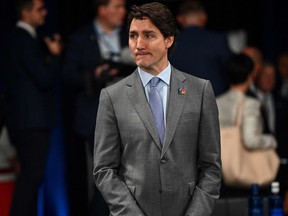


Prime Minister Justin Trudeau looks on at the start of the first plenary session of the NATO summit at the Ifema congress centre in Madrid, on June 29. PHOTO BY GABRIEL BOUYS/AFPArticle content

Most Canadians disapprove of Justin Trudeau’s performance as prime minister and feel he is a divisive leader, with almost as many hoping he resigns before the next election, according to a new public opinion survey probing the legacy of Canada’s leader.

The results of the Postmedia-Léger survey suggest Trudeau faces challenges in his continued electoral success.

“When you take the results to these questions in their entirety, one can’t help but think the progressive coalition that elected Trudeau to his majority in 2015 and contributed to his back-to-back minorities is significantly strained, if not broken,” said Andrew Enns, an executive vice-president at Léger.

“His personal popularity with NDP and Green voters is poor, which leads one to question his ability to win another election, certainly difficult to see him ever winning a majority.”



John Ivison: The rot in Canada’s dysfunctional government is coming from the top


Tasha Kheiriddin: Trudeau's true legacy — stoking the woke

More than half of all respondents in the national survey, regardless of their party support, disapproved of the job Trudeau was doing as prime minister and nearly half of them said they thought he should resign before the next election.

Thirty-two per cent of respondents said they strongly disapproved of Trudeau’s performance with another 23 per cent saying they somewhat disapproved.

That compares to seven per cent who said they strongly approved of how Trudeau was doing and 33 per cent somewhat approved, according to the survey results.

Dislike for Trudeau was strongest in B.C. and Manitoba and Saskatchewan, at 60 per cent, followed closely by Alberta and Quebec at 58 per cent.

“A clear majority disapprove of his performance — higher in key electoral regions of B.C. and Quebec. One might say these numbers can improve as we get clear of the hard road of the pandemic, but when one considers the economic challenges ahead this is not a certainty,” said Enns.

More than 60 per cent of respondents agreed that Trudeau has been divisive during his time in office, and more than 40 per cent felt Canada became a worse country since his election, according to the survey.

A total of 33 per cent of respondents strongly agreed and another 28 per cent somewhat agreed with the statement: “Prime Minister Justin Trudeau often favours certain groups and regions of the country over others, which has created national unity issues.”

Agreement was strongest in Alberta and the Prairies.

There were 22 per cent of respondents who disagreed with the statement, 15 per cent somewhat in disagreement and seven per cent strongly objecting. There were also 17 per cent saying they didn’t know.

“There is evidence of a national unity divide in the country. Across the country there is a strong view the Trudeau government has stoked unity tensions, but this is particularly acute in Alberta and the Prairies,” Enns said.

When asked if they felt Canada was a better, worse, or no different place to live, work and raise a family than when Trudeau was first elected in 2015, 44 per cent of respondents selected worse.

Only 17 per cent said it was a better place, with 30 per cent selecting no different and nine per cent saying they didn’t know.

Almost half of respondents (49 per cent) said Trudeau should resign as Liberal party leader and let someone else lead the party into the next election. Thirty per cent wanted him to remain as leader in the next election and 21 per cent said they weren’t sure.

“It’s interesting that this is the one question NDP voters are more tempered in their negativity, perhaps a reflection of uncertainty what this would mean for their parliamentary deal,” Enns said.

Respondents were also questioned about several policies and issues during Trudeau’s time as prime minister and were asked to select which they see as his greatest accomplishment and which is his greatest disappointment.

Legalizing recreational marijuana was chosen as his greatest accomplishment by 16 per cent, followed closely by managing the COVID-19 pandemic at 15 per cent.

Affordable daycare/childcare as well as reconciliation with Indigenous peoples were both selected by seven per cent, followed by Canada’s reputation internationally (six per cent), gun control (five per cent), climate change action (four per cent). Canada-U.S. relations tied with purchasing the Trans Mountain oil pipeline at the bottom with two per cent each.

It was Conservative and NDP supporters who pushed marijuana legalization to the top of Trudeau’s achievement list, with Liberal supporters more likely to say pandemic response was his highlight.

The greatest disappointment with Trudeau was integrity issues.

Seventeen per cent named integrity issues, such as Trudeau’s handling of the WE Foundation controversy, the Jody Wilson-Raybould and SNC-Lavalin affair and others.

A failure to keep his promises and too much focus on style over substance were both named as their biggest disappointment by 11 per cent. Purchasing the Trans Mountain pipeline disappointed nine per cent of respondents the most.

There was a three-way tie at six per cent for invoking the Emergencies Act during the convoy protests, pandemic management and reconciliation with Indigenous peoples.

Respondents were also asked to compare Trudeau’s time as prime minister since his election in 2015 to that of his father, Pierre Trudeau, who was prime minister from 1968 to 1979 and from 1980 to 1984.

While 31 per cent said father and son performances have been equal and 28 per cent said they didn’t know, Pierre Trudeau’s time in office was favoured by 28 per cent of respondents and Justin Trudeau’s tenure by 12 per cent.

Enns said this isn’t a particularly insightful finding since prime ministers tend to get more popular the further back in history they are.

The public opinion survey studied responses from Canadian residents 18 years and older by 1,501 online surveys through Léger’s online panel between June 30 and July 3, 2022. Results were weighted according to age, gender, and region to ensure a representative sample of the population.

As an online survey, traditional margins of error do not apply, according to Leger. If the data had been collected through a probability sample, the margin of error would be reported as ±2.5 per cent, 19 times out of 20.

• Email: ahumphreys@postmedia.com | Twitter: AD_Humphreys

