SI
SI
discoversearch

We've detected that you're using an ad content blocking browser plug-in or feature. Ads provide a critical source of revenue to the continued operation of Silicon Investor.  We ask that you disable ad blocking while on Silicon Investor in the best interests of our community.  If you are not using an ad blocker but are still receiving this message, make sure your browser's tracking protection is set to the 'standard' level.
Strategies & Market Trends : The Financial Collapse of 2001 Unwinding -- Ignore unavailable to you. Want to Upgrade?


To: Rarebird who wrote (9718)10/25/2022 8:51:38 PM
From: Broken_Clock1 Recommendation

Recommended By
E_K_S

  Respond to of 13881
 
Putin's speeches are available pretty much world wide. Do your homework.


To: Rarebird who wrote (9718)10/25/2022 9:00:25 PM
From: Broken_Clock  Respond to of 13881
 
Putin’s Nuclear Threat
February 27, 2022

Save

The disconnect between the Western and Russian narratives in the current conflict could prove fatal to the world, writes Scott Ritter.


Vladimir Putin and Foreign Minister Sergei Lavrov. (U.N. Photo/Cia Pak)

By Scott Ritter
Special to Consortium News


Vladimir Putin is a madman. He’s lost it. At least that is what the leaders of the West would like you to believe. According to their narrative, Putin — isolated, alone, confused, and angry at the unfolding military disaster Russia was undergoing in Ukraine — lashed out, ostensibly threatening the entire world with nuclear annihilation.

In a meeting with his top generals on Sunday, the beleaguered Russian president announced, “I order the defense minister and the chief of the general staff of the Russian armed forces to put the deterrence forces of the Russian army into a special mode of combat service.”

The reason for this action, Putin noted, centered on the fact that, “Western countries aren’t only taking unfriendly actions against our country in the economic sphere, but top officials from leading NATO members made aggressive statements regarding our country” in relation to the ongoing situation in Ukraine.

The “deterrence forces” Putin spoke of refers to Russia’s nuclear arsenal.

What made the Russian president’s words resonate even more was that last Thursday, when announcing the commencement of Russia’s “special military operation” against Ukraine, Putin declared that “no one should have any doubts that a direct attack on our country will lead to the destruction and horrible consequences for any potential aggressor.” He emphasized that Russia is “one of the most potent nuclear powers and also has a certain edge in a range of state-of-the-art weapons.”

When Putin issued that threat, The Washington Post described it as “empty, a mere baring of fangs.” The Pentagon, involved as it was in its own review of U.S. nuclear posture designed to address threats such as this, seemed non-plussed, with an anonymous official noting that U.S. policy makers “don’t see an increased threat in that regard.”

NATO’s Response


Secretary of State Antony Blinken and others representatives of NATO countries in a group photo at NATO Headquarters in Brussels, March 2021 . (State Department/Ron Przysucha)

For NATO’s part, the Trans-Atlantic military alliance, which sits at the heart of the current crisis, issued a statement in which it noted that:

“Russia’s actions pose a serious threat to Euro-Atlantic security, and they will have geo-strategic consequences. NATO will continue to take all necessary measures to ensure the security and defense of all Allies. We are deploying additional defensive land and air forces to the eastern part of the Alliance, as well as additional maritime assets. We have increased the readiness of our forces to respond to all contingencies.”

Hidden near the bottom of this statement, however, was a passage which, when examined closely, underpinned the reasoning behind Putin’s nuclear muscle-flexing. “[W]e have held consultations under Article 4 of the Washington Treaty,” the statement noted. “We have decided, in line with our defensive planning to protect all Allies, to take additional steps to further strengthen deterrence and defense across the Alliance.”

Under Article 4, members can bring any issue of concern, especially related to the security of a member country, to the table for discussion within the North Atlantic Council. NATO members Estonia, Latvia, Lithuania, and Poland triggered the Article 4 consultation following the Russian incursion into Ukraine. In a statement issued on Friday, NATO Secretary General Jens Stoltenberg expanded on the initial NATO statement, declaring that NATO was committed to protecting and defending all its allies, including Ukraine.

Three things about this statement stood out. First, by invoking Article IV, NATO was positioning itself for potential offensive military action; its previous military interventions against Serbia in 1999, Afghanistan in 2001, Iraq in 2004, and Libya in 2011, were all done under Article IV of the NATO Charter. Seen in this light, the premise that NATO is an exclusively defensive organization, committed to the promise of collective self-defense, is baseless.

Second, while Article V (collective defense) protections only extend to actual NATO members, which Ukraine is not, Article IV allows the umbrella of NATO protection to be extended to those non-NATO members whom the alliance views as an ally, a category Stoltenberg clearly placed Ukraine in.

Finally, Stoltenberg’s anointing of Ukraine as a NATO ally came at the same time he announced the activation and deployment of NATO’s 40,000-strong Response Force, some of which would be deployed to NATO’s eastern flank, abutting Ukraine. The activation of the Response Force is unprecedented in the history of NATO, a fact that underscores the seriousness to which a nation like Russia might attach to the action.

When seen in this light, Putin’s comments last Thursday were measured, sane, and responsible.

What Happens if NATO Convoys or EU Jets Are Hit?


Dassault Mirage F1CR jet operated by French Air Force and based at Reims. (Alan Wilson/Wikimedia Commons)

Since the Article IV consultations began, NATO members have begun to supply Ukraine with lethal military aid, with the promise of more in the days and weeks to come. These shipments can only gain access to Ukraine through a ground route that requires transshipment through NATO members, including Romania and Poland. It goes without saying that any vehicle carrying lethal military equipment into a war zone is a legitimate target under international law; this would apply in full to any NATO-affiliated shipment or delivery done by a NATO member on their own volition.

What happens when Russia begins to attack NATO/EU/US/Allied arms deliveries as they arrive on Ukrainian soil? Will NATO, acting under Article IV, create a buffer zone in Ukraine, using the never-before-mobilized Response Force? One naturally follows the other…

The scenario becomes even more dire if the EU acts on its pledge to provide Ukraine with aircraft and pilots to fight the Russians. How would these be deployed to Ukraine? What happens when Russia begins shooting down these aircraft as soon as they enter Ukrainian airspace? Does NATO now create a no-fly zone over western Ukraine?

What happens if a no-fly zone (which many officials in the West are promoting) is combined with the deployment of the Response Force to create a de facto NATO territory in western Ukraine? What if the Ukrainian government establishes itself in the city of Lvov, operating under the protection of this air and ground umbrella?

Russia’s Nuclear Doctrine


Night training for the Victory Day parade on Red Square, May 4, 2021. ( Micha? Siergiejevicz/Wikimedia Commons)

In June 2020, Russia released a new document, titled “On Basic Principles of State Policy of the Russian Federation on Nuclear Deterrence,” that outlined the threats and circumstances that could lead to Russia’s use of nuclear weapons. While this document declared that Russia “considers nuclear weapons exclusively as a means of deterrence,” it outlined several scenarios in which Russia would resort to the use of nuclear weapons if deterrence failed.

While the Russian nuclear policy document did not call for the preemptive use of nuclear weapons during conventional conflicts, it did declare that “in the event of a military conflict, this Policy provides for the prevention of an escalation of military actions and their termination on conditions that are acceptable for the Russian Federation and/or its allies.”

In short, Russia might threaten to use nuclear weapons to deter “aggression against the Russian Federation with the use of conventional weapons when the very existence of the state is in jeopardy.”

In defining Russia’s national security concerns to both the U.S. and NATO last December, Putin was crystal clear about where he stood when it came to Ukrainian membership in NATO. In a pair of draft treaty documents, Russia demanded that NATO provide written guarantees that it would halt its expansion and assure Russia that neither Ukraine nor Georgia ever be offered membership into the alliance.

In a speech delivered after Russia’s demands were delivered, Putin declared that if the U.S. and its allies continue their “obviously aggressive stance,” Russia would take “appropriate retaliatory military-technical measures,” adding that it has “every right to do so.”

In short, Putin made it clear that, when it came to the issue of Ukrainian membership in NATO, the stationing of U.S. missiles in Poland and Romania and NATO deployments in Eastern Europe, Russia felt that its very existence was being threatened.

The Disconnect


A bus burns Thursday on road from Kharkiv to Kiev as Russia enters the war. (Yan Boechat/VOA/Wikimedia Commons)

The Russian invasion of Ukraine, when seen from the perspective of Russia and its leadership, was the result of a lengthy encroachment by NATO on the legitimate national security interests of the Russian state and people. The West, however, has interpreted the military incursion as little more than the irrational action of an angry, isolated dictator desperately seeking relevance in a world slipping out of his control.

The disconnect between these two narratives could prove fatal to the world. By downplaying the threat Russia perceives, both from an expanding NATO and the provision of lethal military assistance to Ukraine while Russia is engaged in military operations it deems critical to its national security, the U.S. and NATO run the risk of failing to comprehend the deadly seriousness of Putin’s instructions to his military leaders regarding the elevation of the level of readiness on the part of Russia’s strategic nuclear forces.

Far from reflecting the irrational whim of a desperate man, Putin’s orders reflected the logical extension of a concerted Russian national security posture years in the making, where the geopolitical opposition to NATO expansion into Ukraine was married with strategic nuclear posture. Every statement Putin has made over the course of this crisis has been tied to this policy.

While the U.S. and NATO can debate the legitimacy of the Russian concerns, to dismiss the national security strategy of a nation that has been subjected to detailed bureaucratic vetting as nothing more than the temper tantrum of an out of touch autocrat represents a dangerous disregard of reality, the consequences of which could prove to be fatal to the U.S., NATO, and the world.

President Putin has often complained that the West does not listen to him when he speaks of issues Russia deems to be of critical importance to its national security.

The West is listening now. The question is, is it capable of comprehending the seriousness of the situation?

So far, the answer seems to be no.

Scott Ritter is a former U.S. Marine Corps intelligence officer who served in the former Soviet Union implementing arms control treaties, in the Persian Gulf during Operation Desert Storm, and in Iraq overseeing the disarmament of WMD.

The views expressed are solely those of the author and may or may not reflect those of Consortium News.


To: Rarebird who wrote (9718)10/25/2022 9:02:18 PM
From: Broken_Clock3 Recommendations

Recommended By
alanrs
DinoNavarre
E_K_S

  Respond to of 13881
 
Ukraine & Nukes
March 3, 2022

Save

After a New York Times reporter grossly distorted what Putin and Zelensky have said and done about nuclear weapons, Steven Starr corrects the record and deplores Western media, in general, for misinforming and leading the entire world in a dangerous direction.


U.S. troops arrive at Nuremberg International Airport on Feb. 28 to join the NATO Response Force. which was activated for the first time in history in a collective defence context. (NATO)

By Steven Starr
Special to Consortium News

The New York Times recently published an article by David Sanger entitled “Putin spins a conspiracy theory that Ukraine is on a path to produce nuclear weapons.” Unfortunately, it is Sanger who puts so much spin in his reporting that he leaves his readers with a grossly distorted version of the what the presidents of Russia and Ukraine have said and done.

Ukrainian Volodymyr Zelensky’s recent statements at the Munich conference centered around the 1994 Budapest Memorandum, which welcomed Ukraine’s accession to the Nuclear Non-Proliferation Treaty (NPT) in conjunction with Ukraine’s decision to return to Russia the nuclear weapons left on its territory by the Soviet Union.

In other words, the Budapest Memorandum was expressly about Ukraine giving up its nukes and not becoming a nuclear weapon state in the future. Zelensky’s speech at Munich made it clear that Ukraine was moving to repudiate the Budapest Memorandum; Zelensky essentially stated that Ukraine must be made a member of NATO, otherwise it would acquire nuclear weapons.

This is what Zelensky said, with emphasis added:

“I want to believe that the North Atlantic Treaty and Article 5 will be more effective than the Budapest Memorandum.

Ukraine has received security guarantees for abandoning the world’s third nuclear capability [i.e. Ukraine relinquished the Soviet nuclear weapons that had been placed in Ukraine during the Cold War]. We don’t have that weapon. … Therefore, we have something. The right to demand a shift from a policy of appeasement to ensuring security and peace guarantees.

Since 2014, Ukraine has tried three times to convene consultations with the guarantor states of the Budapest Memorandum. Three times without success. . . I am initiating consultations in the framework of the Budapest Memorandum. The Minister of Foreign Affairs was commissioned to convene them. If they do not happen again or their results do not guarantee security for our country, Ukraine will have every right to believe that the Budapest Memorandum is not working and all the package decisions of 1994 are in doubt. . .

I am initiating consultations in the framework of the Budapest Memorandum. The Minister of Foreign Affairs was commissioned to convene them. If they do not happen again or their results do not guarantee security for our country, Ukraine will have every right to believe that the Budapest Memorandum is not working and all the package decisions of 1994 are in doubt.”

Sanger’s Times article implies that it was a “conspiracy theory” that Zelensky was calling for Ukraine to acquire nuclear weapons. Sanger was not ignorant of the meaning of the Budapest Memorandum, rather he chose to deliberately ignore it and misrepresented the facts.

President Vladimir Putin, along with the majority of Russians, could not ignore such a threat for a number of historical reasons that The New York Times and ideologues such as Sanger have also chosen to ignore. It is important to list some of those facts, since most Americans are unaware of them, as they have not been reported in the Western mainstream media. Leaving parts of the story out turns Putin into just a madman bent on conquest without any reason to intervene.

First, both the provinces of Donetsk and Lugansk in the Donbass region voted for independence from Ukraine in 2014 in resistance to a U.S.-backed coup that overthrew the elected president Viktor Yanukovych in February of that year. The independence vote came just eight days after neo-Nazis burned dozens of ethnic Russians alive in Odessa. To crush their bid for independence, the new U.S.-installed Ukrainian government then launched an “anti-terrorist” war against the provinces, with the assistance of the neo-Nazi Azov Battalion, which had taken part in the coup. It is a war that is still going on eight years later, a war that Russia has just entered.

During these eight years, the Ukrainian Armed Forces and Azov have used artillery, snipers and assassination teams to systematically butcher more than 5,000 people (another 8,000 were wounded) — mostly civilians — in the Donetsk Peoples Republic, according to the leader of the DPR, who provided these figures in a press conference recently. In the Luhansk People’s Republic, an additional 2,000 civilians were killed and 3,365 injured. The total number of people killed and wounded in Donbass since 2014 is more than 18,000.

This has received at most superficial coverage by The New York Times; it has not been covered by Western corporate media because it does not fit the official Washington narrative that Ukraine is pursuing an “anti-terrorist operation” in its unrelenting attacks on the people of Donbass. For eight years the war instead has been portrayed as a Russian “invasion,” well before Russia’s current intervention.

Likewise, The New York Times, in its overall coverage, chose not to report that the Ukrainian forces had deployed half of its army, about 125,000 troops, to its border with Donbass by the beginning of 2022.


The importance of neo-Nazi Right Sektor politicians in the Ukraine government and neo-Nazi militias (such as the Azov Battalion) to the Ukrainian Armed Forces, also goes unreported in the mainstream corporate media. The Azov battalion flies Nazi flags; they have been trained by teams of U.S. military advisers and praised on Facebook these days. In 2014, Azov was incorporated in the Ukrainian National Guard under the direction of the Interior Ministry.

The Nazis killed something on the order of 27 million Soviets/Russians during World War II (the U.S. lost 404,000). Russia has not forgotten and is extremely sensitive to any threats and violence coming from neo-Nazis. Americans generally do not understand what this means to Russians as the United States has never been invaded.

So, when the leader of Ukraine essentially threatens to obtain nuclear weapons, this is most certainly considered to be an existential threat to Russia. That is why Putin focused on this during his speech preceding the Russian invasion of Ukraine. Sanger and The New York Times must discount a Ukrainian nuclear threat; they can get away with doing so because they have systematically omitted news pertaining to this for many years.

Sanger makes a very misleading statement when he writes, “Today Ukraine does not even have the basic infrastructure to produce nuclear fuel.”

Ukraine is not interested in making nuclear fuel — which Ukraine already purchases from the U.S. Ukraine has plenty of plutonium, which is commonly used to make nuclear weapons today; eight years ago Ukraine held more than 50 tons of plutonium in its spent fuel assemblies stored at its many nuclear power plants (probably considerably more today, as the reactors have continued to run and produce spent fuel). Once plutonium is reprocessed/separated from spent nuclear fuel, it becomes weapons usable. Putin noted that Ukraine already has missiles that could carry nuclear warheads, and they certainly have scientists capable of developing reprocessing facilities and building nuclear weapons.

In his Feb. 21 televised address, Putin said Ukraine still has the infrastructure leftover from Soviet days to build a bomb. He said:

“As we know, it has already been stated today that Ukraine intends to create its own nuclear weapons, and this is not just bragging.

Ukraine has the nuclear technologies created back in the Soviet times and delivery vehicles for such weapons, including aircraft, as well as the Soviet-designed Tochka-U precision tactical missiles with a range of over 100 kilometers.

But they can do more; it is only a matter of time. They have had the groundwork for this since the Soviet era.

In other words, acquiring tactical nuclear weapons will be much easier for Ukraine than for some other states I am not going to mention here, which are conducting such research, especially if Kiev receives foreign technological support. We cannot rule this out either.

If Ukraine acquires weapons of mass destruction, the situation in the world and in Europe will drastically change, especially for us, for Russia. We cannot but react to this real danger, all the more so since let me repeat, Ukraine’s Western patrons may help it acquire these weapons to create yet another threat to our country.”

NATO-US Refuse Binding Nuclear Treaties

In his Times piece, Sanger states, “American officials have said repeatedly that they have no plans to place nuclear weapons in Ukraine.”

But the U.S. and NATO have refused to sign legally binding treaties with Russia to this effect. In reality, the U.S. has been making Ukraine a de facto member of NATO, while training and supplying its military forces and conducting joint exercises on Ukrainian territory. Why wouldn’t the U.S. place nuclear weapons in Ukraine — they have already done so at military bases within the borders of five other European members of NATO. This in fact violates the spirit of the NPT, another issue that Sanger avoids when he notes that Russia has demanded that the U.S. remove nuclear weapons from the European NATO-member states.

For years the U.S. proclaimed that the Ballistic Missile Defense (BMD) facilities it was placing in Romania and Poland, on the Russian border, were to protect against an “Iranian threat,” even though Iran had no nuclear weapons or missiles that could reach the U.S. But the dual-use Mark 41 launching systems used in the Aegis Ashore BMD facilities can be used to launch Tomahawk cruise missiles, and will be fitted with SM-6 missiles that, if armed with nuclear warheads, could hit Moscow in five-to-six minutes. Putin explicitly warned journalists about this danger in 2016; Russia included the removal of the U.S. BMD facilities in Romania and Poland in its draft treaties presented to the U.S. and NATO last December.


I wonder if Sanger has ever considered what the U.S. response would be if Russia placed missile launching facilities on the Canadian or Mexican border? Would the U.S. consider that a threat, would it demand that Russia remove them or else the U.S. would use military means to do so?

30 Years Ago

Sanger states that today Russia takes a “starkly different from the tone Moscow was taking 30 years ago, when Russian nuclear scientists were being voluntarily retrained to use their skills for peaceful purposes.”

Russians would reply that 30 years ago NATO had not moved to Russian borders and was not flooding Ukraine with hundreds of tons of weapons and the U.S. had not yet overthrown the government in Kiev to install an anti-Russian regime.

While the Times is still considered the U.S. “paper of record,” during the last few decades it has devolved into the primary mouthpiece for the official narratives coming from Washington.

There is a real danger to the nation when a free press is replaced with corporate media that stifles and censors dissent. Rather than a free press, we now have a Ministry of Propaganda that acts as an echo chamber for the latest diktats from the White House. The systematic creation of false narratives by corporate media, designed to serve the purposes of the federal government, have so misinformed the American public about world events that we find the nation ready to go to war with Russia.

This is suicidal course for not only the U.S. and the EU, but for civilization as a whole, because this would likely end in a nuclear war that will destroy all nations and peoples.

Steven Starr is the former director of the University of Missouri’s Clinical Laboratory Science Program, and former board member of Physicians for Social Responsibility. His articles have been published by the Bulletin of the Atomic Scientists, Federation of American Scientists and the Strategic Arms Reduction website of the Moscow Institute of Physics and Technology. He maintains the Nuclear Famine website.

The views expressed are solely those of the author and may or may not reflect those of Consortium News.


To: Rarebird who wrote (9718)10/25/2022 9:27:17 PM
From: Broken_Clock  Read Replies (1) | Respond to of 13881
 
Chris Hedges: Stop Worrying & Love the Bomb
October 25, 2022

Save

The longer the proxy war in Ukraine continues, the closer the U.S. comes to a direct confrontation with Russia. Once that happens, the Dr. Strangeloves running the show will reach for the nukes.
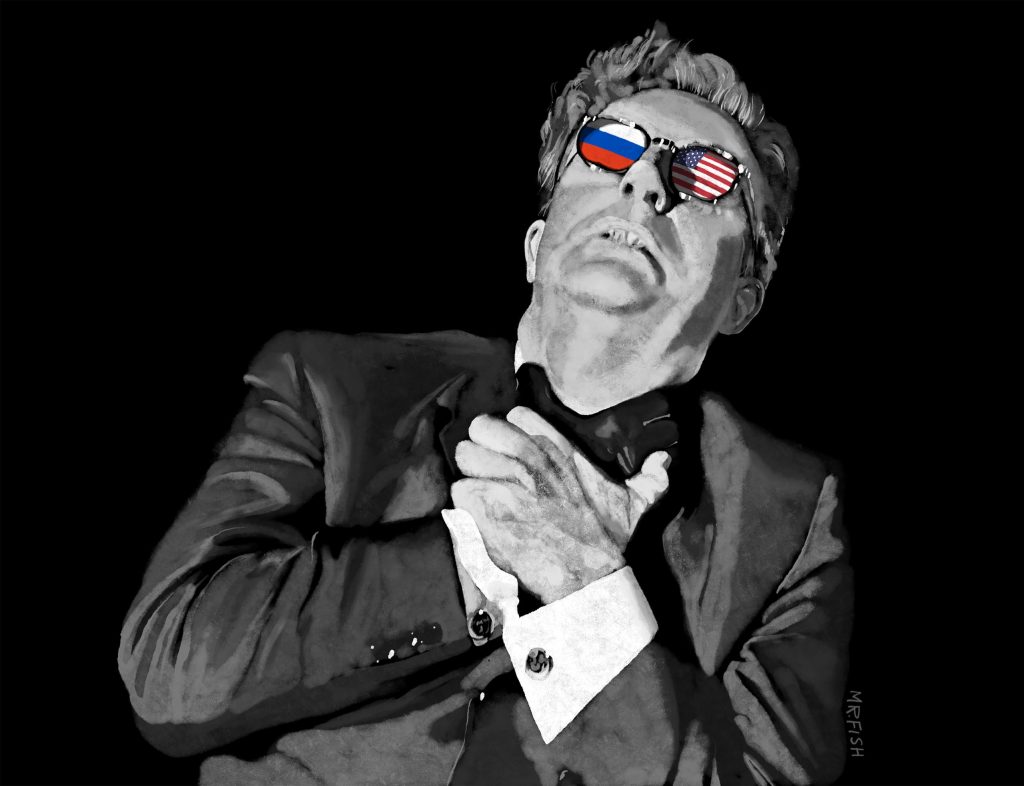

Bombs Away – by Mr. Fish.

By Chris Hedges
ScheerPost.com


I have covered enough wars to know that once you open that Pandora’s box, the many evils that pour out are beyond anyone’s control. War accelerates the whirlwind of industrial killing. The longer any war continues, the closer and closer each side comes to self-annihilation. Unless it is stopped, the proxy war between Russia and the U.S. in Ukraine all but guarantees direct confrontation with Russia and, with it, the very real possibility of nuclear war.

U.S. President Joe Biden, who doesn’t always seem to be quite sure where he is or what he is supposed to be saying, is being propped up in the I-am-a-bigger-man-than-you contest with Russian President Vladimir Putin by a coterie of rabid warmongers who have orchestrated over 20 years of military fiascos. They are salivating at the prospect of taking on Russia, and then, if there is any habitation left on the globe, China.

Trapped in the polarizing mindset of the Cold War — where any effort to de-escalate conflicts through diplomacy is considered appeasement, a perfidious Munich moment — they smugly push the human species closer and closer toward obliteration. Unfortunately for us, one of these true believers is Secretary of State Antony Blinken.

“Putin is saying he is not bluffing. Well, he cannot afford bluffing, and it has to be clear that the people supporting Ukraine and the European Union and the Member States, and the United States and NATO are not bluffing neither,” E.U. foreign policy chief Josep Borrell warned. “Any nuclear attack against Ukraine will create an answer, not a nuclear answer but such a powerful answer from the military side that the Russian Army will be annihilated.”

Annihilated. Are these people insane?
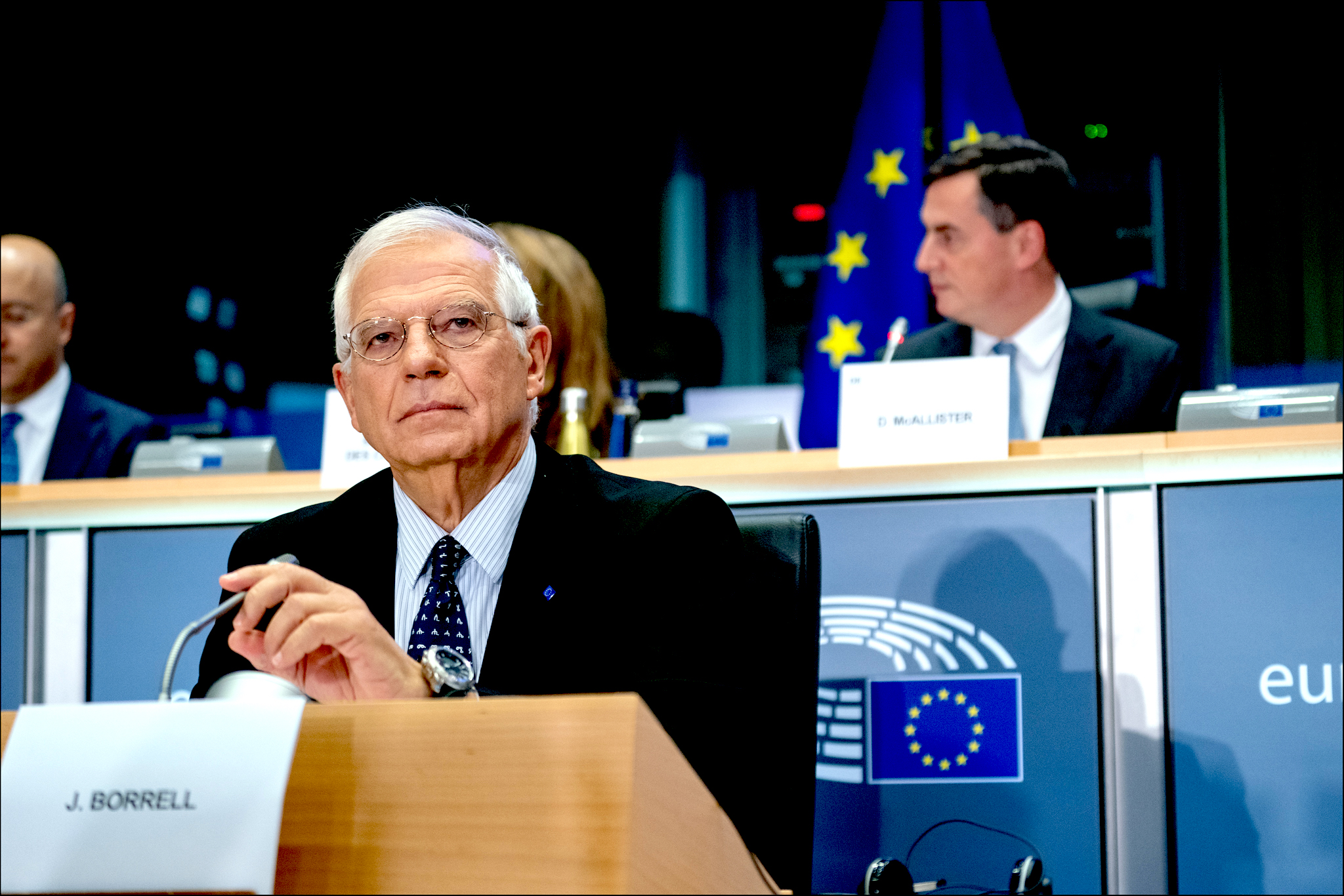

Josep Borrell in 2019. (European Parliament, CC BY 2.0, Wikimedia Commons)

You know we are in trouble when former Donald Trump is the voice of reason.

“We must demand the immediate negotiation of a peaceful end to the war in Ukraine, or we will end up in world war three” the former U.S. president said. “And there will be nothing left of our planet — all because stupid people didn’t have a clue … They don’t understand what they’re dealing with, the power of nuclear.”

I dealt with many of these ideologues — David Petraeus, Elliot Abrams, Robert Kagan, Victoria Nuland — as a foreign correspondent for The New York Times. Once you strip away their chest full of medals or fancy degrees, you find shallow men and women, craven careerists who obsequiously serve the war industry that ensures their promotions, pays the budgets of their think tanks and showers them with money as board members of military contractors.

They are the pimps of war. If you reported on them, as I did, you would not sleep well at night. They are vain enough and stupid enough to blow up the world long before we go extinct because of the climate crisis, which they have also dutifully accelerated.

If, as Joe Biden says, Putin is “not joking” about using nuclear weapons and we risk nuclear “Armageddon,” why isn’t Biden on the phone to Putin? Why doesn’t he follow the example of John F. Kennedy, who repeatedly communicated with Nikita Khrushchev to negotiate an end to the Cuban missile crisis?

Kennedy, who unlike Biden served in the military, knew the obtuseness of generals. He had the good sense to ignore Curtis LeMay, the Air Force chief of staff and head of the Strategic Air Command, as well as the model for General Jack D. Ripper in “Dr. Strangelove,” who urged Kennedy to bomb the Cuban missile bases, an act that would have probably ignited a nuclear war. Biden is not made of the same stuff.
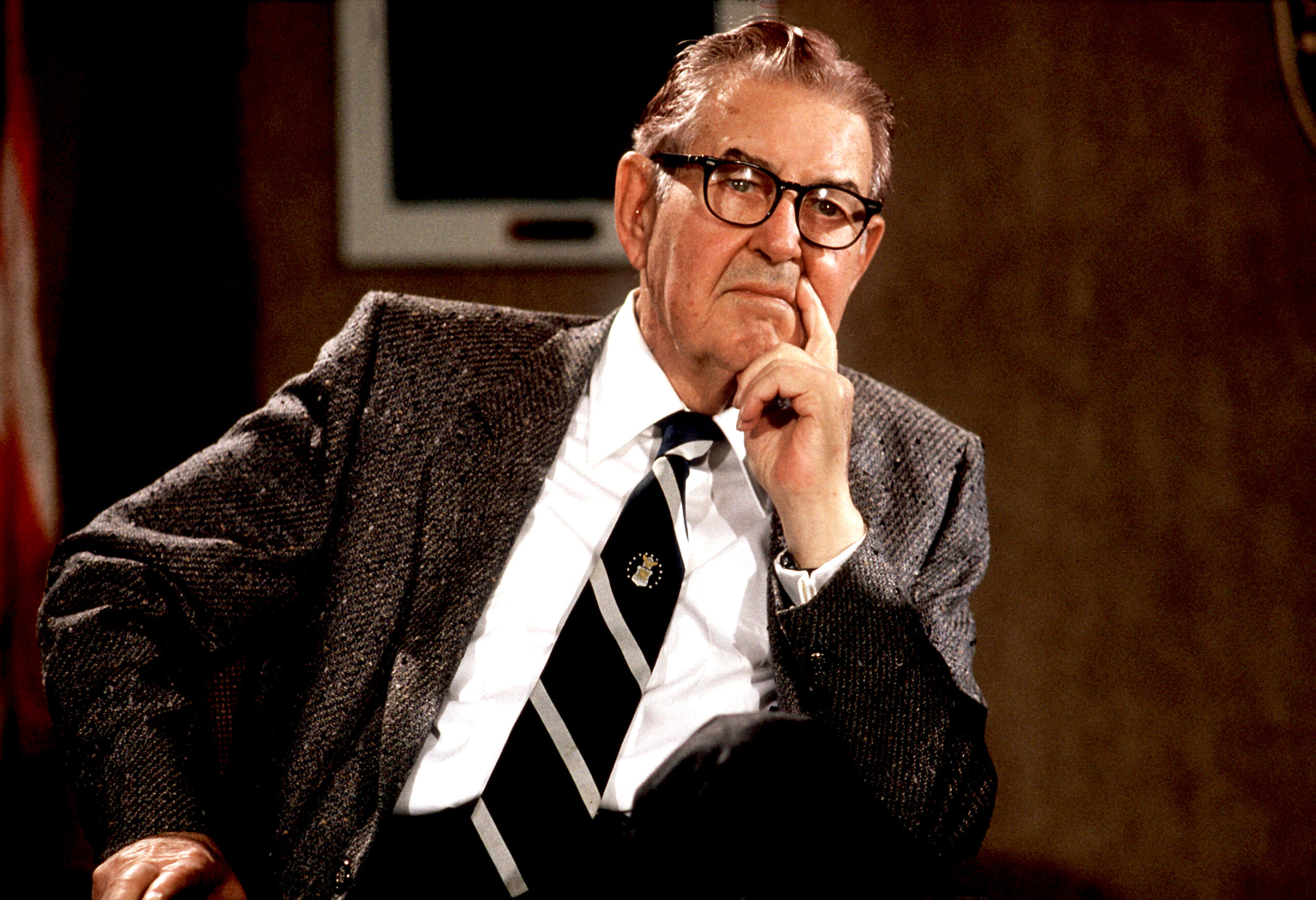

Retired General Curtis LeMay in 1987. (U.S. National Archives, CC BY-SA 4.0, Wikimedia Commons)

Why is Washington sending $50 billion in arms and assistance to sustain the conflict in Ukraine and promising billions more for “as long as it takes”? Why did Washington and Whitehall dissuade Ukraine’s President Vladimir Zelensky, a former stand-up comic who has been magically transformed by these war lovers into the new Winston Churchill, from pursuing negotiations with Moscow, set up by Turkey? Why do they believe that militarily humiliating Putin, whom they are also determined to remove from power, won’t lead him to do the unthinkable in a final act of desperation?

Moscow strongly implied it would use nuclear weapons in response to a “threat” to its “territorial integrity” and the pimps of war shouted down anyone who expressed concern that we all might go up in mushroom clouds, labeling them traitors who are weakening Ukrainian and Western resolve.

Giddy at the battlefield losses suffered by Russia, they poke the Russian bear with ever greater ferocity. The Pentagon helped plan Ukraine’s latest counteroffensive, and the C.I.A. passes on battlefield intelligence. The U.S. is slipping, as we did in Vietnam, from advising, arming, funding and supporting, into fighting.
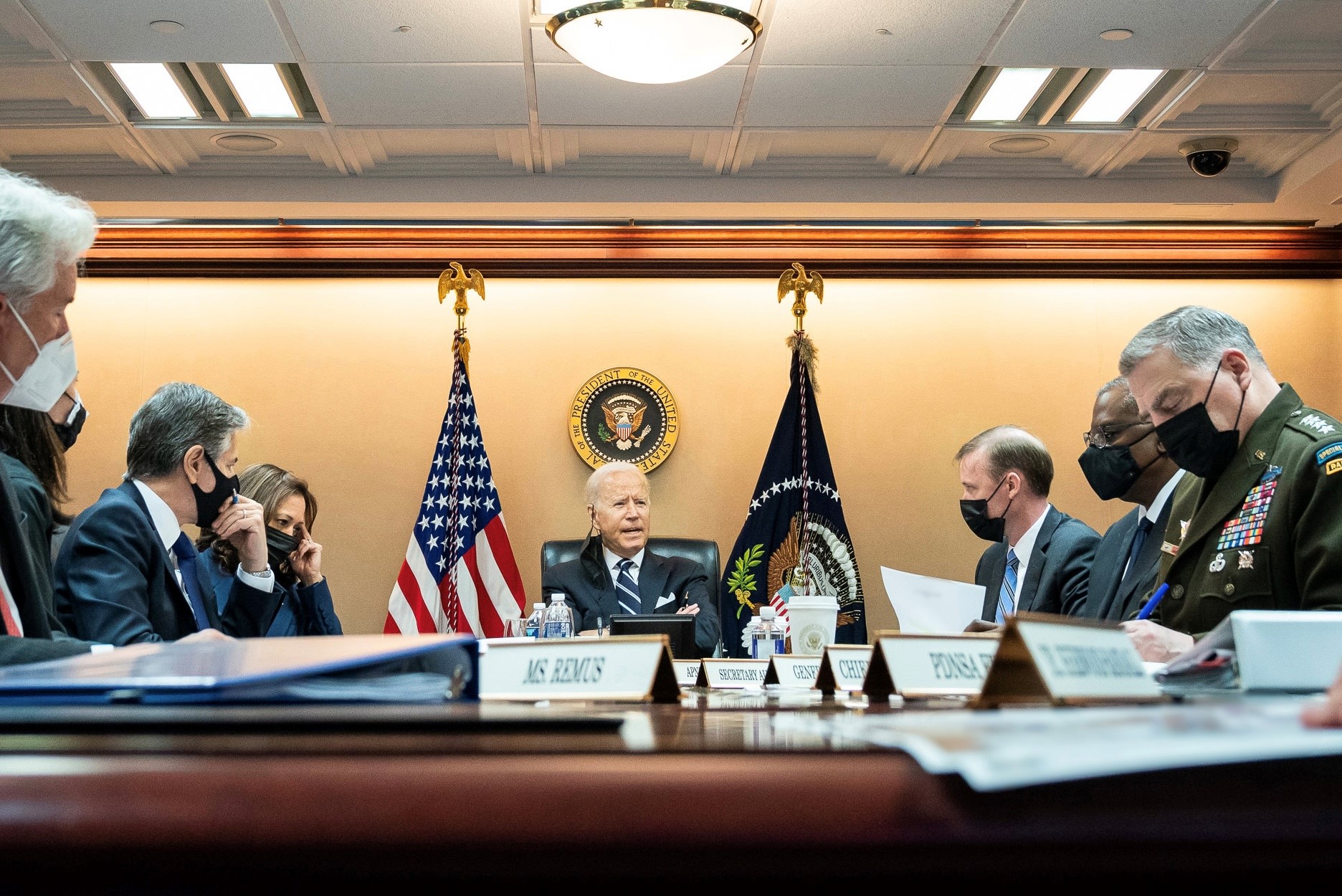

U.S. President Joe Biden during a briefing by his national security team, Aug. 18, 2021. (Public Domain, Wikimedia Commons)

None of this is helped by Zelensky’s suggestion that, to deter the use of nuclear weapons by Russia, NATO should launch “preventive strikes.”

“Waiting for the nuclear strikes first and then to say ‘what’s going to happen to them.’ No! There is a need to review the way the pressure is being exerted. So there is a need to review this procedure,” he said.

Kremlin spokesman Dmitry Peskov said the remarks, which Zelensky tried to roll back, were “nothing else than a call to start a world war.”

The West has been baiting Moscow for decades. I reported from Eastern Europe at the end of the Cold War. I watched these militarists set out to build what they called a unipolar world — a world where they alone ruled.

First, they broke promises not to expand NATO beyond the borders of a unified Germany. Then they broke promises not to “permanently station substantial combat forces” in the new NATO member countries in Eastern and Central Europe. Then they broke promises not to station missile systems along Russia’s border. Then they broke promises not to interfere in the internal affairs of border states such as Ukraine, orchestrating the 2014 coup that ousted the elected government of Victor Yanukovich, replacing it with an anti-Russian — fascist aligned — government, which, in turn, led to an eight-year-long civil war, as the Russian populated regions in the east sought independence from Kiev.
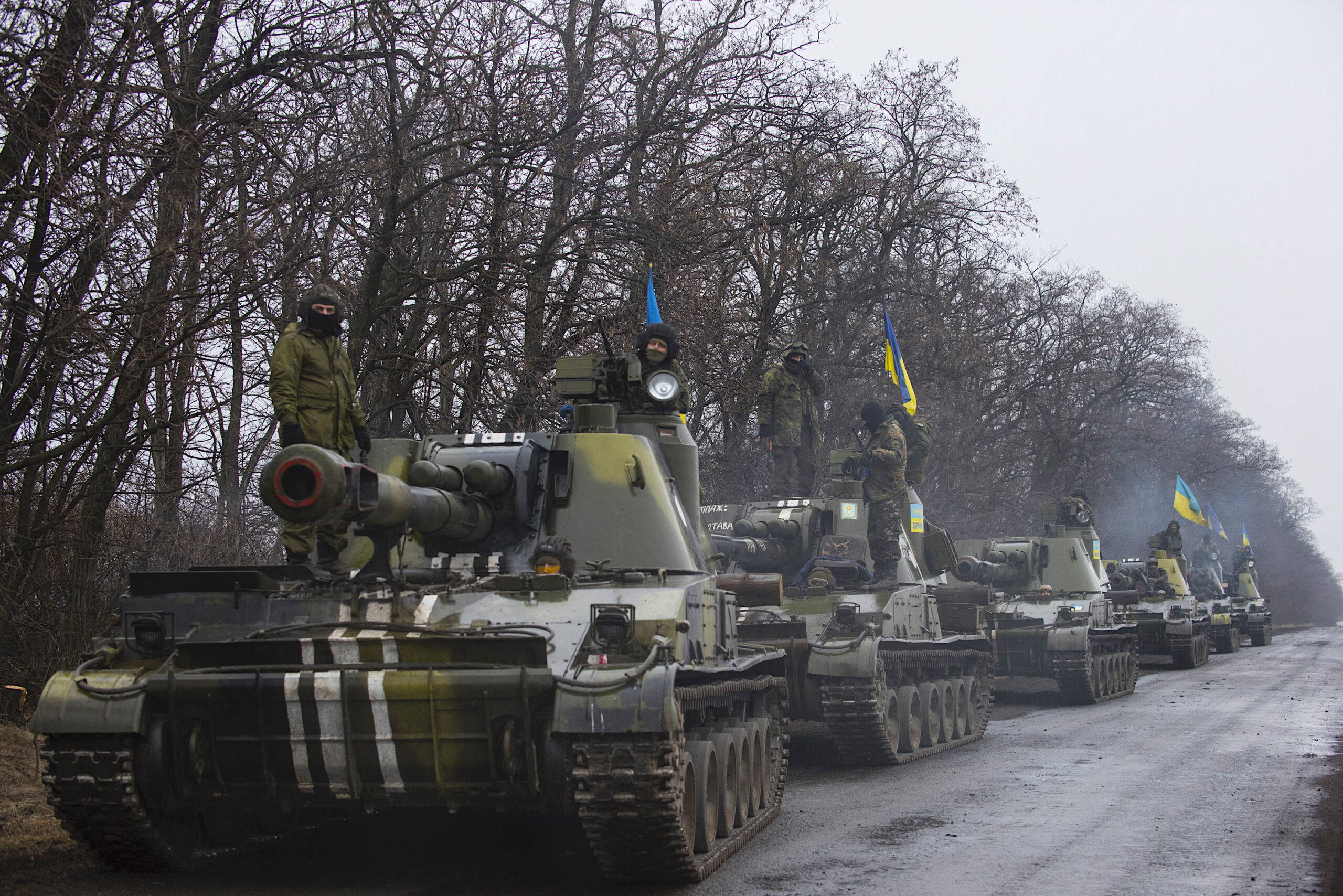

Ukrainian government tanks in eastern Ukraine, 2015. (OSCE)

They armed Ukraine with NATO weapons and trained 100,000 Ukrainian soldiers after the coup. Then they recruited neutral Finland and Sweden into NATO. Now the U.S. is being asked to send advanced long-range missile systems to Ukraine, which Russia says would make the U.S. “a direct party to the conflict.” But blinded by hubris and lacking any understanding of geopolitics, they push us, like the hapless generals in the Austro-Hungarian empire, towards catastrophe.

The West calls for total victory. Russia annexes four Ukrainian provinces. The West helps Ukraine bomb the Kerch Bridge. Russia rains missiles down on Ukrainian cities. The West gives Ukraine sophisticated air defense systems. The West gloats over Russian losses. Russia introduces conscription. Now Russia carries out drone and cruise missile attacks on power, sewage and water treatment plants. Where does it end?

“Is the United States, for example, trying to help bring an end to this conflict, through a settlement that would allow for a sovereign Ukraine and some kind of relationship between the United States and Russia?” a New York Times editorial asks. “Or is the United States now trying to weaken Russia permanently? Has the administration’s goal shifted to destabilizing Putin or having him removed? Does the United States intend to hold Putin accountable as a war criminal? Or is the goal to try to avoid a wider war — and if so, how does crowing about providing U.S. intelligence to kill Russians and sink one of their ships achieve this?”

No one has any answers.

The Times editorial ridicules the folly of attempting to recapture all of Ukrainian territory, especially those territories populated by ethnic Russians.

“A decisive military victory for Ukraine over Russia, in which Ukraine regains all the territory Russia has seized since 2014, is not a realistic goal,” it reads. “Though Russia’s planning and fighting have been surprisingly sloppy, Russia remains too strong, and Mr. Putin has invested too much personal prestige in the invasion to back down.”

But common sense, along with realistic military objectives and an equitable peace, is overpowered by the intoxication of war.

On Oct. 17, NATO countries began a two-week-long exercise in Europe, called Steadfast Noon, in which 60 aircraft, including fighter jets and long-range bombers flown in from Minot Air Base in North Dakota are simulating dropping thermonuclear bombs on European targets. This exercise happens annually. But the timing is nevertheless ominous. The U.S. has some 150 “tactical” nuclear warheads stationed in Belgium, Germany, Italy, the Netherlands and Turkey.
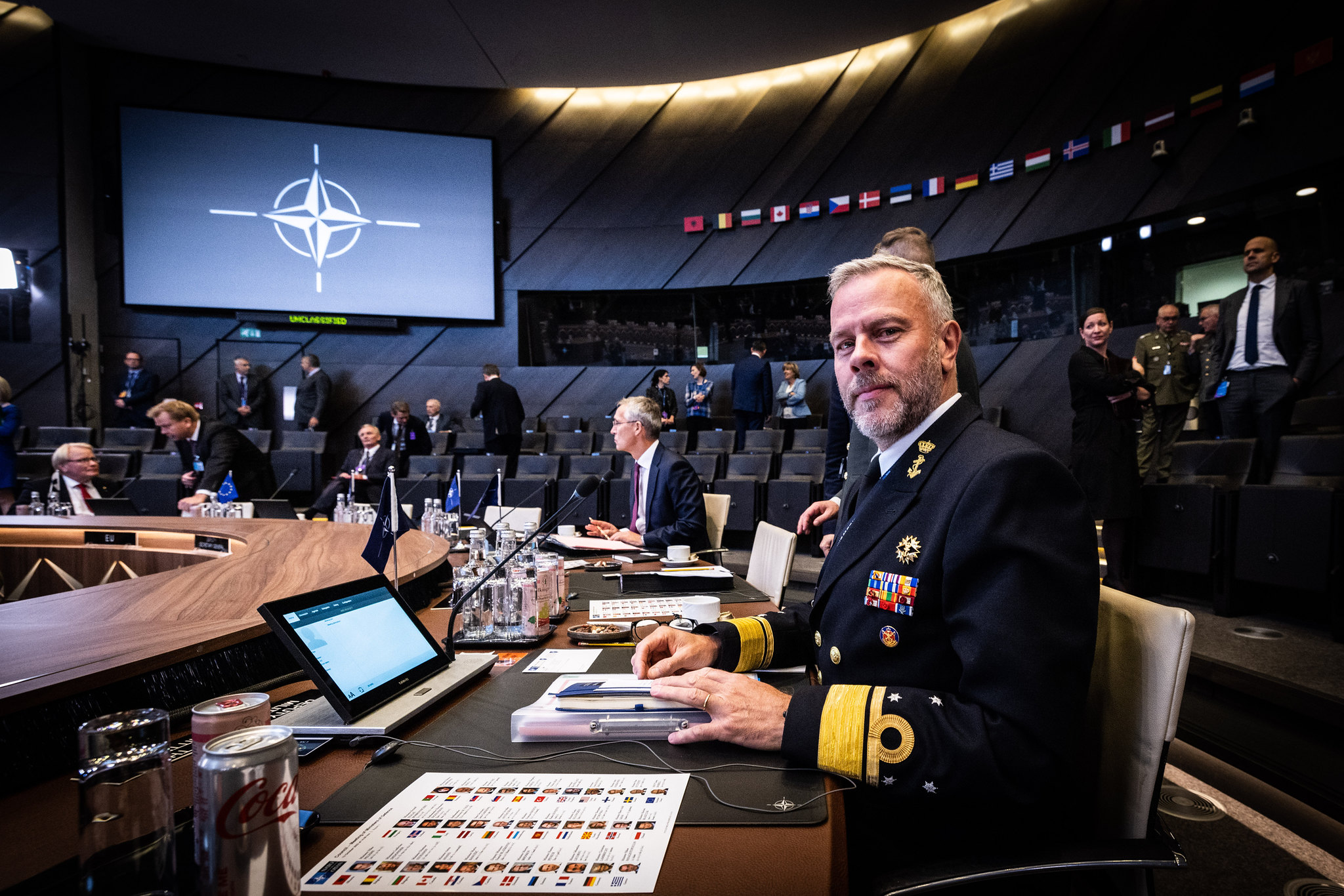

Admiral Rob Bauer, chair of NATO Military Committee, during a meeting of NATO defence ministers on Oct. 13. (NATO)

Ukraine will be a long and costly war of attrition, one that will leave much of Ukraine in ruins and hundreds of thousands of families convulsed by lifelong grief. If NATO prevails and Putin feels his hold on power is in jeopardy, what will stop him from lashing out in desperation? Russia has the world’s largest arsenal of tactical nukes, weapons that can kill tens of thousands if used on a city. It also possesses nearly 6,000 nuclear warheads. Putin does not want to end up, like his Serbian allies Slobodan Miloševic and Ratko Mladic, as a convicted war criminal in the Hague. Nor does he want to go the way of Saddam Hussein and Muammar Gaddafi. What will stop him from upping the ante if he feels cornered?
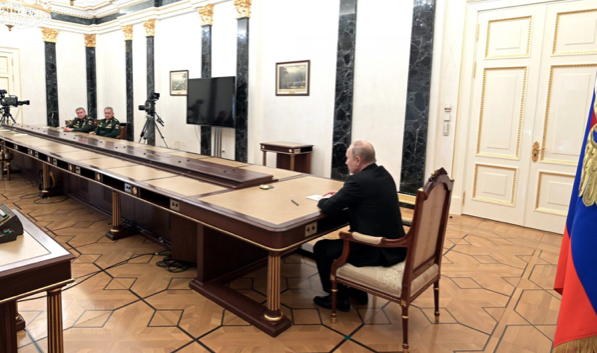

Russian President Vladimir Putin puts nuclear forces on high alert, Feb. 27. (Kremlin)

There is something grimly cavalier about how political, military and intelligence chiefs, including C.I.A. Director William Burns, a former U.S. ambassador to Moscow, agree about the danger of humiliating and defeating Putin and the specter of nuclear war.

“Given the potential desperation of President Putin and the Russian leadership, given the setbacks that they’ve faced so far, militarily, none of us can take lightly the threat posed by a potential resort to tactical nuclear weapons or low-yield nuclear weapons,” Burns said in remarks at Georgia Tech in Atlanta.

Former C.I.A. Director Leon Panetta, who also served as defense secretary under President Barack Obama, wrote this month that U.S. intelligence agencies believe the odds of the war in Ukraine spiraling into a nuclear war are as high as 1-in-4.

The director of National Intelligence, Avril Haines, echoed this warning, telling the Senate Armed Services Committee in May that if Putin believed there was an existential threat to Russia, he could resort to nuclear weapons.

“We do think that [Putin’s perception of an existential threat] could be the case in the event that he perceives that he is losing the war in Ukraine, and that NATO in effect is either intervening or about to intervene in that context, which would obviously contribute to a perception that he is about to lose the war in Ukraine,” Haines said.

“As this war and its consequences slowly weaken Russian conventional strength … Russia likely will increasingly rely on its nuclear deterrent to signal the West and project strength to its internal and external audiences,” Lt. Gen. Scott Berrier wrote in the Defense Intelligence Agency’s threat assessment submitted to the same Armed Services Committee at the end of April.

Given these assessments, why don’t Burns, Panetta, Haines and Berrier, urgently advocate diplomacy with Russia to de-escalate the nuclear threat?

This war should never have happened. The U.S. was well aware it was provoking Russia. But it was drunk on its own power, especially as it emerged as the world’s sole superpower at the end of the Cold War, and besides, there were billions in profits to be made in arms sales to new NATO members.

In 2008, when Burns was serving as the ambassador to Moscow, he wrote to Secretary of State Condoleezza Rice:

“Ukrainian entry into NATO is the brightest of all redlines for the Russian elite (not just Putin). In more than two and a half years of conversations with key Russian players, from knuckle-draggers in the dark recesses of the Kremlin to Putin’s sharpest liberal critics, I have yet to find anyone who views Ukraine in NATO as anything other than a direct challenge to Russian interests.”

Sixty-six U.N. members, most from the Global South, have called for diplomacy to end the war in Ukraine, as required by the U.N. Charter. But few of the big power players are listening.

If you think nuclear war can’t happen, pay a visit to Hiroshima and Nagasaki. These Japanese cities had no military value. They were wiped out because most of the rest of Japan’s urban centers had already been destroyed by saturation bombing campaigns directed by LeMay. The U.S. knew Japan was crippled and ready to surrender, but it wanted to send a message to the Soviet Union that with its new atomic weapons it was going to dominate the world.

We saw how that turned out.

Chris Hedges is a Pulitzer Prize–winning journalist who was a foreign correspondent for 15 years for The New York Times, where he served as the Middle East bureau chief and Balkan bureau chief for the paper. He previously worked overseas for The Dallas Morning News, The Christian Science Monitor and NPR. He is the host of show “The Chris Hedges Report.”

Author’s Note to Readers: There is now no way left for me to continue to write a weekly column for ScheerPost and produce my weekly television show without your help. The walls are closing in, with startling rapidity, on independent journalism, with the elites, including the Democratic Party elites, clamoring for more and more censorship. Bob Scheer, who runs ScheerPost on a shoestring budget, and I will not waiver in our commitment to independent and honest journalism, and we will never put ScheerPost behind a paywall, charge a subscription for it, sell your data or accept advertising. Please, if you can, sign up at chrishedges.substack.com so I can continue to post my Monday column on ScheerPost and produce my weekly television show, “The Chris Hedges Report.”

This column is from Scheerpost, for which Chris Hedges writes a regular column. Click here to sign up for email alerts.

