Must be careful w/ the narrative, especially from NYT and Bloomberg and WaPo, and so based on earlier understandings from Doomberg, I <<dissected>> further, meaning another layer deeper
Re <<A combination of full storage, lower demand and mild weather, among other factors, has eased concerns of a spike in heating and power prices — for now.>> ... in October.
... together w/ <<At the urging of European Union officials and at a high cost, energy companies and governments have filled underground caverns and other facilities to more than 90 percent of capacity, compared with less than 80 percent year ago.>>
... am guessing that a year ago inventory were the way they were due to its logistic-hub nature, as a part of a 'flow' schema, whereas now the hub has been unplugged on the one end to large degree and to another ramped to high price.
EU has to print money to buy energy in effect, via subsidy to its consumers unenthusiastic. Am guessing EU has more capacity capability / capacity to use energy, an imperative, than same to print money given the knock-on effects on food, fertiliser, and and and.
An interesting set of simultaneous equations. Think of it in terms of a patient at hospital hooked up to tubes, and with one tube dangling off of the bed.
Am guessing that EU / Nato, fresh out of Afghanistan victory, sleepwalked into WWIII, in effect, with some entity slightly more consequential / larger / nastier / having a longer and harder stick.
You and I both should notice that the narrative does NOT address the issue of absolute numbers, and only percentages. IOW, something must not be questioned.
I am told that the reason gas price falling is because of the same reason that oil price once fell below -0-, namely, running out of storage, primarily, a solid number, as opposed to guesses about the nature of the winter that barely started.
Let's watch and hope all okay, industries running smoothly, retail happy, governments steady, and and and, and nothing else goes wrong.
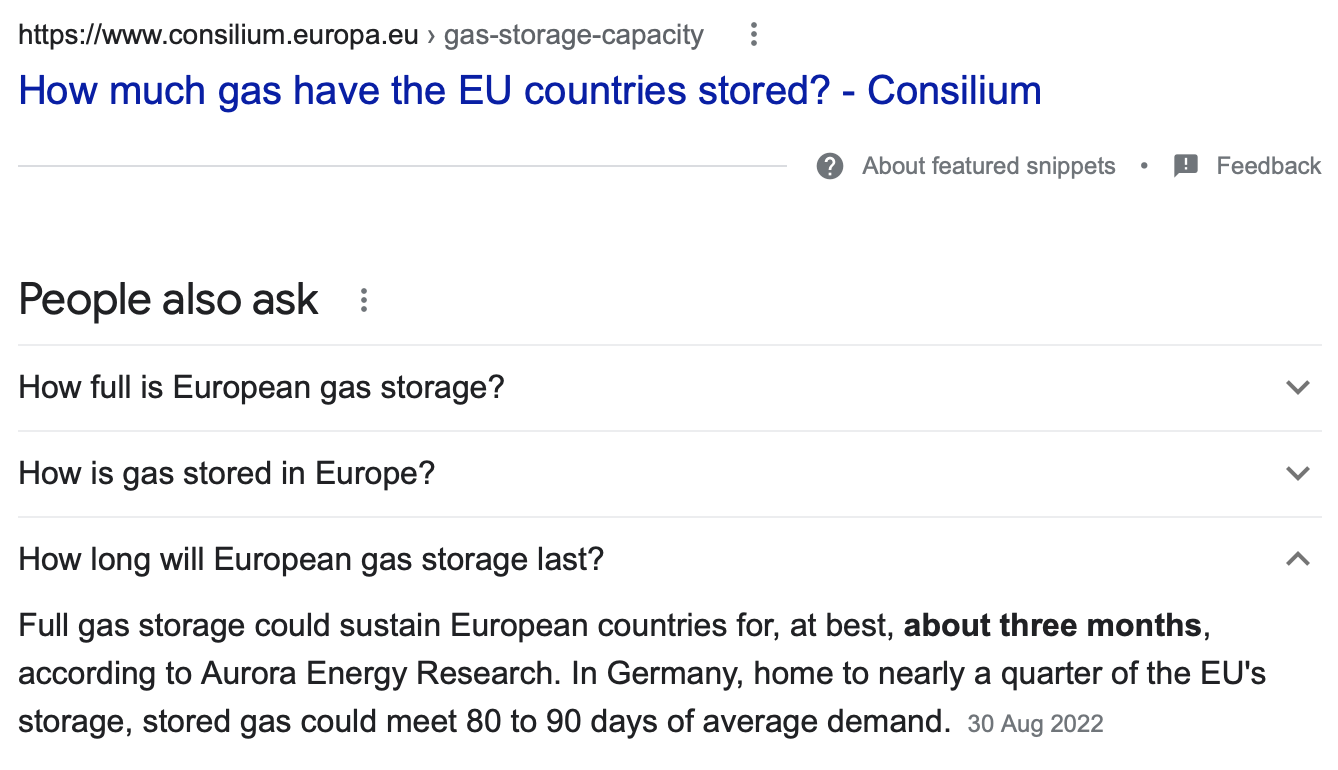
Here below is suggestive, and if so, let's see if Germany shares its absolutely largest stored gas - we must dismiss talks of %
consilium.europa.eu
In the meantime, Reuters said ...
reuters.com
Analysis: Full gas storage no fix for Europe's winter energy crunch
Kate Abnett
4 minute read
August 31, 20222:15 PM GMT+8Last Updated 2 months ago
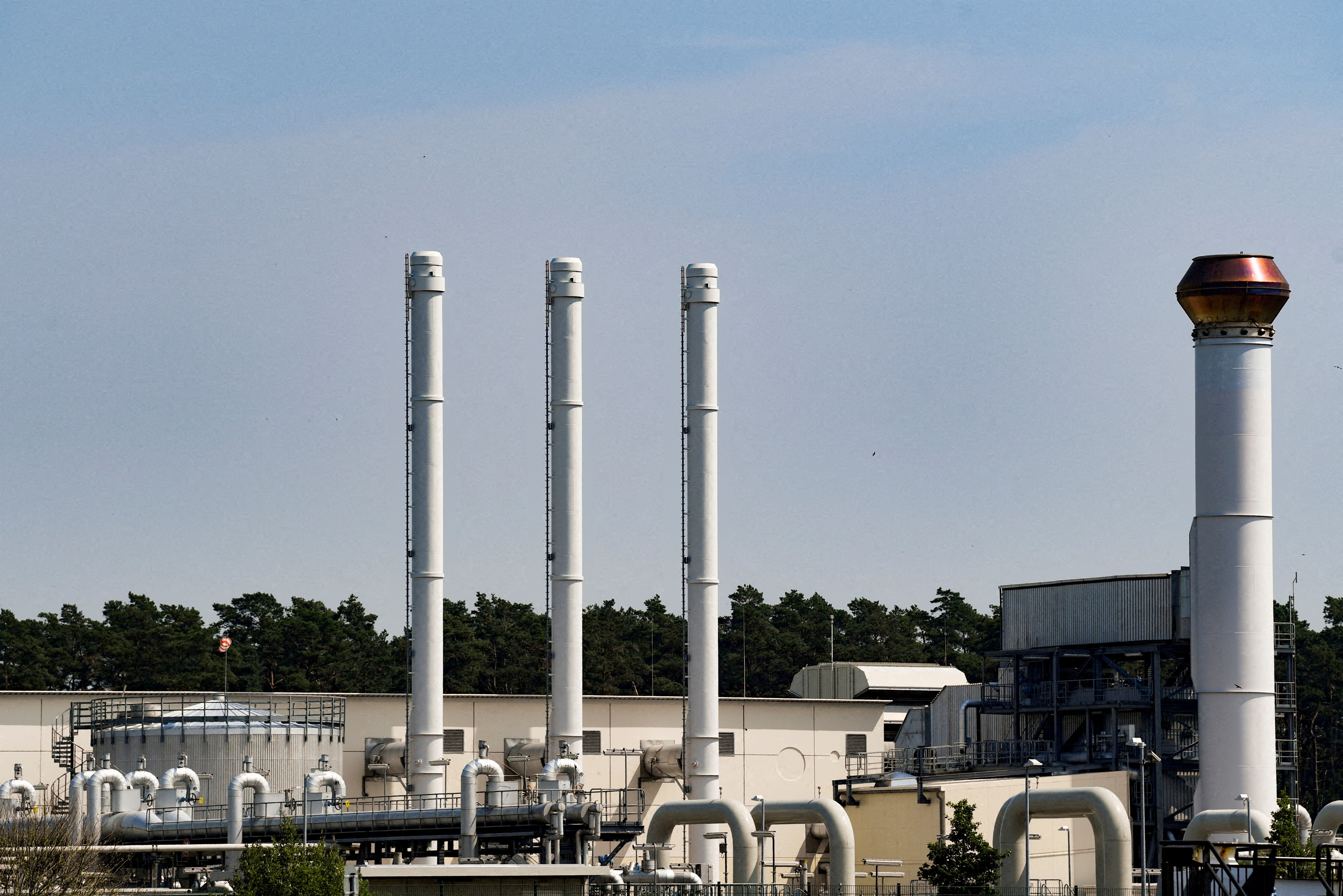
BRUSSELS, Aug 31 (Reuters) - The European Union is on track to beat targets for filling gas storage, but analysts warn the bigger factor for energy security this winter will be whether countries can slash consumption enough to ensure stored fuel lasts through the coldest months.
Following a scramble for fuel over the summer after top European gas supplier Russia invaded Ukraine, Europe's gas storage is now 79.94% full, Gas Infrastructure Europe data shows, setting up countries to exceed their target to have 80% full storage by November.
In a normal year that could cover Europe's winter peak in gas use. But in 2022, with Russian flows already sharply lower - the amount of gas it sends through Nord Stream 1, its main pipeline route into Europe, is at just 20% of capacity - storage will not make up the balance.
Full gas storage could sustain European countries for, at best, about three months, according to Aurora Energy Research. In Germany, home to nearly a quarter of the EU's storage, stored gas could meet 80 to 90 days of average demand.

Reuters Graphics
"To cope with this crisis situation, demand reduction will be even more important than storage," Simone Tagliapietra, a senior fellow at the Bruegel think-tank, told Reuters.
With around 888 terawatt hours (TWh) of gas now in storage, EU countries have already surpassed the 858 TWh their stocks peaked at ahead of last winter.
Advertisement · Scroll to continue
But if countries fail to cut their use of the fuel, Europe's gas caverns would still be emptied by March, according to modelling by data intelligence firm ICIS shared with Reuters - even in a scenario where some Russian gas keeps flowing all winter, and the weather is not unusually cold.
To avert a winter supply crisis, each month countries need to cut their gas use to 15% below the five-year average, ICIS said. That would leave post-winter storage 45% full if Russia kept sending gas, and 26% full if Russia cut flows from October.
A combination of no Russian gas and no aggressive reduction in gas consumption in industries and buildings "could result in electricity rationing" this winter, said Mauro Chavez Rodriguez, European gas research director at Wood Mackenzie.
Yet so far, sustained cuts in gas demand on the scale needed have not happened despite multiple industries being forced by extraordinary gas prices to curtail their output - a phenomenon now affecting two-thirds of European fertiliser production capacity.

Reuters Graphics
ILLUMINATIONS FADE
EU countries agreed in late July to cut their gas use by 15% this winter from average winter levels in 2017-2021. Europe's gas consumption in the first half of August was 11% lower than the five-year average, ICIS said.
German industry's gas use plummeted 21% in July compared with the 2018-2021 average, but before that no other month had seen a bigger than 14% cut, data from the federal energy regulator show.
Unlike most European governments, Germany has introduced some requirements to save energy. They kick in next month and include a ban on gas heating for private swimming pools, a reduction of the illuminations of public landmarks, and a ban on heated shops keeping their doors open all day.
Matthias Buck, Europe director at Agora Energiewende, said Germany needs a 20 to 25% cut in gas use this winter. That includes lowering demand from households - a move he said must be accompanied by more government action to shield low-income households from the surging cost of gas and power.
Failure to save gas this winter would make it far harder to fill storage for next winter. If that happened and Russia cut flows, next year Europe's storage could be drained by November, the Oxford Institute of Energy Studies said.
Liquefied natural gas imports have helped Europe rapidly fill storage this year, but in the absence of Russian flows in 2023, the tightly supplied LNG market would not be able to get Europe's storage facilities back to comfortable pre-winter levels - making it crucial for countries to simply use less gas.
"The storage is the safety net, but a very significant demand reduction is what we need as a priority in this crisis," Matthias Buck said.

Reuters Graphics
Reporting by Kate Abnett in Brussels and Bozorgmehr Sharafedin in London; Editing by Jan Harvey
Our Standards: The Thomson Reuters Trust Principles. |



