Re <<The cutting off of support for the Chinese venture into silicon chip technology is over 20 years too late. Another counterproductive shooting in the foot by the West.>>
... and it p*sses off largest customer as well as makes unhappy largest supplier.
But maybe the move will work out.
In the meantime, if what might happen in Chip-scape is anything like what seems to be happening in EV-arena, then un-good, because, just as in the case of Republic of China Taiwan Province spends 300M to train more engineers, the results of the foundational work shall simply be recruited, cooped or otherwise borrowed.
Before Xi Jinping opened the money spigot he cracked down hard on corruption, so that the money can do some good, and even then some residual corruption took advantage of the money. Team Biden does not seem to be bothering with some foundational steps. Steps that might matter where money is concerned. Money is always, everywhere, concerning.
bloomberg.com
The US Just Can’t Match China’s Industrial Heft
It doesn’t make sense to focus on disparate parts of the EV and battery value chain, yet that’s what the Biden administration is doing.
Anjani Trivedi
1 November 2022 at 05:00 GMT+8
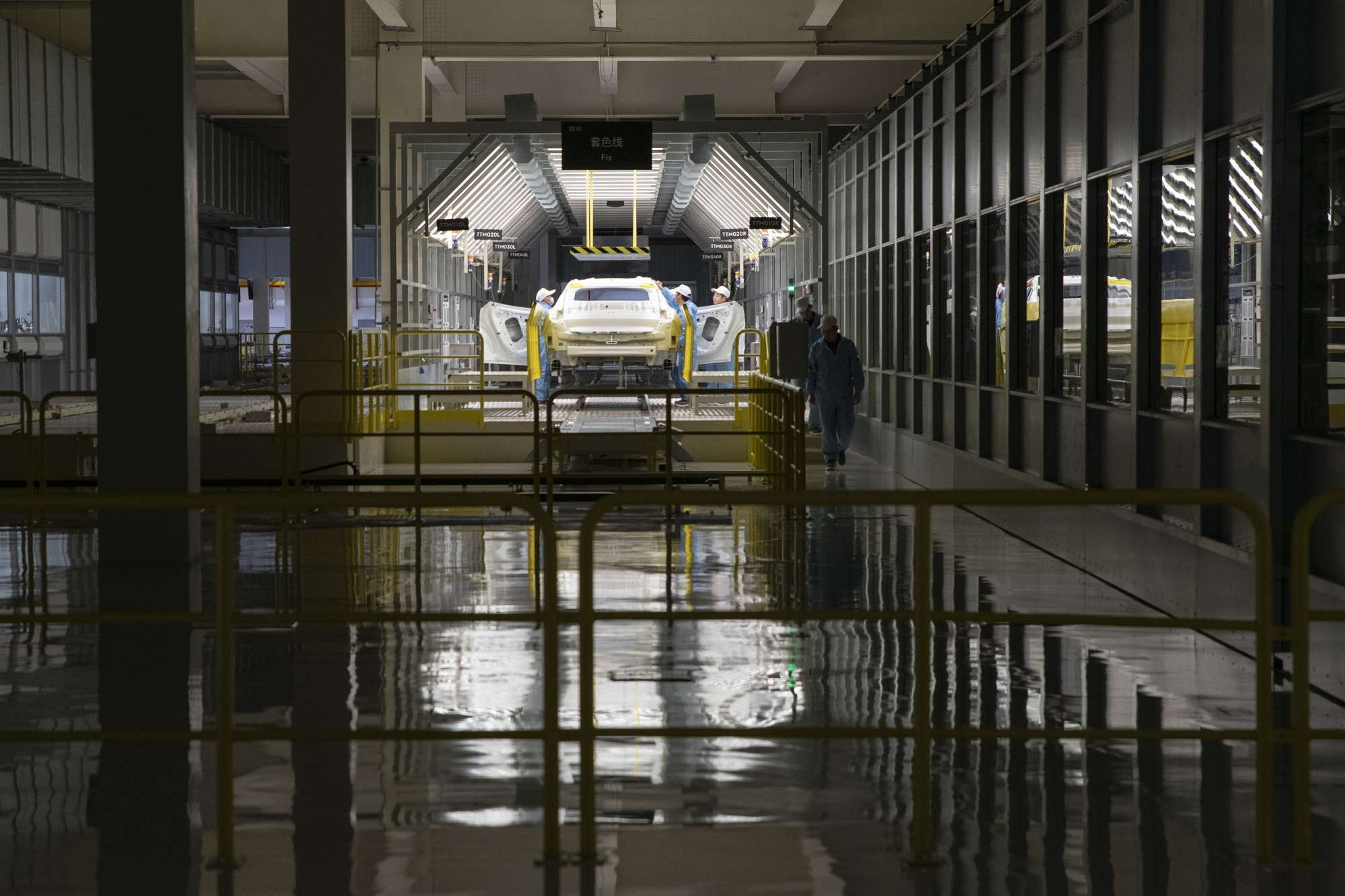
Light years ahead.
Photographer: Gilles Sabrie/BloombergThe American attempt at an industrial policy to build electric vehicles and batteries has, once again, fallen flat. The recently released list of firms selected for $2.8 billion of funding shows as much. They look more like late-stage R&D projects than companies ready to scale.
Earlier this month, the Biden administration announced the first set of projectsthat will be funded by the President’s Bipartisan Infrastructure Law to expand domestic production of EV batteries and the grid, and “for materials and components currently imported from other countries.” Instead of focusing on manufacturing — its biggest weakness — the US Department of Energy has backed firms that will process lithium, “demonstrate new approaches” and recycle powerpacks.
That is misguided — and won’t get the US any closer to the heft of China’s battery economy. The biggest issue is the outlays target parts of the supply chain that are either not as difficult to set up and scale, or further down the value ladder, like processing of lithium, graphite and other materials. It doesn’t focus enough on cell and cathode manufacturing, the most important elements. The government’s investment is expected to be matched by recipients to reach more than $9 billion.
Of the 20 companies participating, most will either separate and process materials or make components like anodes and separators. None are focused on making battery cells and packs or extracting raw metals and elements — the key processes at the beginning and end. Producing cells is tough to begin with because of the constantly evolving manufacturing practices including automation. In addition, their large size and electric charge, along with elements like nickel and cobalt, makes them difficult to handle and control for quality. Sourcing experienced battery engineers is also getting harder.
It’s unclear where the supplies of nickel, lithium and cobalt will come from, or how the US plants will scale up, because most of the investment has been allocated toward yet-to-be fully-proven powerpack technology that’s still not commercially viable. In the meantime, large battery makers have announced big plans — and they too will require supplies.
This patchwork approach won’t work. Countries like Indonesia, for instance, are taking on raw material processing because they have vast nickel resources. Jakarta has used that to draw in big companies likes Tesla Inc., LG Energy Solution Ltd. and Contemporary Amperex Technology Co., and will then leverage this to build out a domestic supply chain, while maintaining a large stake in the global one. Seen through that lens, it doesn’t make sense for the US to focus on disparate parts of the value ladder. Meanwhile, part of the Biden administration’s funding was meant to help create “good-paying” jobs as these sectors grow — in theory. If these projects aren’t scalable or commercially viable, how will they boost employment?
The sad reality is, the US has been here before. This is reminiscent of the 2009 American Recovery and Reinvestment Act, when the Obama administration laid out more than $90 billion for clean energy. It was supposed to drive innovation, modernize the grid and boost manufacturing. Companies like industrial battery manufacturer A123 Systems LLC, along with several other energy firms that had taken over $800 million of grants and loans and promised thousands of jobs, eventually filed for bankruptcy.
Billions of dollars were laid out for lithium-ion powerpacks, recycling, EV components and charging stations. Over a decade later, the US still wasn’t able to meet its own goals that included dominating green sectors and technologies, nor has it been able to get ahead of China. That’s because it never sharpened its mish-mash of a policy and failed to target core areas it could have established a firm grip on.
Ironically, that was around the same time China had turned its attention to batteries — a game-changer for EVs and energy storage. In 2012, when A123 was going bust, Beijing designated the sector a key strategic industry. The country’s focused policy around its automotive sector and deep supply chain has catapulted it on to the world stage, allowing manufacturers like Tesla Inc. to reduce prices and churn out hundreds of thousands of vehicles. Elsewhere, carmakers haven’t been able to manage the incessant price rises without eroding margins or produce enough EVs to meet emissions targets and promises.
At this point, it isn’t really a competition between America and China, the world’s largest market for electric vehicles and manufacturer of batteries. It’s now about US industrial policy against, well, itself. |



