Where's you answer dipshit?
WaPo, NYT and Newsweek all agree...
Q is FOS!
LOL, they live in a world where all people are exactly like them. What they don't understand is very few people are like them. Here's my proof. Where's yours?
+++
To: Qone0 who wrote (1392887) | 2/27/2023 9:26:17 PM | | From: Broken_Clock | of 1392906 | | | LOL, they live in a world where all people are exactly like them. What they don't understand is very few people are like them. Could you be anymore wrong? Check in with tenshits...the Truth is out there Scully!
newsweek.com
Nearly 90 Percent of the World Isn't Following Us on Ukraine | Opinion
Michael Gfoeller and David H. Rundell
On 9/15/22 at 6:58 AM EDT
Current Time 0:14
/
Duration 0:51
China Gives Clearest Support for Russia’s Invasion of Ukraine So
Our familiar system of global political and economic alliances is shifting, and nothing has made this change clearer than the varied reactions to Russia's invasion of Ukraine. While the United States and its closest allies in Europe and Asia have imposed tough economic sanctions on Moscow, 87 percent of the world's population has declined to follow us. Economic sanctions have united our adversaries in shared resistance. Less predictably, the outbreak of Cold War II, has also led countries that were once partners or non-aligned to become increasingly multi-aligned.
Nowhere is the shift more apparent than in energy markets where, unlike with currencies, governments cannot simply print what they need. Here the web of sanctions becomes a sieve.
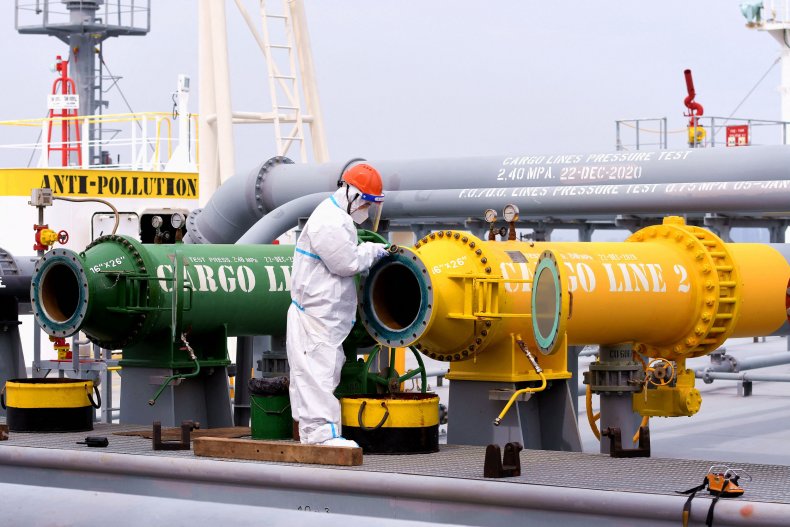
An immigration inspection officer checks an oil tanker carrying imported crude oil at Qingdao port in China's eastern Shandong province on May 9, 2022. STR/AFP via Getty Images Saudi Arabia, long a committed American partner, has established a close alliance with Russia in the OPEC Plus cartel. The Saudis have very publicly declined the request of an American president to increase oil production. Instead, they imported Russian oil for domestic use to export more of their own production. Last week they even reduced production and made clear they may do so again.
China is selling Europe liquid natural gas (LNG) that originated in Siberia while importing Russian oil at the same time. It then refines and exports the oil.
Meanwhile, kept solvent by Chinese oil purchases, Iran has become the largest customer for Russian wheat.
India's petroleum minister has stated publicly that his government has no conflict with Moscow and a "moral duty" to keep down energy prices at home by buying Russian oil.
Alliances that were created in part to counter Western economic and political influence are expanding. Egypt, Saudi Arabia, and Turkey have announced their interest in joining the BRICS (Brazil, Russia, India, China, and South Africa). The Shanghai Cooperative Organization currently links China, Russia, India, and Pakistan, among others. Iran plans to join this month while Bahrain, Egypt, Saudi Arabia, and Qatar are likely to become "dialogue partners," or candidate members.
Newsweek subscription offers >
Additionally, China's ambitious Belt and Road Initiative is tying many African nations to Beijing with cords of trade and debt. Russia is also reaching out in the form of Foreign Minister Sergey Lavrov, who recently addressed his 22 Arab League counterparts in Cairo before touring a number of African countries.
If that's not enough to give the West pause, Moscow is again on the offensive in Latin America, strengthening its military relationships with Nicaragua, Venezuela, and Cuba. The two powerhouses of that region, Brazil and Mexico, have pointedly refused to back Western sanctions against Russia.
The dollar's reserve currency status remains a pillar of the global economic order, but trust in that order has been damaged. Economic sanctions have weaponized parts of the international banking and insurance sectors including the SWIFT fund transfer system. Assets have been seized and commodity contracts canceled. Calls for de-dollarization have become louder. When Russia demanded energy payments in rubles, yuan or UAE Dirhams, China and India complied.
Many Asian economies are now being hit by both rising oil prices and the depreciation of their own currency against the dollar. As a result, they are expanding their use of bilateral currency swaps which allow them to trade among themselves in their own currencies. Eighty years ago the British pound lost its preeminent position among the world's currencies. This is precisely what America's adversaries are trying to do to the dollar and if the Saudis ever stop pricing oil in dollars, they may very well succeed.
Globalization can function only if most participants believe it advances their interests. If the rest believe the West is unfairly using the system for its own benefit, the rules- based international order falls apart and alternatives will emerge.
Today, inflationary pressures and recession fears stalk much of the world. While the wealthy West can afford the cost of sanctions, much of the rest cannot. Europe now competes with the likes of Bangladesh, Sri Lanka, Pakistan, and Thailand for energy shipments. In North Africa and the Middle East, energy and food shortages have raised the prospect of political unrest similar to the Arab Spring.
These concerns are generating considerable anti-Western sentiment across much of the Global South. While a nuclear-armed Russia shows no willingness to end a war its leaders cannot afford to lose; the West is rapidly losing the rest and thus undermining the very rules-based international order it has sought to create. Our most promising solution to this dilemma is likely to be some sort of diplomatic compromise.
David H. Rundell is the author of Vision or Mirage, Saudi Arabia at the Crossroads and a former Chief of Mission at the American Embassy in Saudi Arabia. Ambassador Michael Gfoeller is a former Political Advisor to the U.S. Central Command.
The views expressed in this article are the writers' own. |
|
|



