Re <<Clarification: The ICJ and ICC are separate entities... >>
... illumination on clarification, "close-enough for government work :0))))))
In the meantime, I actually agree w/ below appended Bloomberg article, the explicit theory together with the implicit corollaries, and ... but with caveats / suspicions, them being ...
(1) Theory: defeating Russia is the best way for the west to defend Taiwan, but on the supposition that Russia can be defeated without blowing up the object fought over together with melting of frontline states as examples, before stalemate is declared and conflict frozen
Questionable premise: that Team China would standby and allow Russia to be defeated
(2) Corollaries
(2-i) defending Taiwan is invasion of China, absolutely true
(2-ii) China will not lose Taiwan, assuredly true
(2-iii) Russia will not see China lose Taiwan, likely true
(2-iv) not defeating Russia is the best way to lose Taiwan, likely true
(2-v) losing to Russia is one sure way of losing Taiwan, certainly true
(2-vi) losing to China is another sure way to losing to Russia, undoubtedly true
(2-vii) unclear Taiwan is anyone but China's to lose, simply true
(2-viii) inability to defeat Russia would say do not try fighting with China, am guessing true
Suspicion: winning against Russia together with China playing rope-a-dope in the middle, and hope to win is laughably ridiculous close to a knee-slapper, and a slam-dunk knee-slapper once one starts the fight by crippling the economies of own allies and p*ss-off alliance populations, just a another guess
Suspicion: that any politician can be elected whilst pitching such a forward strategy to take on Russia and China should perhaps best to relegated to 'the dustbin of history' as the comrades-in-arms would admonish, yup, a guess, but in any case best not be allowed to rule a nation that hopes to make it across the line marked 'test-of-time'
Otherwise am agnostic, in watch & brief mode, and happy to treat ICC / ICJ as details not mattering much if at all to big-arrow sweeps of history and broad brush strokes of time leading up to and across 2026 / 2032
Am guessing can send Hal Brands a card that reads, "Taiwan as good as lost", by date May 2024, one or another way, whether by (i) electioneering or by (ii) Russia not-losing-yet by that juncture, after which we are good to go for 2026 and catch sight of 2032 per equation of relentless timing
bloomberg.com
Defeating Russia Is the Best Way for the West to Defend Taiwan
Republican presidential contenders are wrong: Protecting Ukraine isn’t a distraction from the rivalry with China.
Hal Brands
31 March 2023 at 19:00 GMT+8
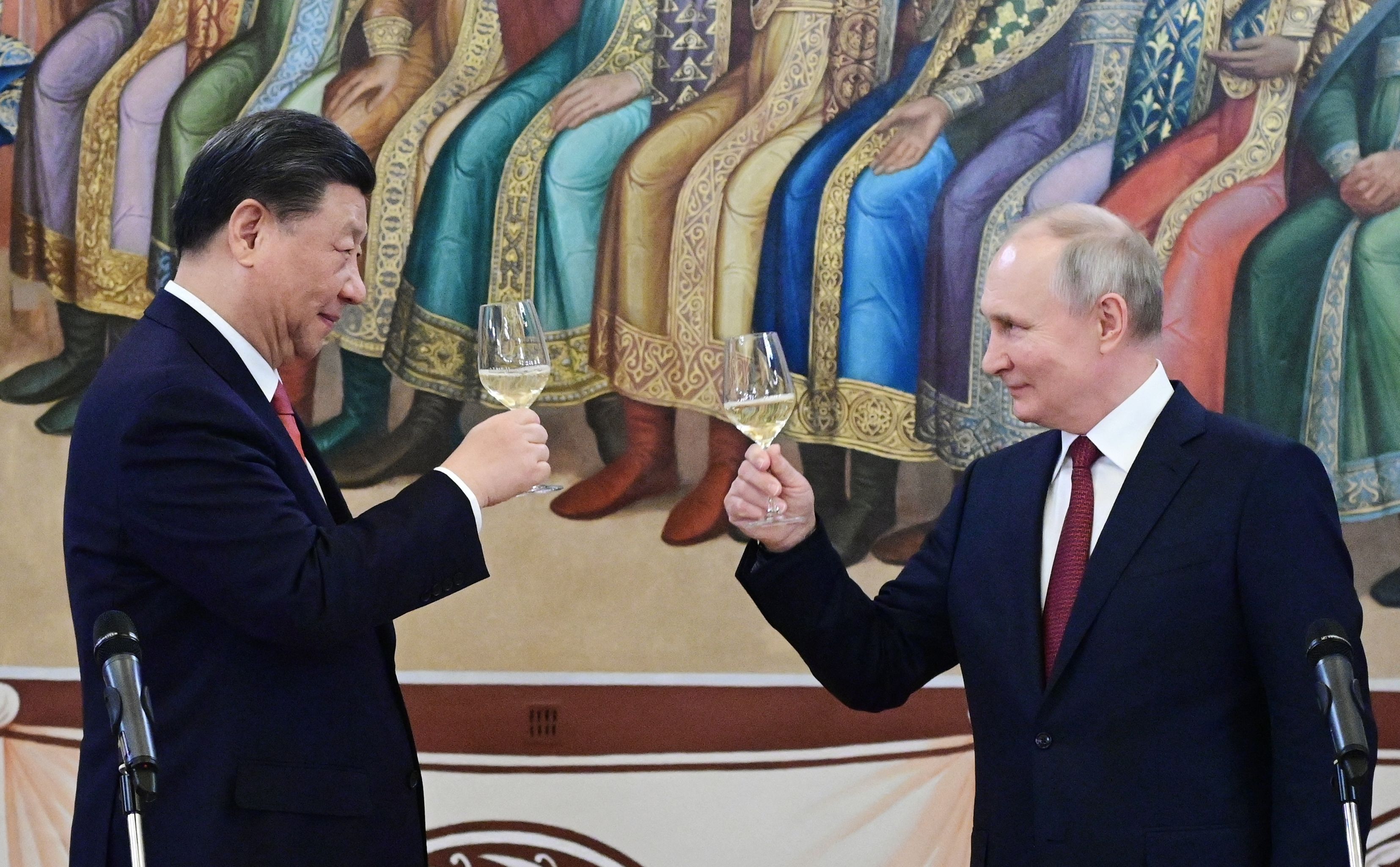
A toast to defeat?
Photographer: Pavel Byrkin/AFP/Getty Images
Can the US help Ukraine while preparing to defend Taiwan? The answer, according to some likely Republican presidential aspirants, is no. If America fights an “endless proxy war in Ukraine,” says Senator Josh Hawley, it may fail “to deter China from invading Taiwan.” Giving Kyiv a “blank check,” argues Florida Governor Ron DeSantis, is no way to beat Beijing.
This argument sounds rigorously strategic, at first: Statecraft is about making hard choices. Yet statecraft also involves grasping complex truths. In this case, America is unlikely to succeed against China if it cuts Ukraine adrift — and supporting Kyiv in the current war may help the US get ready for the next one.
Begin with what should be obvious: Reducing support for Ukraine means increasing the odds of Russian victory. Ukraine can’t hold off Russian forces without arms and ammunition from the Western world; without the US, no combination of countries can provide the necessary support. That is indeed a sad commentary on the state of European defenses. It’s also a matter of realism.
If Russia imposes an unfavorable peace on Ukraine — one that leaves it controlling large chunks of Ukrainian territory — it will have the ability to renew aggression when it chooses. It will also create grave insecurity in Eastern Europe, which will, in turn, create more demands on US military power.
Yes, Washington could respond by leaving Europe to the Europeans. But that would negate 80 years of American grand strategy. It would turn the US into a regional power amid intensifying global competition. It surely wouldn’t elicit much cooperation, whether military, diplomatic or economic, from the world’s largest bloc of liberal democracies — Europe — in confronting the threat from Beijing.
The greatest challenge to American security is in Asia, but the US will struggle to prevail without a relatively secure, supportive Europe on its side.
To be clear, resources and attention are finite. A long war in Ukraine will impose costs, measured in munitions and in distraction, on the US. Yet the tradeoff between Ukraine and Taiwan doesn’t have to be zero-sum.
If Ukraine is distracting America, it is devouring Russia. Moscow’s losses, in men and materiel, are shredding its ground forces. The more those losses mount, the less threat President Vladimir Putin will pose to Eastern Europe — and the more focus Washington can responsibly shift to Asia.
Moreover, the war in Ukraine is serving as a proving ground for concepts and capabilities that can help win a war over Taiwan. This conflict is delivering an education in the demands of defending against drones and cruise missiles. It is showcasing long-range strike capabilities that the US and its friends could use to turn the Western Pacific’s “first island chain” — the string of features running from the Korean Peninsula down to Indonesia — into a death trap for Chinese warships. It is yielding new insights, for the US, into how AI can improve intelligence collection and decision-making, and for Taiwan, on how decentralized command practices and whole-of-society resistance can make all the difference.
Finally, an extended war in Ukraine offers America a chance to truly get serious about defense. The present weakness of the so-called defense industrial base is appalling. It may take years to rebuild the stocks of Javelin missiles America has given Ukraine. In a war against China, the Pentagon would run out of some munitions in days, with no easy way to replace them — let alone the ships, planes and submarines that might be lost. By making the scale and severity of the problem clear, the Ukraine war may also help Washington find the urgency to fix it.
There is historical precedent. In 1940-41, Americans debated whether providing lend-lease aid to Britain would simply squander resources the US needed for itself. Yet it turned out that this wasn’t an either/or proposition. Spending on weapons destined for Britain helped stimulate America’s then-feeble arms industry, reducing the time it took the US to mobilize after the Japanese attack on Pearl Harbor.
“We are buying, not lending,” said Secretary of War Henry Stimson: America was putting industry on a war footing while the country was still at peace.
The question is whether the US will do something similar today. President Joe Biden’s administration is, as Deputy Secretary of Defense Kathleen Hicks explains, buying key munitions “to the limits of the industrial base.” The Pentagon can use multiyear procurement contracts that give firms incentive to invest; it is learning, from the Ukraine experience, how to knife through red tape. But no one can really claim America is moving with wartime urgency when Biden continues to propose defense budget “increases” that don’t even keep pace with inflation.
The “Asia First” contingent is right about one thing: If the US conducts business as usual, then aid to Ukraine may come at Taiwan’s expense. Yet if the US conducts business as usual, it wouldn’t be able to defend Taiwan even if it abandoned Ukraine tomorrow.
America faces real challenges in two theaters simultaneously. Its best chance to succeed involves using the stimulus provided by one to prepare for the other. |



