SI
SI
discoversearch

We've detected that you're using an ad content blocking browser plug-in or feature. Ads provide a critical source of revenue to the continued operation of Silicon Investor.  We ask that you disable ad blocking while on Silicon Investor in the best interests of our community.  If you are not using an ad blocker but are still receiving this message, make sure your browser's tracking protection is set to the 'standard' level.
Strategies & Market Trends : 2026 TeoTwawKi ... 2032 Darkest Interregnum -- Ignore unavailable to you. Want to Upgrade?


To: marcher who wrote (197920)4/30/2023 5:47:23 AM
From: TobagoJack1 Recommendation

Recommended By
marcher

  Respond to of 218228
 
Re <<balloon>>

... found, and a reminder, sovereign airspace in the vertical direction, is only defined by what can be shot down over any domain's territory inclusive of the 12-miles (kilometres(?) close-enough for officialdom work) from ocean frontage

independent.co.uk

Mysterious Russian spacecraft appears to be chasing US military satellite

US satellite appears to have made its first jump to a higher orbit away from Russian spacecraft

Vishwam Sankaran
2 days ago


A strange Russian “inspector” spacecraft appears to be stalking a confidential US military satellite, experts have pointed out.

The Russian satellite Kosmos-2558, launched in August last year, has frequently come close to the American military satellite USA-326, which the Pentagon said is meant to gather intelligence via “overhead reconnaissance”.

Space observers have flagged Kosmos-2558 as an “inspector” satellite capable of moving close to other satellites and gathering data.

Orbiting Earth in the same plane but at different speeds, the Russian satellite has been able to pass beneath USA-326.

When Kosmos-2558 was launched in August 2022, it was placed in almost the same orbit as the classified US reconnaissance satellite, Space.com noted.

In March, observers reported Kosmos-2558 performing an orbit-raising maneuver to reach an inclination of about 35km below USA-326.

In the latest development amid this cat-and-mouse chase, the US satellite appears to have made its first jump to a higher orbit away from Kosmos-2558, Insider reported, citing astrophysicist Jonathan McDowell.

The Russian satellite was approaching USA-326 for a close pass of about 30km on 7 April, but after the latter’s orbit change, the shortest distance between the two increased to 45km, space observer Nico Janssen noted.

This is not the first time US and Russian satellites have engaged in such manoeuvers.

In 2020, another Russian spacecraft, Kosmos-2542, made several approaches close to the US optical intelligence satellite USA-245.

The US has frequently condemned Russia’s “irresponsible” activities in orbit.

US vice president Kamala Harris voiced concerns last year over Russian missile tests to take out their own satellites, calling such moves “reckless” and “irresponsible” as they could put other space missions in danger.

In 2018, the US also condemned Russia’s launch of a mysterious satellite that appeared to have a “space apparatus inspector” and exhibiting “very abnormal behaviour”.

A US Space Force general also warned Russian and Chinese spacecraft could attack US satellites with lasers and jammers.


To: marcher who wrote (197920)5/1/2023 7:23:59 PM
From: TobagoJack  Read Replies (1) | Respond to of 218228
 
Re <<old 'balloon'>>

incipient balloon gap that might require formation of near-space force, to fill gap between airforce and space force

am surprised that CNN did not spin the little ship as testbed for a monster fleet that would be used as a green, sustainable, carbon energy fuel-free, post-atomic ultra long range troop carrier to be used once the planet returns to primordial times

edition.cnn.com

Exclusive: Never-before-seen Chinese military blimp caught on satellite images of remote desert base

CNN — none

A large blimp developed by the Chinese military has been spotted for the first time at a remote base in the desert of northwestern China, exclusive new satellite imagery obtained by CNN shows.

Aerospace experts say the images, taken three months before a Chinese spy balloon was shot down off the coast of South Carolina, could signal a notable advancement in China’s airship program, demonstrating a more versatile and maneuverable craft than previously seen or known.

The images, taken in November 2022 by US satellite imaging company BlackSky, show a roughly 100-foot long blimp in the middle of a nearly kilometer-long runway at a desert military complex in northwestern China. CNN presented the imagery to a number of aerospace experts, who confirmed they show a blimp and runway, bookended by a pivot point used to launch airships, as well as a massive, nearly 900-foot airship hangar.

Oklahoma Aerospace Institute executive director Jamey Jacobs said a blimp like this could be used as a “submarine of the skies,” and that it appears to have dedicated propulsion and navigation capabilities, which would allow it to loiter over an area for an extended period.

“It really is the next leap for them in terms of furthering the engineering and support of research funding in that direction,” Jacobs said.

CNN reached out to several congressional and administration offices familiar with US intelligence on China who would not speak directly about the base or the blimp.
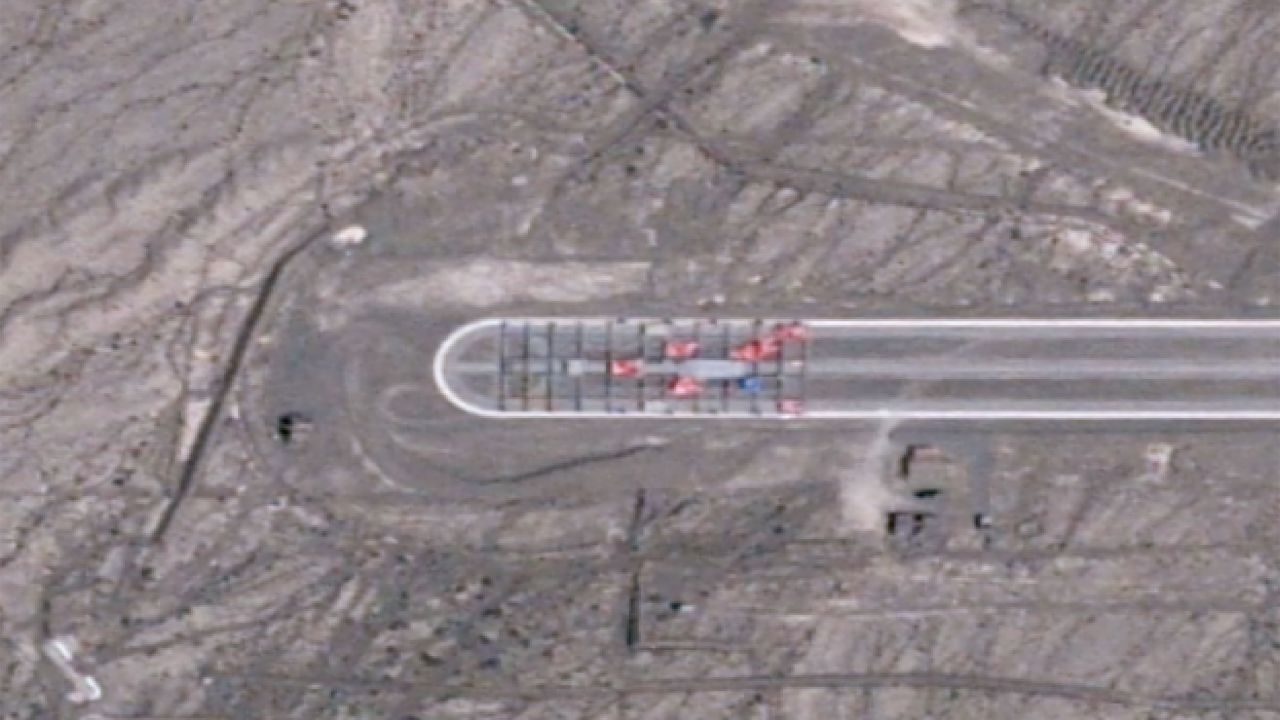


A senior Defense Department official declined to comment on what threats the blimp represents in China’s arsenal but said since it’s visible, the Pentagon would be aware.

“You can expect because it’s available via satellite imagery that we’re tracking the object,” the official said.

The CIA declined a request for comment. The National Security Council did not respond to a request.

China’s ‘near space’ program

The spy balloon incident from January brought significant attention to China’s airship program, revealing how useful airships can be to its spying activities. According to a 2018 report by the Rand Corporation on the country’s modern warfare strategy, these types of airships are attractive to the Chinese because they’re “less expensive … and provide more-precise intelligence” than satellites, in addition to being “less susceptible to destruction” than planes.

Although China is not alone in utilizing airships – the US military has used aerostats – this discovery now confirms the PLA program uses all three types of airships: blimps, aerostats and free-floating balloons.

Eli Hayes, a researcher who has studied the Chinese airship program for years, also noted that the blimp’s appearance at a Chinese military facility marks a notable transition in Chinese blimp technology and research – it’s not just civilian anymore.

“It’s not just people talking about possible applications or use cases,” Hayes told CNN, explaining that past Chinese airships and accomplishments have been constructed by research institutions and universities. While it’s unclear whether those institutions assisted in the creation of this blimp, Hayes does note that some are known to have deep ties to the People’s Liberation Army, and at least one has been on a US sanctions list for decades.

CNN asked the Chinese Defense Ministry about the blimp, and its purpose, but did not immediately receive a response. China is in the midst of a five-day May Day holiday.

Military patents

Additional satellite imagery and analysis of the site suggests that the PLA has significantly loftier goals for its site, and its airship program.


“If I had to guess, [this blimp is] probably some sort of testing,” said William Kim, a surveillance balloon specialist at The Marathon Initiative, a non-profit military and diplomatic research organization.

Where the airship program fits into the Chinese military’s overall organizational structure remains a mystery, although patents are giving a glimpse that they’ve recently created a unit to oversee the technology.

A number of patents involving airship technologies were recently reassigned to a new PLA group – Unit 63660 – according to Hayes. A CNN review of Chinese patents confirms that the new unit holds a number of other patents relating to airship technology and storage, and that they were recently reassigned from a previous PLA unit.

A 900-foot hangar

When the PLA originally built the massive 900-foot hangar in 2013, there was little to no activity around it for years, according to a CNN review of hundreds of satellite images. When winter storms would cover the desert base with snow, other areas of the complex and roadways would be plowed while the snow around most of the runway and hangar sat largely undisturbed.
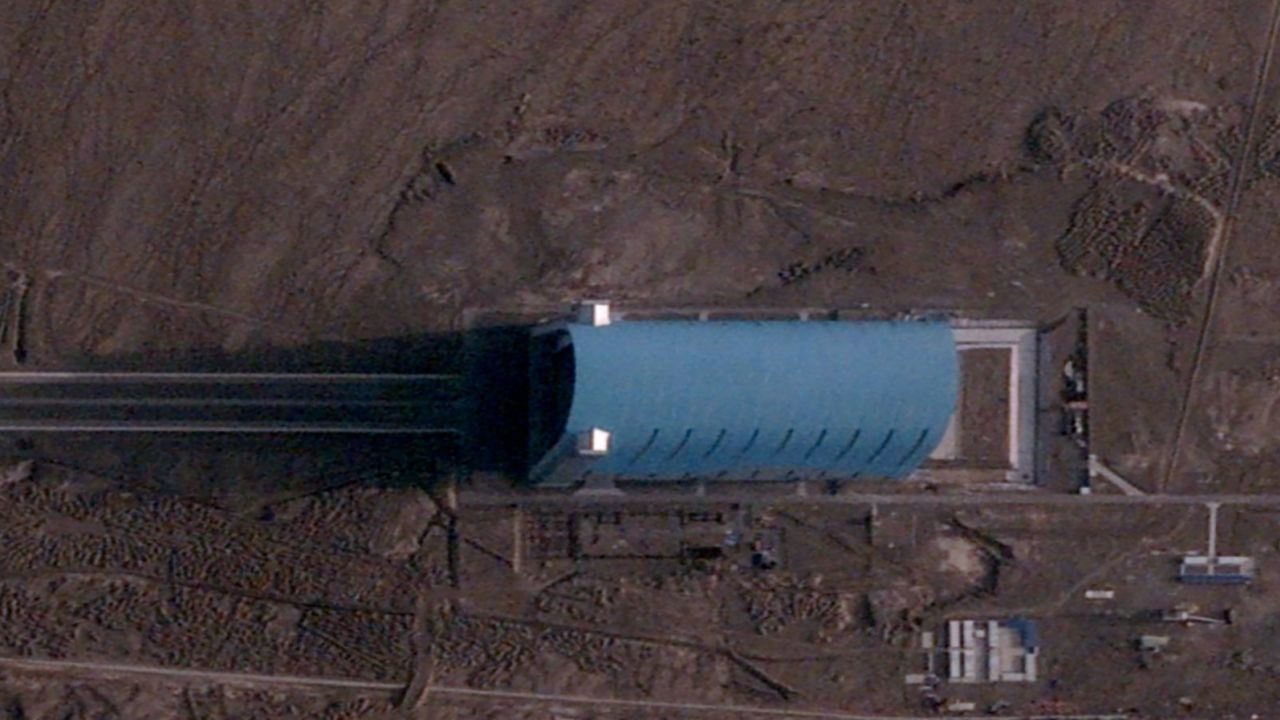


Jacobs told CNN that it’s unlikely the cavernous hangar was purpose built for the blimp seen in the satellite image.

“This blimp hangar is sized for much larger aircraft than what you have for this particular vehicle here,” he said, which is an indication that the blimp could be a test vehicle or sub-mission.

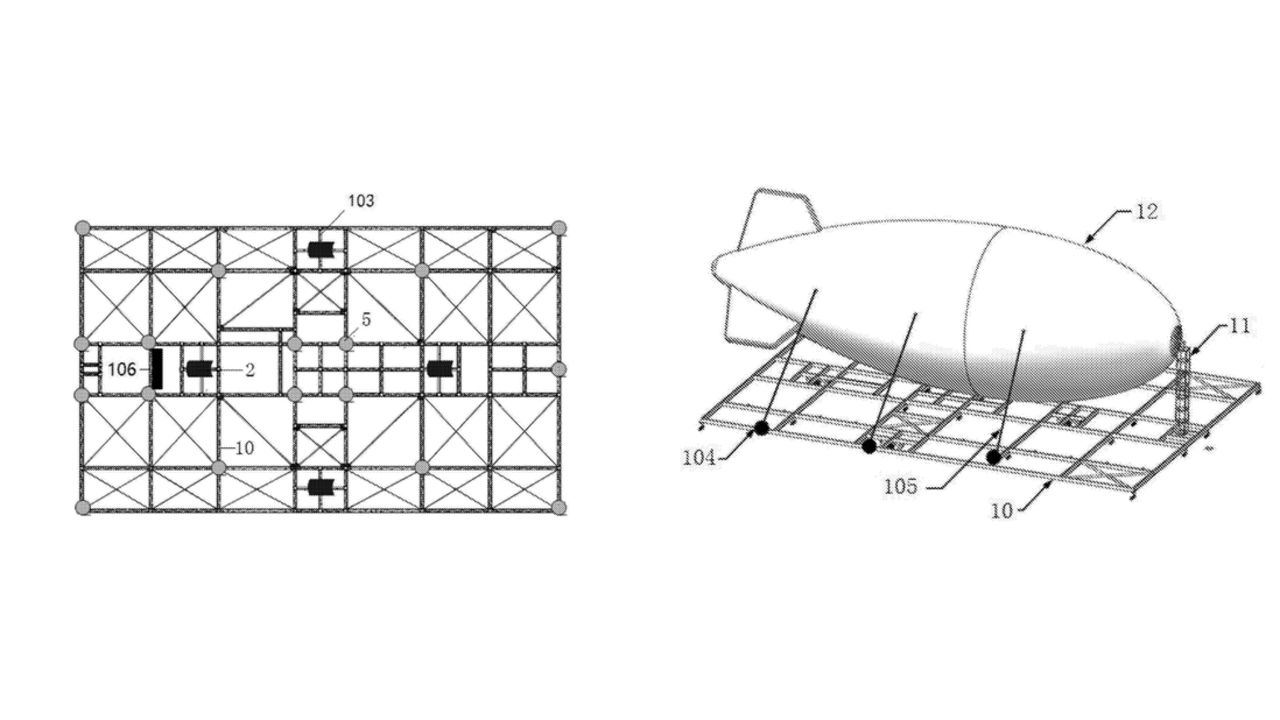
In 2020, a massive cradle-like device was spotted on the nearly kilometer-long runway. The cradle is so large – roughly 400 feet long and 160 feet wide – Jacobs says it’s highly unlikely the comparatively small blimp seen in the satellite images can even use it.

The cradle also bears distinct similarities to a Chinese patent that Hayes discovered, which would hold a large stratospheric airship.

Additional activity at the site continues to increase, as well as the hangar complex’s footprint. Additional satellite imagery provided to CNN by BlackSky shows construction, which includes subterranean excavation and foundation pouring, is continuing.

It’s unclear what their purpose is, but Hayes says a major indicator that China is really ramping up their airship program is if a truly large airship emerges from the hangar.

“At this site in particular, I would really want to see the big airship,” Hayes said.

CORRECTION: This story has been updated to correctly reflect the US sources CNN reached out to and that they declined to address the blimp and the remote Chinese military base.

CNN’s Steven Jiang contributed to this report


To: marcher who wrote (197920)7/4/2023 7:20:37 PM
From: TobagoJack  Read Replies (1) | Respond to of 218228
 
Re <<old 'balloon'>>

... the issue seems to be nearing closure, and so we must remember the balloon spy that was a balloon that did not spy, and wrongly executed, which delayed Blinken's homage to Beijing, that which would have been a sought after followup to CIA Burns secret mission trip, and a nice lead for Yellen's pleading for whatever, and all before Biden could have spoil the festive feel. Alas, misunderstandings, they happen

zerohedge.com

Pentagon Belatedly Claims Chinese Balloon Did Not Collect Data In US

The Chinese 'spy balloon' narrative continues to unravel - or is at least full of holes and contradictions - and all the Biden administration has to show for it is continually spiraling US-China relations, despite recent attempts to rescue diplomacy. After the high altitude balloon was first spotted January 28 flying over North American airspace, it was shot down by an F-22 fighter jet on February 4, with the debris subsequently recovered off the North Carolina coast.

The Pentagon has now asserted that the Chinese balloon likely did not collect data while it traversed US airspace. "We believe that it did not collect while it was transiting the United States or flying over the United States, and certainly the efforts that we made contributed, I’m sure," said Pentagon spokesman Brig. Gen. Pat Ryder on Thursday.

Gen. Ryder said this after being asked by journalists about a fresh Wall Street Journal report which alleged US-manufactured equipment was found in the data collection undercarriage of the balloon, which Beijing has insisted all along was just a 'weather balloon'.

[url=][/url]

US officials cited preliminary findings from the debris examination to say the US equipment was used to collect photos, videos and other data. They described that what's essentially American-made eavesdropping equipment has been identified.

The WSJ report described:

Several defense and intelligence agencies, along with the Federal Bureau of Investigation, have analyzed the debris retrieved after the U.S. military detected and shot down the balloon nearly five months ago in an event that added fresh, unexpected volatility to the already fraught U.S.-China relationship.
That analysis found the balloon was crammed with commercially available U.S. gear, some of it for sale online, and interspersed with more specialized Chinese sensors and other equipment to collect photos, video and other information to transmit to China, the officials said. Those findings, they said, support a conclusion that the craft was intended for spying, not weather monitoring as Beijing has said.


This may have included easily available off-the-shelf US-made components, which even hobbyists and researchers make common use of.

According to more from the exchange at the Pentagon press briefing:

Question: General Ryder, can you respond to reports that suggest that, onboard the Chinese spy balloon, were found off the shelf American equipment? Were there -- was there any sensitive American equipment onboard? How do you think that American equipment was obtained? Did -- were there any laws broken? And what was it capable of doing? What can you tell us?
GEN. RYDER: Sure. Thanks, Jennifer. So -- so look, I don't have any specifics to provide as it pertains to the PRC high altitude balloon and any potential U.S. components. That said, I will say that, you know, we are aware, in previous cases, for example, things like drones and -- and other capabilities, what have you, where off-the-shelf, commercial U.S. components have been used in capabilities. So that, in and of itself, is not surprising.


Following the balloon shootdown incident the Pentagon had tracked multiple other small balloons, with US jets having downed no less than three unidentified objects in the days that followed, some over far northern Canada.

But the White House in follow-up had admitted the three objects could have been "totally benign." President Biden in mid-February acknowledged that they were likely "balloons tied to private companies, recreational or research institutions, studying weather or conducting other scientific research."

