Re <<Gold>>, and the cited WSJ article Message 34291894 is gold-positive
or
coincidences happening
scmp.com
‘Genuinely worried’ Asian investors flock to safe haven gold amid US dollar woes
- Long seen as a safe-haven asset, gold has soared in popularity over the past month among investors in Asia’s trading hubs of Singapore and Hong Kong
- Bank collapses in March and a potential US debt default compounded concerns of a looming credit crunch, driving investors towards the precious metal

Biman Mukherji
Published: 9:30am, 15 May, 2023
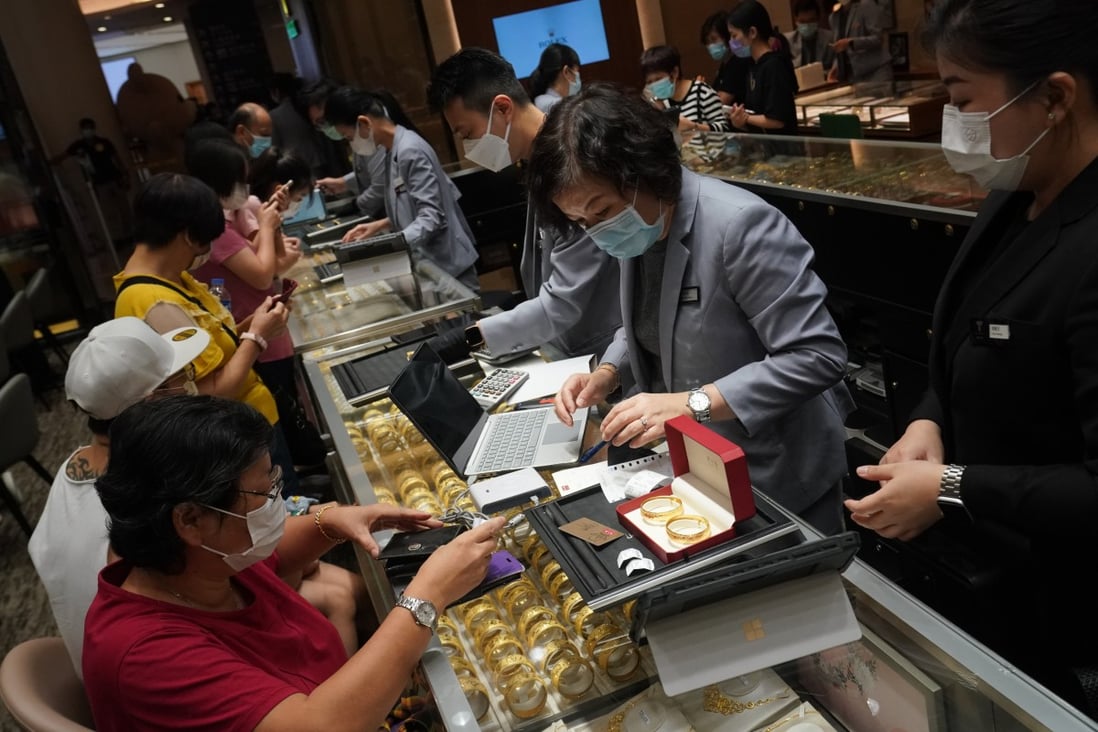
Long considered an alternative currency and safe haven, gold purchases among investors have exploded over the past month in Asia’s trading hubs. Photo: Felix Wong
Canadian investor Brian Foster* started buying gold a year ago, picking up a little more of the precious metal every time he visited Hong Kong – about once every three months – Singapore or Switzerland, until he’d accumulated some US$120,000 worth.
“This is mostly to mitigate the risk of disruption of access in any one place due to catastrophic events,” he told This Week in Asia, obliquely referring to potential conflicts amid rising geopolitical tensions, most notably between the United States and China.
He has also converted most of his cash savings that were in US dollars to British pounds, Swiss francs and Singapore dollars, but is most optimistic about precious metals, which now comprise 15 per cent of his portfolio.
Long considered an alternative currency and safe-haven asset, gold has soared in popularity over the past month as investors in Asia’s trading hubs of Hong Kong and Singapore have flocked to the yellow metal, which has an inverse relationship with the trouble-beset US dollar.
“Our gold turnover in April increased by 40 per cent since March and 110 per cent since January,” said Padraig Seif, founding partner of Hong Kong-based Precious Metals Asia, adding that the buying momentum had carried over to this month.
Many of his clients were “genuinely worried” that keeping their money in low-yield deposit accounts would erode the long-term value of their savings, he said, as the recent banking turmoil in the US has shaken investor confidence.
Over the course of five days in March, three small- to mid-size US banks failed, triggering a sharp decline in stock prices. Swift regulatory action was taken, but it failed to douse mounting fears of a prolonged economic slump as high interest rates raise the spectre of mortgage defaults.
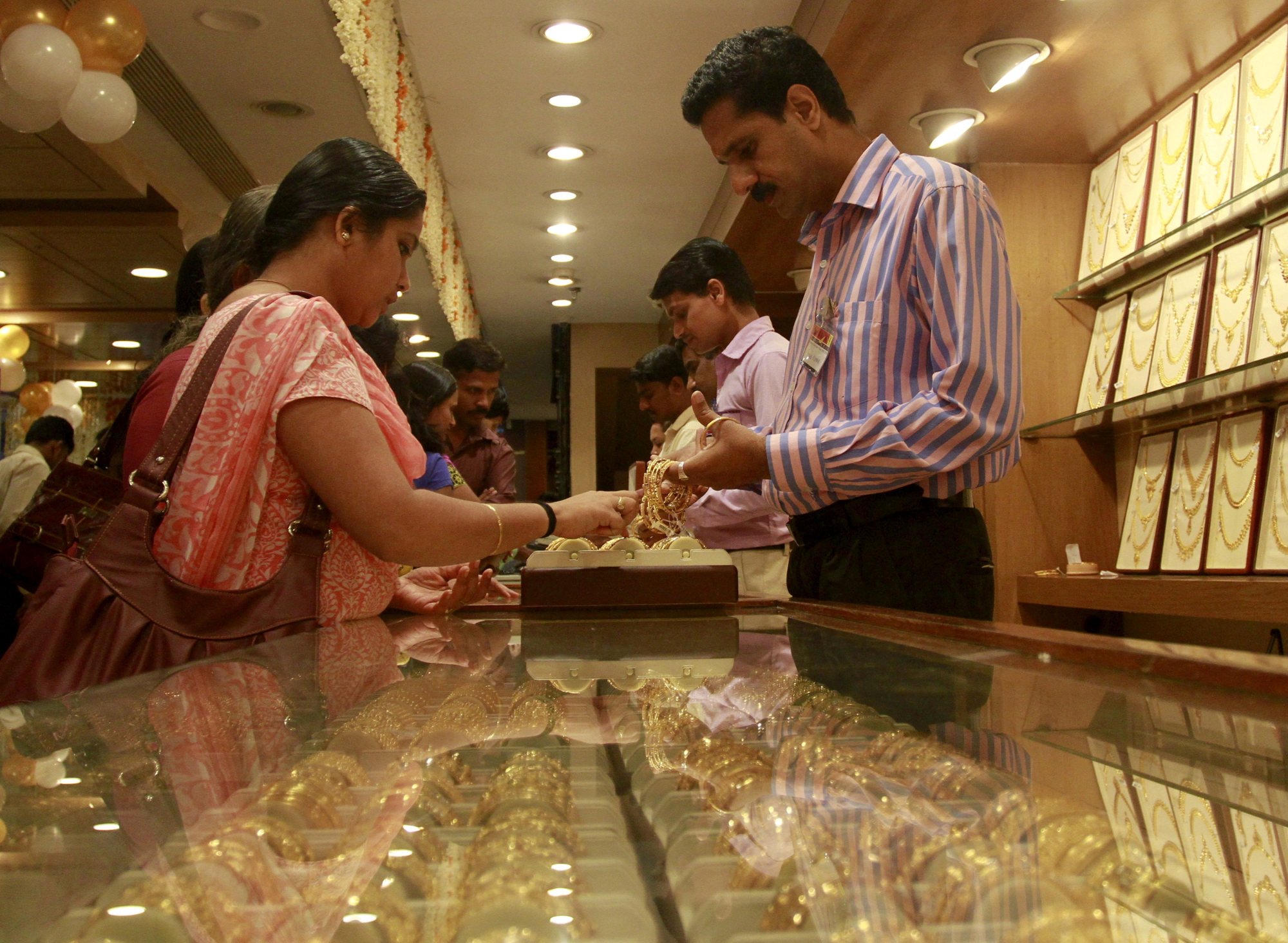
Gold prices have hit successive record highs of more than US$2,000 an ounce since cracks first appeared in the US banking system in March. Photo: Reuters
Nearly half of Americans are anxious about the safety of the money they have in bank accounts or other financial institutions, according to a Gallup poll in May.
Those fears have been compounded by worries of a credit crunch as a possible US debt default looms, with the White House and Congress unable to reach an agreement over increasing the government’s US$31.4-trillion borrowing limit.
Gold prices have hit successive record highs of more than US$2,000 an ounce since cracks first started to appear in the US banking system in March. Prices have remained above that level – last seen in the wake of Russia’s invasion of Ukraine – this month amid signs of a US economic slowdown.
But the record-high prices have not dented demand in Hong Kong, where premiums – extra money paid for speedier deliveries – on gold “kilobars” have more than doubled from two-and-a-half years ago, traders say.
Singapore is seeing similar robust demand.
“Yes, investment demand for gold bars and gold coins has risen significantly,” said Luke Chua, chief executive officer of leading Singapore-based bullion firm BullionStar.
In April alone, it sold 378kg of gold bars and coins, 37.9 per cent higher than the same month a year ago. Trade volumes last month were about 40 per cent of the whole of the first quarter’s demand this year, according to company data.
Chua attributed the rise in demand to the US banking crisis, the debt ceiling stand-off, the Federal Reserve’s rate increases and the weakness of the US dollar.
The writing seems to be on the wall for the US dollarSpencer Campbell, SE Asia Consulting
Opinions on how much further gold will rise are widely divergent, but few are willing to bet on a pullback any time soon.
The combination of factors shows that the US economy is not in good shape and “a flight to safe-haven gold is inevitable”, said Spencer Campbell, director of Singapore-based SE Asia Consulting, adding that “the writing seems to be on the wall for the US dollar”.
Some Singapore-based traders believe gold has the potential to reach US$2,450 per ounce in the next few months, he said.
Most experts agree that prices will rise, but many forecast only modest increases.
Gold could rise by another 6 per cent by the year-end, said Ross Norman, London-based CEO at Metals Daily, adding that the weakness of the US dollar alone was not propelling the precious metal, which has rallied 13 per cent since early March while the US dollar has fallen by 4 per cent.
Besides the banking crisis, sticky inflation, declining treasury yields and geopolitical issues have all been powering the metal’s growth in value.
Is dollar’s death ‘greatly exaggerated’?
While talk of de-dollarisation – an end of the US dollar’s hegemony – has increased, in reality its share of international trade has fallen only marginally, Norman said. “De-dollarisation may well gather momentum though and if this entails dollar weakness then so much the better for gold as it enjoys an inverse relationship.”
The ball was set rolling by Malaysian Prime Minister Anwar Ibrahim last month as he called for a new currency that the BRICS members – Brazil, Russia, India, China and South Africa – could use to settle global trade deals. China has also been making a greater play for the yuan.
More bilateral trades are now being settled in currencies other than US dollars – such as Indonesia-China transactions in rupiah and yuan – and the dollar’s share as a reserve currency has declined, from 70 per cent in 2000 to 60 per cent today, said Pushan Dutt, an economics professor at INSEAD business school.
“But the death of the dollar is greatly exaggerated,” he said.

Gold’s rising value has been powered by sticky inflation, declining treasury yields and geopolitical issues, besides the US banking crisis. Photo: Bloomberg
To push the yuan, China needs to remove capital controls, deepen capital markets, and float the currency but is reluctant to do so in case it appreciates, Dutt said. A BRICS currency makes even less sense, he added, as India will not join a reserve currency that’s dominated by China.
As for cryptocurrencies, Dutt said “we are yet to see a strong use case”, noting that such assets “turned out to be neither a medium of exchange nor a store of value”.
Dutt said that he expects to see greater inflows into exchange-traded funds (ETFs) for gold, but the key driver is likely to be the political stand-off in Washington over the debt ceiling, rather than exchange rate increases.
Gold ETFs in March saw net inflows of US$1.9 billion for the first time in 10 months, according to World Gold Council data. Investor sentiment has turned skittish since then, but experts are optimistic demand will pick up following the surge in physical gold.
US Treasury Secretary Janet Yellen has warned that the US could face a historic default on its bonds and other obligations in early June, and the implications are likely to be even more damaging at a time when markets have been roiled by the recent banking turmoil.
Analysts are hopeful of a last minute resolution.
In the meantime, the economic uncertainty is bound to increase inflows into physical gold and ETFs in the coming weeks and months, according to Ed Moy, former director of the US Mint.
The US abandoned the gold standard – having its monetary system pegged to gold – in 1971 to curb inflation and prevent foreign nations from overburdening the system by redeeming their dollars for gold.
In the past, the US dollar was considered a “safe-haven asset” alongside gold and benefited from events such as US and global recessions, the Russia-Ukraine war and US-China tensions “but with the dollar’s weakening, gold has been the main beneficiary”, Moy said. |



