the art of hypersonic is about blindingly-fast speed paired with exquisitely fine manoeuvrability, and Team USA was hard at work on Mach 5 without success so abandoned the effort better to focus on Mach 10. China, is flying at Mach 12, working on Mach 18, planning on Mach 30, and can already down Mach 5
However, to do Mach XX, computer simulations do not cut it. One needs to work on cutting edge plasma physics, that which can really only be reliably studied just so ...
As with the case of quantum communication satellites, other Teams are way behind, by ~ 7+ years.
Simple function of how many brains can be thrown at any problem and work to resolution by multiple means faster
newatlas.com
China's record-breaking Mach 30 wind tunnel harnesses timed explosions
SCMP
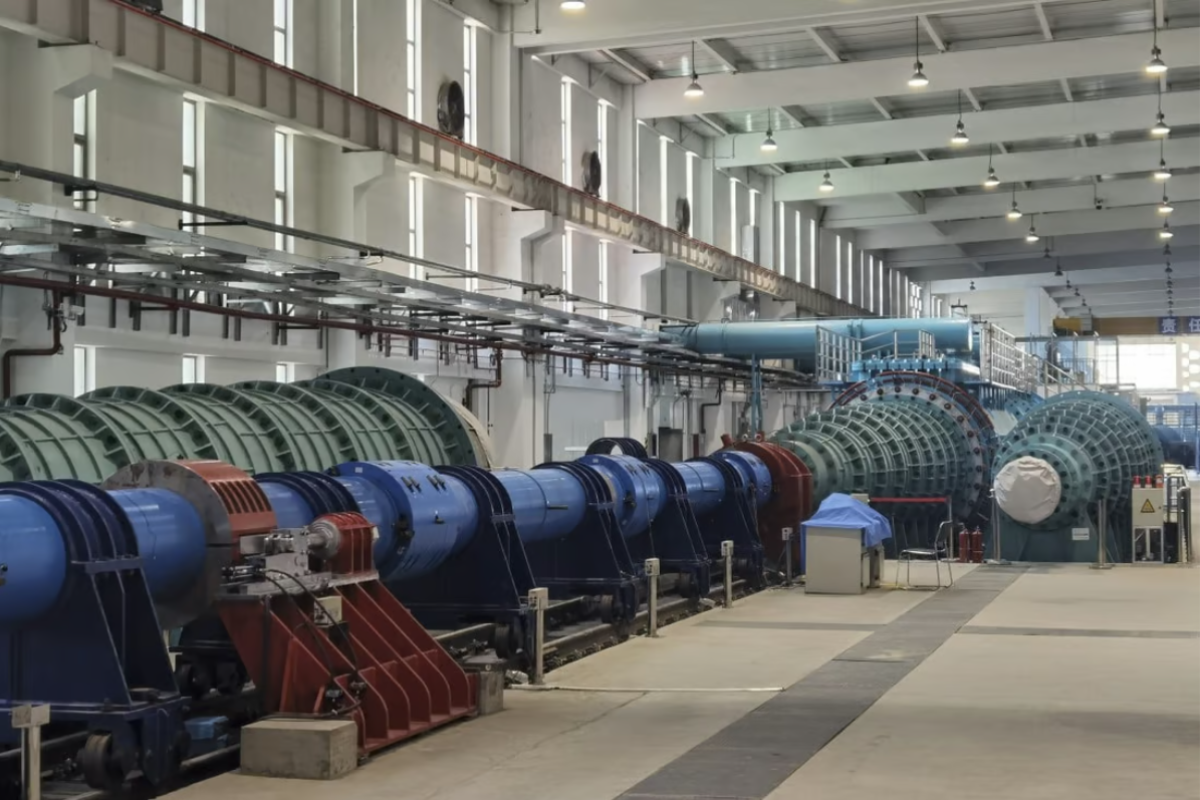
The Chinese Academy of Sciences (CAS) has announced that the world's fastest hypersonic wind tunnel is up and running, a detonation-driven shock tunnel that'll allow aerodynamic testing for aircraft, spacecraft and missiles at air speeds up to Mach 30.
The idea of a wind tunnel is simple enough: if you want to know how a shape will perform at a given air speed, you build the shape, then hold it still in a test chamber and observe as air is blown past it at the desired speed.
If all you're testing is a car, you can get away with simply using big fans, and perhaps a looping chamber that keeps the air circulating to reduce the power draw. If you want to get your air up to the speed of sound, you can start choking the flow by reducing the diameter of your tunnel, but as Scott Manley explains in his charming Scottish brogue, that won't take you any faster, since the air just compresses and becomes more dense.
To go well into supersonic speeds, you actually have to widen the tunnel out again after the choke point, allowing the re-expansion of the compressed air to drive an even faster flow, just like in the exhaust nozzle of a rocket. Indeed, back in the 1960s, that's what a nascent NASA did at its Langley research center, effectively building a million-horsepower, high-pressure methane-burning rocket and sitting the test pieces, like heat-shield tiles from the space shuttle, in the nozzle at speeds up to Mach 7, letting bits that burned or broke off simply blow out the back into the swamp behind the tunnel.
Fans are no use generating these hypersonic speeds; you need pressure to drive hypersonic air flows. Indeed, you can hold a volume of super-pressurized, high-temperature air in one chamber, put a converging/diverging test tunnel after that and a big vacuum chamber on the other end, and achieve high Mach numbers in extremely short bursts.
For longer-duration experiments, you might look to something like an arc-jet tunnel like the one at the University of Texas-Arlington, which can push hot gas for up to 200 seconds at hypersonic speeds.
If you reckon you can keep the thing in focus with your cameras and instruments, you can fire an object through ambient air at hypersonic speeds at a ballistic range for a much closer simulation of the ambient air conditions. You'd better fire it straight, though, with no wobbles – and that's no simple task. Another option might be to partner up with a company like Varda, which will stick your test item and equipment to one of its "space factory" satellites, which de-orbit and enter the atmosphere at about Mach 25.
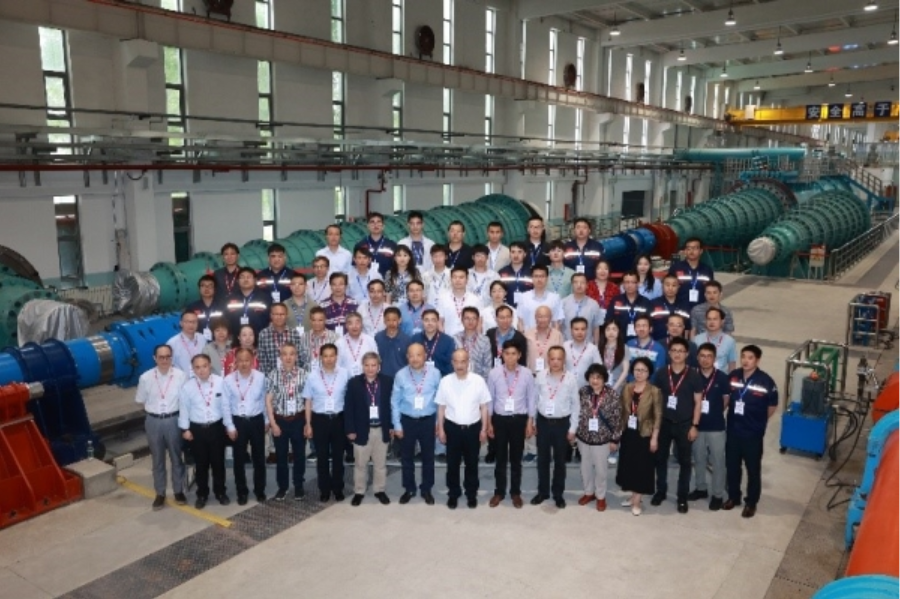
The Institute of Mechanics team with the JF-22 wind tunnel Chinese Academy of Sciences
But the JF-22 tunnel in China, completed in 2021 and now verified by 16 "independent experts" from China's National Natural Science Foundation (NNSF), takes things considerably further, claiming a world-leading Mach 30, or airspeeds of 6.4 miles per second (10.3 km/sec) through a huge experimental chamber with a diameter around 13 ft (4 m).
Located in northern Beijing, this is the latest in a JF-series of wind tunnels built at the CAS's Institute of Mechanics dating back into the 1950s, when, according to interviews translated by Hidden China, early attempts using hydrogen combustion-powered airflows would occasionally blow the roof off the building.
But it was this kind of detonation, not the relatively calm and controllable process of combustion, that would eventually lead to hypersonic test chamber speeds. A Mach 30 wind tunnel, according to the South China Morning Post, requires about as much energy as the entire Three Gorges Dam hydro power plant produces. Detonation releases extreme amounts of energy if you can keep it under control.
Thus, the JF-22 uses "a series of precisely timed explosions to generate a series of shock waves that reflect off each other and converge at a single point." Lead scientist on the JF-22 project, Professor Jiang Zonglin, dubbed this a "reflected direct shock wave driver."
The NSSF expert team "verified that the project team completed the project construction content and research objectives on schedule and in an all-round way, unanimously agreed to pass the acceptance, and evaluated the comprehensive performance indicators of the wind tunnel in terms of effective test time, total temperature, total pressure and nozzle flow field size."
While many early hypersonic wind tunnels were mainly focused on spacecraft, there's now much more focus on hypersonic missiles. Extremely difficult to intercept, some hypersonic missiles are also able to stay much closer to Earth than regular ICBMs, effectively hiding under the horizon and only popping up on radars at the target once they're perilously close and moving at insane speed.
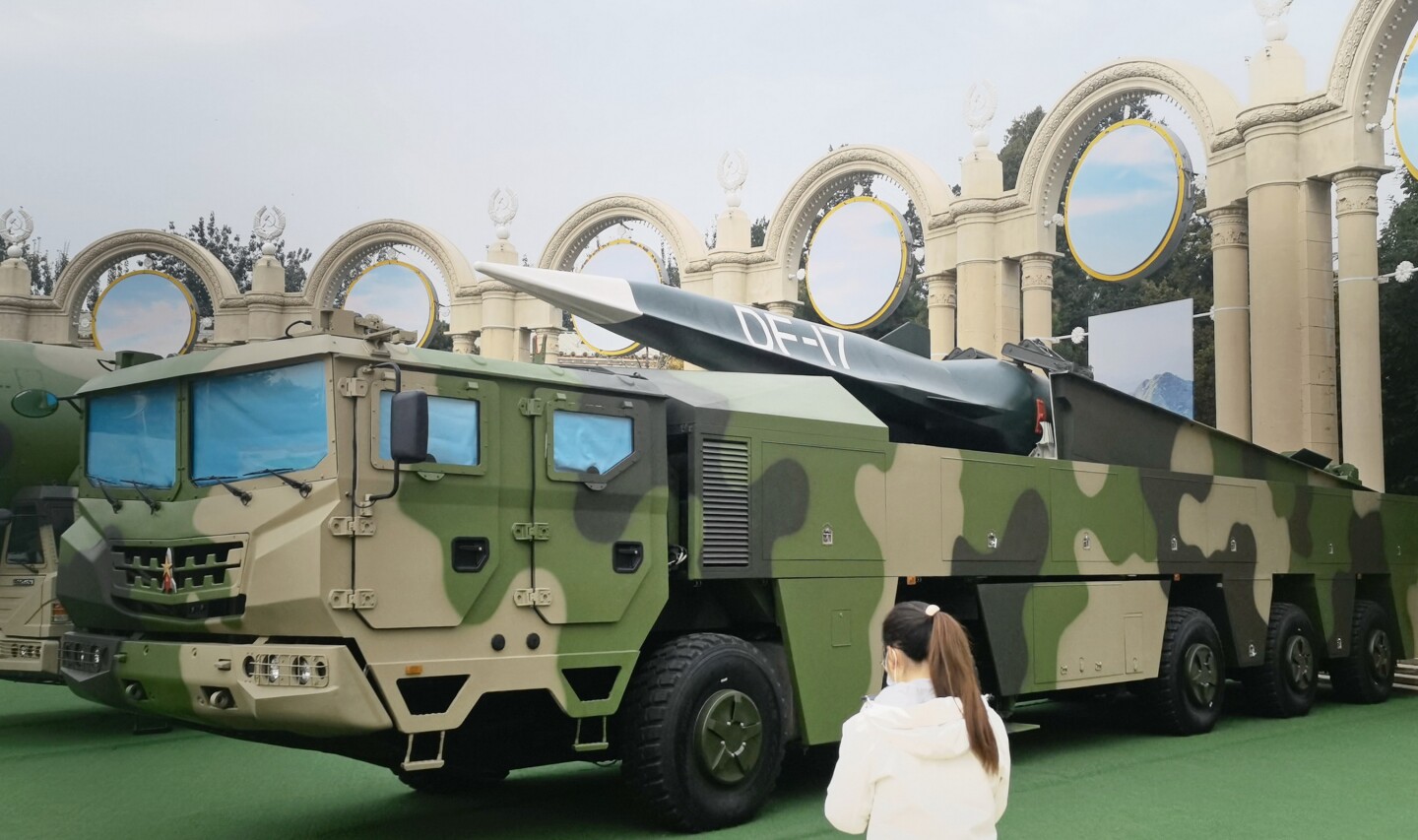
The DF-17 ballistic missile is designed to carry and launch the DF-ZF hypersonic glide vehicle
??? / Wikimedia Commons
The CAS's previous hypersonic wind tunnel, the JF-12, is still operating at the same site as the new JF-22, and capable of speeds between Mach 5 and Mach 9. According to a Hypersonic Systems Development report from the US Air Force's China Aerospace Studies Institute, "the JF12 wind tunnel is believed to have played a crucial role in the development of China’s DF-ZF hypersonic glide vehicle." The highly maneuverable, nuclear-capable DF-ZF, launched from a DF-17 ballistic missile, is believed to operate in the Mach 5-10 zone, and first went into testing in 2014, two years after the JF-12 wind tunnel was first fired up.
So the new JF-22 tunnel, with its brief bursts of Mach 30 and large test chamber, definitely appears relevant to Western national security interests, even if the same report notes that a less well-publicized facility in Mianyang, also home to China's primary nuclear weapons R&D and production center, houses the largest wind tunnel facility in the world, with tunnels capable of simulating air speeds up to Mach 24. "Some foreign analysts regard the facility as the likely location of China’s scramjet engine hypersonic wind tunnel tests," reads the report.
Interesting times!
Sources: Chinese Academy of Sciences, South China Morning Post |



