"we can't pretend that we're going to stop the climate from changing no matter what Saint Greta tells us."
Well, we started the temperature change, so we had better figure out how to stop it from changing more; we know how to do that. How much has the temperature increased since the first time you said, "climate change is liberal bullshit"? I know that had to be well B4 you first said "woke bullshit".
What caused the Maui wildfires? How drought and wind played a part (nbcnews.com)
A distant hurricane and severe drought conditions combined to create the kind of disaster that some scientists say show how climate change is a "threat multiplier."
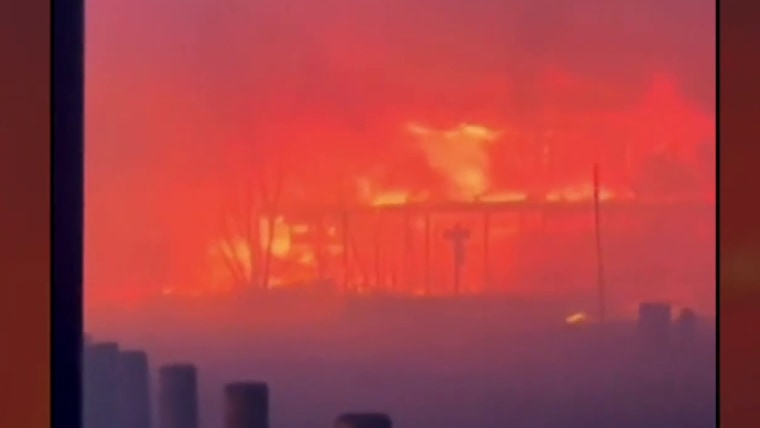
Hawaii wildfire survivors share their harrowing experiences01:48
Aug. 10, 2023, 8:02 PM UTC / Updated Aug. 14, 2023, 5:44 PM UTC
By Denise Chow
The catastrophic wildfires in Hawaii that have killed at least 96 people in Maui and reduced much of a historic seaside town to ash were fueled by severe drought conditions and fierce, hurricane-strength winds — a confluence of extremes amplified by climate change that experts say quickly turned a bad situation into a worst-case scenario.
A wildfire tore through the town of Lahaina, once the capital of the Kingdom of Hawaii, and caused extensive damage across West Maui and surrounding areas on Tuesday. Crews are still battling blazes in Maui and on the Big Island.
The precise cause of the wildfires is not yet known, emergency officials said Wednesday, but they were exacerbated in part by strong easterly trade winds whipped up by Hurricane Dora, which has been churning over the central Pacific Ocean.
On Tuesday, the hurricane was passing some 400 miles south of Hawaii — a far enough distance that the storm was not expected to make landfall, but close enough to bring high winds across the island chain.
“Our most disastrous wildfires in U.S. history have been associated with extremely strong wind events,” said Crystal Kolden, a pyrogeographer and associate professor at the University of California, Merced, who once worked as a wildland firefighter herself.
But it was how those strong winds interacted with Maui’s mountainous topography that created such volatile fire conditions in the town of Lahaina, she said.
The effect is known as downslope wind. As wind passes over a mountain and comes down the other side, it becomes compressed under extremely high pressure, making it both super dry and super hot, Kolden said.
“What that meant was that any place where the winds were aligned and there was this downslope wind, they had the strongest, the driest and the hottest winds associated with this larger hurricane wind event,” she said.
Wind gusts up to 67 mph were reported in some spots in Maui, enabling fires to move quickly over the landscape.
Drought conditions in West Maui also helped the wildfires spread, engulfing shrubs and grasses so rapidly that 12 people jumped into the ocean to escape the blazes.
“When you have dry fuels and you have the high winds, and then when you burn into the community and you start getting structures on fire, then you have lots of embers and it’s just a firestorm,” said Craig Clements, director of the Wildfire Interdisciplinary Research Center at San José State University in California.
Clements said he was “in awe” watching the events unfold in Maui. Although wildfires are not altogether uncommon in Hawaii, such intense blazes are not often associated with tropical locales.
In a news briefing on Wednesday, Maj. Gen. Kenneth Hara, commander general of the Hawaii Army National Guard, said high winds, dry conditions and low humidity contributed to a red flag situation that “set the conditions for the wildfires.”
Experts said that while it can be difficult to tease out the exact fingerprints of climate change on individual extreme weather events, the Hawaiian wildfires demonstrate the risks associated with human-caused global warming.
“When we talk about climate change, we always say that it exacerbates the likelihood of an event because it loads the dice,” Kolden said. “There has always been the potential for hurricanes to pass near Hawaii. There has always been the potential for drought in Hawaii. But it’s all happening more frequently. And when it happens, it’s more extreme.”
As such, climate change acts as a "threat multiplier," increasing each individual risk and exacerbating them if and when they collide, said Katharine Hayhoe, an atmospheric scientist and chief scientist at The Nature Conservancy.
“Every extreme event today is occurring over a background of an altered climate,” she said.
For instance, warmer-than-usual oceans can fuel the formation of bigger and stronger hurricanes. Higher temperatures from global warming also make droughts more frequent and intense, and dry vegetation, including non-native grasses and shrubs, burn quickly and provide dangerous fuel for wildfires.
“And then on top of that — the icing on the cake or the straw on the camel’s back, so to speak — you have climate change,” Hayhoe said. “It’s a threat multiplier, an exacerbator, an amplifier.”
--
|



