Rat's Berkeley buddy says stop the slaughter...and I agree.
Authored by Leighton Woodhouse via Public Substack,
There is no victory in this war. There are only bad and worse outcomes...
[url=]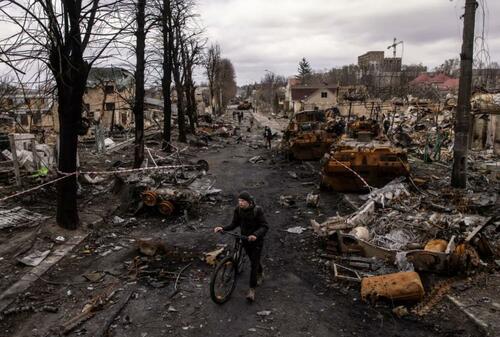 [/url] [/url]
Last February, as Russia’s invasion of Ukraine entered its second year, President Biden visited Poland and pledged the United States’ eternal support for the Ukrainian military.“Our support for Ukraine will not waver,”Biden declared. “NATO will not be divided, and we will not tire.”
A few days before, Vice President Kamala Harris had made the same promise.“The United States will support Ukraine for as long as it takes,”she toldan audience in Germany. “We will not waver.”
“If Putin thinks he can wait us out, he is badly mistaken,”the Vice President went on.
“Time is not on his side.”
But that’s not what the United States’ top military officer appears to believe.Two weeks ago, Chairman of the Joint Chiefs of Staff Mark Milley told the BBCthat the vaunted Ukrainian counteroffensive has only until the autumn weather turns, and the cold and the rain impede the maneuverability of Ukrainian forces, to achieve its goals. Time is running out for the Ukrainian army’s best and perhaps only chance at driving the Russians out of Crimea and the Donbas region.
For months, analysts and media pundits hyped the Ukrainian counteroffensive as the campaign that could finally turn the momentum of the war against Russia. “This assault could turn the tide of the battle for Ukraine, just as the Allied assault on the Normandy beaches altered the trajectory of World War II,” trumpetedWashington Post columnist David Ignatius. The counteroffensive would “achieve significant breakthroughs and accomplish much more than most analysts are predicting,” former General David Petraeus toldWashington Post columnist Max Boot. Russian forces may “collapse over broad areas,” Petraeus further speculated.
Privately, the Biden administration was less optimistic. A top secret intelligence document leaked on Discord anticipatedonly “modest territorial gains” by the Ukrainian army. That bleak prognostication appears to be materializing. Ukraine has thus far failed to break through Russia’s defenses, and U.S. intelligence agencies do not expectthe Ukrainian army to capture Melitopol — a key objective of the counteroffensive, as doing so would put the Ukrainian army in a position to cut off the land bridge to Crimea, severing Russia’s supply lines.
In his BBC interview, Milley insisted that the counteroffensive is making “very steady progress,” a talking point that Secretary of State Antony Blinken has also recited. And indeed, late last month, the Ukrainian army puncturedthe first of Russia’s three defensive layers in Southern Ukraine. But even the best-case scenario, describedto The Economist by a Defense Intelligence Agency official, doesn’t put Ukrainian soldiers past the third line of defense until the end of the year, deep into the season Milley expects to stymie Ukrainian progress, and with winter around the corner.
Even if, by some extraordinary turn of events, the counteroffensive broke through Russia’s defenses this year, Ukrainian forces would likely be so depleted as to be in no position to push beyond that point and take back Crimea.For months, the Ukrainian government has struggledto conscript troops, as fighting-age men have hidden from recruitment officers, bribed them, or simply ignored summonses. In January, rates of desertion and disobedience among Ukrainian soldiers forced President Zelensky to sign a billincreasing prison sentences to a decade or longer. Though Russia, too, is facing similar problems, it has a larger population to draw on.
If the counteroffensive fails and Russia maintains control of Crimea, the only way Ukraine could prevail over the long term would be with NATO troops directly in combat — a suicidal situation that would invite a global nuclear confrontation. And even then, a victory for Ukraine that comes years rather than weeks from now could come at the price of the total destruction of the entire country.
In interviews, Ukrainians have characterized the counteroffensive as a “disappointment.”
“I want the price they paid to be reasonable,”the wife of a combat veteran toldThe Washington Post in August.
“Otherwise it’s just useless, what they went through.”
Her husband, who lost a leg to a landmine, told the Post that soldiers on the frontline are unprepared and unmotivated. Another Kyiv resident said that new soldiers last just two to three days on the front.
And yet, the Biden administration is pushing for another $24 billionaid package for Ukraine. “There’s no alternative,” President Biden saidabout continued financing of the war.
Ukraine is turning into the proxy version of Afghanistan or Iraq: an endless conflict in which victory is always around the corner, in which the Pentagon and the defense industry push for escalation after escalation regardless of the reality on the ground, in which deaths mount and a country is destroyed only to end in defeat or a Pyrrhic victory years later, once enough American voters have had their fill of war.
But Biden is wrong: thereisan alternative. It’s time to stop backing Ukraine and force an end to the war.
...
There is no happy ending to this conflict.
A combination of Russian aggression and Western recklessness has destroyed Ukraine’s brief experiment in independence.
If the current counteroffensive fails, as it seems likely to, there will be no good options for the country.Either Ukraine will be partitioned now under one peace treaty, or it will be partitioned in the future under another, and only after many more people have died and a great deal more destruction has been wrought on Ukraine’s infrastructure and economy. In either case, the country will revert back to its centuries-long struggle for national unification, with Russia playing its old historical role as the enemy of that project. This is the price Ukrainians will pay for peace, a price that both Russia and the United States have imposed on them. But the cost of further war will be much greater.
No fair-minded person is happy about these grim prospects for Ukraine. But as one of the two countries capable of ending the conflict, it’s time for the United States to take stock of reality and accept that there is no winning this war.Our generals, our diplomats, and the American elite will be the last to accept this. Left to their own devices, they will allow the fighting to go on forever. It’s time we force them to make a different choice. |



