"Human activity is causing drastic changes to the Earth’s climate, but that doesn’t mean we should upend our lives and stop emitting carbon altogether."
Yeah, it does mean stopping emissions over the next 30 years, but that doesn't mean upending lives, unless you are overly-traumatized by have to buy LEDs instead of incandescent lights. It just means replacing carbon energy sources with the sun, wind, water, geothermal, biofuels, maybe nukes, and lots of storage. You won't have to do much; the burden is on utilities, the transportation sector, maybe ag, and manufacturing.
Extreme Temperature Diary- Sunday October 1st, 2023/Main Topic: Why the World Won’t Ditch Fossil Fuels Soon – Guy On Climate
Main Topic: Why the World Won’t Ditch Fossil Fuels Soon
Dear Diary. If you are climate conscious, you may dream of a world in which fossil fuel use stopped tomorrow. But what if you got your wish in late 2023? Everything would stop. There would be practically no air travel. Food would be much harder to grow and transport to a grocery store. Unless you owned an EV you could not travel. Even most mass transit would cease. Heaven forbid that your power grid depends on the burning of coal or natural gas. If so the lights would go out, and if you do own an EV, it could not be charged. Most computer systems would fail. In other words, if fossil fuels magically disappeared tomorrow, civilization as we know it would collapse.
The transition to electrifying everything and running all things off of renewable energy needs to happen fast. And our very existence depends upon a quick transition. Yes, we need fossil fuel use to continue 21st century lifestyles but putting society in a warlike footing for transition is essential given warning signs this year that we have seen from a climate at about 1.3°C above preindustrial conditions.
Here is more why our transition is so difficult and delays for essential change are occurring:
What ending fossil fuel extraction across the world would look like – The Washington Post
What the world would look like without fossil fuelsA thought experiment shows the complexities of phasing out oil, gas and coal
Analysis by Shannon Osaka Climate zeitgeist reporter
September 30, 2023
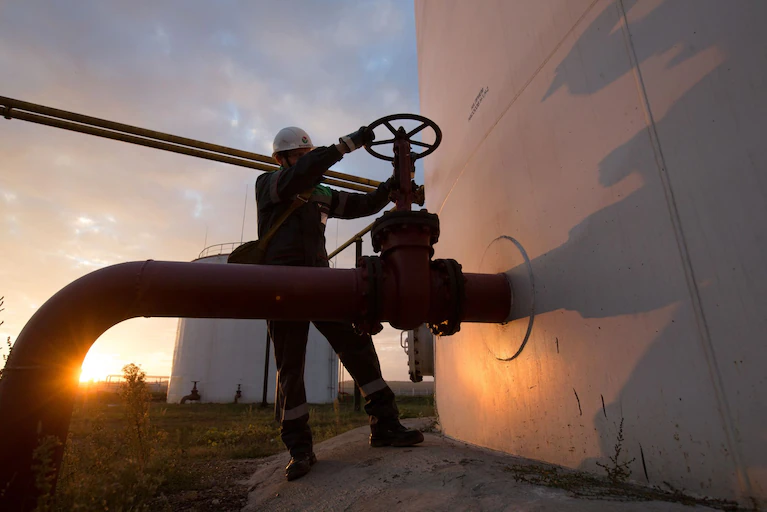 Oil delivery equipment near Ufa, Russia, in 2016. (Andrey Rudakov/Bloomberg News) Oil delivery equipment near Ufa, Russia, in 2016. (Andrey Rudakov/Bloomberg News)
In any given year, the worldproduces staggering quantities of fossil fuels. Roughly 36.5 billion barrels of oil. Over 8 billion metric tons of coal. The United States alone extracts and processes over 100 billion cubic feet of natural gas. When those fossil fuels are burned, planet-warming gases are released. All that coal, oil and gas is the reason that September has already seen record-high temperatures and the world is likely to miss its goal of limiting global temperature rise to 1.5 degrees Celsius.
When climate activists march, chant or stage sit-ins, they are often calling for an end to those fossil fuels. Earlier this month at New York’s Climate Week, protesters urged world leaders to “end fossil fuels now” and sent a letter to President Biden asking him to commit to phasing out fossil fuel extraction in the United States. United Nations Secretary General António Guterres hosted a climate summit where the only nations invited were those ready to commit to “no new coal, oil and gas.”
But what would happen if the world did suddenly stop extracting fossil fuels? And what does that mean for attempts to phase out something humanity has depended on for centuries?
Most everyone agrees that a sudden, abrupt halt in fossil fuel production — if, for example, the United States and Saudi Arabia and every other large producer shut down their oil wells all at the same time — would be catastrophic.
“Oh, dear God,” said Samantha Gross, director of the energy security and climate initiative at the Brookings Institution. “I don’t even know where to start.”
If fossil fuel production were stopped tomorrow, the world would quickly grind to a halt. Even in areas where a large portion of electricity is run on renewables, fossil fuels are often used to provide “firm” power that can come on at any time of the day or night. Without that power, electricity grids would see widespread blackouts. Within a few weeks, a lack of oil — still the major fuel used for trucking and shipping goods worldwide — would impede deliveries of food and other essential goods.
“Even if I could walk to the grocery store, there’d be no food there,” Gross explained. Governments would probably work to curb demand and ration remaining stores of fossil fuels — but even those reserves would last for only so long. The United States’ strategic petroleum reserve, for example, currently holds around 347 million barrels of oil; that would last the country just 17 days at current levels of use. It would last the world just 3½ days.
Such a sudden phaseout isn’t, of course, what activists are really asking for. “The expectation isn’t that extraction will stop everywhere in the world,” said Kelly Trout, the research co-director at Oil Change International. Many groups are focused on preventing new oil and gas extraction, in line with models that show that any new oil and gas production will take the world over the 1.5-degrees-Celsius goal.
 Marchers in New York on Sept. 17. (Justin Lane/EPA-EFE/Shutterstock) Marchers in New York on Sept. 17. (Justin Lane/EPA-EFE/Shutterstock)
The International Energy Agency, for example, which models energy transitions to zero-out carbon emissions, says there is no need for the world to open new coal mines or develop oil and gas projects that have long lead times. But, “continued investment is required in some existing oil and gas assets and other approved projects,” the agency said in its latest report.
Olivier Bois von Kursk, a policy analyst at the International Institute for Sustainable Development, points out that oil and gas fields, on average, lose about 4 percent of their production every year as reservoir pressure decreases. That’s close to the decline of roughly 3 percent per year that the IEA modeled in its scenario for cutting emissions to zero by 2050.
“So you could just keep the fields that are already in operation,” von Kursk said.
‘Slim, elegant and a little scary’: Here’s what wind energy’s future looks like
But that would require a huge and rapid build-out of solar, wind, batteries and electric vehicles. The IEA predicts that the world will have to triple renewable energy capacity in just seven years to cut fossil fuel demand by 20 percent. Countries will also need to push rapid expansion of electric trucks and further development of new technologies like carbon capture and hydrogen.
Still, new oil and gas wells continue to pop up all over the world. According to a recent report from Oil Change International, the United States is responsible for around one-third of planned fossil fuel expansion between now and 2050. On Friday, the Biden administration unveiled a plan to allow more offshore oil and gas leasing in the Gulf of Mexico over the next five years to ensure the government can also auction new offshore wind leases.
And policymakers and researchers argue over whether developed countries should phase out fossil fuel production first — since they’ve emitted the most carbon emissions to date — or continue to produce to ensure steady fossil fuel supplies for the rest of the word.
As the world transitions to clean energy, the build-out of renewables should be balanced with the phase-down of fossil fuels. But timing those two difficult, complex processes is easier said than done. IEA Executive Director Fatih Birol, who is helping lead the global push to eliminate unabated fossil fuels worldwide by 2050, said in a recent interview that he worries about how the shift could leave coal, oil and gas workers unemployed.
“The biggest worry I have is: ‘What are the implications of the clean energy transition in some of the segments of the population that are badly affected?’” Birolsaid. “In a not very well-planned transition, there could be a bit of a backlash with political implications.”
Climate activists and policymakers have long debated where climate action should focus: On cutting demand by building out renewables, phasing out gas-powered cars, etc. — or cutting supply by stopping production of fossil fuels. So far, governments have not focused much on cutting supply. And activists are getting frustrated.
“Any new leasing will make the world more dangerous and less prosperous,” Mattea Mrkusic, energy transition policy lead at the climate advocacy group Evergreen Action, said in a statement. “We don’t have time to go backward.”
More on climate changeUnderstanding our climate: Global warming is a real phenomenon, and weather disasters are undeniably linked to it. As temperatures rise, heat waves are more often sweeping the globe — and parts of the world are becoming too hot to survive.
What can be done? The Post is tracking a variety of climate solutions, as well as the Biden administration’s actions on environmental issues. It can feel overwhelming facing the impacts of climate change, but there are ways to cope with climate anxiety.
Inventive solutions: Some people have built off-the-grid homes from trash to stand up to a changing climate. As seas rise, others are exploring how to harness marine energy.
What about your role in climate change? Our climate coach Michael J. Coren is answering questions about environmental choices in our everyday lives. Submit yours here. You can also sign up for our Climate Coach newsletter.
By Shannon Osaka Shannon Osaka is a climate reporter covering policy, culture, and science for The Washington Post. Before joining The Post, she was a climate reporter at the nonprofit environmental outlet Grist. Twitter |



