SI
SI
discoversearch

We've detected that you're using an ad content blocking browser plug-in or feature. Ads provide a critical source of revenue to the continued operation of Silicon Investor.  We ask that you disable ad blocking while on Silicon Investor in the best interests of our community.  If you are not using an ad blocker but are still receiving this message, make sure your browser's tracking protection is set to the 'standard' level.
Strategies & Market Trends : 2026 TeoTwawKi ... 2032 Darkest Interregnum -- Ignore unavailable to you. Want to Upgrade?


To: bull_dozer who wrote (202052)10/15/2023 8:21:58 PM
From: TobagoJack  Respond to of 219884
 
Re <<“In the years that followed, the Israelis recognized that short, sharp military actions would be used to ignite crises that would distract international attention from Israeli stonewalling, or permit a steady outward creep of Israel's frontiers. Moshe Dayan admitted as much. Coveting the Golan Heights before they were actually seized in the 1967 Six Day War, Dayan noted that "we'd send a tractor to plow some place in the demilitarized zone...and we knew ahead of time that the Syrians would shoot. If they didn't shoot, we'd tell the tractor to move deeper, until the Syrians fired on it. And then we'd activate artillery and the air force. We thought, 'we can change the armistice lines by a series of operations that are less than war.'" Always claiming to be a "status quo state," Israel was actually an expansionist one.">>

... must refrain from amplifying agitation-propaganda (agi-prop).

In the meantime, ... re <<"status quo state">>

appears that China China China is a status quo state, unless propaganda is actual-propaganda

newsweek.com

China Isn't Going to War Because It Doesn't Have To
On 10/15/23 at 7:14 PM EDT

Relax, boys and girls: China won't invade Taiwan, and the U.S. Navy won't engage Chinese forces any time in the foreseeable future. It's a scam, a goof, a Muppet show, whose point is to cover up the incompetence and corruption which led the Pentagon to spend trillions on obsolete weapons. We lost the South China Sea years ago. We're in roughly the same position as Britain was in Singapore in late 1941, except that unlike the feckless British, we know it. We just can't admit it.

The U.S. Department of Defense has known since no later than 2012—when I consulted for the late Andrew Marshall at the Office of Net Assessment—that Chinese surface-to-surface (STS) missiles can destroy U.S. aircraft carriers, or any other military asset that isn't submerged. Not until recently did the U.S. military concede this in official assessments.

In contrast to the Reagan Administration, which made missile defense a priority, we're doing little to counter China's formidable capabilities. We can't test defenses against hypersonic missiles, because we can't even launch a hypersonic missile. Lockheed junked its flagship hypersonics program last March.

China is under no time pressure to take military action. From a military standpoint, a seaborne landing like the Normandy invasion of December 1944 would be senseless. Taiwan has storage capacity for 11 days of natural gas consumption. A Chinese blockade would force Taiwan's surrender in short order.


Pictured president Tsai Ing-wen on the the Keelung warship part of the "Han Kuang 38 Exercise" joint interception combat live ammunition exercise. Taiwan Military News Agency

The Pentagon knows this, and isn't stupid enough to stumble into a firefight. Nonetheless, American commanders talk as if Chinese soldiers are about to hit Taiwanese beaches. In March 2021, Pacific Fleet commander Adm. Philip Davidson, Pacific Fleet commander, warned that China might invade Taiwan by 2027. Chief of naval operations Michael Gilday, said he could "not rule out" a Chinese attempt to invade as early as 2023.

Really? Why indeed would China risk military action of any kind in the Taiwan Strait? For the time being, China is getting everything it wants from the island. Taiwanese investment on the mainland is running at $4 billion a year and rising. Taiwanese chip engineers built China's chip fabrication plants.

Leave aside the risk of a nuclear exchange—depicted chillingly in Admiral James Stavridis' thriller 2034—the least consequence of any kinetic confrontation would be a global economic slump due to trade restrictions.

China has a decisive advantage in its home theater, and it's growing. It can deal with Taiwan whenever it wants. "The conventional arm of the PLARF is the largest ground-based missile force in the world, with over 2,200 conventionally armed ballistic and cruise missiles and with enough antiship missiles to attack every U.S. surface combatant vessel in the South China Sea with enough firepower to overcome each ship's missile defense," as Maj. Christopher J. Mihalwrote in 2021 in a U.S. Army journal.

"The [People's Liberation Army Air Force's] ground-based missile forces complement the air and sea-based precision strike capabilities of the PLAAF and PLAN," the Pentagon's November 29,2022 report,?"Military and Security Developments Involving the People's Republic of China," found. "The PLARF continues to grow its inventory of DF-26 IRBMs, which are designed to rapidly swap conventional and nuclear warheads. They are also capable of precision land-attack and anti-ship strikes in the Western Pacific, the Indian Ocean, and the South China Sea from mainland China.

And that doesn't take into account Chinese hypersonic missiles, against which there is no defense; hypersonics fly as fast as the anti-missile missiles that are supposed to intercept them. "China has tested and deployed a new longer-range hypersonic missile that is probably able to evade U.S. defenses, according to an overlooked top-secret document among those? recently leaked. Now, the public can see what the American intelligence community already knew: China is quickly improving its capacity to strike thousands of miles from its shores and prevent the United States from intervening," Josh Rogin reported last April in the Washington Post.

One circumstance, and one only, would prompt China to take military action against Taiwan, and that is a move by the island toward sovereignty. It mounted a de facto two-day blockade of Taiwan in August 2022 during then-House Speaker Pelosi's visit. In China's calculus, the Speaker of the House is second in line to the president, and Pelosi's visit raised the prospect of diplomatic recognition of Taiwan.

As long as China can maintain the diplomatic fiction that Taiwan is a renegade province that belongs to China, it will eschew the use of force. But Beijing would view American support for an independent Taiwan as an attempt to break up China, as the imperialist powers did during the 19th and early 20th centuries, and respond with all the power at its disposal.

If we don't want a war, all we need to do is preserve Taiwan's status quo.

In sad emulation of great powers of the past, the United States has invested in the wrong kind of weapons for a kind of war that won't be fought again. Battleships took the lion's share of every combatant's military budget before World War II, and as Victor Davis Hanson observes in The Second World Wars, Germany and Japan made the mistake of building battleships rather than carriers, and that probably cost them the war. After Japanese bombers sunk four U.S. battleships at Pearl Harbor and two British capital ships near Singapore in December 1941, no navy ever laid a battleship keel again. The aircraft carrier ruled the seas for half a century. Now missiles have made the carrier obsolete.

Under Reagan, the federal development budget (building weapons prototypes) comprised 0.75 percent of GDP, compared to a paltry 0.25 percent today. If we want to restore the technological edge of America's military, we need to mobilize our national resources and fund R & D on Reagan's scale. That requires a radical shift in defense priorities from forever wars to high-tech weaponry. That's the right thing to do, but it would take years to achieve in the best-case scenario.

In the meantime, trash-talking China will get us nowhere. The kind of "denial" that applies to our national debate over Taiwan has more to do with Freud than Clausewitz. It's time to stop posturing and start rebuilding.

David P. Goldman is Deputy Editor of Asia Times and a Washington Fellow of the Claremont Institute. He formerly was global head of debt research at Bank of America.

The views expressed in this article are the writer's own.


To: bull_dozer who wrote (202052)10/15/2023 8:31:38 PM
From: TobagoJack  Respond to of 219884
 
From Bloomberg

bloomberg.com

In Pictures: A Week of Protests as Israel-Hamas Conflict Rages in Gaza
Caroline Alexander
14 October 2023 at 03:05 GMT+8

The Oct. 7 raid by Palestinian militants took Israel’s government and intelligence services by surprise. As authorities scrambled to muster a response to the biggest attack in years, the Hamas gunmen who had poured into southern Israel by land, sea and air killed 1,300 Israelis, mostly unarmed civilians, in several villages, military bases and a desert rave, and took dozens of others hostage.

Prime Minister Benjamin Netanyahu promised a crushing campaign against Hamas, which rules Gaza and is committed to Israel’s destruction. The tiny coastal enclave is now under a complete blockade. More than 1,500 people have been killed in retaliatory strikes. And on Friday, half the population of about 2 million was told to leave northern areas and move south as Israel appeared to be preparing for a ground offensive that risks drawing in other enemies including Hezbollah.

Scenes of carnage on both sides is outraging civilians in the region and beyond. This week, competing demonstrations were held in countries around the world. Here’s a look at some of them.



For more on the Israel-Hamas war, click here.


Demonstrators during a pro-Israel march in the Copacabana neighborhood of Rio de Janeiro, Brazil, on Oct. 15.Photographer: Dado Galdieri/Bloomberg


Demonstrators during a pro-Palestinian rally outside La Moneda Palace in Santiago, Chile, on Oct. 14.Photographer: Cristobal Olivares/Bloomberg


People wrapped in an Israeli flag at a rally in solidarity at Bellecour square in Lyon, France, on Oct. 10.Photographer: Jeff Pachoud/AFP/Getty Images


A Palestinian supporter holds a Palestinian flag during a protest outside the Israeli embassy in Mexico City, Mexico, on Oct. 12.Photographer: Marco Ugarte/AP Photo


People lay candles and shoes on the bank of the Danube river during a rally in support of Israel in Budapest, Hungary, on Oct. 10.Photographer: Ferenc Isza/AFP/Getty Images


Protestors shout slogans as they hold placards during a rally in support of Palestinians next to the United Nations offices in Geneva, Switzerland, on Oct. 12.Photographer: Fabrice Coffrini/AFP/Getty Images


People attend a "Stand with Israel" vigil and rally in New York City, US, on Oct. 10.Photographer: Ed Jones/AFP/Getty Images


A pro-Palestine demonstration in the grounds of Al-Azhar mosque in Cairo, Egypt, on Oct. 13.Photographer: Islam Safwat/Bloomberg


Supporters of Israel during a counter rally to a pro-Palestine demonstration in New York, on Oct. 13.Photographer: Spencer Platt/Getty Images


Riot police officers arrest a demonstrator at Herrmannplatz, Berlin, on Oct. 11, as pro-Palestinian gatherings took place in the German capital despite a police ban.Photographer: John MacDougall/AFP/Getty Images


Supporters of the Palestinian people during a rally in the Times Square neighborhood of New York, on Oct. 13.Photographer: Spencer Platt/Getty Images


People hold Israeli national flags and display their lit mobile phones during a rally in support of the people of Israel, in Buenos Aires, Argentina, on Oct. 9.Photographer: Luis Robayo/AFP/Getty Images


Indonesian Muslims gather in support of Palestine after Friday prayers in Yogyakarta, Indonesia, on Oct. 13.Photographer: Ulet Ifansasti/Getty Images


Protesters gather at Tahrir Square during an anti-Israel demonstration in Baghdad, Iraq, on Oct. 13.Photographer: Ahmad Al-Rubaye/AFP/Getty Images


People gather during a demonstration in a show of support for Israel in Lyon, central France, on Oct. 10.Photographer: Laurent Cipriani/AP Photo


People attend a pro-Palestine rally in Republique Square, Paris, France, on Oct. 12.Photographer: Luc Auffret/Anadolu/Getty Images


Supporters of Israel demonstrate with national flags in Beverly Hills, California, US, on Oct. 9.Photographer: David Swanson/AFP/Getty Images
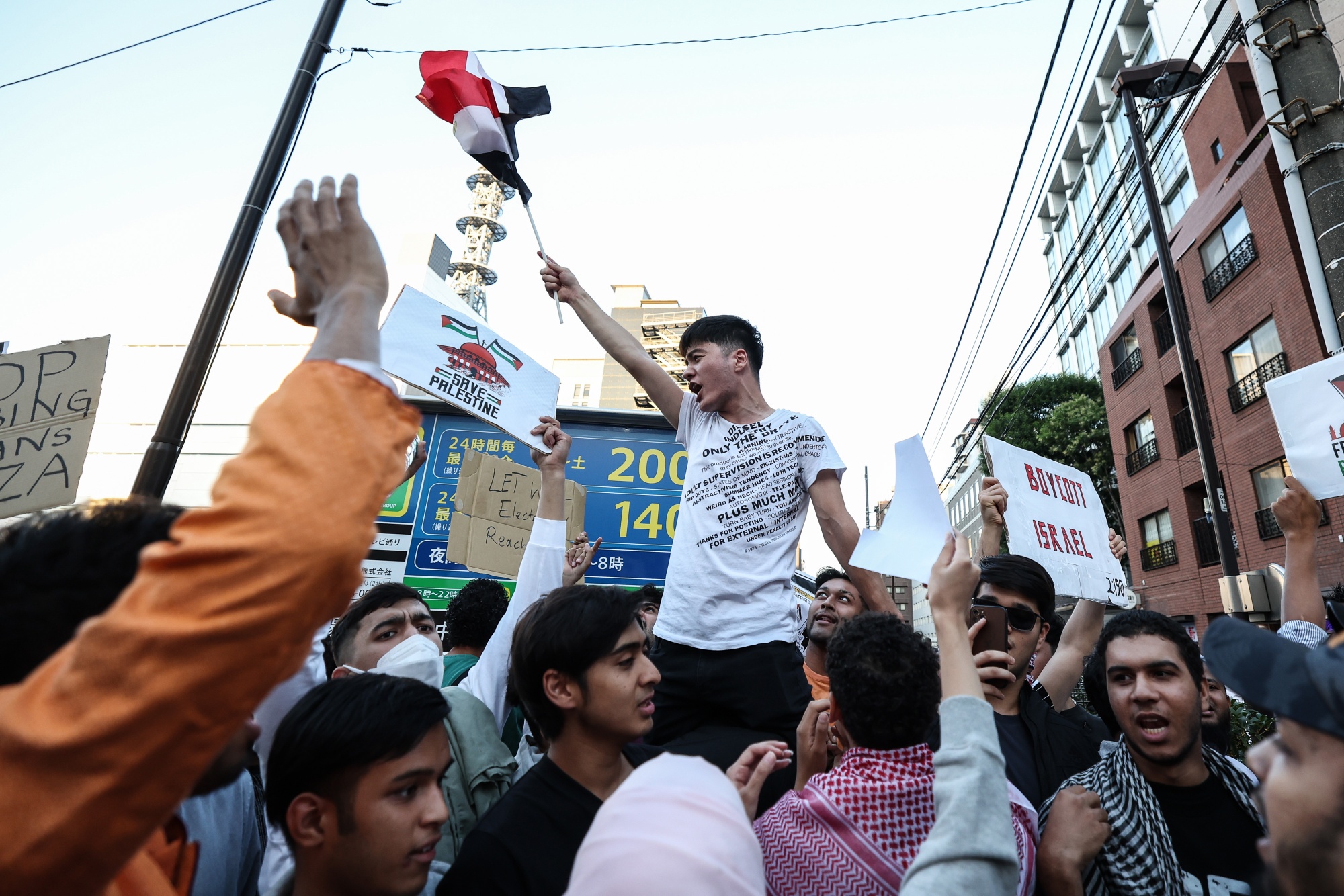

People hold signs and chant slogans during a protest near the Embassy of Israel in Tokyo, Japan, on Oct. 13.Photographer: Takashi Aoyama/Getty Images


A "Stand with Israel" vigil and rally in New York City, US, on Oct. 10.Photographer: Ed Jones/AFP/Getty Images


Demonstrators in support of the Palestinian people in Chicago, US, on Oct. 11.Photographer: Scott Olson/Getty Images


Riot police stand by as demonstrators in support of Israel show Israeli flags during demonstration in Duisburg, western Germany, on Oct. 9.Photographer: Ina Fassbender/AFP/Getty Images


Protestors run away from teargas rounds during a rally in support of Palestinians called by 'Collectif 69' in Lyon, France, on Oct. 11.Photographer: Olivier Chassignole/AFP/Getty Images


The Eiffel Tower illuminated with the colors of Israel after a demonstration in a show of support for Israel, in Paris, France, on Oct. 9.Photographer: Michel Euler/AP Photo


Palestinian supporters wave flags as they march to the Sydney Opera House in Sydney, Australia, on Oct. 9.Photographer: Rick Rycroft/AP Photo


A giant Israeli national flag displayed near the Colosseum during a rally in support of the people of Israel in central Rome, Italy, on Oct. 10.Photographer: Tiziana Fabi/AFP/Getty Images


To: bull_dozer who wrote (202052)10/16/2023 12:04:51 AM
From: bull_dozer1 Recommendation

Recommended By
Pogeu Mahone

  Read Replies (4) | Respond to of 219884
 
It’s official: The era of China’s global dominance is over

We've reached the end of an era for the Chinese economy.

For the past three decades, China has been on the upswing of a supercycle that saw an almost uninterrupted expansion of the country's capacity to manufacture, appetite to consume, and ability to project power across the world economy. The Chinese Communist Party relentlessly pursued economic development over all else, even when that single-mindedness pushed the party to make debilitating policy mistakes — creating a massive bubble in the property market, saddling provinces with loads of debt, and failing to transition away from an overreliance on investment. There was no time to stop for corrections while China's mind was on money alone.

This era of expansion was not only a boon for Beijing, it also helped fuel global demand. Countries relied on China's hunger for speedy modernization and industrial might to supercharge their own development. Even American companies saw China as the next great global market — and made bets accordingly.

They lost those bets.


news.yahoo.com

