Very cool gadget that should make submariners and surface seafaring combatants nervous to the point of operational paralysis until such time submarines, and surface battle ships are encased in wire mesh cages the way battle tanks are :0)))))))
the gizmo might even the playing field for the little domains against the big battle ship players
It is also an interesting development for the continental players at the expense of the maritime players, especially if and when coupled with land-based anti-ship missiles and flying things.
Do not believe the widget requires chips more sophisticated than 200 nm, especially given the demand for resiliency.
scmp.com
Could China surprise enemies with weapon that lies in wait on the seabed? | South China Morning Post
Published: 4:00pm, 13 Oct, 2023
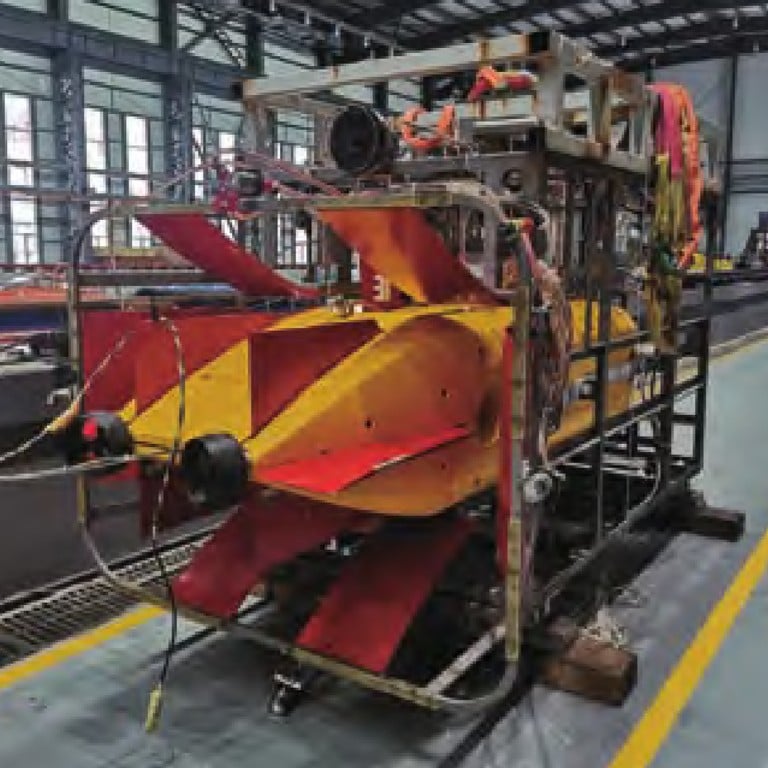
The Abyss prototype deep sea weapon has passed several rounds of sea tests in China, its developers said. Photo: Shenyang Institute of Automation, Chinese Academy of Sciences
Chinese scientists say they are testing a prototype for a deep sea weapon that could lie in wait on the seabed thousands of metres below the surface, beyond the reach of most detection methods.
The early prototype of the Abyss system passed several rounds of sea tests at undisclosed locations up to December last year, according to the project team from the Chinese Academy of Sciences’ Shenyang Institute of Automation.
A paper by the team, whose institute is under US sanctions, was published in the peer-reviewed journal Robot and is the first public announcement of Abyss.
The system can operate at depths of up to 11,000 metres (36,000ft) and is currently being mainly used for research, according to the paper.
An eventual military version will be bigger and more powerful, as well as more sophisticated, and capable of staying on the seabed for up to a year, twice the endurance of the prototype, said the team, led by robotics scientist Xu Huixi.
The paper said underwater pre-positioned weapons will “play a critical role” in future naval combat. “Unmanned aerial vehicles (AUV), missiles, torpedoes and other combat equipment can be pre-placed on the seabed, and [lurk] for a long time,” it added.
“With a certain degree of mobility and a high level of autonomous decision-making ability, they can engage in a wide range of tasks including reconnaissance, monitoring, detection, communication, command, and offensive or defensive strikes.”
Abyss features a docking station and a car-sized AUV – equipped with sensors, artificial intelligence chips and a quiet propulsion system – that can be pre-deployed and activated by remote signal when a target is in range, the scientists said.
Read key economic stories from China, including the US-China trade war, sanctions, and economic developments.
The AUV can perform a range of tasks, including surveillance, target identification and weapons delivery. On completion of a mission, it will return to the station, send data to home command, get a recharge and go asleep until the next order arrives.
China’s anti-access/area denied (A2/AD) strategy has been a prime concern for the US military, with the PLA’s capacities growing rapidly, according to publicly available information.
The high-risk military flash points of the South China Sea and the waters off the eastern coastline of Taiwan feature depths of thousands of metres. Pre-deployed smart weapons in these areas could prevent the US or its allies from interfering in a regional conflict.
Why the South China Sea dispute remains one of the region’s most pressing issues
Two years ago, the USS Connecticut – one of the US Navy’s most advanced nuclear attack submarines – was severely damaged during a secret mission in the South China Sea.
The incident, which was later blamed on an unexpected underwater mountain, raised questions about the ability of US submarines to detect any silent, man-made objects that may be in their way.
The PLA’s A2/AD strategy was tested by researchers from the North University of China using a simulated war game. In a peer-reviewed paper published in May, they said the findings suggested a few dozen hypersonic missiles could sink an entire US carrier fleet in the South China Sea.
The PLA Navy is also building a radar system capable of detecting incoming missiles from thousands of kilometres away, according to another research paper published on May 31.Other reported Chinese advances include an electromagnetic launch system that can fire and reload missiles at unprecedented speed, trans-medium anti-ship missiles that can both fly and swim in water, as well as directed energy weapons against drones, aircraft and even satellites.
Chinese researchers have also proposed an endurance deep sea weapon powered by nuclear energy – with some suggesting it could be deployed near US naval bases to destroy vessels soon after leaving port. Progress on development of these weapons remains mostly classified.
According to Xu’s team, the scale of China’s deep sea weapons varies significantly, with small systems mainly acting as small base stations, “with the ability to complete routine reconnaissance, detection and other combat auxiliary tasks”.
“Large-scale systems are mainly composed of numerous deep-sea bases, unmanned submersibles, and underwater observation networks, and have functions such as centralised attack, full logistic supply and overall battlefield support,” the paper said.China is not the only country developing AUV systems designed for long-term residence in strategic locations. Private companies in Britain, Brazil, the US, Japan and Canada have been working on similar technologies for the past decade.
While military uses for the technology remain largely unknown, these commercial systems are usually small and operate at depths no greater than 3,000 metres (9,840ft). They are mainly used for tourism, scientific research and pipe inspections.
Deep sea endurance is a challenge, with the crushing pressure and corrosion, along with other negative elements, accelerating component ageing and causing unexpected breakdowns, according to Xu and his team.
“In the history of ocean exploration, there are many cases of AUV crashes due to various malfunctions, such as the British Autosub2 and American Nereus AUV,” they said.Nereus, one of the most advanced AUVs ever built, lost contact with its mother ship in 2014 during a 9,900 metre (32,500ft) dive near New Zealand. Analysis of the floating debris suggested it was destroyed by an implosion.
Other challenges identified in the paper included the base station’s energy storage capacity and the AI’s decision-making abilities, as well as the difficulties of coordinating with different manned or unmanned vessels.
There is also the challenge of achieving long-range communications at extreme depths, with the needs for high bandwidth and security often in conflict, the researchers said.
Solving these problems will take a large-scale, close collaboration among researchers from many disciplines – such as material science, machine learning and information technology – across the country, according to the paper.
The researchers said the technology could be useful in many civilian sectors, with several deep sea station models similar to Abyss already in development.
These systems are intended for non-military tasks in distant waters like the Indian Ocean and the Arctic, where they could provide long-term monitoring for mining activities, underwater volcanic eruptions, analysis of the impacts of climate change – and even the discovery of unknown life forms, they said.
China, which consumes more energy and resources than any other country, has its eyes on untapped seabed treasures including combustible ice and minerals. China’s interest in the polar regions, where the ice caps are melting, has also been rising rapidly. |



