SI
SI
discoversearch

We've detected that you're using an ad content blocking browser plug-in or feature. Ads provide a critical source of revenue to the continued operation of Silicon Investor.  We ask that you disable ad blocking while on Silicon Investor in the best interests of our community.  If you are not using an ad blocker but are still receiving this message, make sure your browser's tracking protection is set to the 'standard' level.
Strategies & Market Trends : 2026 TeoTwawKi ... 2032 Darkest Interregnum -- Ignore unavailable to you. Want to Upgrade?


To: bull_dozer who wrote (202552)11/11/2023 10:32:39 PM
From: TobagoJack  Respond to of 219892
 
Very exciting, giving the power of war vs peace to Team USA leaders

scmp.com

Xi-Biden Apec summit: ex-US envoy Max Baucus calls for frank talks on Taiwan to ease ties
Published: 11:00am, 12 Nov, 2023
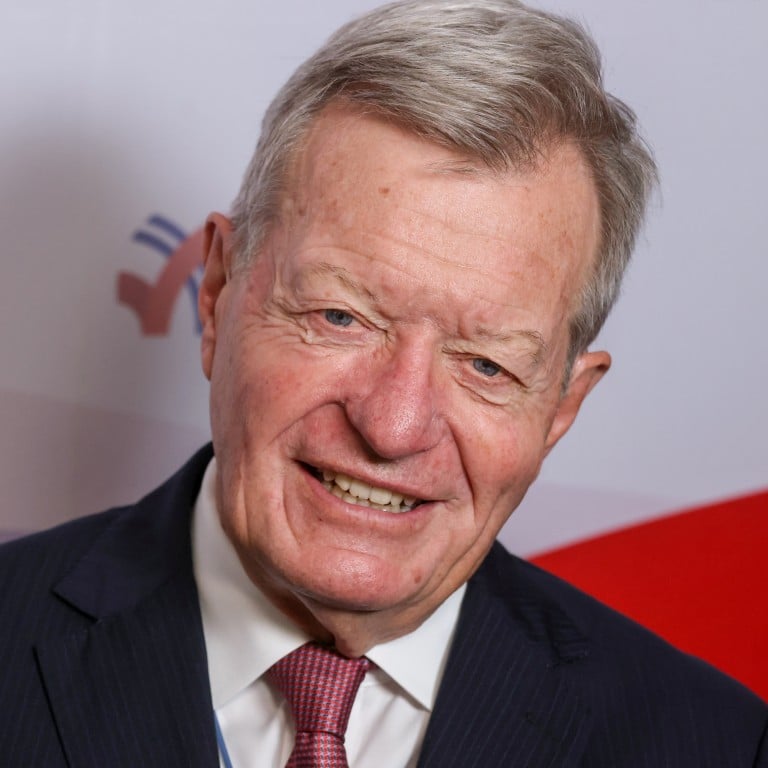

Max Baucus, US ambassador to Beijing from 2014 to 2017 and a former senator, says a lack of American understanding of China has made many bilateral issues difficult to resolve. Photo: Jonathan Wong

Candid exchanges on Taiwan could help to avoid miscalculations when the US and Chinese heads of state meet on the Apec sidelines this week, former US ambassador to China Max Baucus said.

Chinese President Xi Jinping is expected to be “very firm” on the Taiwan issue when he meets US counterpart Joe Biden in San Francisco on Wednesday, Baucus said, adding the summit would be helpful for the US to better understand China’s positions on different matters of contention.

“China’s non-negotiable position [on Taiwan] is not well understood in America. And it’s important for him, President Xi, to make that clear to President Biden,” he told the Post in an interview on the sidelines of the Hong Kong Forum on US-China relations on Friday.

“The more [Beijing] makes it clear, and clear enough in a non-confrontational way … That’s going to help President Biden realise that some of the actions taken by his administration, arms sales, for example, or proposed legislation by other members of Congress, may not be a good idea,” said Baucus, ambassador to China under president Barack Obama from 2014-17 and a former senator.

PLA will show ‘no mercy’ against Taiwan independence moves, top Chinese general says

Tensions between Beijing and Washington over Taiwan have continued to rise in recent years.

While the US maintains that it abides by its “one China” policy and does not recognise the self-ruled island as a separate state, it has increased arms sales and stepped up government-to-government contacts with Taipei, triggering some of Beijing’s most intense live-fire drills around Taiwan.

US warships also continue to make what Washington calls “freedom of navigation” sailings through the Taiwan Strait.

In August, Biden for the first time approved arms sales to Taiwan under a programme usually reserved for sovereign states, and signed a Congress-backed bill to boost economic ties with Taiwan into law, sparking strong protests from Beijing.

Beijing has stressed that it will never compromise on Taiwan or renounce the use of force to defend its sovereignty over the island, which it considers a breakaway province awaiting unification with the mainland.

A weekly curated round-up of social, political and economic stories from China and how they impact the world.

Addressing the Hong Kong Forum on Thursday via video link, Chinese ambassador to the US Xie Feng urged Washington to stop “playing with fire” on Taiwan and take “concrete actions” to manage differences with Beijing.
Baucus said that a lack of American understanding of China had made many bilateral issues difficult to resolve.

However, ‘ignorance is bliss sometimes”, he said. “Many members of Congress are new. They have no knowledge of Chinese history. None … If you don’t know something, then you can do something.”

He also noted that few US lawmakers had anything constructive to say about China. The political climate in Washington over China was “so toxic” because of concerns over China’s rise, that it might threaten the US-established post World War II order, Baucus said.

Such a climate could lead to many misunderstandings and uncertainties in bilateral relations, but may also be able to explain many of the US approaches towards China, he said, citing restrictions against Chinese telecoms giant Huawei as an example.

“When the Huawei issue first arrived, Americans, especially American politicians, we’re just scared at home that Huawei wants to build backbone technology, communications backbone technology that means they can spy [on us],” he said.

“And where’s the evidence? Where is the evidence of Huawei actually spying?”

“And the answer I got … we don’t have to provide the evidence. All we have to say is China, [that] is all we have to do.”

Technology has become the centre of the bilateral rivalry as the US ramps up control measures targeting China’s hi-tech sector, citing national security concerns. This has included a ban on Huawei, restricting chip exports to China and checks on investment. New restrictions are also expected to target fields such as artificial intelligence and quantum computing.Baucus said he expected more restrictions down the road, but “trust” and “communication” could help the two sides tackle contentious issues.

He also expressed hope that China and the US might have a better chance to cooperate on fighting the international trafficking of fentanyl.

Washington hopes to announce a new commitment from China and potentially set up a working group on stemming “the flow of fentanyl into the US” when Biden meets Xi at Apec, NBC News reported last week, citing people familiar with the matter.

Chinese companies have been accused of being involved in producing chemicals used to make fentanyl that has contributed to a deadly “synthetic opioid epidemic” in the US – a charge that Beijing has consistently denied.

Baucus said the real question following the Xi-Biden meeting in San Francisco would be whether both sides can fulfil the “promises” they make to each other.

“Both countries want to protect their own interests,” he said. “And we draw lines. Sometimes we draw the line closer to our own individual preference. Sometimes you draw the line closer to cooperation.

“Both countries are now starting to draw the line that looks a little more toward cooperation.”


To: bull_dozer who wrote (202552)11/13/2023 5:09:27 AM
From: TobagoJack1 Recommendation

Recommended By
fred woodall

  Respond to of 219892
 
Germany might flip, and not go down quietly,
to join the heartland,
in which case a loss / win, depending on PoV.

Germany might go down, should it not do a flipping,
disconnect / de-couple / de-risk from the heartland,
in which case a different but still loss / win, depending on PoV.

Very interesting possibilities, as posited by the rapidly rising alt-German party, and
also mentions in passing the issue of demographics on your shores, both of them,

that by 2045 the white / non-white populations shall do a flipping, says the VLOG.

2045 coincidentally comes after the 2026 TeoTwawKi, and
2045 conveniently comes after the 2032 Darkest Interregnum.

Am agnostic, as my 2026 / 2032 has nothing to do with the VLOG's 2045, and
everything to do with Team China's 2049.

Recommendation w/r 2045, getmoregold, and fire up the melting pot, start melting,
perhaps reparations might help, but that would boost gold.

Recommendation w/r to 2049, getmoregold, for different reasons.

In the meantime we watch & brief on the UK and Russia, and see how they go.


Heartland en.wikipedia.org
Who rules East Europe commands the Heartland;
who rules the Heartland commands the World-Island;
who rules the World-Island commands the world.


To: bull_dozer who wrote (202552)11/13/2023 5:28:05 AM
From: TobagoJack1 Recommendation

Recommended By
fred woodall

  Read Replies (1) | Respond to of 219892
 
ultra bullish
gainesvillecoins.com

PBoC in a Hurry to Buy Gold: Covertly Bought 593t of Gold YTD
Jan Nieuwenhuijs
The PBoC is in a hurry to buy enormous amounts of gold, indicating it’s preparing for substantial changes in the dollar-centric international monetary system.

Based on information from industry sources and my personal calculations, total gold purchases by the Chinese central bank (reported and unreported) in Q3 accounted for 179 tonnes. Year-to-date the PBoC bought 593 tonnes, which is 80% more than what it bought in the first three quarters last year. Its total estimated gold holdings are 5,220 tonnes, more than twice what’s officially disclosed at 2,192 tonnes.


The movement towards gold by central banks is showing no sign of slowing down. Mainly the Chinese central bank is on a voracious buying spree since 2022, and it’s obtaining way more metal than what is officially reported. The People’s Bank of China (PBoC) buys gold off the radar, not to send shockwaves through the market, allowing it to exchange its dollars for more bullion in anticipation of shifts in the international monetary order.

Every quarter we at Gainesville Coins compute an estimate of how much gold is bought by central banks surreptitiously. Of these unreported purchases about eighty percent is bought by the Chinese central bank; the other twenty percent is acquired by central banks from, for example, Saudi Arabia, according to industry sources that prefer to stay anonymous.

In the Gold Demand Trends Q3 by The World Gold Council (WGC) total estimated gold purchases by central banks, derived from publicly available data and field research, accounted for 337 tonnes. Reported gold acquisitions by central banks—data collected by the International Monetary Fund (IMF)—accounted for 211 tonnes. Eighty percent of the difference is 101 tonnes, which, added to what the PBoC publicly states to have bought in the third quarter, compounds to 179 tonnes. Year-to-date the PBoC has bought a record 593 tonnes, which is 790 tonnes annualized! (For more details on how I calculate PBoC gold holdings please read my previous article).


The start of the Ukraine war, early 2022, sparked the US to optimal dollar weaponization, which made the PBoC ramp up gold buying aggressively. Ever since, the Chinese central bank’s shoppings have been a huge support for gold as evidenced by the spread between the price of bullion and the TIPS yield. Although the (inverse) correlation between gold and the TIPS yield has always been nonsensical, it took a war for the PBoC and market participants with similar interests to end it, because time was running out to diversify their dollars.


Now that the TIPS model to price gold is of less relevance ( in October real rates and gold went up together), we can extend our discussion of de-dollarization. Some pundits claim there is no de-dollarization, or, even, there will be no de-dollarization. Although I agree the role of the dollar in international finance is not quickly to wane, we must make an important distinction between the dollar as a trade currency and a reserve currency. As a reserve currency there is no fiat currency that can replace the dollar. The US has broad and ( usually) liquid financial markets, no capital controls, and it’s running sizable fiscal and current account deficits that can supply the world with debt securities to store dollars in.

But that doesn’t mean that gold, which has no counterparty risk, is universally accepted, and evenly distributed, can’t replace the dollar as the world’s reserve currency. Not only are China and other countries in the Global South preparing for this scenario, the European Union is doing the same. And with more war in the Middle East, and few solutions other than inflation to resolve the global debt overhang, gold’s time to shine comes closer and closer.

Tweet by the author

Regarding trade currencies, the Chinese have set up the Shanghai International Gold Exchange (SGEI) in the Shanghai Free Trade Zone that facilitates “offshore” gold trading in renminbi. The SGEI empowers foreigners to use renminbi as a trade currency that can be converted into gold to store any surpluses without affecting China’s balance of payments. (For more information read “ The Shanghai International Gold Exchange and Its Role in De-Dollarization.”)

My estimate of world central bank gold holdings is at an all-time high, and gold’s share of global international reserves has been steadily increasing in recent years, from a historic low that was formed during a time of financial stability and relative peace. My expectation is that gold holdings relative to foreign exchange (mostly dollars) will continue to grow in the foreseeable future.


To: bull_dozer who wrote (202552)11/13/2023 6:17:41 AM
From: TobagoJack  Respond to of 219892
 
Trade deal between China / USA?

