Should have listened to the voices of reason....
Now the horse has left the barn...
The United States Is Reaping What It Sowed in Ukraine The U.S. government continues sending weapons to Ukraine, escalating the likelihood of war with Russia.
progressive.org
by Nicolas J S Davies, Medea Benjamin
February 1, 2022
9:19 AM
The United States and Russia both claim their escalations in Ukraine are defensive, responding to threats by the other side. The resulting spiral of escalation only makes war more likely. Ukrainian President Volodymyr Zelensky is warning that “ panic” by U.S. and Western leaders is already causing economic destabilization in the Eastern European country.
The U.S. and NATO’s interest in Ukraine is not really about resolving its regional differences, but about something else altogether.
Germany is wisely refusing to funnel more weapons into Ukraine, in keeping with its long-standing policy of not sending weapons into conflict zones. Ralf Stegner, a senior Member of Parliament for Germany’s ruling Social Democrats, told the BBC that the Minsk-Normandy process agreed to by France, Germany, Russia, and Ukraine in 2015 is still the right framework for ending the civil war.
“The Minsk Agreement hasn’t been applied by both sides,” Stegner said, “and it just doesn’t make any sense to think that forcing up the military possibilities would make it better. Rather, I think it’s the hour of diplomacy.”
By contrast, most U.S. politicians and corporate media have fallen in line with a one-sided narrative that paints Russia as the aggressor in Ukraine, and supports sending more weapons to Ukrainian government forces.
The most critical events that have been airbrushed out of the West’s political narrative are the violation of agreements that Western leaders made at the end of the Cold War not to expand NATO into Eastern Europe, and the U.S.-backed coup in Ukraine in February 2014. Western mainstream media accounts instead date the crisis in Ukraine back to Russia’s reintegration of Crimea in 2014, and the decision by ethnic Russians in Eastern Ukraine to secede from Ukraine as the Luhansk and Donetsk People’s Republics.
But these were not unprovoked actions; they were responses to the U.S.-backed coup, in which an armed mob led by the neo-Nazi Right Sector militia stormed the Ukrainian parliament, forcing the elected President Viktor Yanukovich and members of his party to flee for their lives.
The remaining members of parliament voted to form a new government, subverting the political transition and plans for a new election that Yanukovich had publicly agreed to the day before, after meetings with the foreign ministers of France, Germany, and Poland.
The U.S. role in managing the coup was exposed by a leaked 2014 audio recording of Assistant Secretary of State Victoria Nuland and U.S. Ambassador Geoffrey Pyatt working on their plans, which included sidelining the European Union and shoehorning in U.S. protege Arseniy Yatsenyuk as prime minister.
Both of Nuland’s hand-picked puppets in Ukraine, Prime Minister Yatsenyuk and President Poroshenko, were soon mired in corruption scandals. Yatsenyuk was forced to resign after two years and Poroshenko was named in a tax evasion scandal revealed in the Panama Papers. Post-coup, war-torn Ukraine remains the poorest country in Europe, and one of the most corrupt.
The Ukrainian military had little enthusiasm for a civil war against its own people in Eastern Ukraine, so the post-coup government formed new “ National Guard” units to assault the separatist People’s Republics. The infamous Azov Battalion drew its first recruits from the Right Sector militia and openly displays neo-Nazi symbols, yet it continues to receive U.S. arms and training, even after the U.S. Congress explicitly cut off its funding in the FY2018 Defense Appropriations bill.
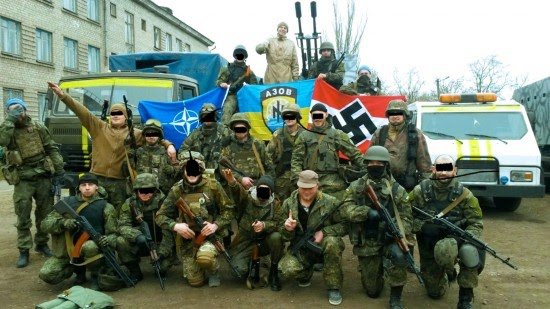 Photo by russia-insider.com Photo by russia-insider.com
U.S. allies in Ukraine, with NATO, Azov Battalion, and neo-Nazi flags.
In 2015, the Minsk and Normandy negotiations led to a ceasefire and the withdrawal of heavy weapons from a buffer zone around the separatist-held areas. Ukraine agreed to grant greater autonomy to Donetsk, Luhansk, and other ethnically Russian areas of Ukraine, but it has failed to follow through on that agreement.
A federal system, with some powers devolved to individual provinces or regions, could help to resolve the all-or-nothing power struggle between Ukrainian nationalists and Ukraine’s traditional ties to Russia that has dogged its politics since independence in 1991.
But the U.S. and NATO’s interest in Ukraine is not really about resolving its regional differences, but about something else altogether. The U.S. coup was calculated to put Russia in an impossible position. If Russia did nothing, a post-coup Ukraine would sooner or later join NATO, as NATO members had already agreed to in principle in 2008. NATO forces would advance right up to Russia’s border, and Russia’s important naval base at Sevastopol in the Crimea would fall under NATO control.
On the other hand, if Russia had responded to the coup by invading Ukraine, there would have been no turning back from a disastrous new war with the West.
The United States has given Ukraine $2.7 billion in military aid since 2014, including $650 million since President Biden took office, along with deployments of U.S. and NATO military trainers.
Ukraine has still not implemented the constitutional changes called for in the 2014 and 2015 Minsk agreements, and the unconditional military support that the United States and NATO have provided has encouraged Ukraine’s leaders to effectively abandon the Minsk-Normandy process and simply reassert sovereignty over all of Ukraine’s territory, including Crimea.
In practice, Ukraine could only recover those territories by a major escalation of the civil war, and that was exactly what Ukraine and its NATO backers appeared to be preparing for in March 2021.
In October, Ukraine launched new attacks in Donbass. Russia, which had about 100,000 troops stationed near Ukraine since March, responded with new troop movements and military exercises. U.S. officials launched an information warfare campaign to frame Russia’s actions as an unprovoked threat to invade Ukraine, concealing their own role in fueling the threatened Ukrainian escalation that Russia is responding to.
Underlying all of these tensions is NATO’s expansion through Eastern Europe to the Russian border, in violation of commitments Western officials made at the end of the Cold War. The U.S. and NATO’s refusal to acknowledge that they have violated those commitments or to negotiate a diplomatic resolution with the Russians is a central factor in the breakdown of U.S.-Russian relations.
If the United States and NATO are not prepared to negotiate new disarmament treaties, remove U.S. missiles from countries bordering Russia, and dial back NATO expansion, Russian officials say they will have no option but to respond with “appropriate military-technical reciprocal measures.”
This expression may not refer to an invasion of Ukraine, as most Western commentators have assumed, but to a broader strategy that could include actions that hit much closer to home for Western leaders.
For example, Russia could place short-range nuclear missiles in Kaliningrad (between Lithuania and Poland), within range of European capitals; it could establish military bases in Iran, Cuba, Venezuela, and other countries; and it could deploy submarines armed with hypersonic nuclear missiles to the Western Atlantic.
Hypersonic nuclear missiles off the U.S. East Coast would put the United States in a similar position to that in which NATO has placed the Russians. China could adopt a similar strategy in the Pacific to respond to U.S. military bases and deployments around its coast.
So the revived Cold War that U.S. officials and corporate media hacks have been mindlessly cheering on could very quickly turn into one in which the United States would find itself just as encircled and endangered as its enemies.
Will the prospect of such a twenty-first century Cuban Missile Crisis be enough to bring U.S. leaders back to the negotiating table, to start unwinding the suicidal mess they have blundered into? We certainly hope so. |



